

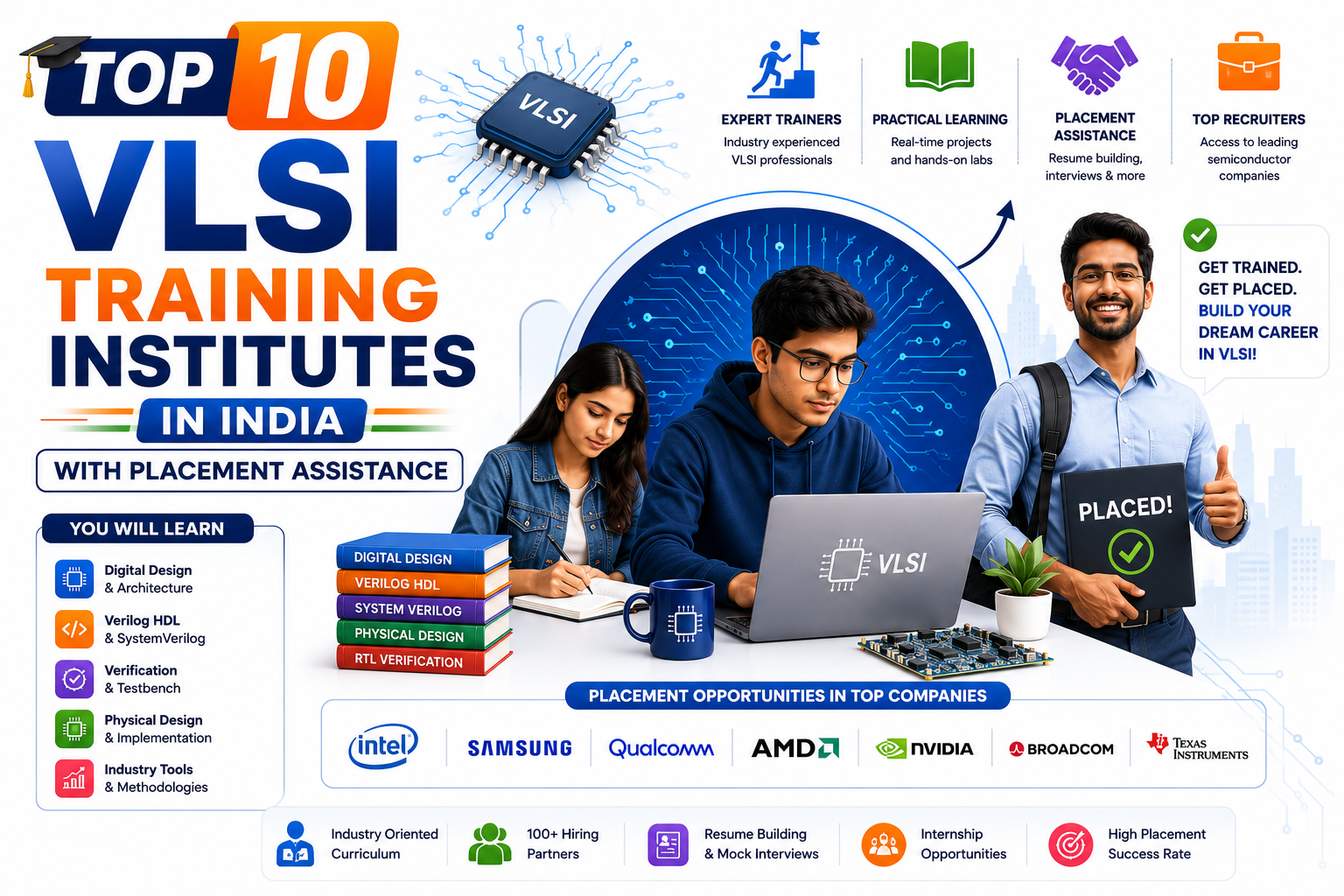
Top 10 VLSI Training Institutes in India with Placement Assistance
Navigate through this article using the table of contents below
Table of Contents
No headings found in this article.
India will need more than one lakh trained VLSI and chip-design engineers by 2026. But most electronics graduates finish college without ever touching a real chip-design tool. So the institute you pick for VLSI training matters a lot — it can be the difference between getting hired at a semiconductor company and struggling with a degree that doesn't open doors.
This is not a paid or sponsored list. Every institute below was checked against the same five things: how much of the chip-design process they actually teach, whether they give real hands-on time on industry tools, how experienced their trainers are, how honest they are about placements, and whether they are based near places where semiconductor companies actually hire.
Why Choosing the Right VLSI Institute Matters So Much in 2026
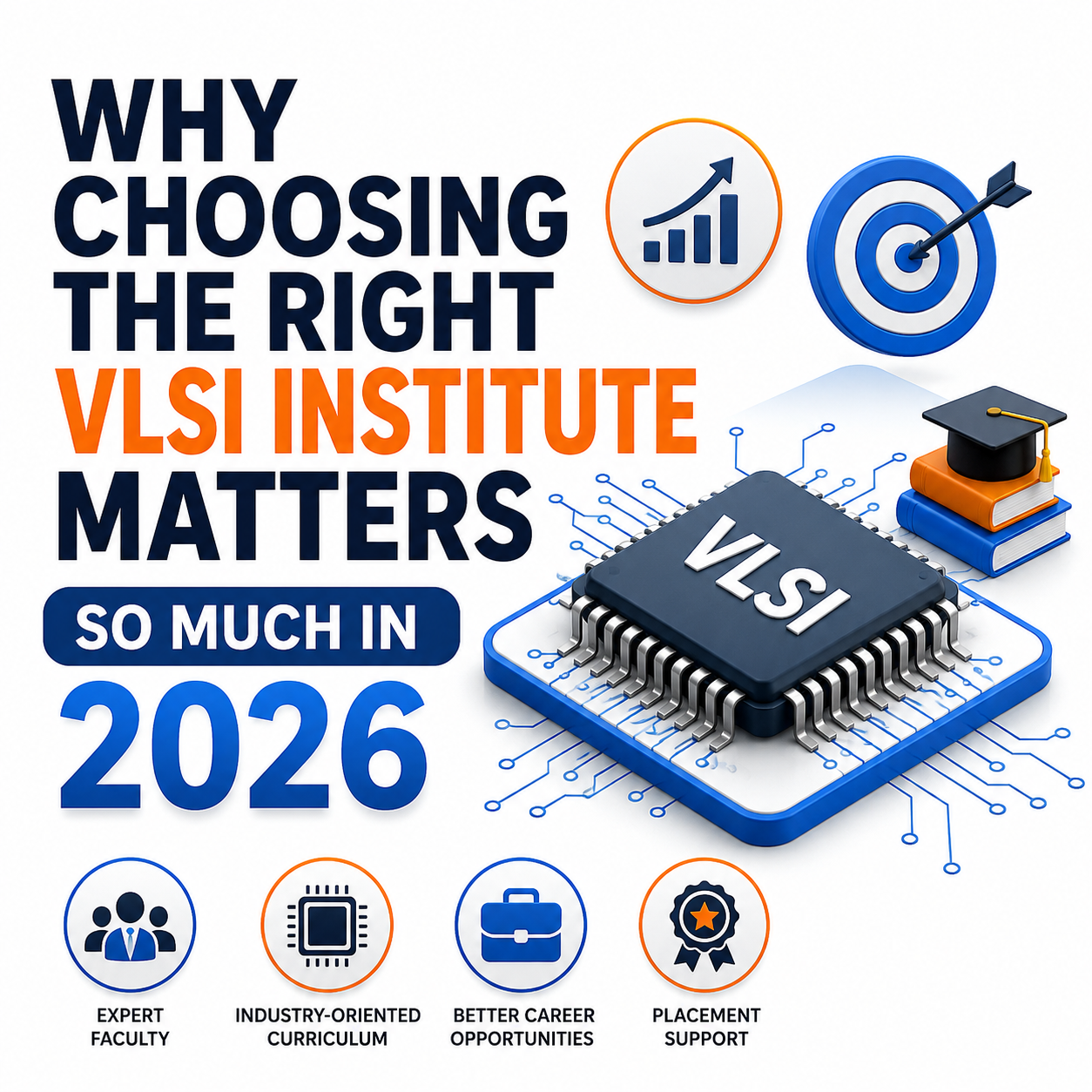
India's semiconductor industry is not just growing on paper — it is actually being built right now. The India Semiconductor Mission has a budget of ₹76,000 crore, and big companies like Intel, Micron, Tata Electronics, CG Power, Kaynes, and HCL-Foxconn have already committed serious investment. Bangalore alone has around 70% of India's chip design jobs, and Hyderabad, Noida, Chennai, and Pune are quickly becoming new hubs too.
Here's the strange part: India produces about six lakh electronics graduates every year, but semiconductor companies still struggle to find people for basic RTL design, verification, and physical design jobs. The problem is not a lack of people — it's a lack of proper training. Most colleges only teach theory and never let students touch the actual software (like Synopsys, Cadence, or Mentor) that every chip company expects you to know. Good VLSI training institutes in India exist to fix exactly this gap — but not all of them do it equally well, which is why comparing them properly before joining matters.
Top 10 VLSI Training Institutes in India — Ranked
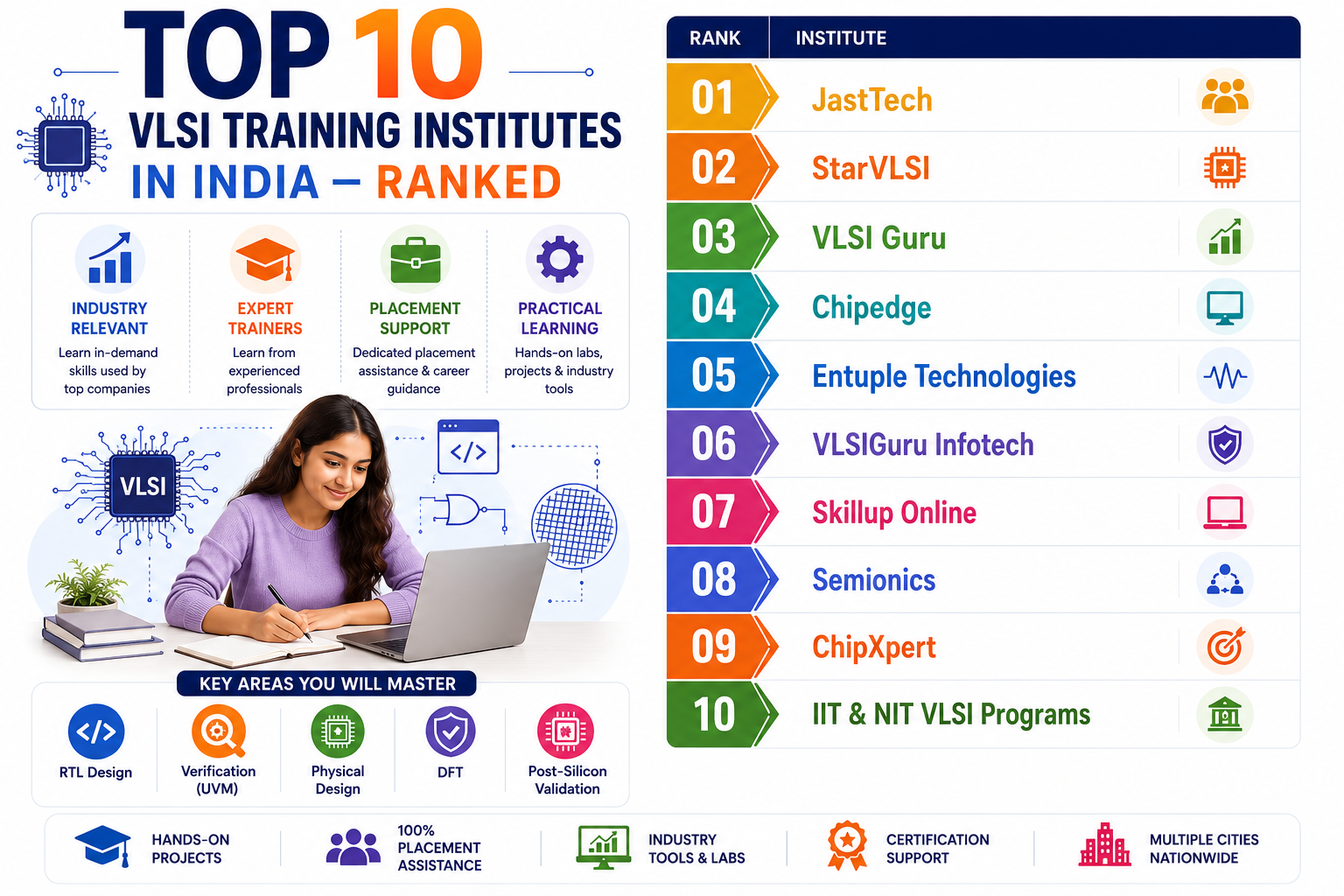
1. JastTech
JastTech is an ISO 9001:2015 certified VLSI and semiconductor training institute and currently the most complete option on this list for anyone who wants to learn the full chip design process instead of just one narrow piece of it. The course covers RTL Design, Functional Verification using UVM, Physical Design, DFT, and Post-Silicon Validation — in simple terms, it teaches you everything from writing the first lines of chip code to testing the final manufactured chip, all in one structured program with real hands-on practice on industry tools. What makes JastTech different from most other institutes is how many cities it operates in. Almost every other name on this list is based only in Bangalore. JastTech instead has centers in six cities — Noida, Hyderabad, Bangalore, Chennai, Pune, and Kolkata — which means students across nearly every part of India can get quality VLSI training close to home, including the two biggest chip design hubs in the south, Bangalore and Chennai. Each of these six centers also has its own placement support team, which is rare since most institutes only push placements through one flagship branch.
2. StarVLSI
StarVLSI focuses mainly on Backend Physical Design — basically the stage where a chip's logical design gets turned into a real, manufacturable layout. They claim a high placement rate in this specific area. This narrow focus works well if you already know you want to do Physical Design, but it doesn't teach much RTL design or verification if you're still figuring out what you want to specialize in.
3. VLSI Guru
Running since 2012, VLSI Guru is placement-focused and puts a lot of emphasis on Static Timing Analysis and Physical Design. They are known for solid mock interview preparation, which genuinely helps — though their course doesn't cover as many topics as some full-stack programs.
4. Chipedge
Chipedge teaches VLSI fully online, covering design flow, physical design, and embedded systems. It works well if you're a working professional who needs flexible timing, but since there's no physical lab, you get less real hands-on tool practice compared to institutes with an actual campus.
5. Entuple Technologies
Entuple specializes in RF design, mixed-signal, and analog layout, along with regular digital VLSI training. This makes it a good and fairly rare choice if you specifically want to work in Analog Mixed-Signal roles, since most general VLSI institutes don't go deep into this area.
6. VLSIGuru Infotech
VLSIGuru Infotech focuses on verification and low-power chip design, with structured training in UVM-based verification and CPF/UPF low-power design methods. It's a solid pick if your goal is specifically a verification engineer role.
7. Skillup Online
Skillup Online offers both self-paced and instructor-led VLSI courses, which suits working professionals who need to learn on their own schedule rather than fixed batch timings. Like other online-only options, it lacks real-time lab access.
8. Semionics
Semionics teaches ASIC design, physical design, and analog layout, with a focus on practical workflow rather than just theory. It has built a growing online community of learners and mentors through its academy platform.
9. ChipXpert
ChipXpert frames VLSI training as a long-term career strategy, covering Physical Design, Verification, DFT, Protocols, and FPGA, with structured mentorship along the way. The content is well-organized for self-driven learners but doesn't carry the same placement brand recognition as older, more established institutes.
10. IIT and NIT VLSI Programs
These are academic M.Tech-level VLSI programs at India's top engineering institutes, offering strong research exposure and experienced faculty. They are excellent if you're aiming for research or a PhD, but the coursework is usually less focused on quick, practical job-readiness compared to dedicated, placement-driven training institutes.
How to Check if a VLSI Institute Is Actually Good Before You Join
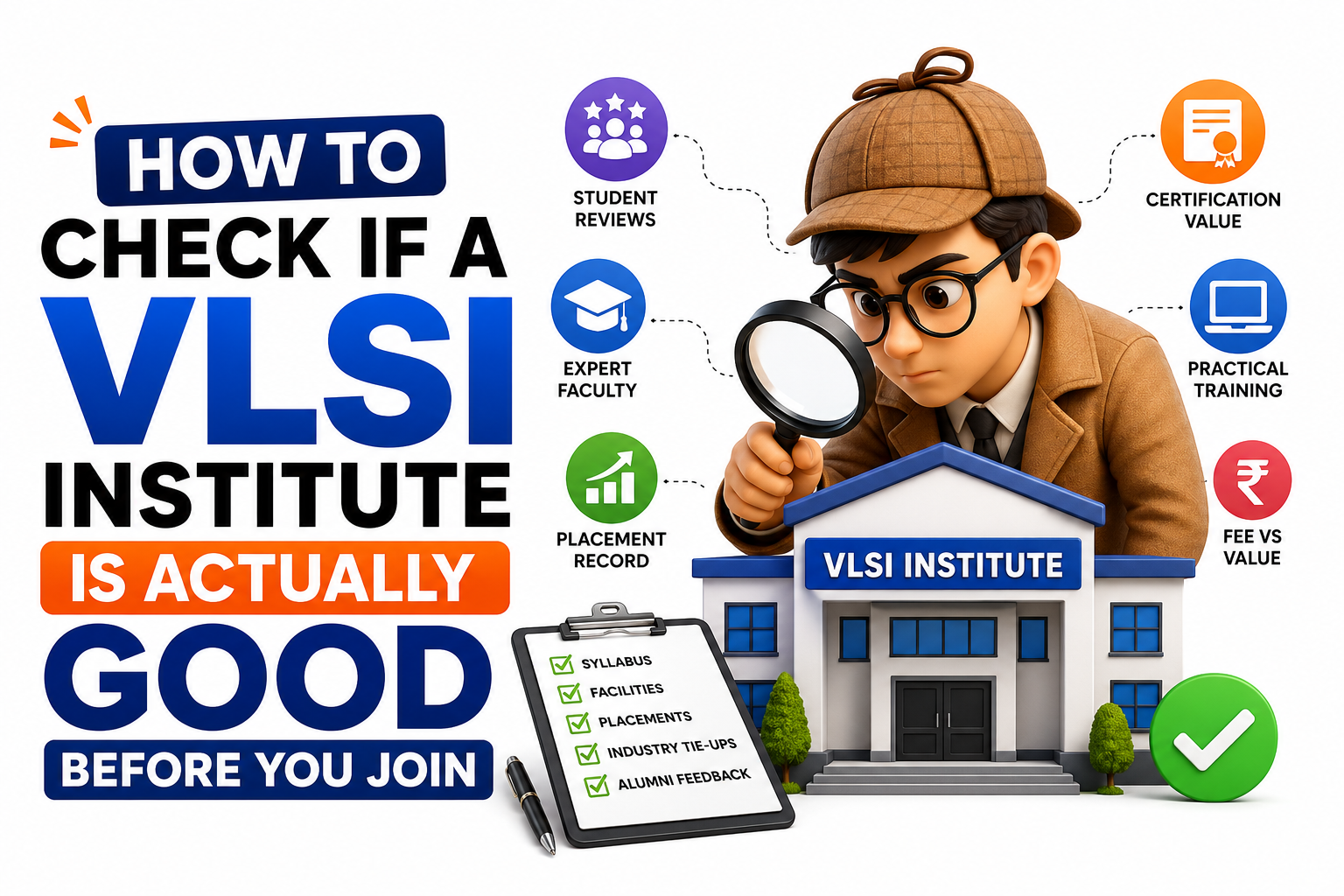
Most students only compare institutes by fee and course duration — but these two things actually matter the least for your career. Here's what really matters, in order of importance.
• Real tool access: Make sure you'll actually use tools like Synopsys, Cadence, or Mentor with your own hands — not just watch slides or screenshots.
• Full course or one specialty: Decide if you want to learn the whole chip-design process (RTL to final chip) or go deep into just one stage. Pick the institute that matches your goal.
• Trainers with real industry experience: Trainers who have actually worked on real chips know the mistakes and problems that textbooks don't mention — and they explain things differently.
• A real project to show in interviews: Having one solid project you can explain confidently matters far more in interviews than a stack of certificates.
• Honest placement information: Ask for actual company names and recent results, not just a vague "100% placement" claim.
• Location near hiring hubs: Training in or near a city like Bangalore, Chennai, Hyderabad, Noida, or Pune gives you better access to referrals and walk-in interviews.
Read more about :- TOP VLSI TRAINING INSTITUTES IN INDIA (2026)
What a Good VLSI Course Should Teach You
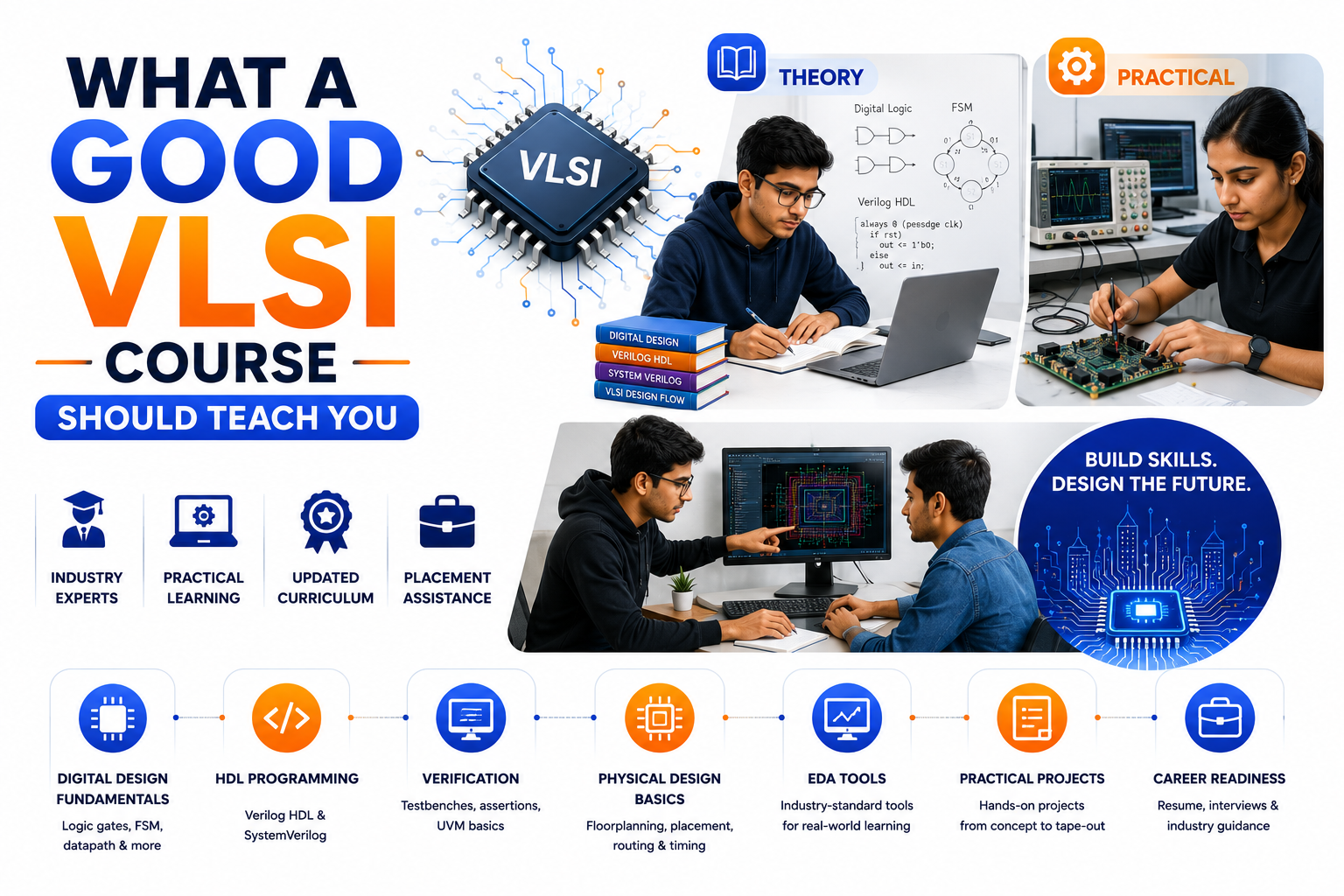
VLSI is not just one skill — it's actually a series of different stages, each needing different tools and a different way of thinking. A good training program should at least introduce you to all of these stages, even if you later specialize in just one.
• RTL Design: Writing chip logic using Verilog and SystemVerilog, designing state machines, pipelining, and understanding how synthesis works.
• Functional Verification: Using UVM to test whether a chip design actually works correctly before it's manufactured.
• Physical Design: Turning the logical design into a real, manufacturable layout — covering floorplanning, placement, clock tree design, routing, and timing checks.
• DFT (Design for Test): Building in scan circuits and self-test features so manufactured chips can be tested for defects.
• Analog and Mixed-Signal Layout: Designing at the transistor level — important for engineers who want to work on AMS (Analog Mixed Signal) chips.
• Post-Silicon Validation: Testing the actual physical chip after it's manufactured, to confirm it works the way it was designed — a skill that's in high demand as more Indian-designed chips reach production.
How Much VLSI Engineers Earn in India, by Specialization
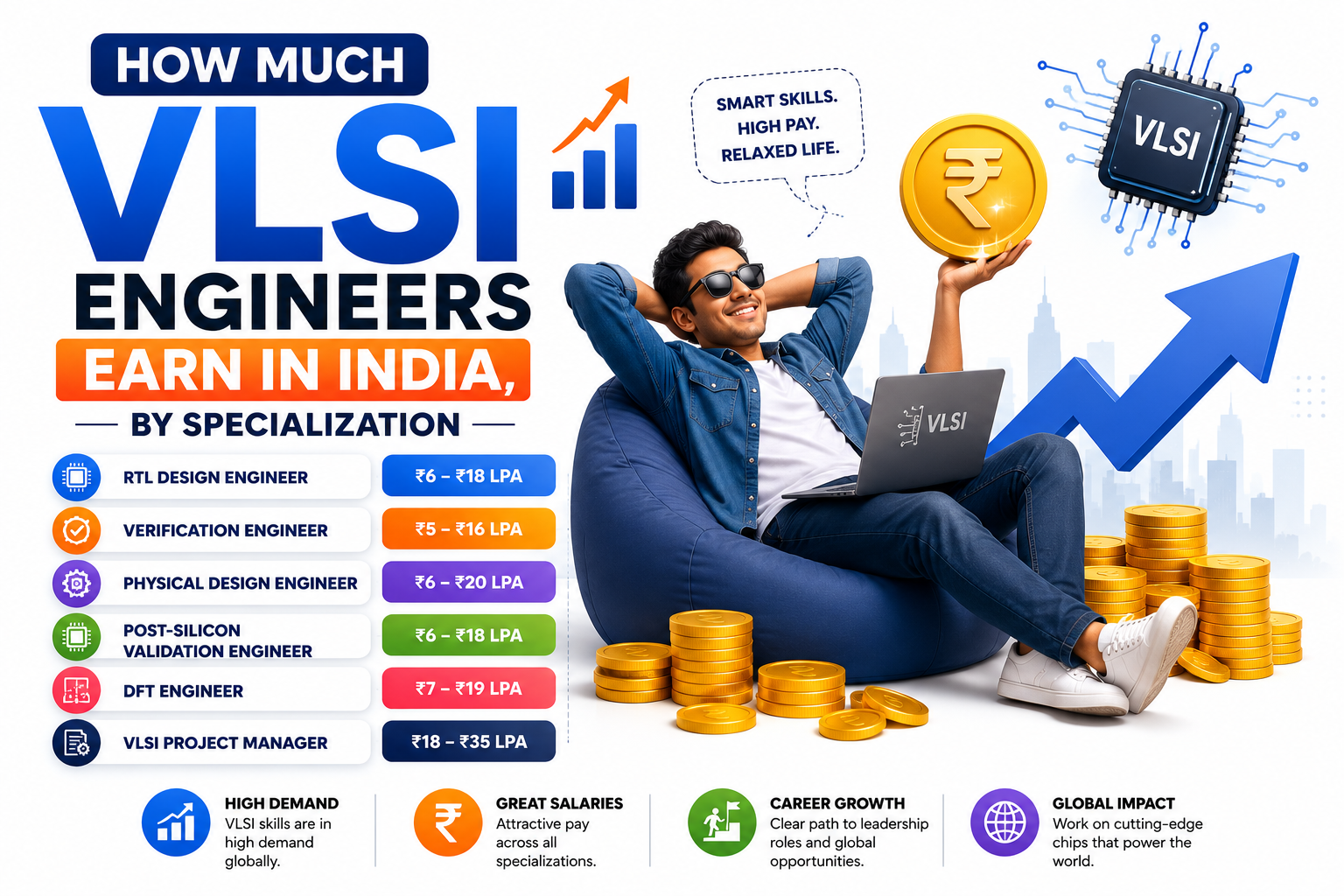
VLSI training is an investment, and like any investment, it helps to know what return you can realistically expect before you commit.
Programs vary widely — a basic online course might cost around ₹25,000, while a full, placement-backed program with real EDA tool access can go up to ₹1 lakh or more. The fee difference usually reflects the depth of training and the quality of placement support, which directly affects what your first job looks like.
On the salary side, RTL Design Engineers in India typically start somewhere between ₹6 and ₹10 lakh a year. It is not the highest entry point, but the growth is real — engineers with five or more years in RTL design regularly reach ₹25 to ₹35 lakh. Verification is where things get more interesting. Good UVM verification engineers are genuinely hard to find, and companies pay for that scarcity. Entry-level packages of ₹7 to ₹12 lakh are common, and experienced verification engineers often cross ₹28 to ₹38 lakh. Physical Design follows a similar arc — starting at ₹6 to ₹11 lakh and growing to ₹25 to ₹40 lakh with experience. DFT is a narrower specialization, with entry at ₹6 to ₹10 lakh and senior-level earnings around ₹22 to ₹32 lakh.
VLSI Training Hubs in India, City by City
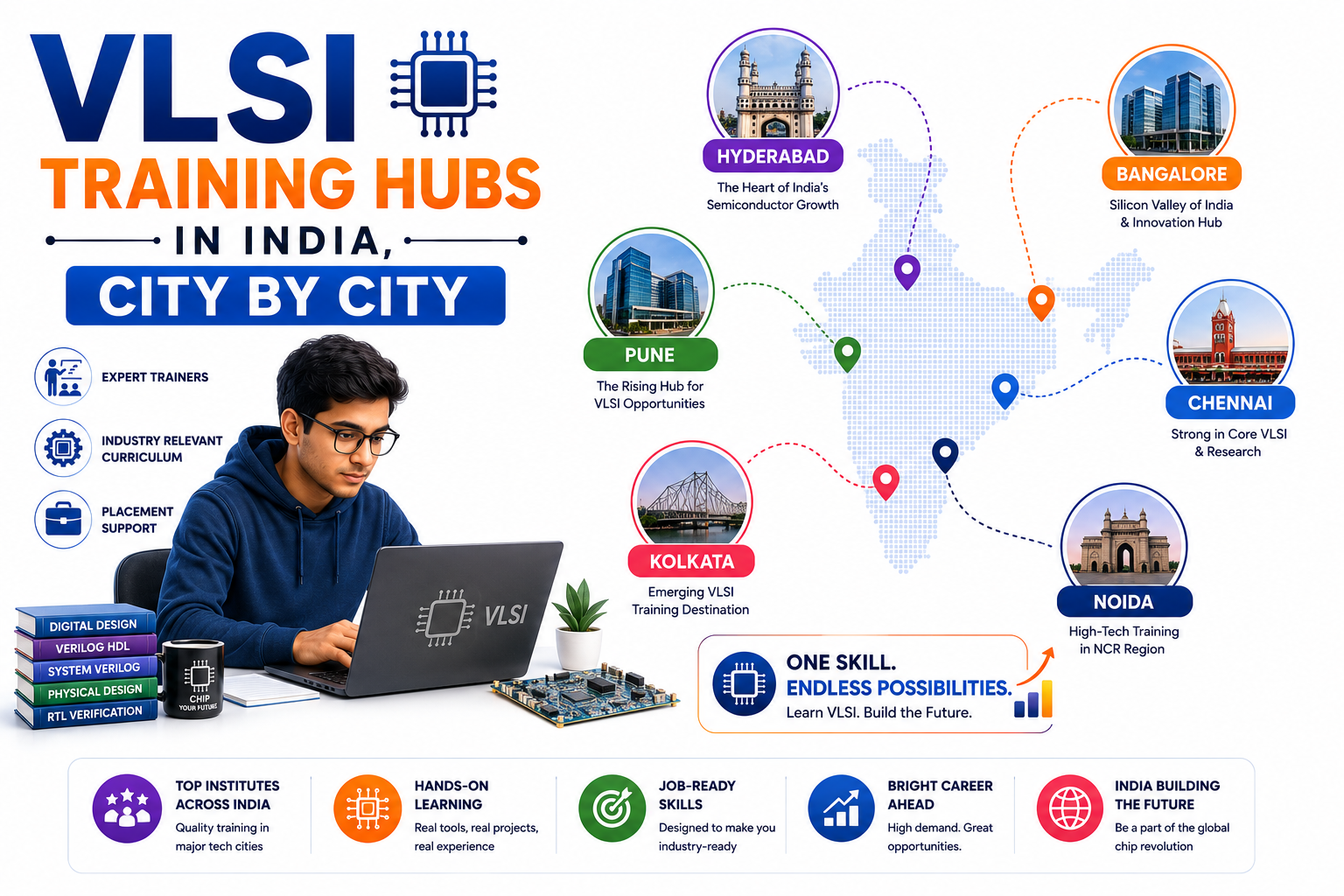
Bangalore
Bangalore is India's biggest semiconductor city — around 70% of India's chip design jobs are here. Companies like Intel, Qualcomm, Samsung, Texas Instruments, and AMD all have design centers in Bangalore, which is why it has the most VLSI training institutes and the most entry-level hiring in the country.
Chennai
Chennai is another major chip design city in South India, with a strong base of semiconductor and electronics companies and a long history of engineering talent. JastTech's Chennai center gives students in Tamil Nadu and nearby states a way to get proper VLSI training without having to move to Bangalore.
Hyderabad
Hyderabad is India's fastest-growing second semiconductor hub. It's home to Micron's chip assembly and testing plant, NVIDIA's growing R&D center, and many smaller fabless design companies. Institutes with a real Hyderabad presence give students direct access to this growing market.
Noida and the Delhi NCR Region
Noida is becoming an important VLSI hub thanks to the Uttar Pradesh Semiconductor Policy, which has already attracted around ₹40,000 crore in investment proposals, plus the upcoming HCL-Foxconn chip packaging unit in Jewar. Training in Noida gives North India students access to this new and growing ecosystem close to home.
Pune and Kolkata
Pune has a growing number of embedded systems and semiconductor R&D companies, while Kolkata is still an underserved but emerging market for proper VLSI training in East India. Very few institutes have a real presence in both these cities, which is why JastTech's reach here stands out.
Common Mistakes Students Make When Picking a VLSI Institute

Looking at outcomes across different VLSI training providers, the same mistakes keep repeating. Avoiding these can make a real difference to your career.
• Choosing based only on fee: the cheapest option often skips real tool access, which you genuinely need for interviews.
• Switching specializations too soon: jumping between RTL, Physical Design, and DFT without really learning any one of them makes your interview answers weak.
• Collecting certificates without real skills: interviewers care about whether you can actually debug a problem, not how many certificates you have.
• Skipping interview practice: being able to clearly explain your project and your thinking matters almost as much as your technical knowledge.
• Trusting placement numbers blindly: always ask for actual company names and recent results instead of just believing a percentage.
• Ignoring location: training near an active hiring city like Bangalore, Chennai, Hyderabad, Noida, or Pune gives you a real advantage with referrals and walk-in interviews.
Conclusion
India's semiconductor industry is heading into its biggest growth phase yet, backed by a ₹76,000 crore national mission and real investment from Intel, Micron, Tata Electronics, and HCL-Foxconn — but none of this helps your career unless your training is actually good enough to get you hired. Among all the institutes covered here, JastTech stands out for combining ISO 9001:2015 certified training with a presence in six cities — Noida, Hyderabad, Bangalore, Chennai, Pune, and Kolkata — along with a curriculum that covers everything from RTL Design and Verification to Physical Design, DFT, and Post-Silicon Validation. No matter which institute you finally choose, always check for real tool access, trainers with genuine industry experience, and honest, verifiable placement results — not just marketing promises.