

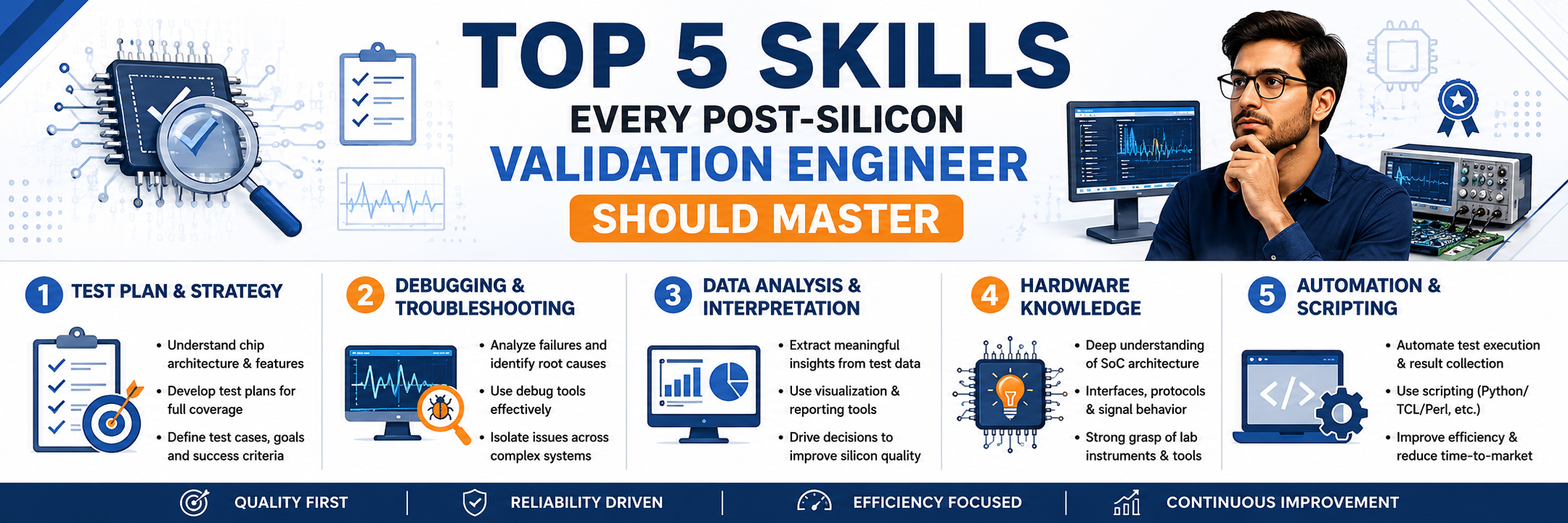
Top 5 Skills Every Post-Silicon Validation Engineer Should Master
Navigate through this article using the table of contents below
Table of Contents
No headings found in this article.
A chip can pass every simulation on paper and still fail the moment it powers up on real silicon. That gap between "it worked in simulation" and "it works in the lab" is where post-silicon validation earns its reputation as one of the toughest, most rewarding corners of chip design.
Anyone building a career here quickly learns that success depends less on theory and more on hands-on judgment. The engineers who move fastest are the ones who combine deep hardware intuition with practical debugging instincts, and that combination doesn't happen by accident. It's built one skill at a time, often through structured learning and real bench experience.
1. Strong Understanding of Silicon Debug Methodologies
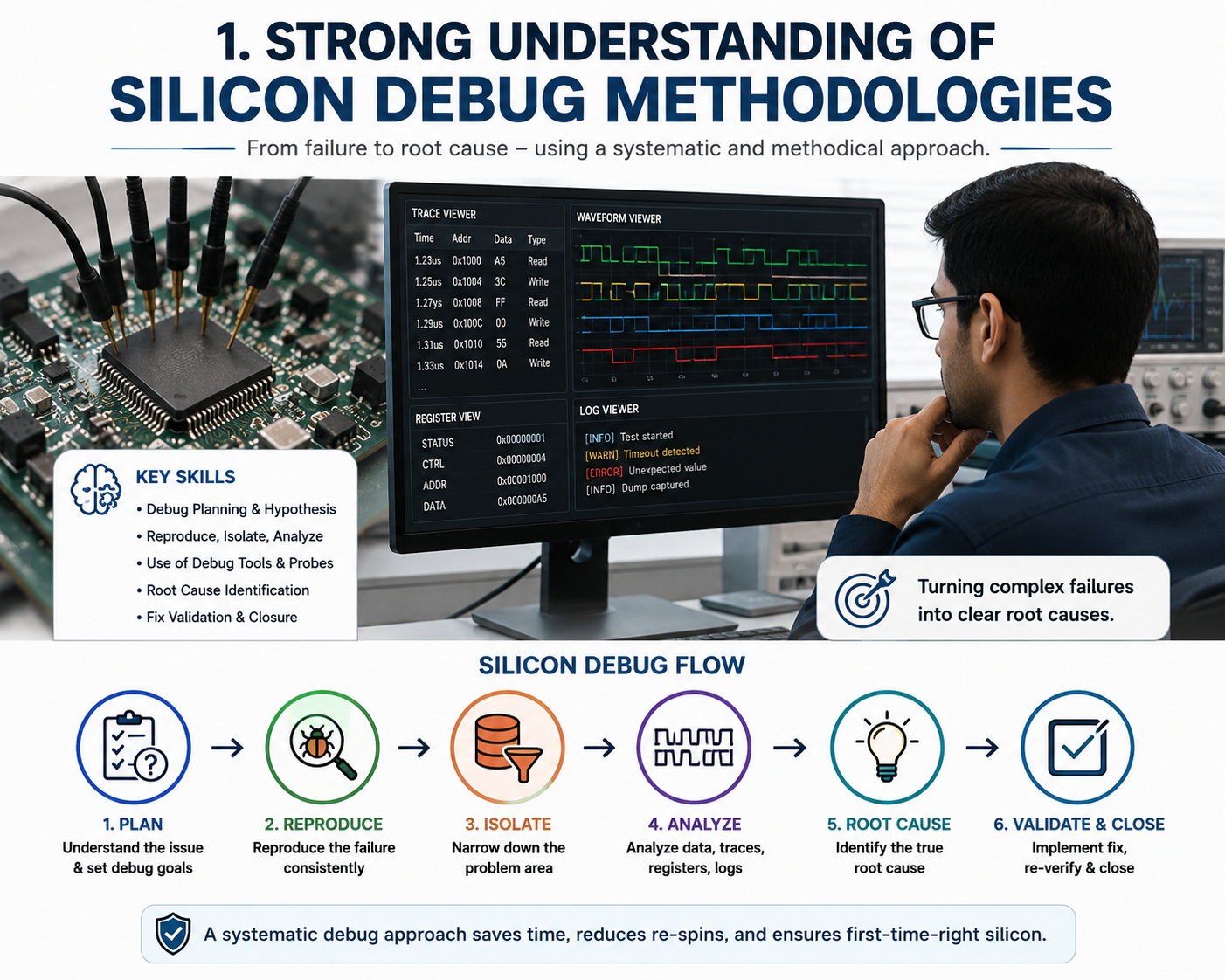
Before touching an oscilloscope or a debug board, a validation engineer needs a mental model of how silicon actually behaves once it leaves the fab. This means knowing how to isolate a failure, narrow it down to a block or signal, and separate a genuine silicon defect from a test setup issue. Debug methodology isn't something you memorize from a textbook; it's a way of thinking that develops through repetition. Engineers who invest early in a structured post silicon validation course tend to build this instinct faster because they see real failure patterns instead of only reading about them.
2. Hands-On Lab and Bench Equipment Proficiency
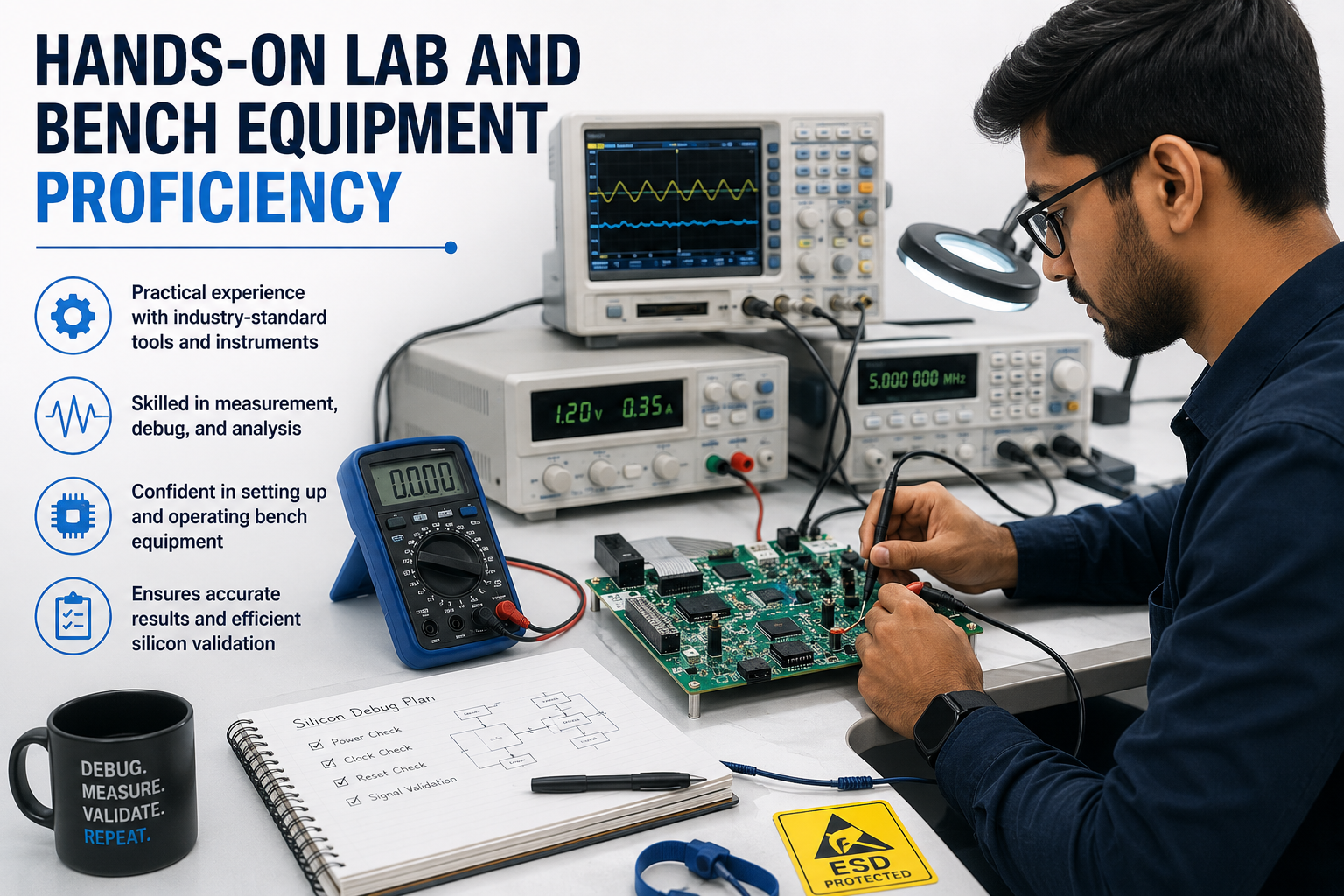
Post-silicon work happens in the lab, not just at a desk. That means comfort with oscilloscopes, logic analyzers, protocol analyzers, and various probing techniques becomes non-negotiable. An engineer needs to know which tool answers which question, how to set up a clean measurement, and how to read subtle anomalies like noise, jitter, or timing violations directly off a waveform. This is a skill that simply cannot be learned passively. It has to be practiced repeatedly until reaching for the right equipment feels automatic rather than deliberate.
3. Scripting and Automation Capability
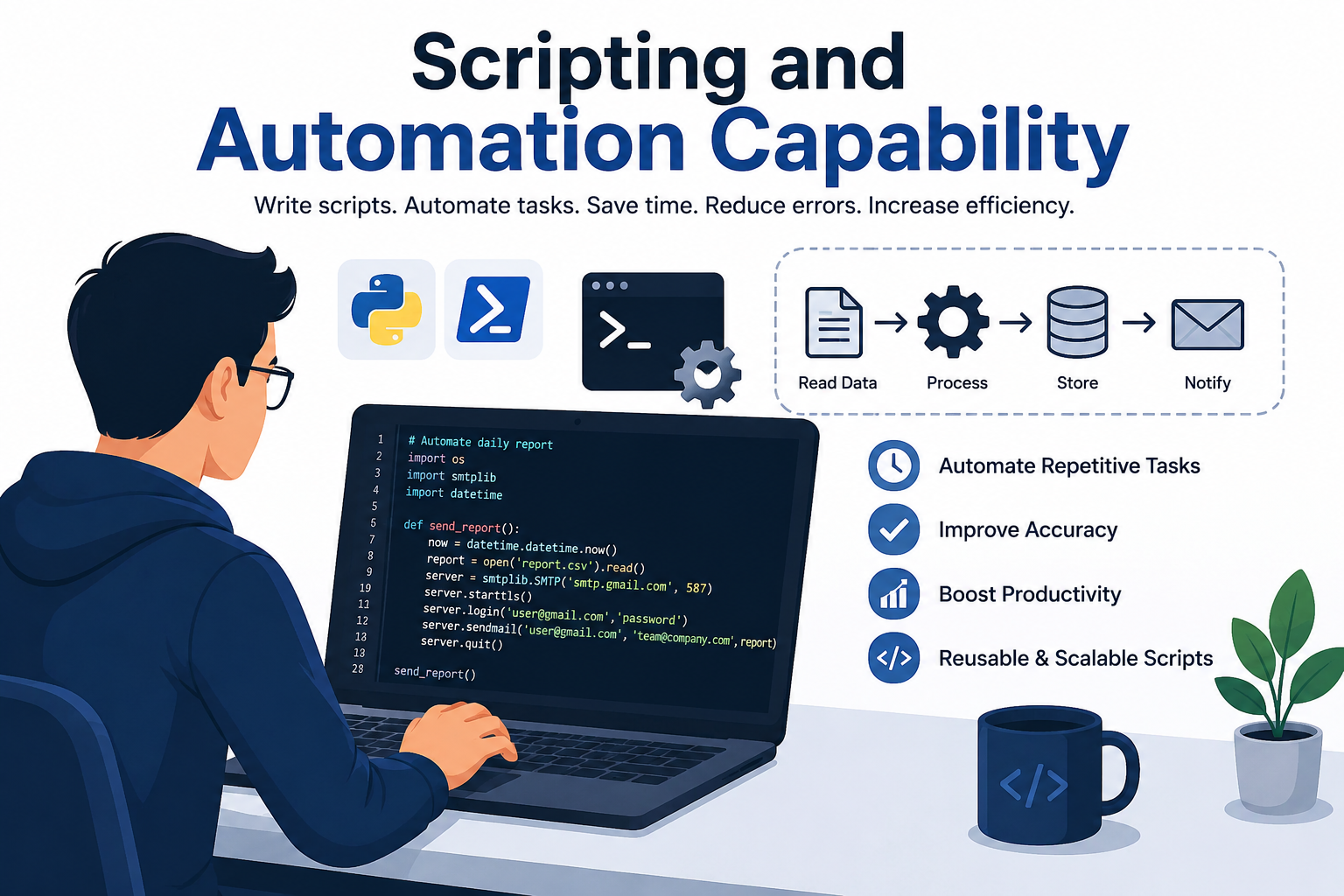
Modern validation labs generate enormous volumes of test data, and manually sifting through logs is neither realistic nor scalable. Engineers who can automate repetitive tasks using Python, Perl, or shell scripting save enormous amounts of time and reduce the chance of human error. Automation also extends to building custom test scripts, parsing failure logs, and creating dashboards that track coverage across hundreds of test scenarios. This is one of the biggest differentiators between an engineer who reacts to problems and one who proactively catches them before they escalate. Good vlsi training in india programs are increasingly weaving scripting modules directly into their curriculum because the industry has made this skill essentially mandatory.
4. Solid Grasp of DFT and Test Structures
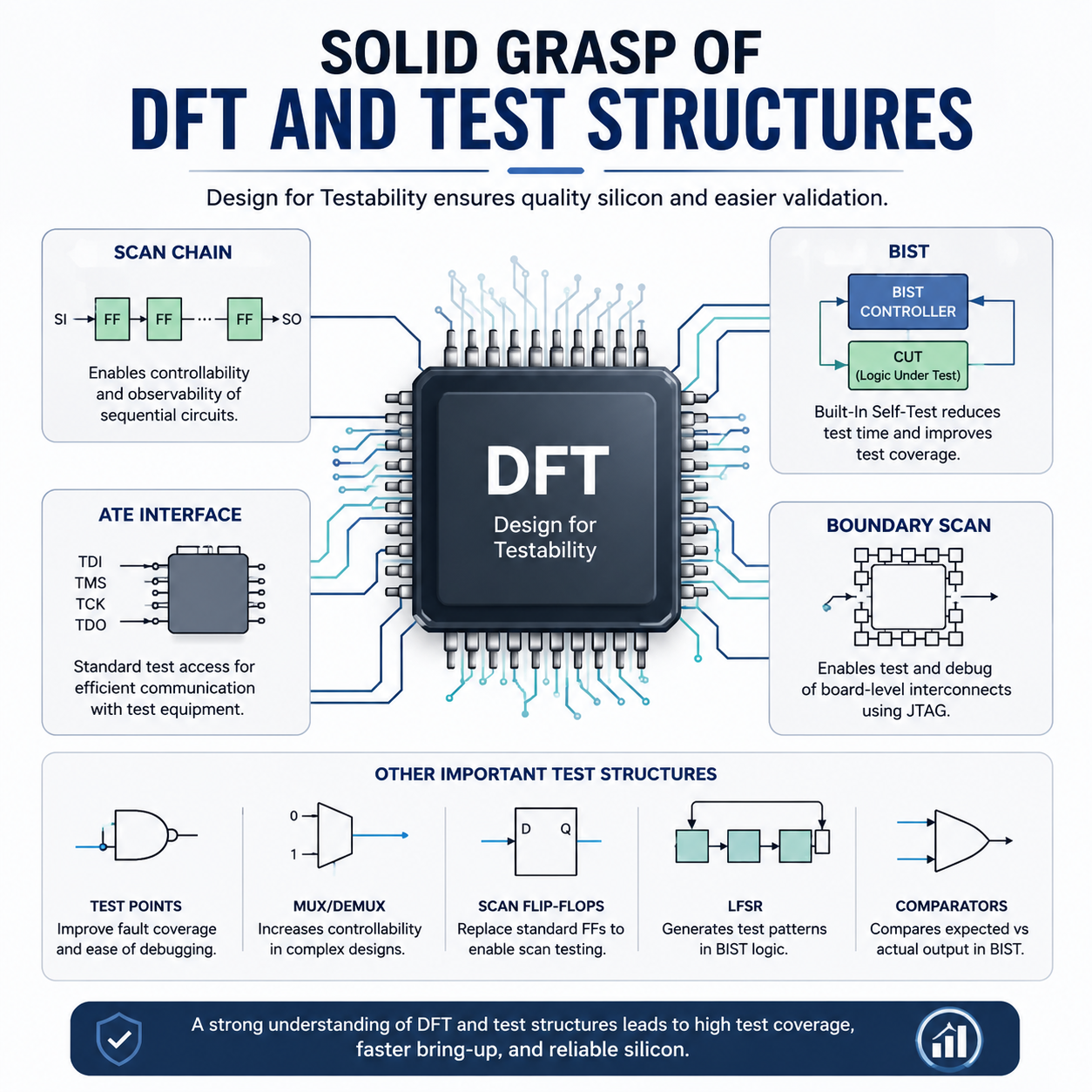
Design-for-test structures like scan chains, built-in self-test, and boundary scan aren't just something to be aware of; they're tools a validation engineer actively relies on during debug. Knowing how these structures work internally makes it far easier to isolate whether a failure originates in logic, memory, or the I/O interface. It also helps bridge the gap between design intent and what actually shows up during silicon bring-up. Engineers who skip this foundation often find themselves guessing during debug sessions instead of working through a structured, evidence-based process.
5. Cross-Functional Communication and Documentation
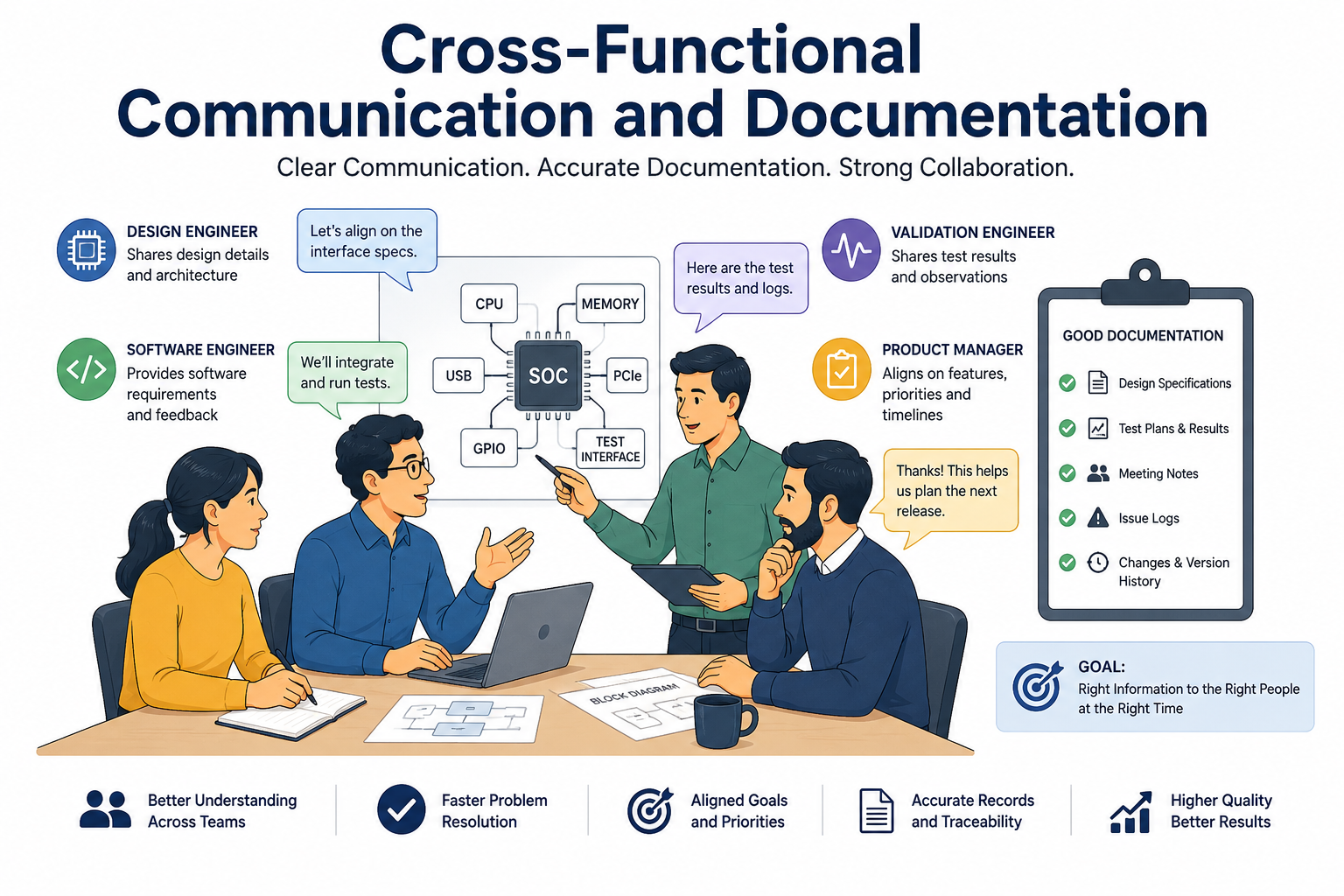
Validation rarely happens in isolation. An engineer typically works alongside design, architecture, and firmware teams, and each failure needs to be documented clearly enough that anyone reading the report understands the issue without needing a live walkthrough. This means writing precise bug reports, presenting findings without ambiguity, and knowing how to explain a hardware-level issue to someone who may only understand it from a software perspective. Strong communication doesn't just make debugging faster; it builds trust across teams and often determines how quickly a fix reaches production.
Building These Skills the Right Way
None of these five skills exist in isolation, and most professionals don't master them purely through on-the-job learning. That's part of why a well-structured post silicon validation course has become such a popular starting point. A good program combines theory with actual lab exposure, giving engineers a chance to practice debug scenarios before facing them under real deadline pressure.
At the same time, broader exposure to VLSI concepts, from design to verification to test, helps validation engineers understand the full picture rather than just their narrow slice of it. This is why many professionals also look for solid vlsi training in india, since it builds the surrounding context that makes post-silicon work far more intuitive.
Conclusion
Post-silicon validation is one of those disciplines where experience compounds quickly. The engineers who stand out aren't necessarily the ones with the most theoretical knowledge; they're the ones who've deliberately built debug intuition, lab fluency, scripting ability, DFT understanding, and communication skills side by side. Each skill reinforces the others, and together they turn a good engineer into someone labs actively want on their team.
If you're serious about growing in this field, treating these five skills as a checklist rather than a wish list is a good place to start. Pick one, practice it deliberately, and let the next one follow naturally.