

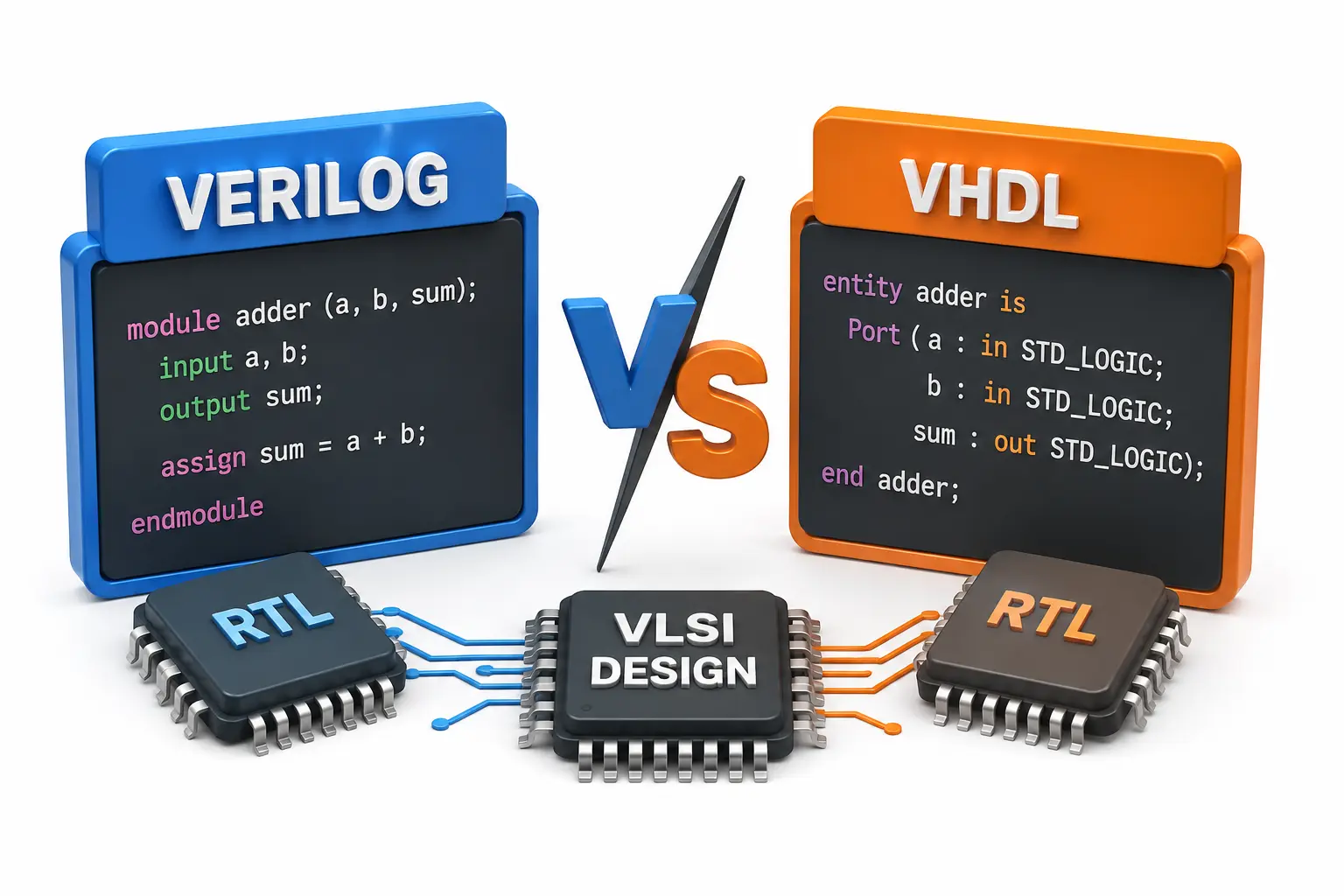
Verilog vs VHDL Which HDL Should You Learn for VLSI Design?
Navigate through this article using the table of contents below
Table of Contents
No headings found in this article.
Choosing your first hardware description language can feel like a major career decision. Verilog and VHDL can both describe sophisticated digital systems, yet they encourage different coding styles and appear with different frequency across semiconductor, FPGA, aerospace, research, and verification environments.
The more important question is therefore not simply which language is “better.” You need to understand which HDL fits your target role, how quickly it can take you from digital fundamentals to practical RTL projects, and what you should learn after mastering the language itself.
Verilog vs VHDL Comparison for VLSI Design
| Feature | Verilog | VHDL |
|---|---|---|
| Syntax | Compact and relatively easy to learn | More verbose and highly structured |
| Typing | Less strict typing | Strongly typed language |
| ASIC Design | Widely used in ASIC and VLSI RTL design | Used in selected ASIC and specialized projects |
| FPGA Design | Commonly used for FPGA development | Strongly used in many FPGA environments |
| Learning Curve | Generally easier for VLSI beginners | Requires more familiarity with strict language rules |
| SystemVerilog Path | Natural progression from Verilog to SystemVerilog | Separate HDL ecosystem |
| Best For | ASIC RTL, VLSI front-end and verification paths | FPGA and specialized engineering applications |
| VLSI Fresher Choice | Recommended starting point for many ASIC-focused learners | Useful when the target role or company specifically uses VHDL |
Start With Hardware Thinking, Not Language Syntax
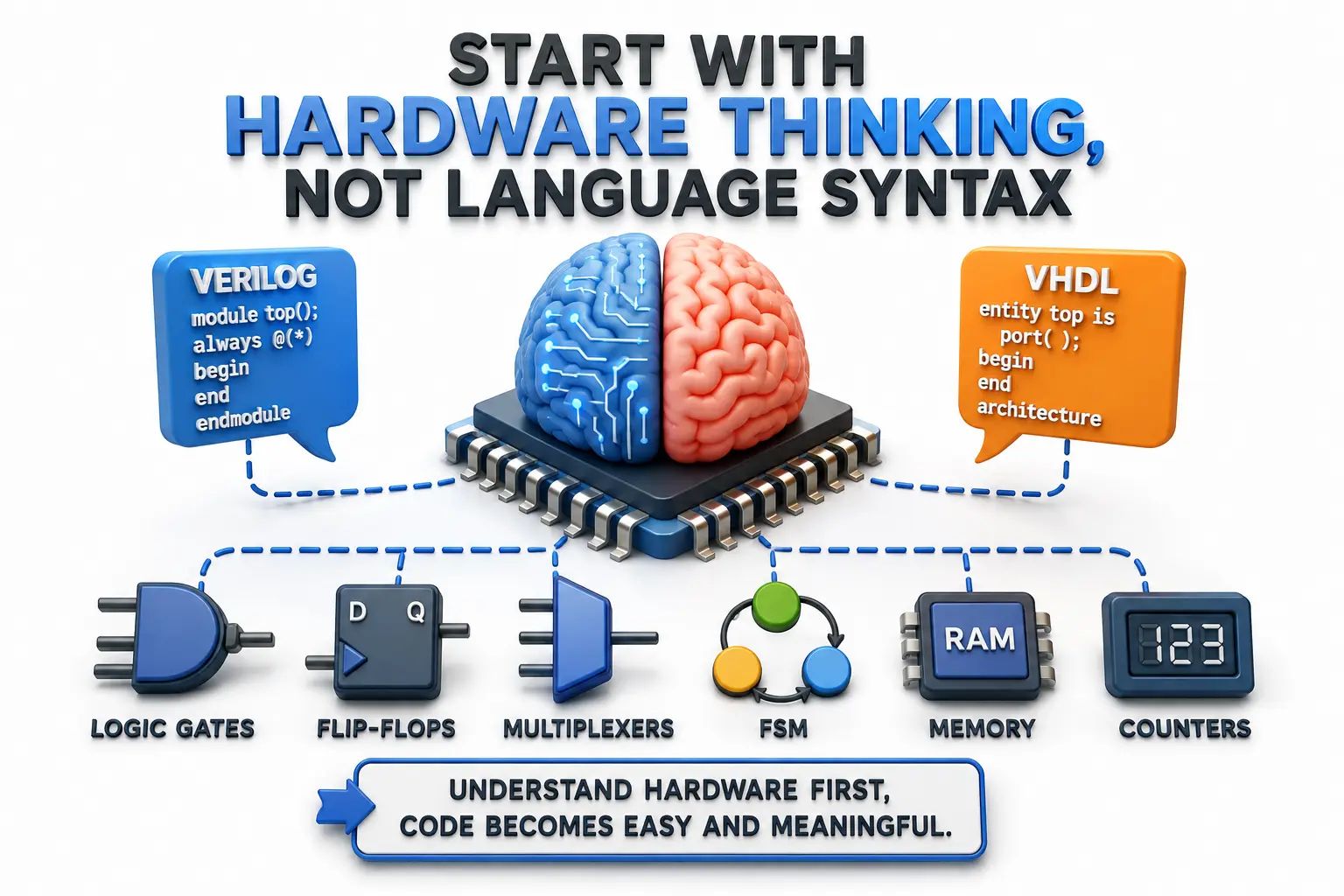
Before comparing Verilog and VHDL, understand what an HDL actually does. A hardware description language is not simply another programming language. When you write RTL, you are describing hardware structures and behavior that may ultimately become registers, combinational logic, multiplexers, counters, state machines, memories, and interconnected digital blocks.
This distinction matters because beginners sometimes concentrate on memorizing syntax while missing the hardware being inferred. Knowing how to write an if statement is less valuable than understanding whether that statement describes combinational logic, a register, priority logic, or an unintended latch.
A strong starting foundation should therefore include:
Boolean algebra and logic gates
Combinational and sequential circuits
Flip-flops, registers and counters
Multiplexers and decoders
Finite-state machines
Clock and reset concepts
Setup and hold timing fundamentals
RTL simulation and synthesis
Once these concepts are clear, moving between HDLs becomes considerably easier. The language is the description mechanism; digital design knowledge is what determines whether the resulting hardware is correct.
Why Verilog Is Often the Practical Starting Point
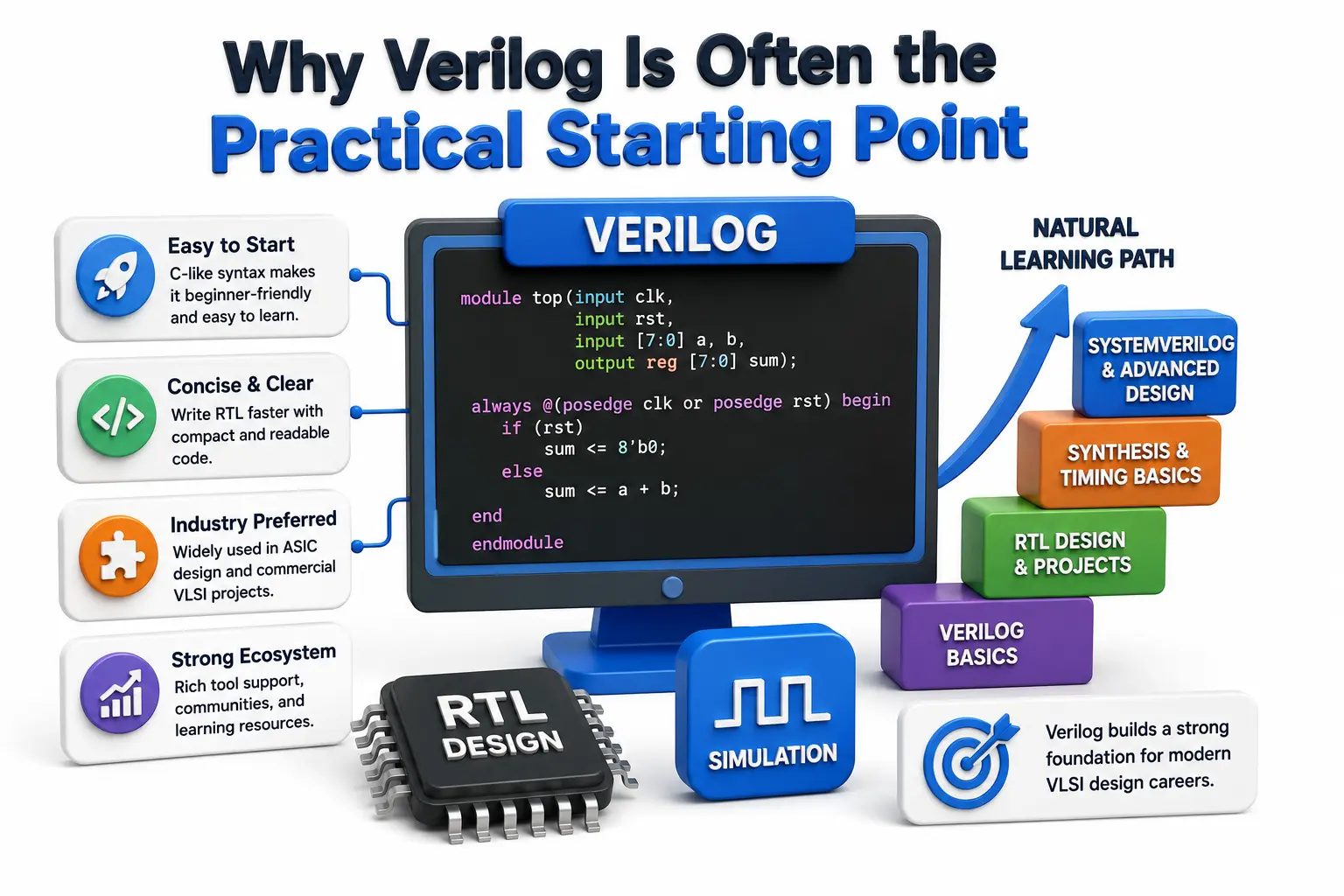
Verilog uses relatively compact syntax and shares some visual familiarity with C-style programming. This can make the first stages of RTL development less intimidating for electronics students who already have basic programming exposure.
Designers can use it to describe modules, ports, continuous assignments, combinational logic, sequential blocks, FSMs and parameterized hardware. Its concise nature also means students can spend more time examining waveforms and understanding circuit behavior instead of dealing with extensive language boilerplate.
For students researching Verilog vs VHDL for VLSI design, career direction should carry more weight than personal syntax preference. Verilog has historically developed a particularly strong position in commercial ASIC design, while its evolution is closely connected with SystemVerilog.
That creates a logical learning progression:
Digital electronics → Verilog RTL → simulation and synthesis → SystemVerilog → advanced RTL or verification
This progression is particularly useful for someone targeting front-end semiconductor roles because the knowledge gained from Verilog is directly relevant when moving into the broader SystemVerilog ecosystem.
Why VHDL Still Deserves Serious Attention
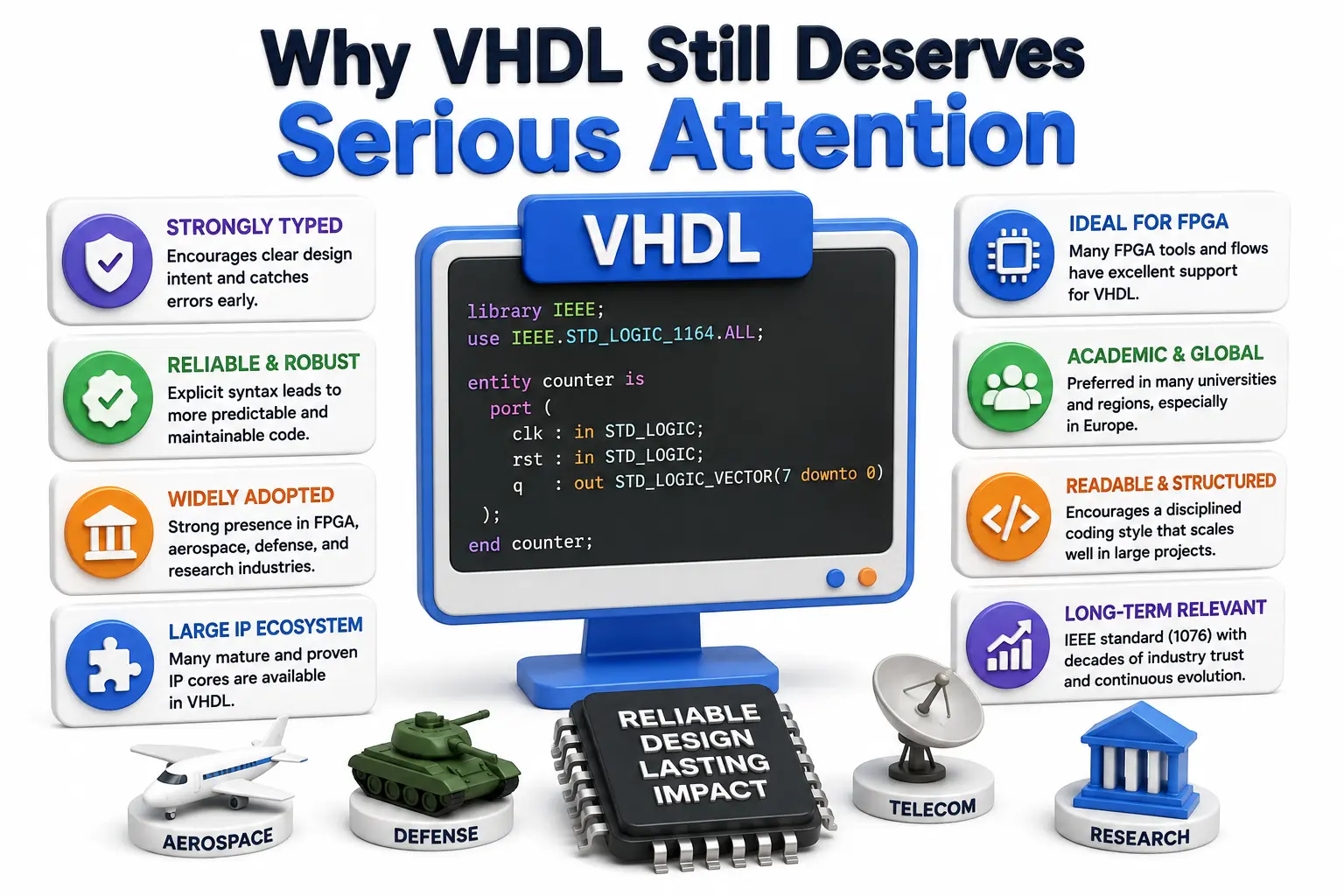
VHDL should not be dismissed simply because Verilog can be quicker to write. Its strongly typed and explicit nature encourages engineers to define signals, interfaces and data types carefully. Although beginners may initially experience more compilation errors, that strictness can also expose mistakes earlier.
Its structure can be valuable in large engineering environments where readability, explicit design intent and disciplined interfaces matter. VHDL remains particularly relevant in FPGA development and has traditionally maintained a significant presence in European engineering, aerospace, defense and other specialized environments.
Students may prefer VHDL when they:
Are entering a company that already uses it
Want to specialize in FPGA development
Work with an academic curriculum built around VHDL
Prefer strict typing and explicit coding
Target industries where existing IP is VHDL-based
The key lesson is that VHDL is not an obsolete alternative. Both languages can describe synthesizable digital hardware. The appropriate choice depends heavily on the ecosystem surrounding the project.
Your Career Track Should Decide Which HDL Comes First
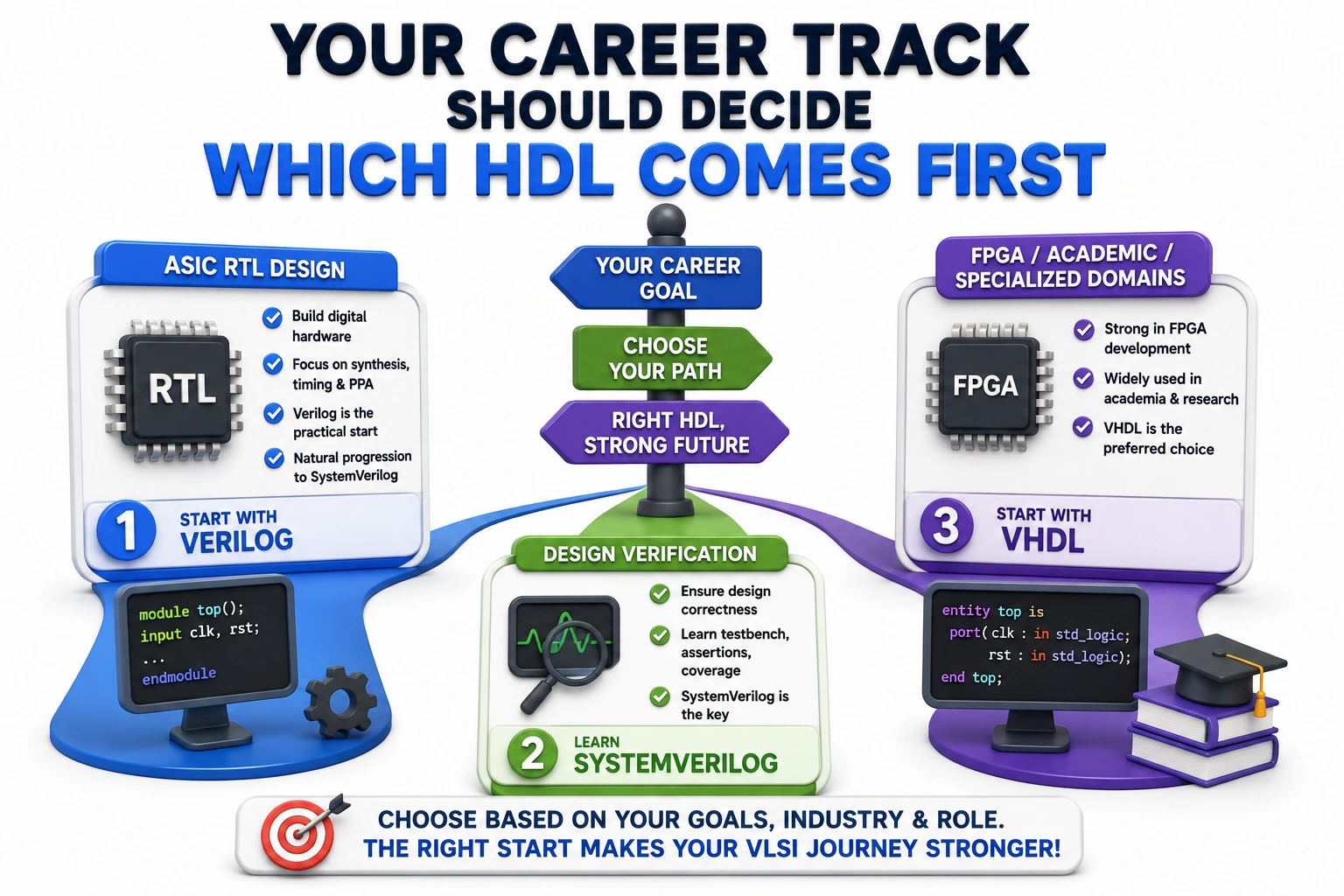
A student targeting ASIC RTL design has different requirements from someone building FPGA systems for aerospace applications. This is why choosing an HDL solely because somebody calls it “easy” can produce the wrong learning strategy.
For ASIC RTL design, learning Verilog first is generally a practical route because it provides a foundation that naturally extends toward SystemVerilog. You should eventually become comfortable with synthesizable RTL, linting, simulation, synthesis, timing concepts and common digital interfaces.
For design verification, basic Verilog knowledge remains valuable, but SystemVerilog becomes far more important. Verification engineers need to understand the design they are testing while developing skills in assertions, constrained-random verification, functional coverage and methodologies such as UVM.
For FPGA engineering, the answer is more environment-dependent. Both languages remain viable, and the existing codebase, organization, FPGA toolchain and team standards may determine which one you use.
This role-based approach is more useful than asking which HDL can theoretically build better hardware. In competent hands, both can describe the same digital functionality.
Do Not Stop After Learning HDL Syntax
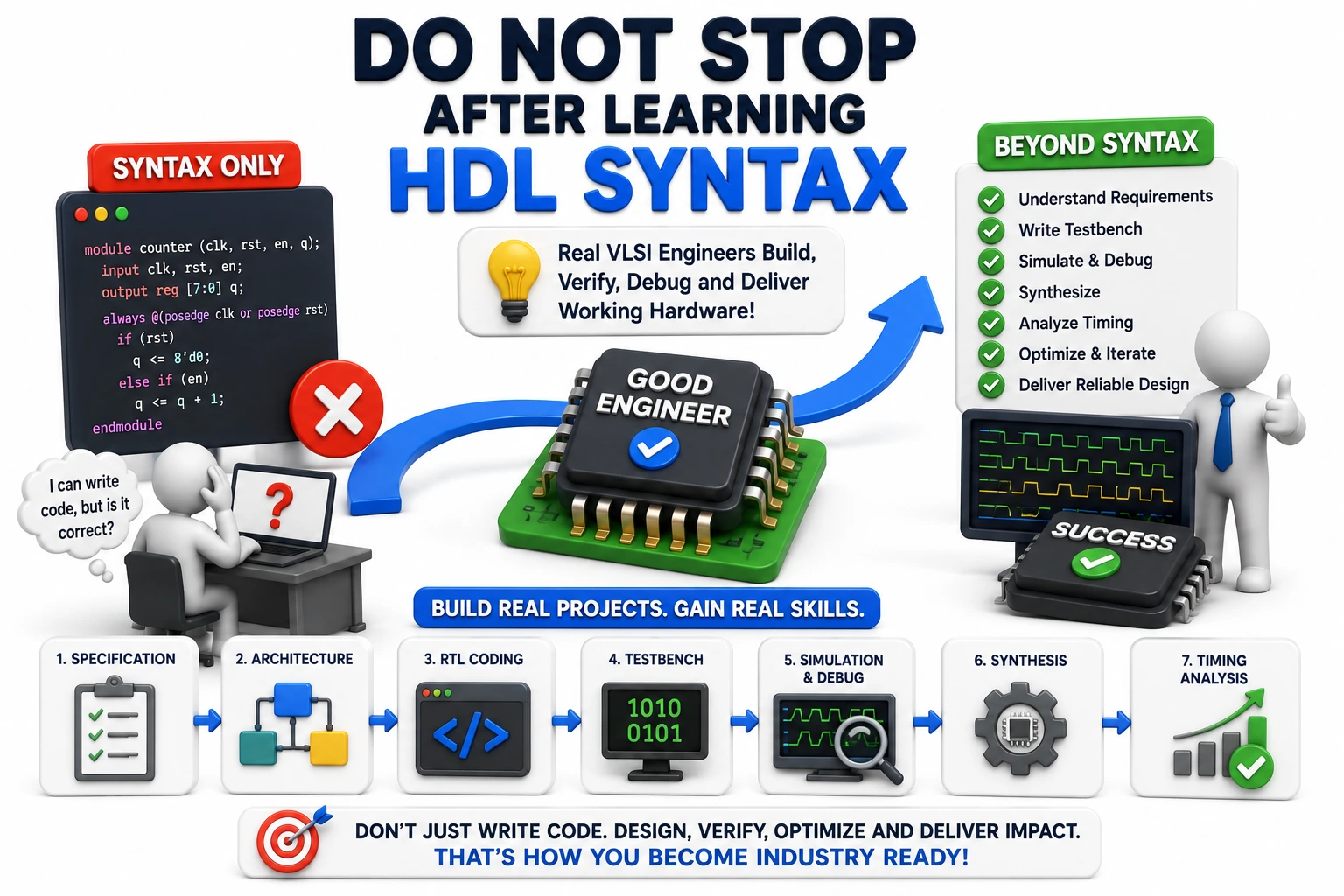
Completing a language course does not automatically make someone RTL-ready. Semiconductor employers need engineers who understand what their code becomes after synthesis and who can identify incorrect hardware behavior through simulation and debugging.
Instead of writing only gates and basic counters, progress toward increasingly realistic projects. Build a configurable counter, UART controller, FIFO, sequence detector, arbiter, ALU, register bank or simple bus-connected peripheral. Write testbenches, simulate corner cases and inspect waveforms instead of assuming that successful compilation means correct hardware.
Your project workflow should gradually become:
Specification → architecture → RTL coding → testbench → simulation → debugging → synthesis → timing review
This is where structured training can make a meaningful difference. At JastTech, learners preparing for VLSI careers can benefit from focusing on practical RTL development alongside the digital fundamentals, debugging habits and design-flow understanding required to move beyond textbook syntax.
A small but thoroughly verified project often demonstrates stronger engineering ability than a large project copied from an online repository.
Build a Learning Roadmap That Goes Beyond Verilog or VHDL
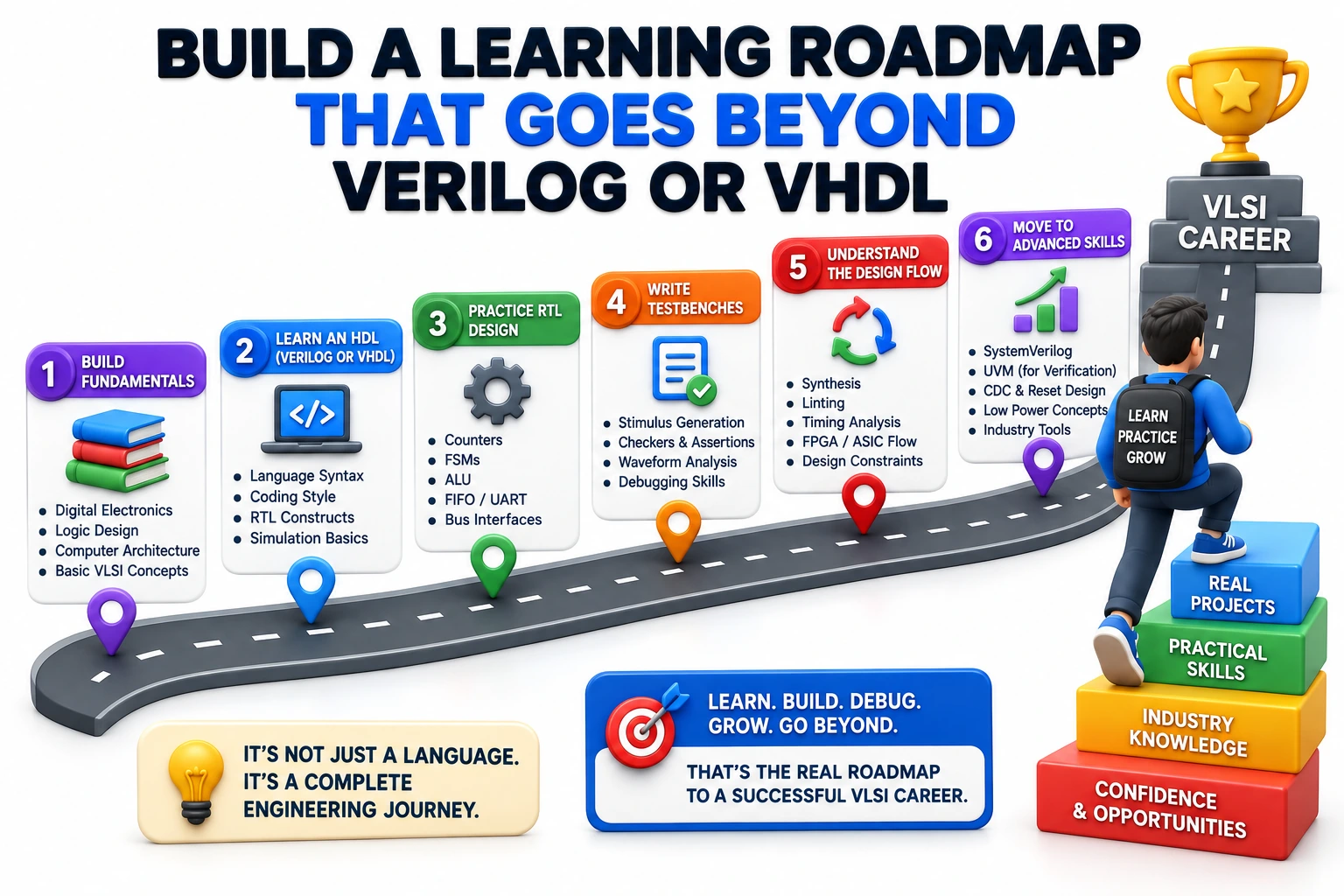
If your objective is a professional semiconductor career, your roadmap should extend beyond the initial HDL decision. Begin with digital electronics, choose one language, and use it repeatedly until you can translate specifications into synthesizable hardware without depending on tutorials for every block.
If you choose Verilog, move next toward SystemVerilog and deeper RTL concepts. Learn blocking versus non-blocking assignments, parameterization, FSM design, reset strategies, clock-domain fundamentals, synthesis implications and basic timing analysis.
If you begin with VHDL, develop the same hardware-design discipline. Later, learning enough Verilog/SystemVerilog to understand another team's RTL can make you more adaptable in mixed-language projects.
Most importantly, practice debugging. Introduce test scenarios that intentionally break your design. Read simulator messages, inspect waveforms and trace incorrect outputs back to the RTL. This process develops engineering judgment that syntax exercises cannot provide.
The goal is not to become someone who “knows Verilog” or “knows VHDL.” The goal is to become an engineer capable of converting a hardware requirement into reliable, synthesizable and verifiable digital logic.
Conclusion
Verilog is usually the stronger first choice for students whose primary goal is commercial VLSI, ASIC RTL design or a future transition into SystemVerilog-based design and verification. Its compact syntax makes it approachable, while its relationship with modern SystemVerilog workflows creates a natural path toward more advanced front-end skills.
VHDL remains a valuable engineering language, particularly for FPGA-oriented and specialized environments where existing projects, organizational standards or industry requirements favor it. Whichever language you choose, spend less time worrying about winning the HDL debate and more time mastering digital design, RTL architecture, simulation, synthesis, debugging and practical projects. Those abilities ultimately determine your value as a VLSI engineer.