

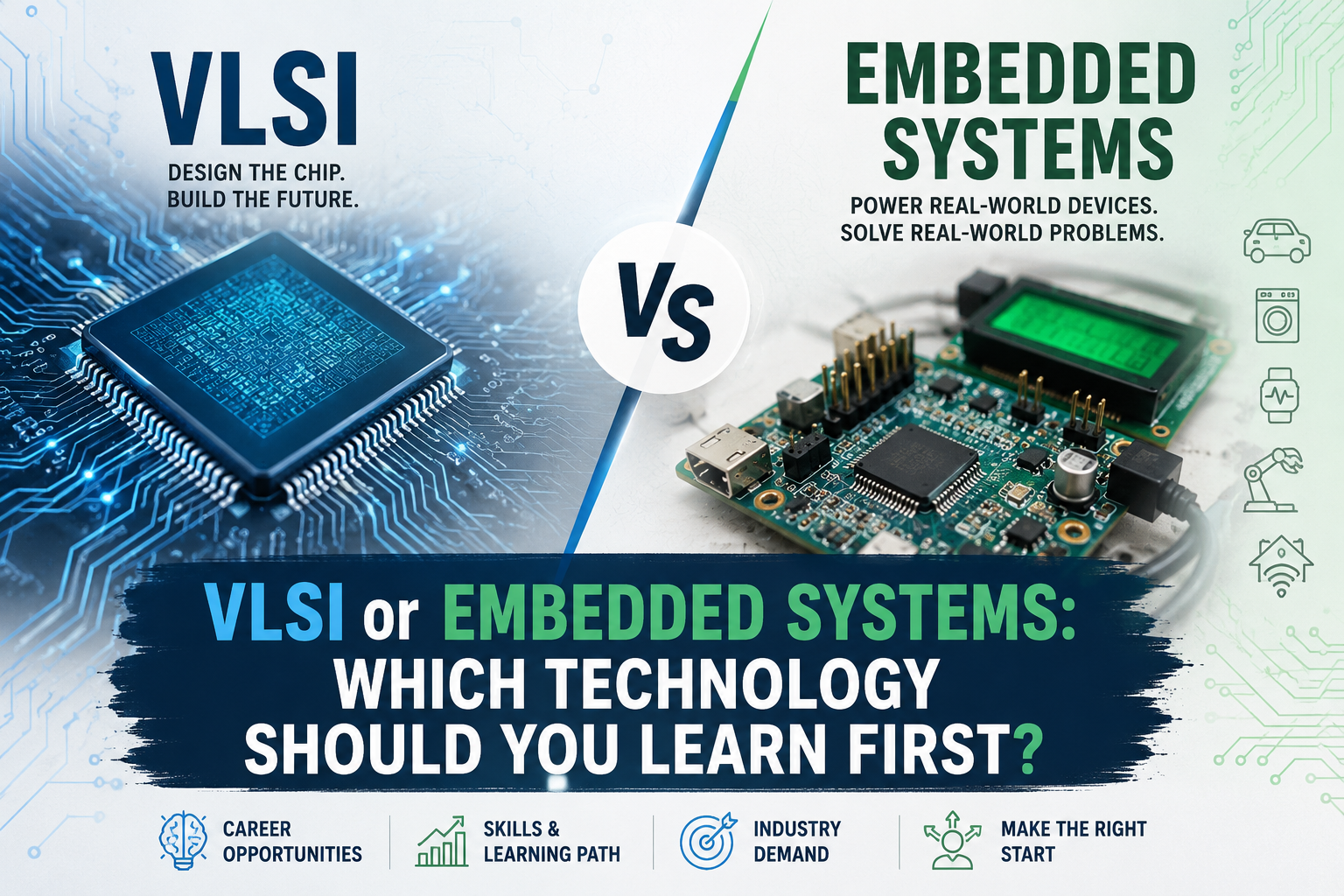
VLSI or Embedded Systems: Which Technology Should You Learn First?
Navigate through this article using the table of contents below
Table of Contents
No headings found in this article.
Picture two engineers standing at a crossroads, both holding the same map but pointing in opposite directions. One says the future is written in silicon. The other says it's written in code that talks directly to hardware. Both are right, and that's exactly why this decision feels so confusing.
If you've been researching career paths in the hardware and semiconductor space, you've probably typed "VLSI course in India" or "embedded system training in India" into Google more times than you'd like to admit. The honest answer is that neither field is objectively "better" — but one of them will fit your goals, your learning style, and your timeline far more naturally than the other. Let's break this down without the confusion.
1.What VLSI Actually Involves
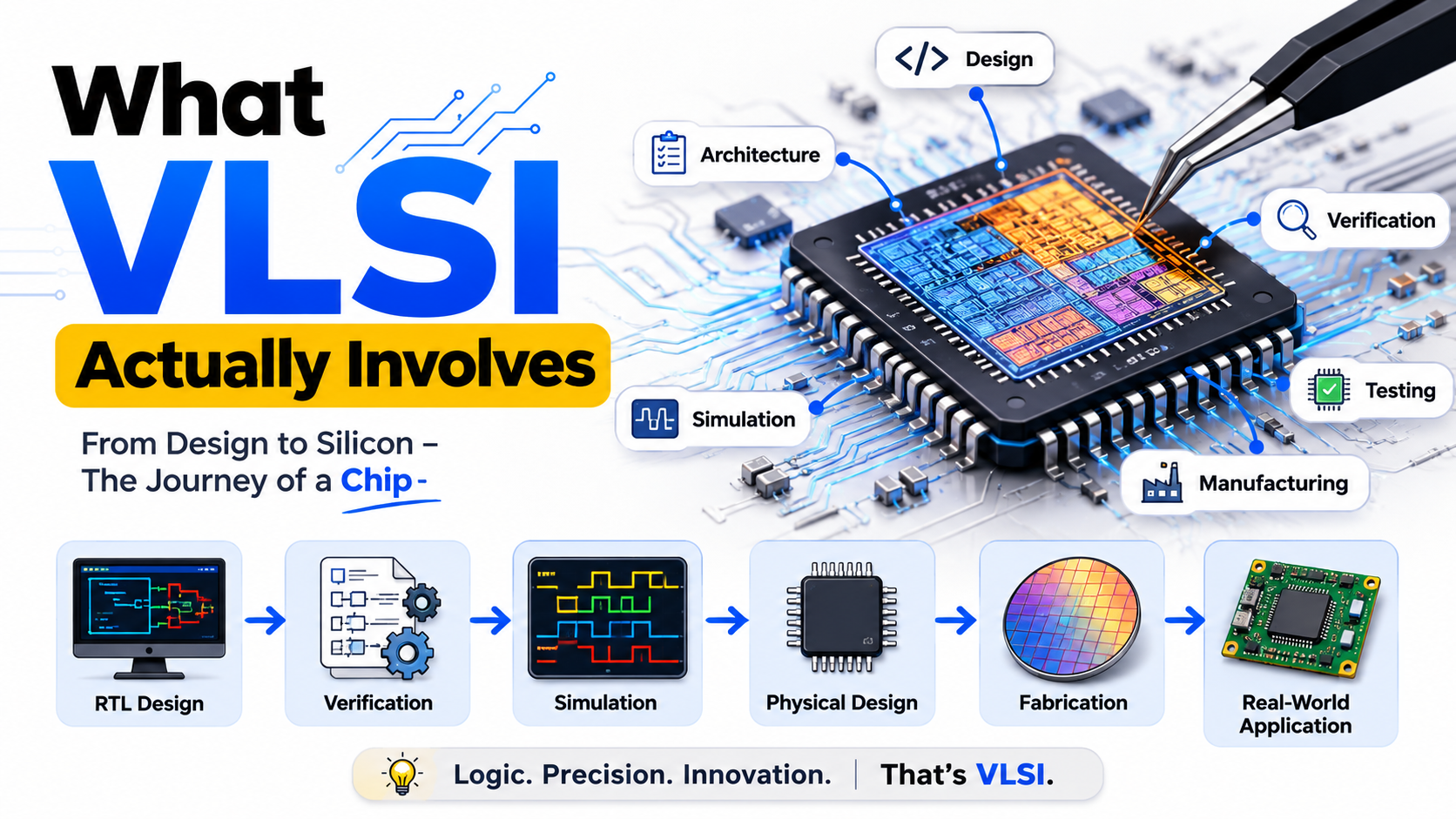
VLSI, or Very Large Scale Integration, is the process of designing and fabricating chips that pack millions (sometimes billions) of transistors onto a single piece of silicon. When you learn VLSI, you're stepping into the world that builds processors, memory chips, and the tiny components inside every smartphone, laptop, and car on the road today.
This field is deeply rooted in digital logic design, semiconductor physics, and hardware description languages like Verilog and VHDL. It's a specialized domain, and that specialization is exactly why VLSI professionals are in such high demand. Companies aren't just looking for people who understand theory — they want people who can simulate, verify, and physically design chips that actually work in silicon. This is also why practical, hands-on learning matters so much more here than in many other technical fields. A good VLSI course in India typically walks you through RTL design, verification methodologies, physical design, and tape-out flows, giving you exposure to real industry tools rather than just textbook concepts.
2.What Embedded Systems Actually Involves
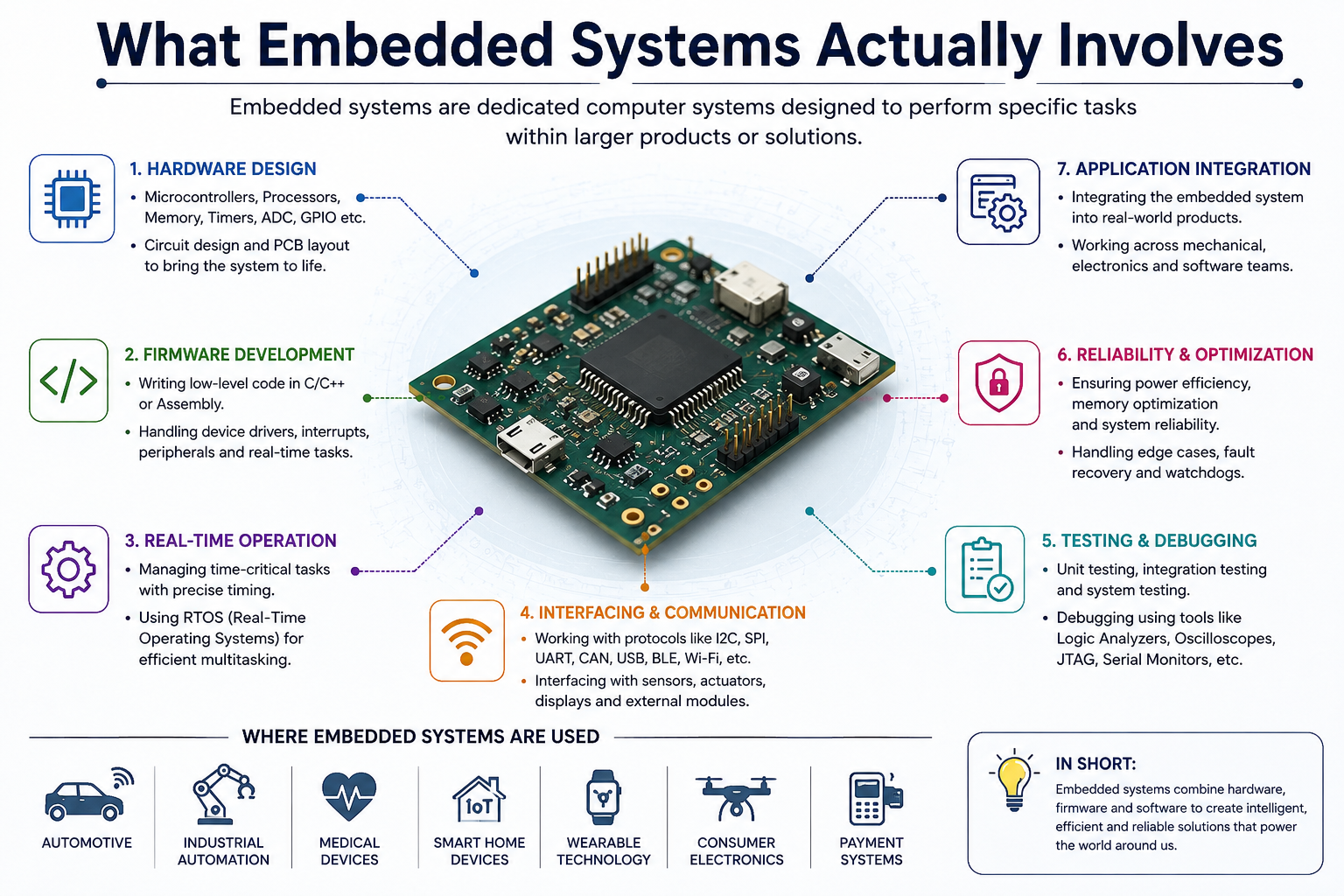
Embedded systems sit one layer above chip design. Instead of creating the silicon itself, you're programming and building the systems that run on top of it — the microcontrollers, sensors, and firmware that make a washing machine smart, a car's airbag deploy at the right millisecond, or a fitness band count your steps accurately.
This field blends hardware knowledge with software skills. You'll work with microcontrollers, real-time operating systems, communication protocols like I2C and SPI, and low-level programming in C or C++. It's a field that rewards people who enjoy debugging, building physical prototypes, and seeing immediate, tangible results from their code. Because embedded systems touch nearly every industry — automotive, healthcare, consumer electronics, industrial automation — the demand for skilled embedded system training in India has grown steadily, and it shows no signs of slowing down.
3.Comparing the Learning Curves
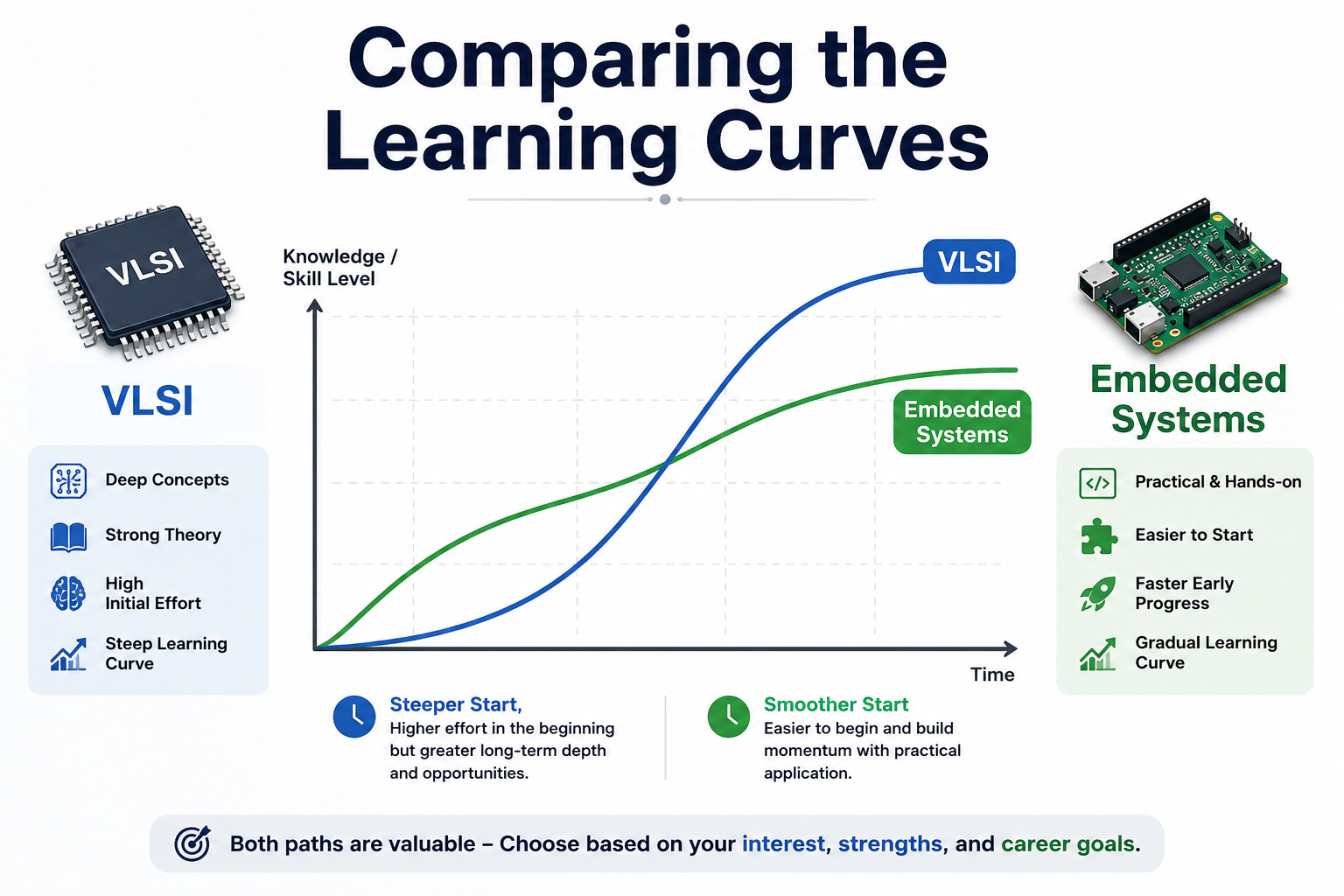
Here's where most people get stuck: which one is actually harder to learn first?
VLSI tends to have a steeper initial learning curve because it requires a strong grip on digital electronics fundamentals before you even touch design tools. Concepts like timing analysis, logic synthesis, and layout design take time to sink in, and the tools themselves (like Cadence or Synopsys) have a real learning curve of their own.
Embedded systems, on the other hand, often feels more approachable in the beginning. If you already know some C programming, you can start blinking an LED on a microcontroller board within your first few sessions. That said, embedded systems gets progressively more complex as you move into real-time constraints, memory optimization, and multi-layered communication protocols — so the difficulty evens out over time rather than front-loading like VLSI does.
Neither path is "easier" in absolute terms. It's more accurate to say VLSI front-loads its difficulty, while embedded systems builds difficulty gradually as projects scale up.
4.Career Scope and Industry Demand

Both fields are thriving, but they serve different corners of the tech industry. VLSI professionals are hired by semiconductor giants, chip design firms, and product companies building custom silicon. With India's growing push toward semiconductor manufacturing and design hubs, cities offering strong VLSI training in Hyderabad have become launchpads for people wanting to enter this space, since the city has developed a genuine cluster of design centers and R&D units over the past decade.
Embedded systems professionals, meanwhile, find opportunities across a much wider spread of industries — automotive companies building ADAS systems, healthcare firms designing medical devices, consumer electronics brands, and industrial automation companies all need embedded talent. If you want variety across industries, embedded systems offers more doors. If you want deep specialization within a high-value, high-barrier-to-entry niche, VLSI offers that instead.
Salary trends in both fields are strong, particularly for people who back their learning with real project work rather than just certificates. Recruiters in both domains consistently say the same thing: they care more about what you've built and debugged than which course logo appears on your resume.
5.How to Decide Which One Fits You First
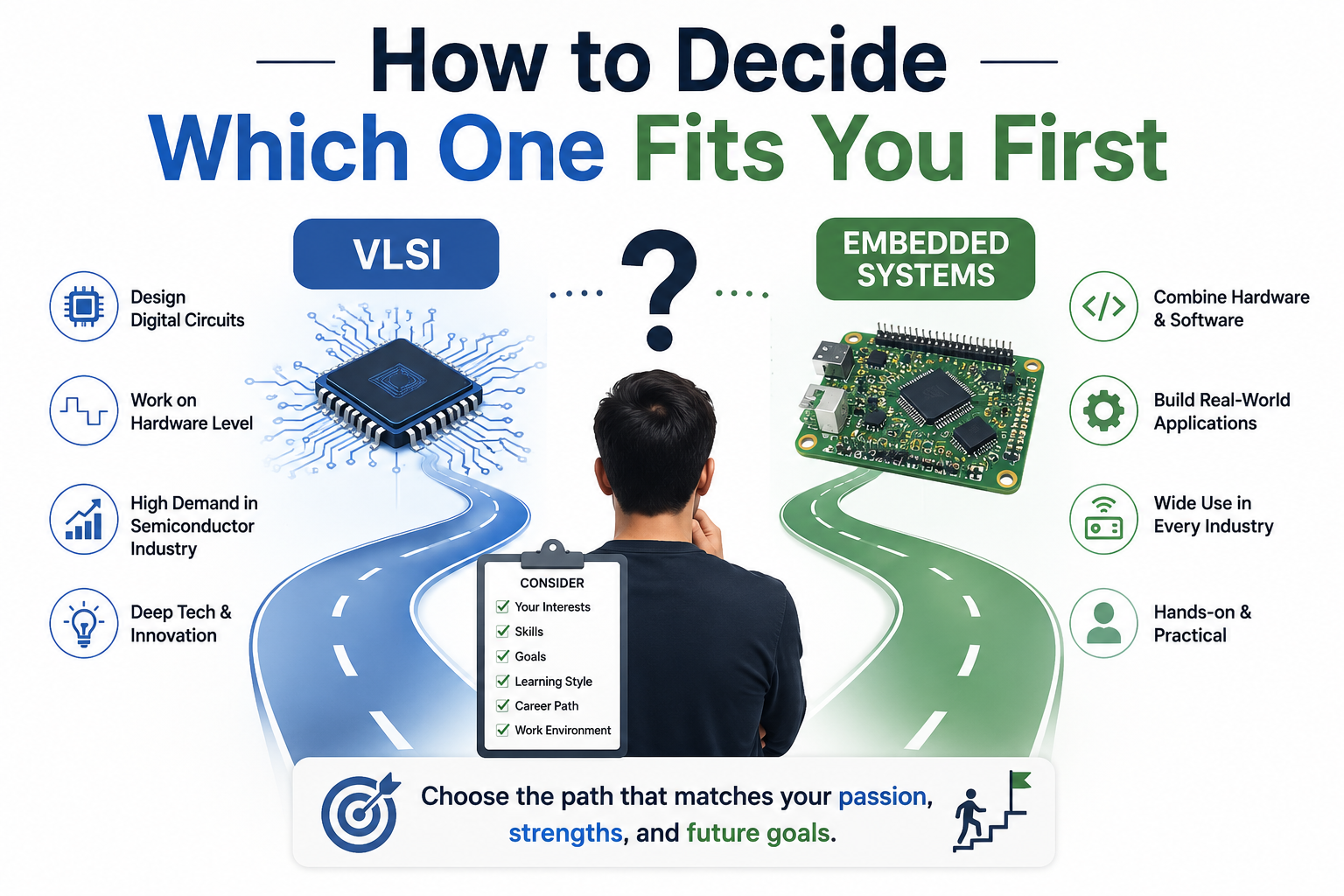
Instead of asking which technology is "better," ask yourself a few honest questions.
Do you enjoy thinking in terms of physical circuits, timing diagrams, and silicon-level behavior? Or do you get more excited writing code that directly controls a physical device's behavior? Your answer usually points you toward VLSI or embedded systems respectively.
Think about your timeline too. If you want to see working projects within weeks, embedded systems tends to deliver that faster. If you're comfortable with a longer runway before you start building complete designs, VLSI's depth will pay off in the long run.
It also helps to look at your local ecosystem. If you're based near a semiconductor hub, structured VLSI training in Hyderabad or similar cities can give you access to mentors, labs, and networking opportunities that are hard to replicate through self-study alone. If your interest leans toward products and devices rather than chips themselves, a solid embedded system training in India program with hands-on lab access will get you further, faster.
Finally, don't treat this as a permanent, irreversible choice. Many professionals who start in embedded systems later move into VLSI once they want to understand what's happening below the software layer, and plenty of VLSI engineers pick up embedded skills to work on system-level integration. Understanding one genuinely makes learning the other easier down the line — the fields overlap more than people expect.
Conclusion
There's no universal right answer to VLSI versus embedded systems — only the right answer for where you are right now. If chip-level design and silicon fascinate you, and you're willing to put in the groundwork before seeing results, VLSI will reward your patience with a highly specialized, high-value skill set. If you'd rather build things that respond to the real world quickly and work across a wider range of industries, embedded systems will keep you engaged with faster feedback loops.
Whichever path you choose, the real differentiator isn't the technology itself — it's how deeply you understand what you're building and why. Pick the one that excites you enough to keep learning past the difficult first few weeks, because that persistence is what actually determines your career outcome, not the label on the course you took.