

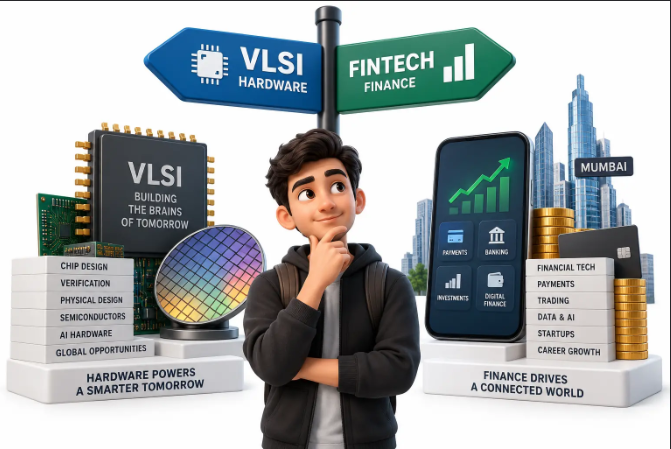
VLSI vs Fintech Careers in Mumbai Why Engineers Are Choosing Hardware Over Finance
Navigate through this article using the table of contents below
Table of Contents
No headings found in this article.
Mumbai has always made finance look like the obvious career destination. Banking, trading, payments, fintech and financial technology surround ambitious engineers. But another career path is quietly becoming harder to ignore: semiconductor engineering and VLSI.
For electronics graduates, the choice is no longer simply between a core job and a higher-paying technology role. VLSI is creating a different proposition—deeper specialization, complex engineering ownership and skills connected directly to the chips powering AI, automobiles, communication and modern computing.
Mumbai Gives Fintech the Home-Ground Advantage
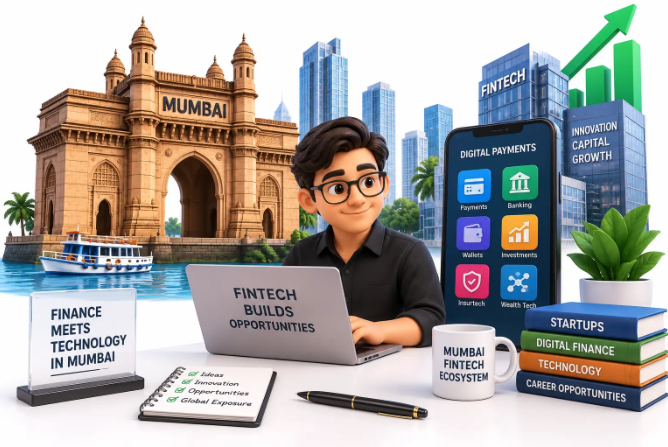
Mumbai's relationship with finance is difficult to compete with. The city brings together banks, financial institutions, insurance companies, investment firms, fintech businesses and technology teams supporting financial services. For engineers comfortable with software, this creates multiple possible entry points.
A fintech career can involve far more than understanding banking. Engineers may work on:
Backend and distributed systems
Payment infrastructure
Cloud platforms and APIs
Cybersecurity
Data engineering
Fraud-detection systems
AI and machine-learning applications
Trading and financial platforms
This breadth gives fintech an important advantage: opportunity volume and career flexibility. Software engineers can potentially move between fintech, SaaS, e-commerce, consulting and other technology industries because many programming and platform skills are transferable.
But that flexibility creates another question for ECE and electrical graduates. If you spent years studying digital electronics, semiconductor devices, processors and computer architecture, do you want to move completely toward software and financial systems—or build deeper expertise around hardware?
That question is making VLSI increasingly interesting.
VLSI Offers Engineers a Different Kind of Specialization
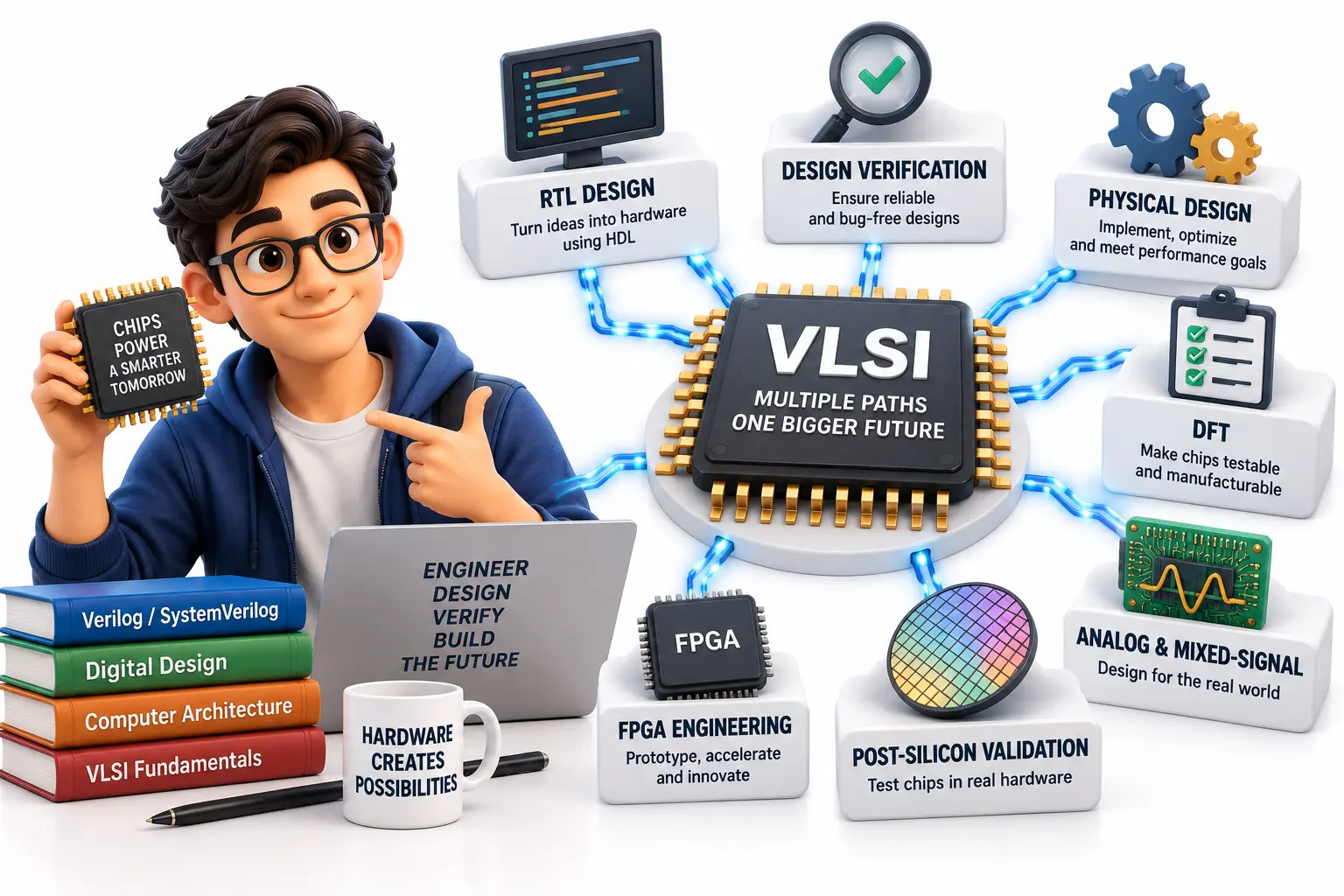
Fintech engineers primarily build systems that operate on computing hardware. VLSI engineers can help create the hardware itself.
That distinction changes the nature of the career.
A digital chip can pass through architecture, RTL design, functional verification, synthesis, design-for-test, physical implementation, timing analysis, fabrication and post-silicon validation. Each stage requires specialized engineering knowledge.
Possible VLSI career tracks include:
RTL design
Design verification
Physical design
Static timing analysis
DFT
Analog and mixed-signal design
FPGA engineering
Post-silicon validation
This specialization creates a higher technical entry barrier. Knowing basic Verilog is not enough for an RTL career, just as learning SystemVerilog syntax alone does not make someone a verification engineer.
Engineers must understand how digital hardware behaves, how timing affects circuits, how designs are verified and how specifications become functioning silicon. The learning curve can be demanding, but that technical depth is also one of VLSI's biggest attractions.
India's Semiconductor Push Changes the Career Equation
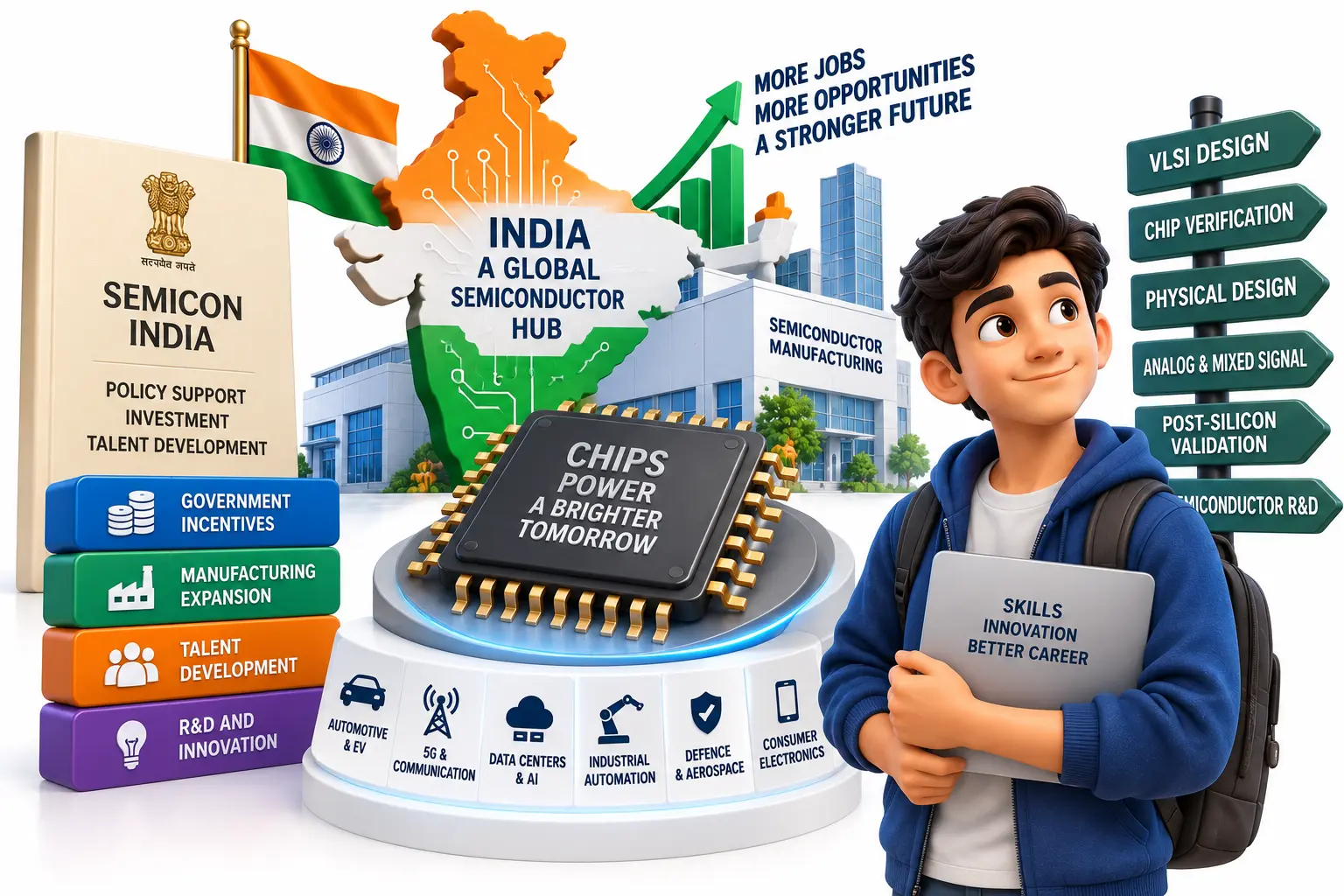
For years, Indian electronics students faced an uncomfortable reality: they studied hardware but often found far more visible opportunities in software. The semiconductor expansion happening across India is gradually changing that equation.
Chip demand is being driven by AI infrastructure, smartphones, automotive electronics, electric vehicles, industrial automation, telecommunications, IoT systems, defence applications and data centres. India is simultaneously attempting to expand its presence across semiconductor design, manufacturing, packaging, testing, research and talent development.
For Mumbai engineers, this means career planning should no longer be restricted to the jobs available within one city's boundaries.
Semiconductor careers operate through interconnected engineering clusters. Mumbai professionals can consider opportunities across Maharashtra as well as established semiconductor centres such as Bengaluru, Hyderabad, Chennai, Noida and emerging manufacturing locations.
This makes VLSI a national engineering career rather than simply a local employment category.
The result is important: electronics graduates now have a stronger reason to ask whether moving immediately into generic software or fintech is really their best long-term use of an engineering degree.
Hardware Skills Can Create a Stronger Technical Moat
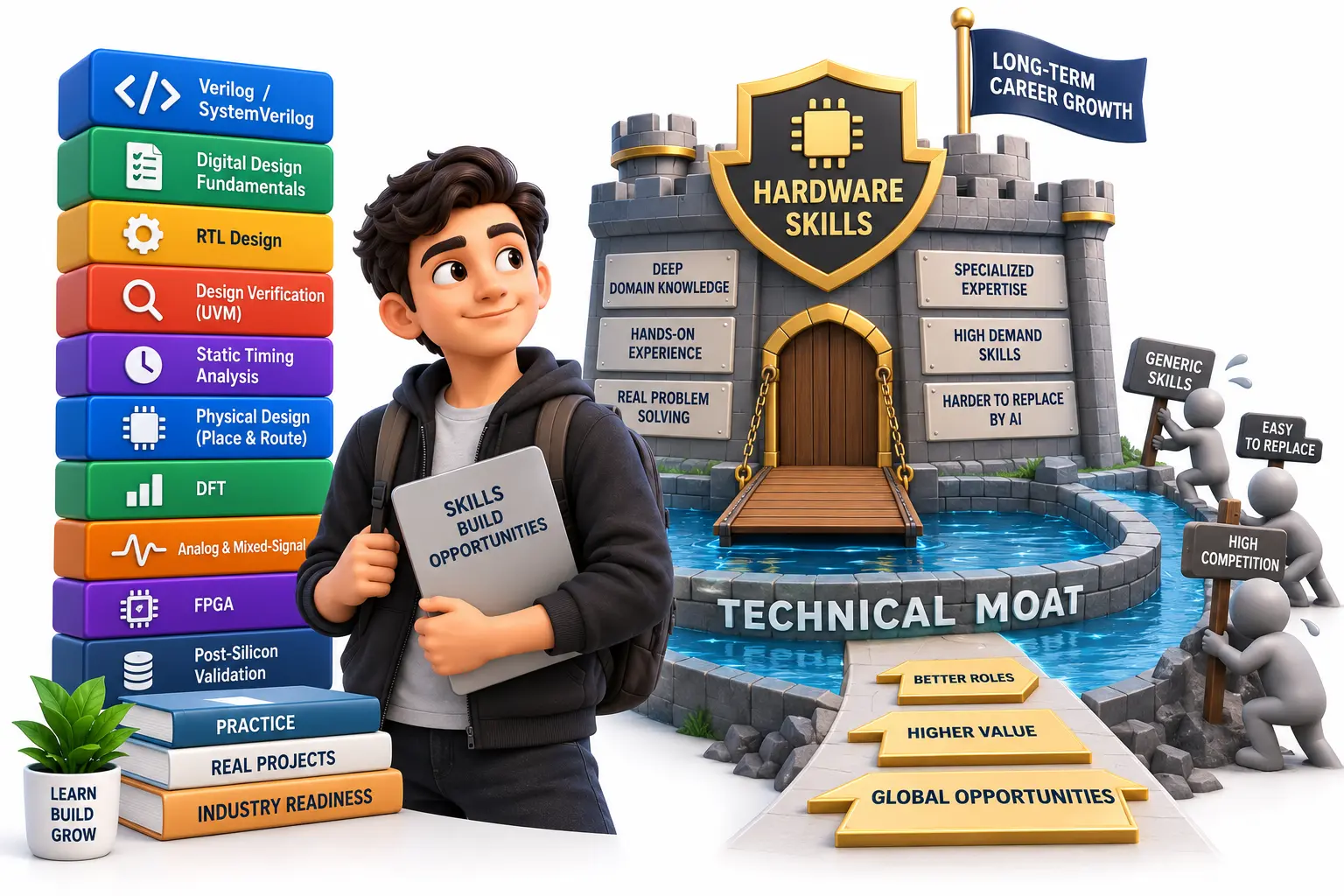
One reason engineers are attracted to VLSI is the concept of a technical moat—a combination of knowledge and experience that becomes increasingly difficult to reproduce quickly.
Consider an engineer who develops expertise in RTL microarchitecture, SystemVerilog, synthesis and timing. Another might specialize in UVM-based verification, assertions and coverage closure. A physical-design engineer may build deep experience in floorplanning, placement, clock-tree synthesis, routing and timing closure.
These capabilities take time to develop.
A fresher considering a vlsi training institute in mumbai should therefore evaluate practical engineering exposure rather than simply looking at course duration or tool names. The real question is whether the learning process develops digital-design fundamentals, debugging ability, project experience and understanding of the complete chip-development flow.
JastTech can position training around this industry-readiness principle by helping learners connect theoretical electronics concepts with practical VLSI workflows instead of treating software tools as the entire skill.
That distinction matters because specialization becomes valuable when engineers can solve real design and verification problems—not when they simply collect certificates.
AI Will Transform Both Careers but in Different Ways
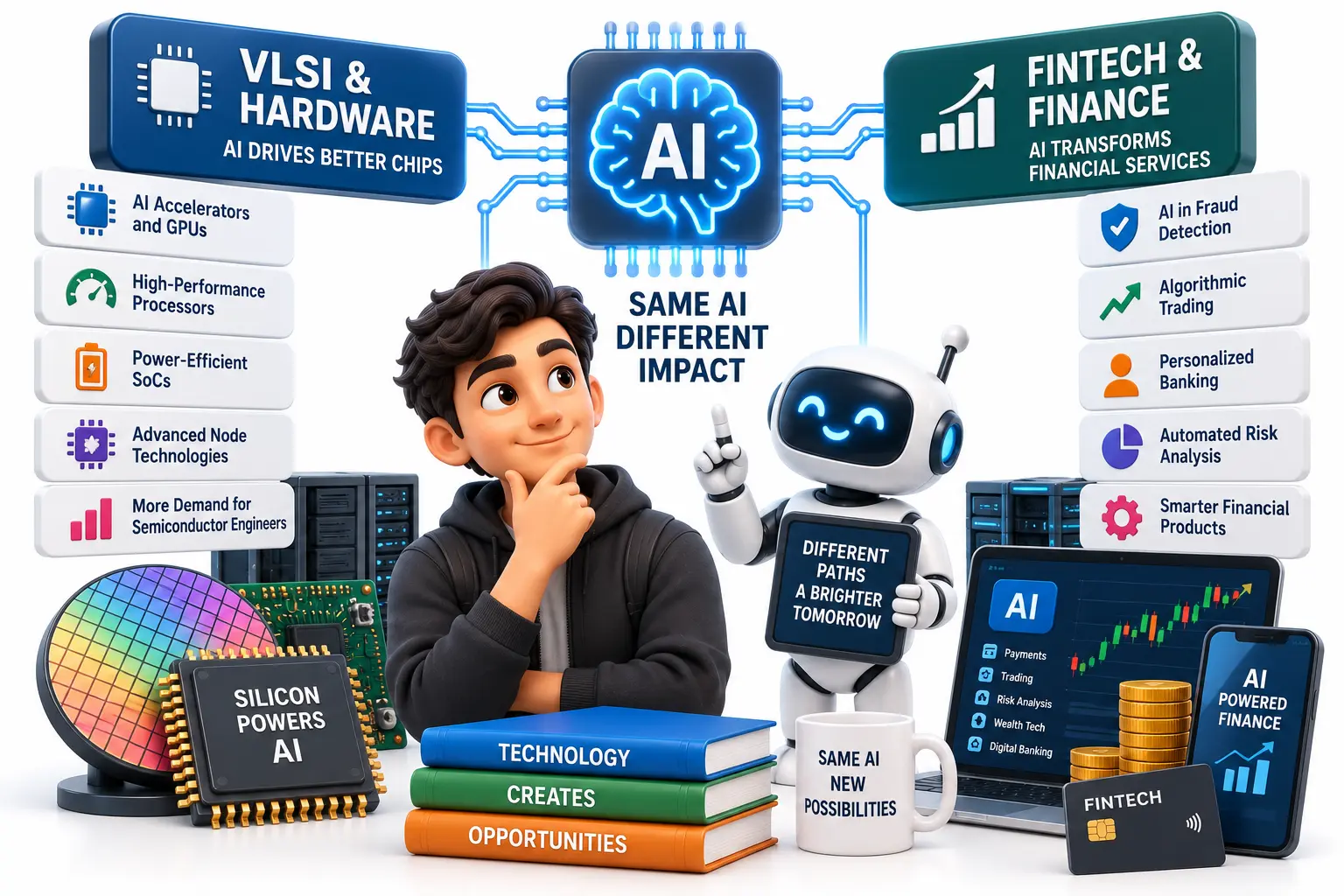
AI makes the VLSI-versus-fintech comparison even more interesting.
Fintech companies are rapidly incorporating AI into fraud detection, customer support, risk analysis, software development, financial operations and data-driven products. Engineers working in finance will increasingly need to understand AI-assisted development, cloud infrastructure, data systems and automation.
Semiconductors sit underneath that same transformation.
Large AI models require enormous computing capacity. GPUs, AI accelerators, high-speed memory systems, networking chips and specialized processors determine how efficiently those models can run. Improvements in artificial intelligence therefore create demand not only for better software but also for more capable silicon.
VLSI engineers will use increasing levels of automation and AI-assisted engineering as EDA technologies evolve. Their role, however, still requires understanding hardware constraints such as timing, power, area, architecture, verification and physical implementation.
The smartest career question is consequently not, "Which field is protected from AI?"
Neither field is.
A better question is, "Which technical foundation do I want AI to amplify?"
For fintech engineers, that foundation may be software, data and financial systems. For VLSI engineers, it may be digital hardware, semiconductor design and computing architecture.
Choose Between VLSI and Fintech Based on How You Think

Salary should influence a career decision, but it should not make the entire decision.
Fintech can be an excellent choice for engineers who enjoy programming, distributed systems, financial products, data, fast development cycles and broader software mobility. Mumbai provides an especially attractive environment because finance and technology already overlap throughout the city's economy.
VLSI is better suited to a different engineering personality.
Consider hardware if you enjoy:
Digital logic and electronics
Understanding processors and chip architecture
Debugging difficult technical problems
Verilog or SystemVerilog
Timing and hardware behaviour
Working deeply within one engineering specialization
Building expertise that compounds over several years
There is also an important trade-off. VLSI generally requires more domain-specific preparation before engineers become genuinely job-ready. Fintech and software provide a wider variety of entry routes, while semiconductor roles can demand stronger alignment between education, projects and specialized skills.
Neither career wins automatically.
For an electronics engineer who dislikes hardware and loves building software products, choosing VLSI simply because semiconductors are growing would be a poor decision. Similarly, moving into fintech only because Mumbai is India's financial capital can waste a genuine interest in electronics and chip design.
The strongest career is usually the one in which your natural engineering interests align with a market willing to reward increasingly advanced skills.
Conclusion
Mumbai's fintech ecosystem will remain a powerful career destination, and engineers who enjoy software, data, payments and financial technology have compelling reasons to enter it. But electronics graduates now have another serious option. India's semiconductor ambitions are making VLSI more visible as a specialized engineering career rather than an academic niche.
The real shift is therefore not engineers abandoning finance for hardware. It is engineers gaining enough alternatives to make a deliberate choice. For someone fascinated by digital systems, chip architecture and deep technical problem-solving, VLSI can offer something fintech cannot replicate: the opportunity to build a career around the silicon underneath the digital economy itself.