

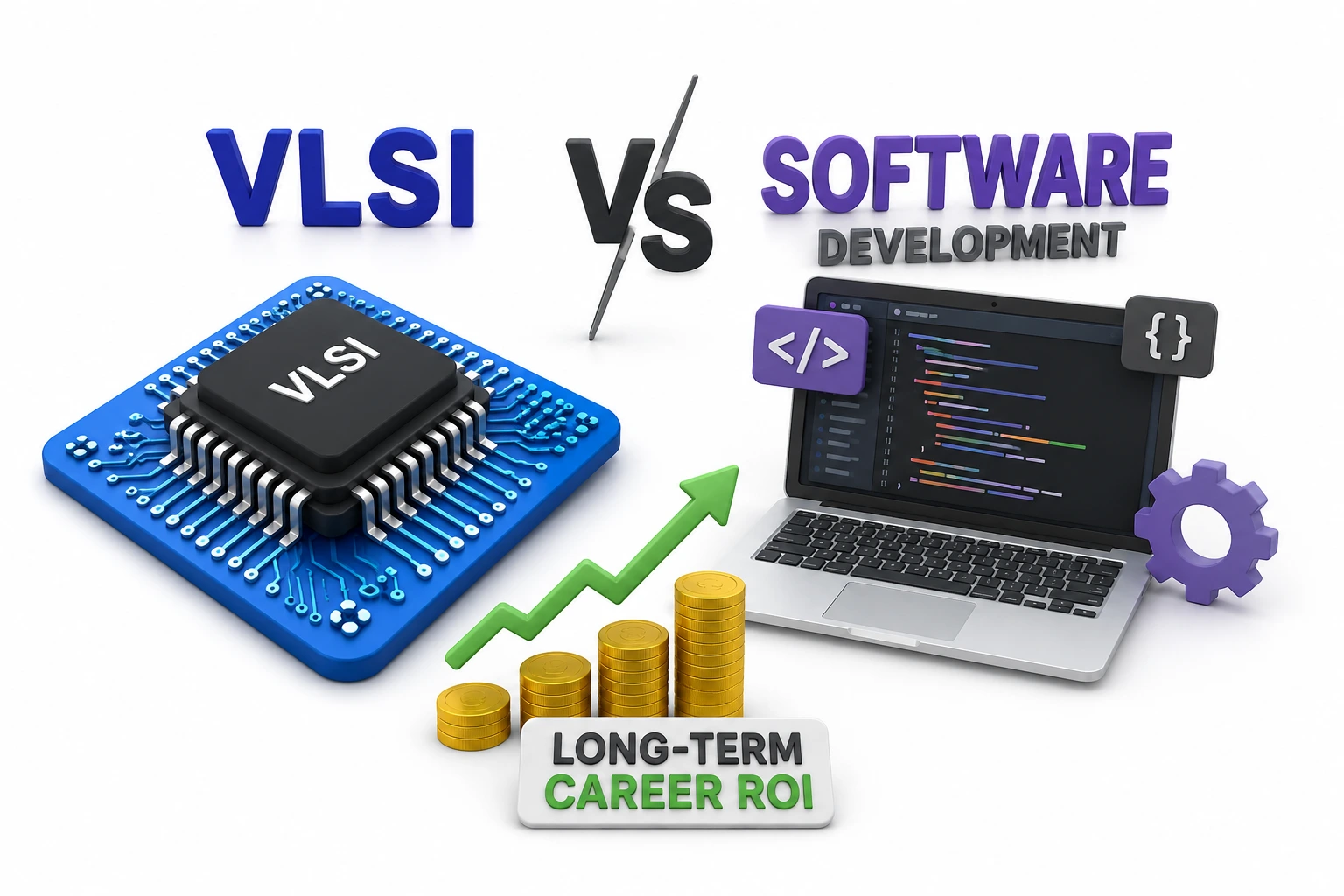
VLSI vs Software Development in Pune Which Has Better Long-Term Career ROI?
Navigate through this article using the table of contents below
Table of Contents
No headings found in this article.
Choosing between VLSI and software development looks simple until you calculate the next ten years instead of the next salary offer. Pune gives engineering graduates access to both technology ecosystems, making the decision less about hype and more about where your skills can compound.
Software offers accessibility, enormous career variety and faster entry routes. VLSI offers specialization, deeper engineering barriers and opportunities connected to the semiconductor industry. So which delivers better long-term career ROI in Pune? The answer depends on much more than starting salary.
Career ROI Is More Than Your First Salary
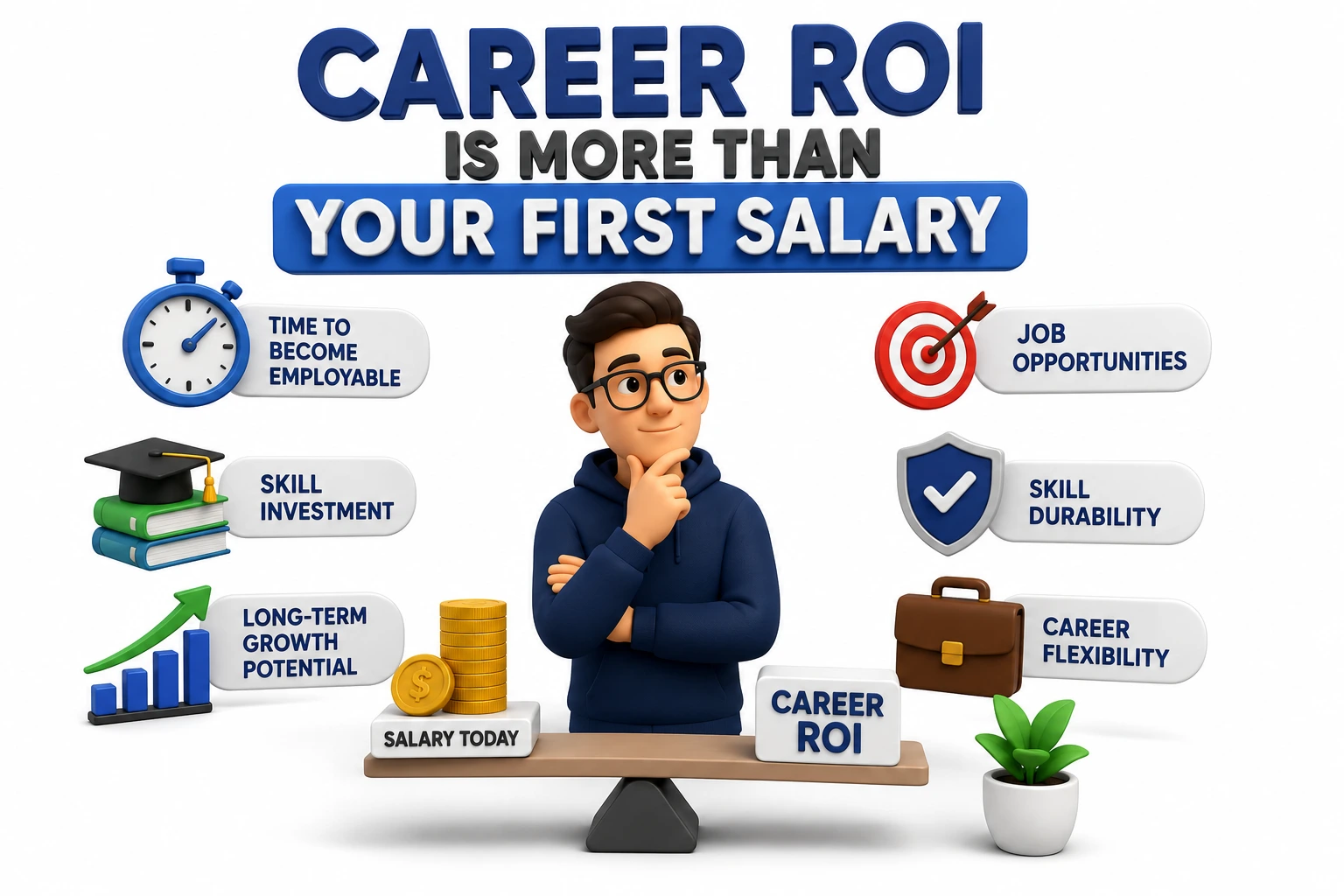
Many students define return on investment as the salary they receive immediately after training or graduation. Career ROI is broader. You are investing years of learning, practice, project work and professional development, so the real question is what those investments can produce over an entire career.
Software development generally provides a faster entry route. A student can learn programming, data structures, databases, web technologies and a development stack before targeting junior positions. VLSI normally demands stronger electronics fundamentals plus specialization in areas such as RTL design, design verification, DFT, physical design or post-silicon validation.
A useful career ROI calculation should consider:
Time required to become employable
Cost and difficulty of skill development
Number of realistic entry-level opportunities
Competition for those opportunities
Salary progression after specialization
Durability of technical knowledge
Ability to move into senior technical roles
Software can therefore deliver stronger short-term accessibility ROI, while VLSI can create attractive specialization ROI for engineers who successfully cross its higher entry barrier.
Pune Gives Software the Advantage in Opportunity Volume
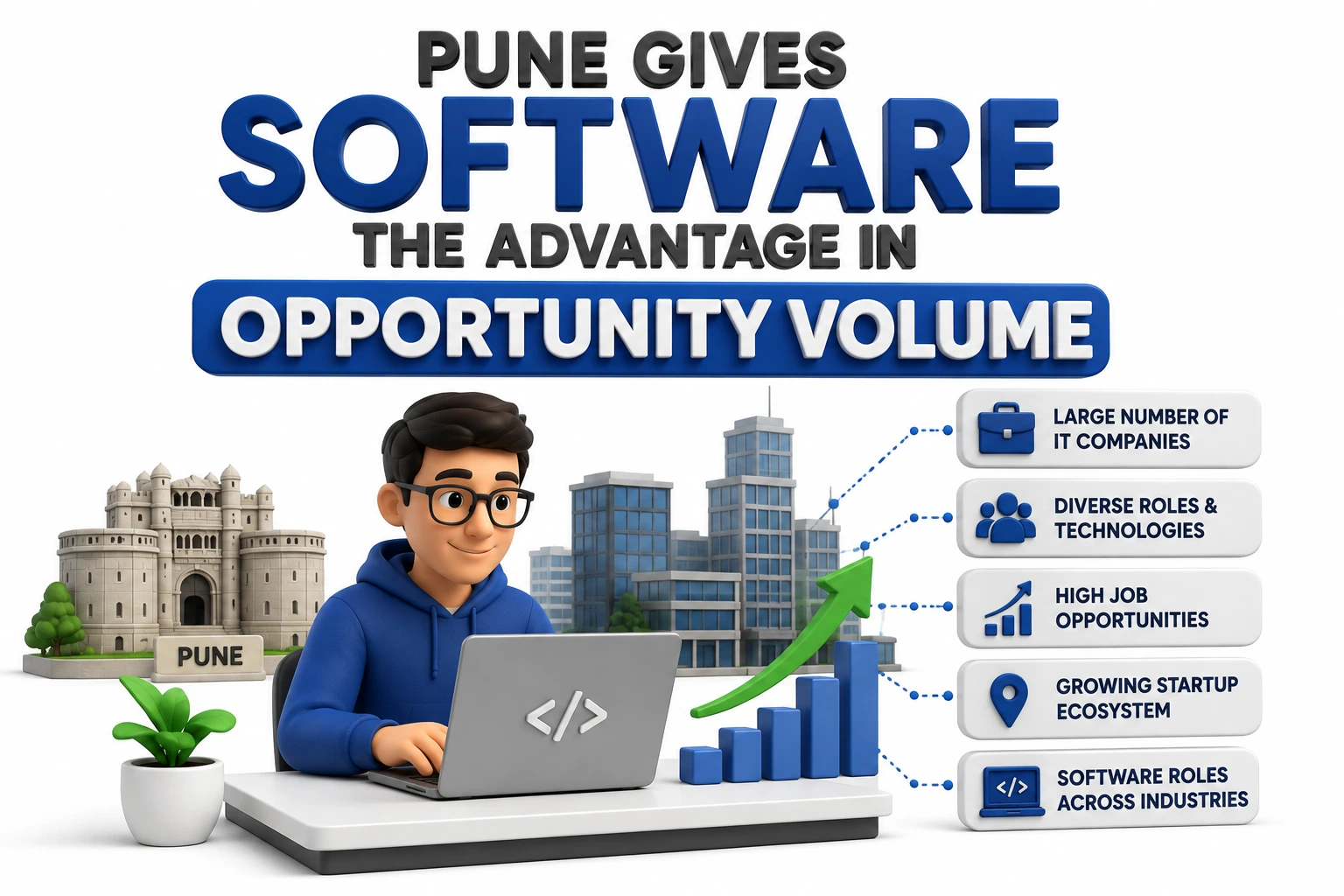
Software development remains the broader employment ecosystem. Pune has long supported IT services, enterprise technology, product engineering, automotive software, cloud platforms, data engineering and increasingly AI-related development. That diversity matters because career ROI also depends on how many alternative employers and roles are available.
Software engineers can move between backend development, full-stack engineering, DevOps, cloud, data engineering, cybersecurity and other adjacent areas. This flexibility is valuable when technologies or business conditions change.
VLSI opportunities are narrower because semiconductor engineering requires specialized teams and infrastructure. However, narrower does not automatically mean weaker. Pune currently has visible semiconductor opportunities across design verification, RTL, physical design and related engineering functions.
For an electronics graduate investigating vlsi career growth in pune, the important distinction is therefore opportunity quality versus opportunity quantity. Software gives you a larger playing field; VLSI gives you a smaller field in which advanced domain expertise can become particularly valuable.
VLSI Has a Higher Entry Barrier but Creates Deeper Specialization
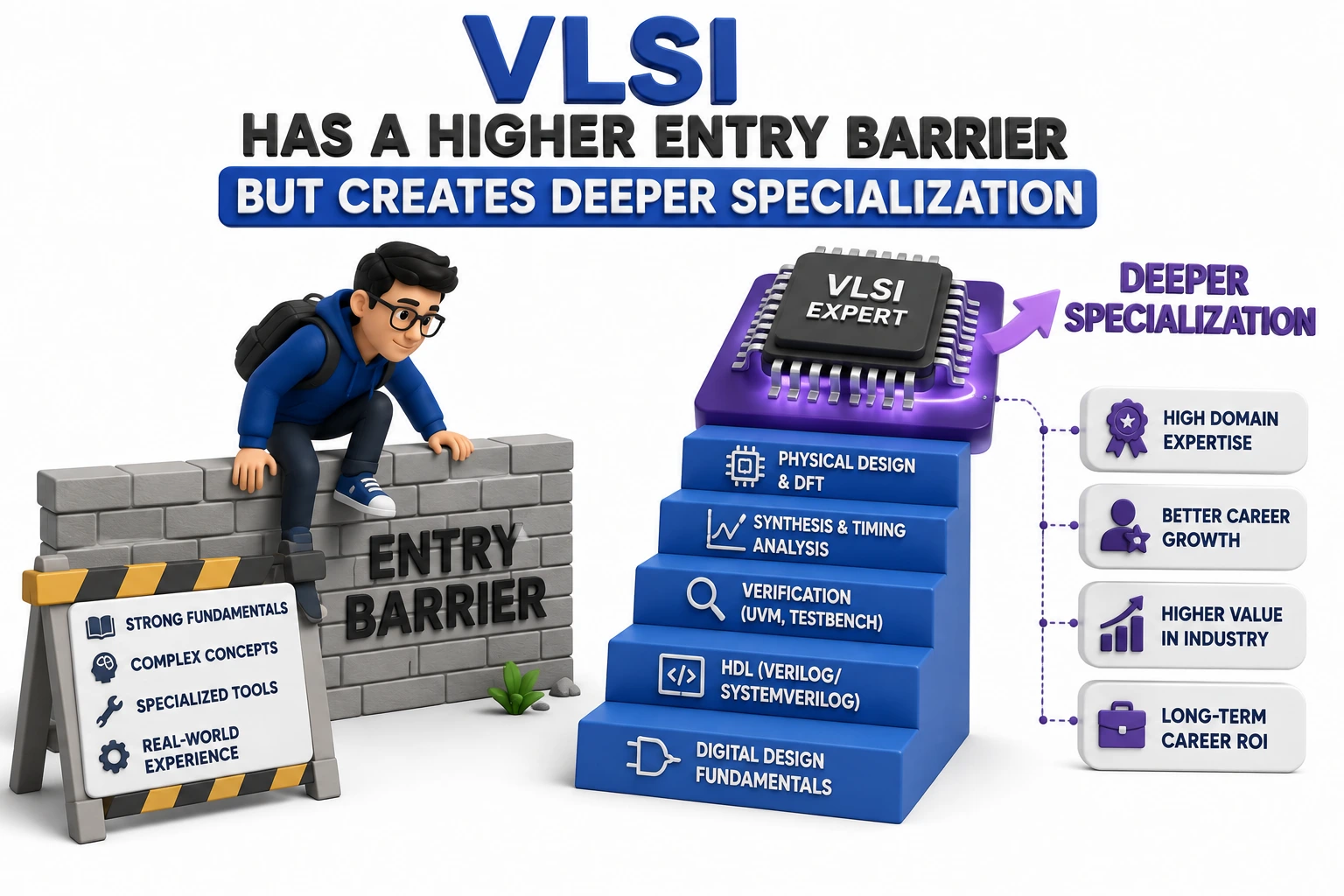
The difficulty of entering VLSI is simultaneously its disadvantage and one of its long-term strengths.
Learning Verilog syntax alone does not make someone an RTL engineer. Similarly, learning SystemVerilog classes does not automatically make someone a verification engineer. Employers need candidates who understand digital electronics, hardware behavior, timing, debugging and the consequences of design decisions.
Depending on the career track, a VLSI learner may need knowledge of:
Digital logic and computer architecture
Verilog and SystemVerilog
RTL design and synthesis
UVM and verification methodology
Static timing concepts
CMOS fundamentals
Linux and scripting
Industry EDA workflows
Debugging and project execution
This is why choosing a vlsi training institute in pune should involve examining practical labs, projects, trainer experience and domain-specific depth rather than simply comparing course duration.
Software also becomes extremely difficult at higher levels. Distributed systems, cloud architecture, security, AI infrastructure and performance engineering require substantial expertise. The difference is that software provides more beginner-level entry routes before that specialization becomes necessary.
AI Changes the ROI Equation for Both Careers
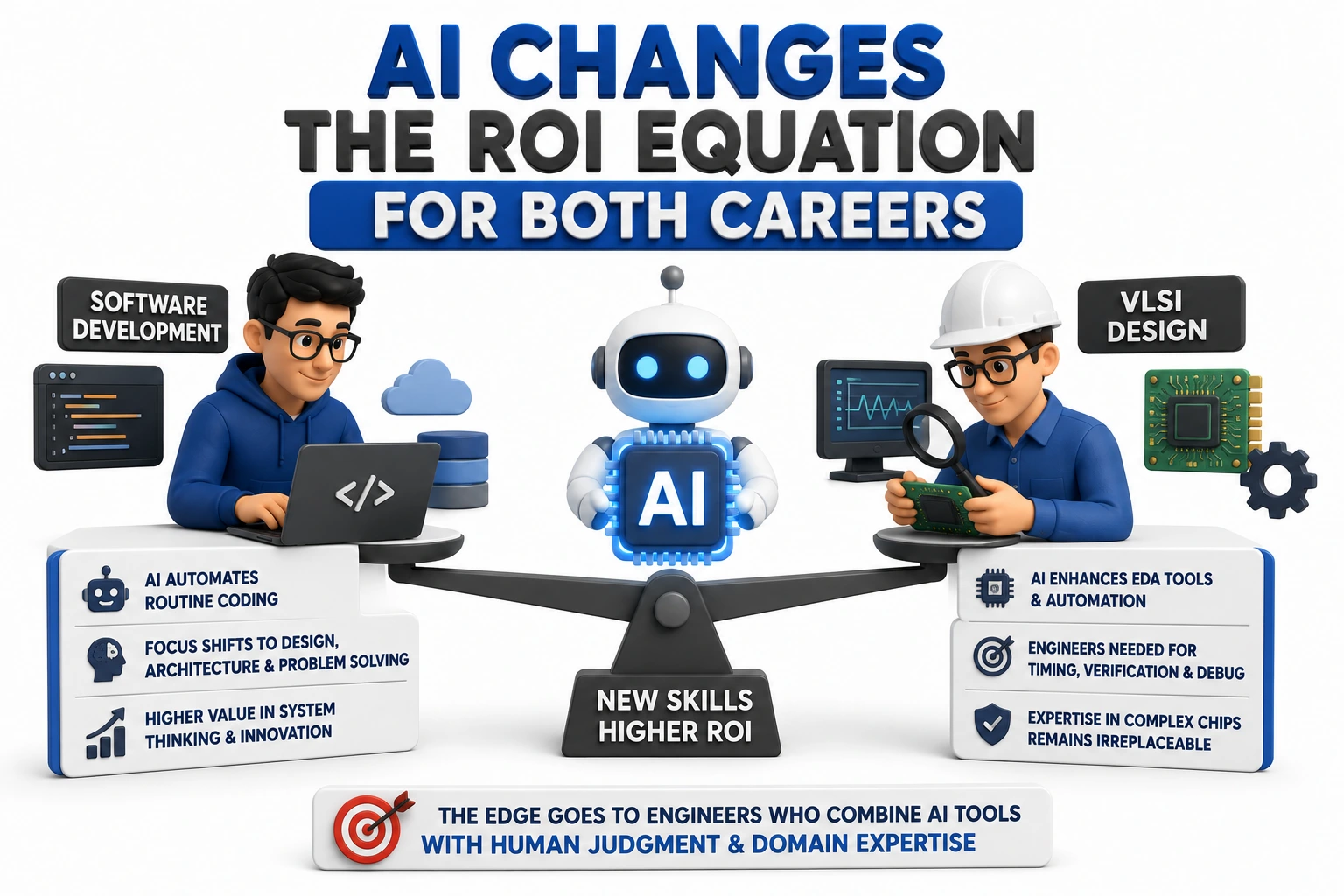
Artificial intelligence has made the VLSI-versus-software discussion more interesting in 2026. Software development is not disappearing, but the value of simply producing routine code is changing as AI coding systems become more capable. Senior software engineering increasingly emphasizes architecture, system design, problem solving and oversight rather than raw code production alone.
VLSI engineers are not protected from automation either. Semiconductor companies use increasingly sophisticated EDA automation for synthesis, verification, implementation, optimization and analysis. AI can improve these workflows, but engineers still need to understand constraints, architectures, failures and trade-offs.
The safest strategy in either career is therefore to move toward engineering judgment.
For software, that means progressing beyond syntax into systems, architecture, security, performance and AI-assisted development. For VLSI, it means moving beyond tools into timing, verification strategy, architecture, design constraints and debugging.
Students evaluating a vlsi class in pune should consequently ask how much engineering problem-solving they will actually perform instead of focusing only on software-tool exposure.
Skill Durability Can Give VLSI an Attractive Long-Term Return
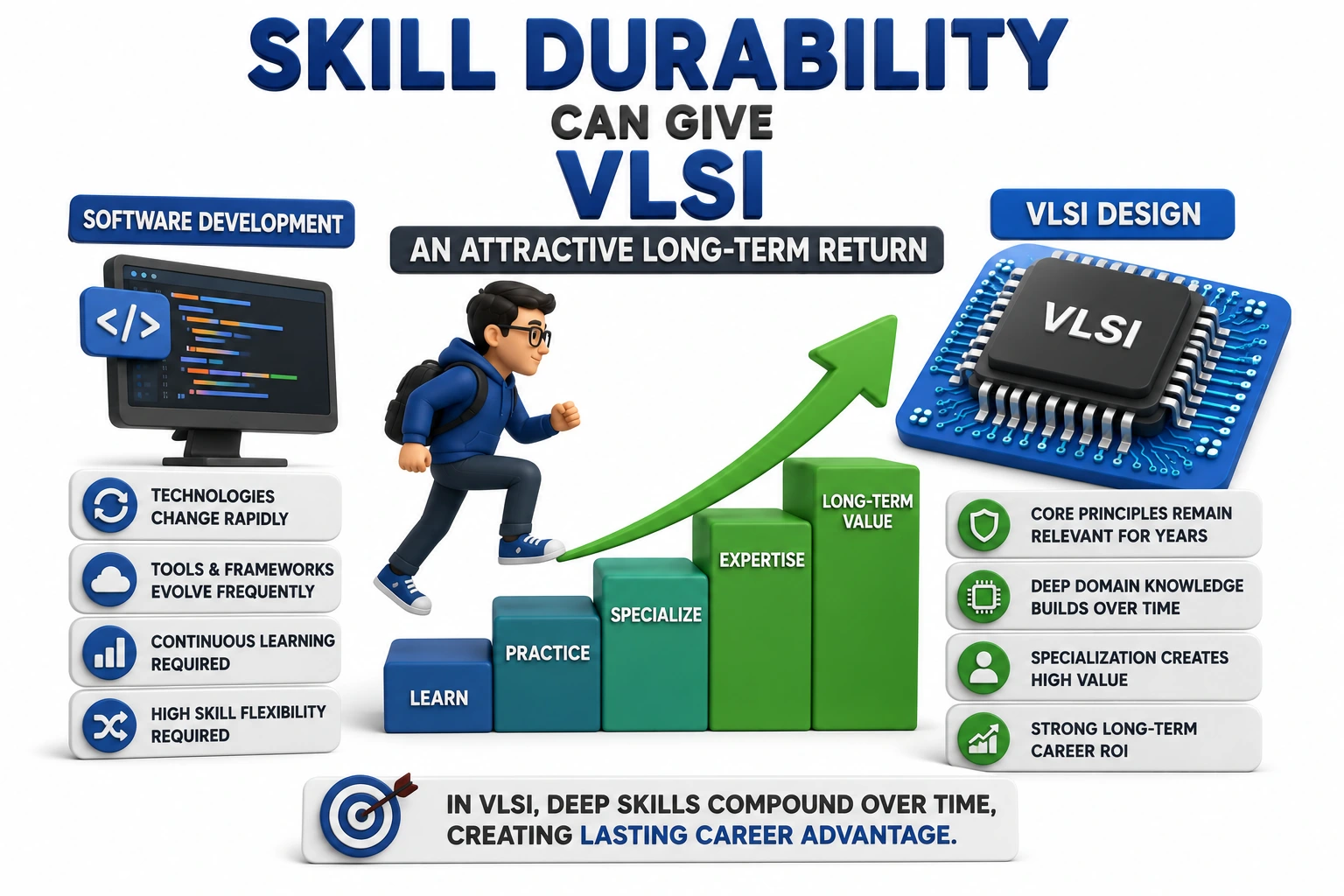
Software technologies can change rapidly. A framework that dominates today's hiring market may become less important several years later. However, foundational software concepts such as algorithms, databases, networking, operating systems and system architecture remain highly transferable.
VLSI has a different learning cycle. Digital design, timing, semiconductor fundamentals and hardware architecture evolve, but core engineering principles tend to remain relevant for long periods. Engineers usually build deeper specialization as their careers progress.
This creates an important ROI distinction.
A software developer may benefit from breadth and mobility, moving rapidly between technologies and industries. A VLSI engineer may benefit from depth and scarcity, accumulating domain knowledge that becomes difficult for newcomers to replicate quickly.
That does not mean every VLSI engineer will outperform every software developer financially. Top software engineers can achieve exceptional compensation, while poorly developed VLSI skills can limit opportunities. Recent salary comparisons also show wide ranges depending on employer tier, experience and specialization rather than one guaranteed outcome for either profession.
Your Engineering Personality Should Decide the Final ROI
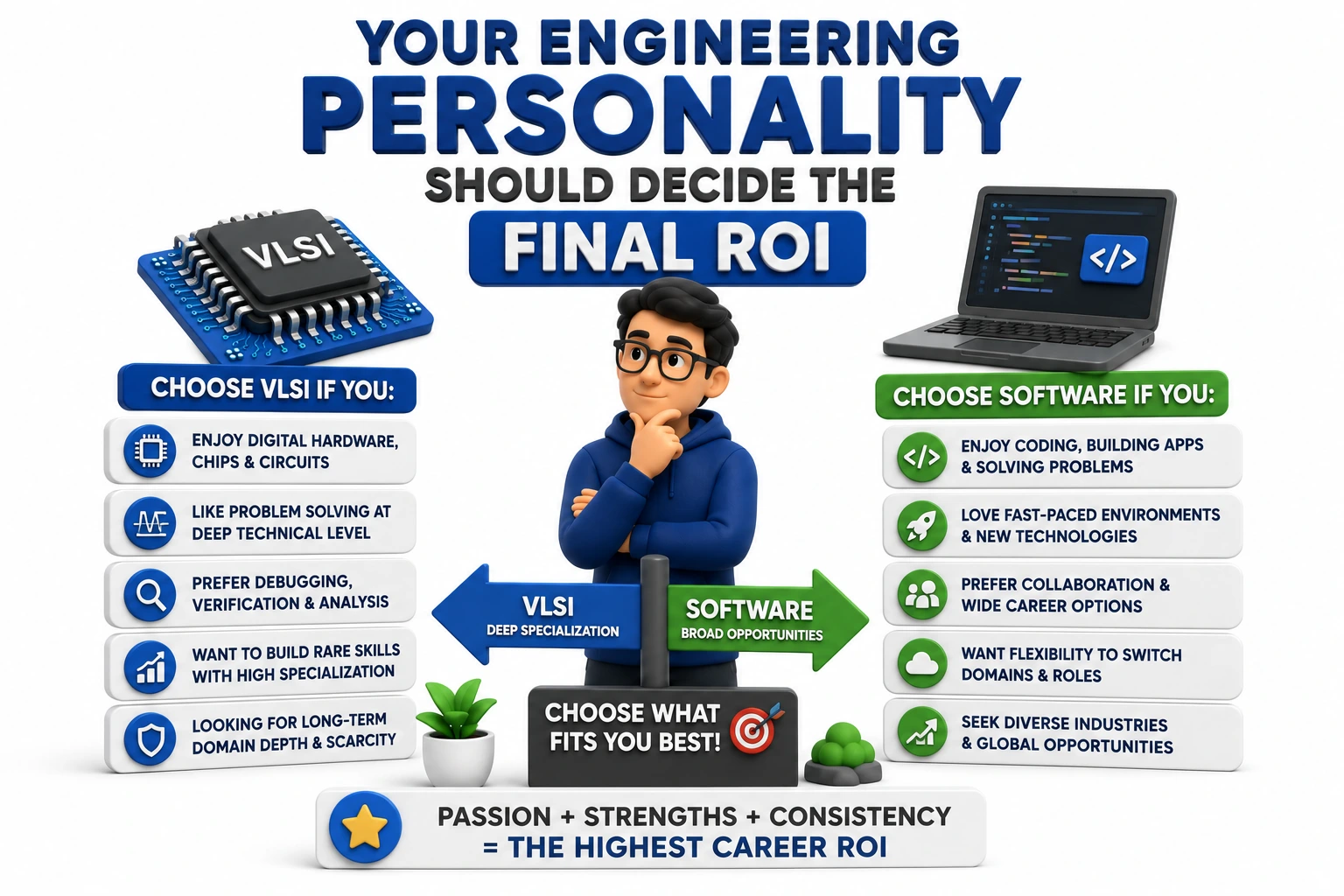
The career producing the highest theoretical salary is irrelevant if you dislike the work required to become excellent at it.
Choose software development if you enjoy programming, algorithms, application development, rapid experimentation and continuously changing technology stacks. It can also be attractive if career mobility and a wider range of employers are major priorities.
Consider VLSI if digital hardware, processors, semiconductor technology, RTL, verification or chip implementation genuinely interests you. Electronics and ECE graduates can particularly benefit from converting their academic foundation into specialized industry skills.
Before joining vlsi coaching in pune, students should identify the actual role they want to pursue instead of treating “VLSI” as one job. RTL design, verification, DFT, physical design and validation require different combinations of skills.
Training providers such as JastTech can be evaluated on this same principle: look at whether the learning path develops fundamentals, domain-specific knowledge, practical projects, debugging ability and interview readiness rather than judging a program only by certificates or tool names.
Conclusion
There is no universal winner between VLSI and software development in Pune. Software currently provides the stronger advantage in opportunity volume, career flexibility and ease of entering different technology domains. For someone who enjoys software engineering and continuously upgrading technical skills, its long-term ROI can be excellent.
VLSI offers a different investment proposition: higher entry difficulty, fewer roles and a steeper learning curve, but deeper specialization and the possibility of building valuable semiconductor expertise over time. For an electronics engineer genuinely interested in hardware, that specialization can produce compelling long-term ROI. The smartest choice is therefore not VLSI versus software, but which field you are capable of becoming exceptionally good at for the next decade.