

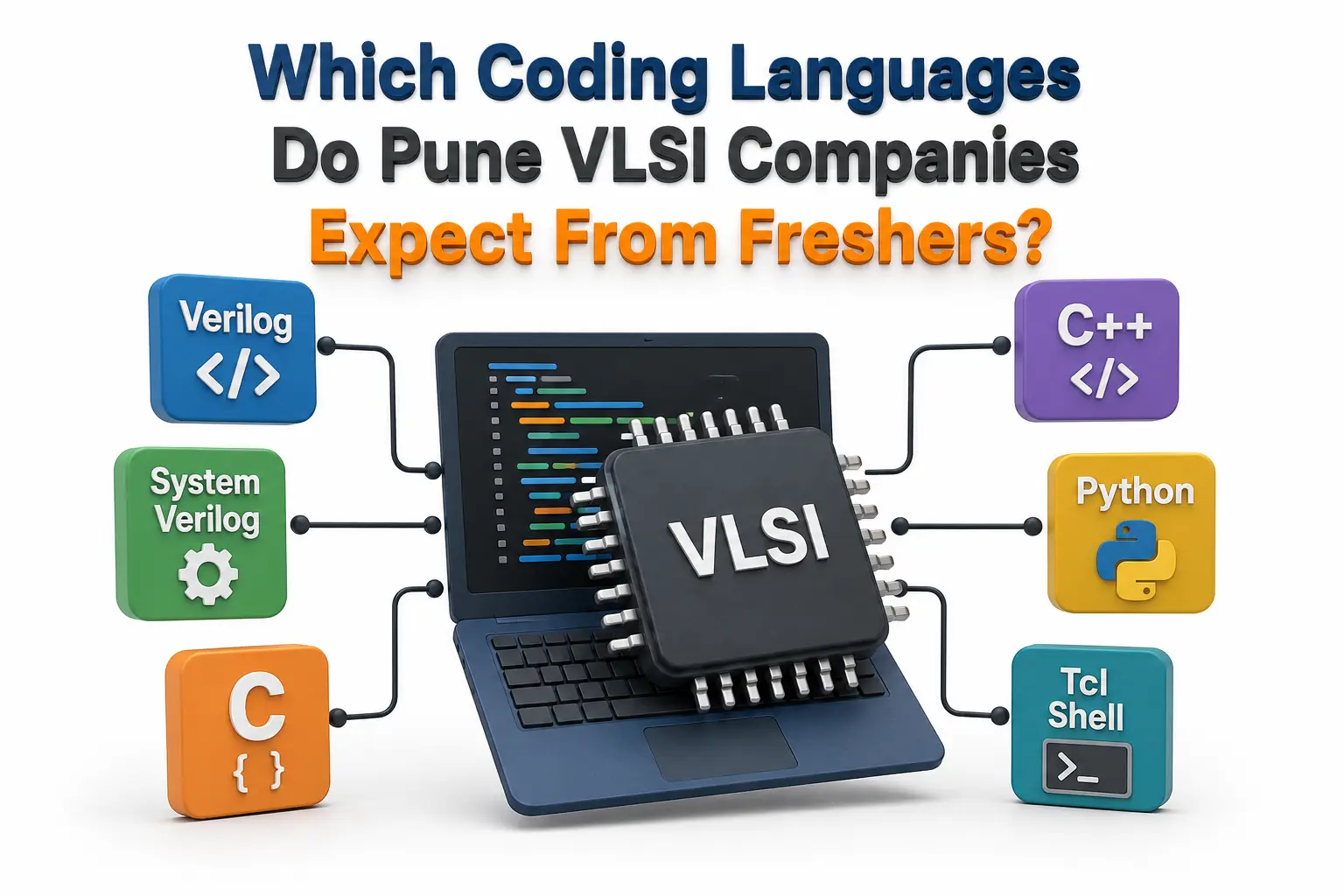
Which Coding Languages Do Pune VLSI Companies Expect From Freshers?
Navigate through this article using the table of contents below
Table of Contents
No headings found in this article.
Pune’s semiconductor ecosystem is creating opportunities for electronics graduates, but knowing digital electronics alone rarely makes a fresher job-ready. Employers increasingly expect candidates to translate hardware concepts into RTL, verification environments, automation scripts, or embedded code.
The confusing part is deciding what to learn first. Verilog, SystemVerilog, C, C++, Python, Tcl, and Shell can all appear around VLSI roles, but they serve very different purposes. The smartest learning path depends on whether you want RTL design, verification, physical design, or validation.
Verilog Builds the Foundation for RTL Design
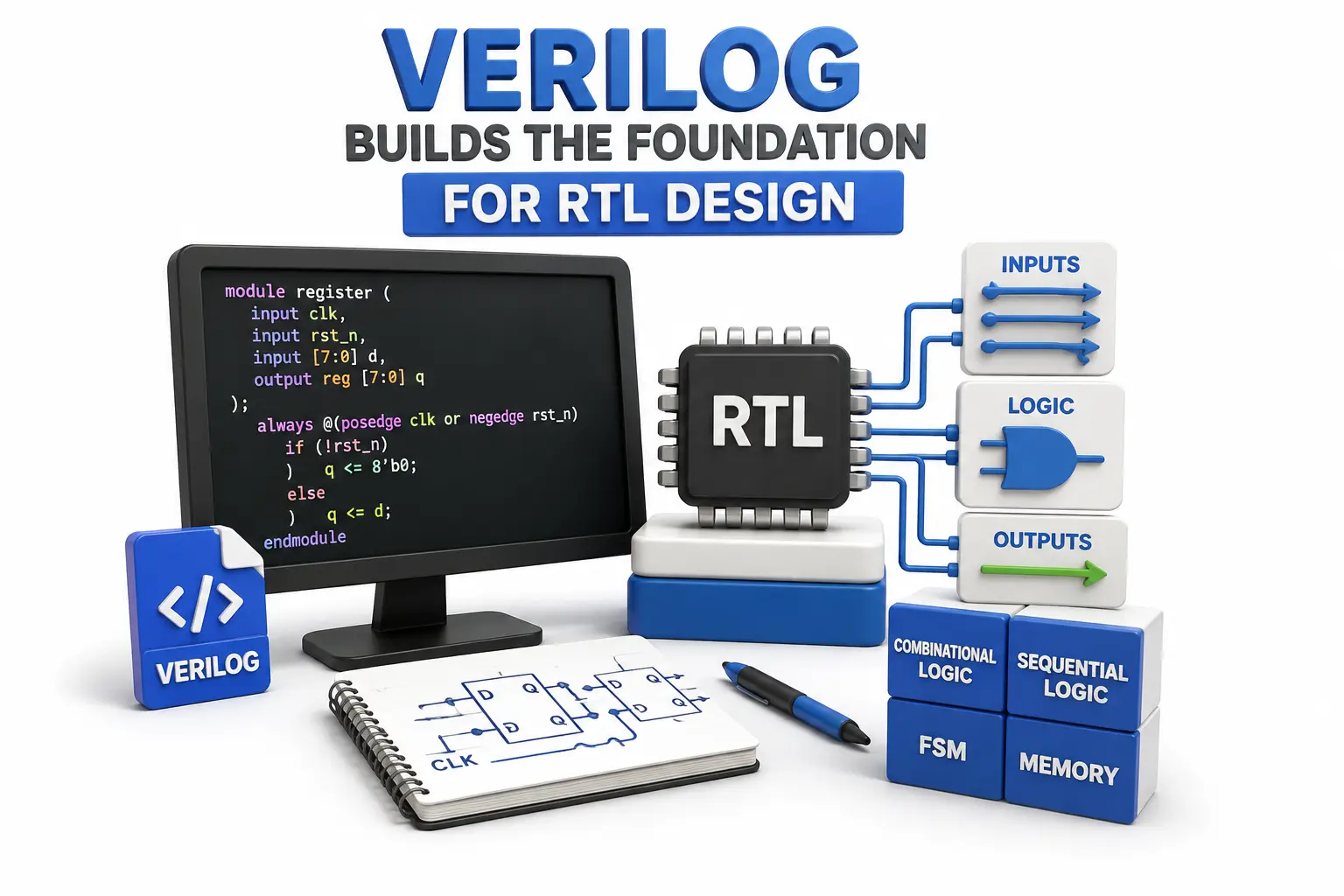
For freshers targeting digital VLSI roles, Verilog remains one of the most useful starting points. It teaches you to describe hardware behavior rather than think like a conventional software developer. A candidate should understand how RTL represents combinational and sequential circuits.
Knowing syntax alone is not enough. Pune employers can evaluate whether you understand what your code becomes in hardware. You should be comfortable with:
Combinational and sequential logic
Blocking versus non-blocking assignments
Registers, counters and shift registers
Finite-state machines
Memories and basic interfaces
Synthesizable versus non-synthesizable constructs
Testbenches and simulation
Common RTL coding mistakes
A good fresher project might involve designing and simulating a FIFO, UART, ALU, SPI controller or small processor block. Such projects give you something concrete to discuss during interviews and demonstrate that you can move from specification to RTL and debugging.
SystemVerilog Is Critical for Modern Verification Roles
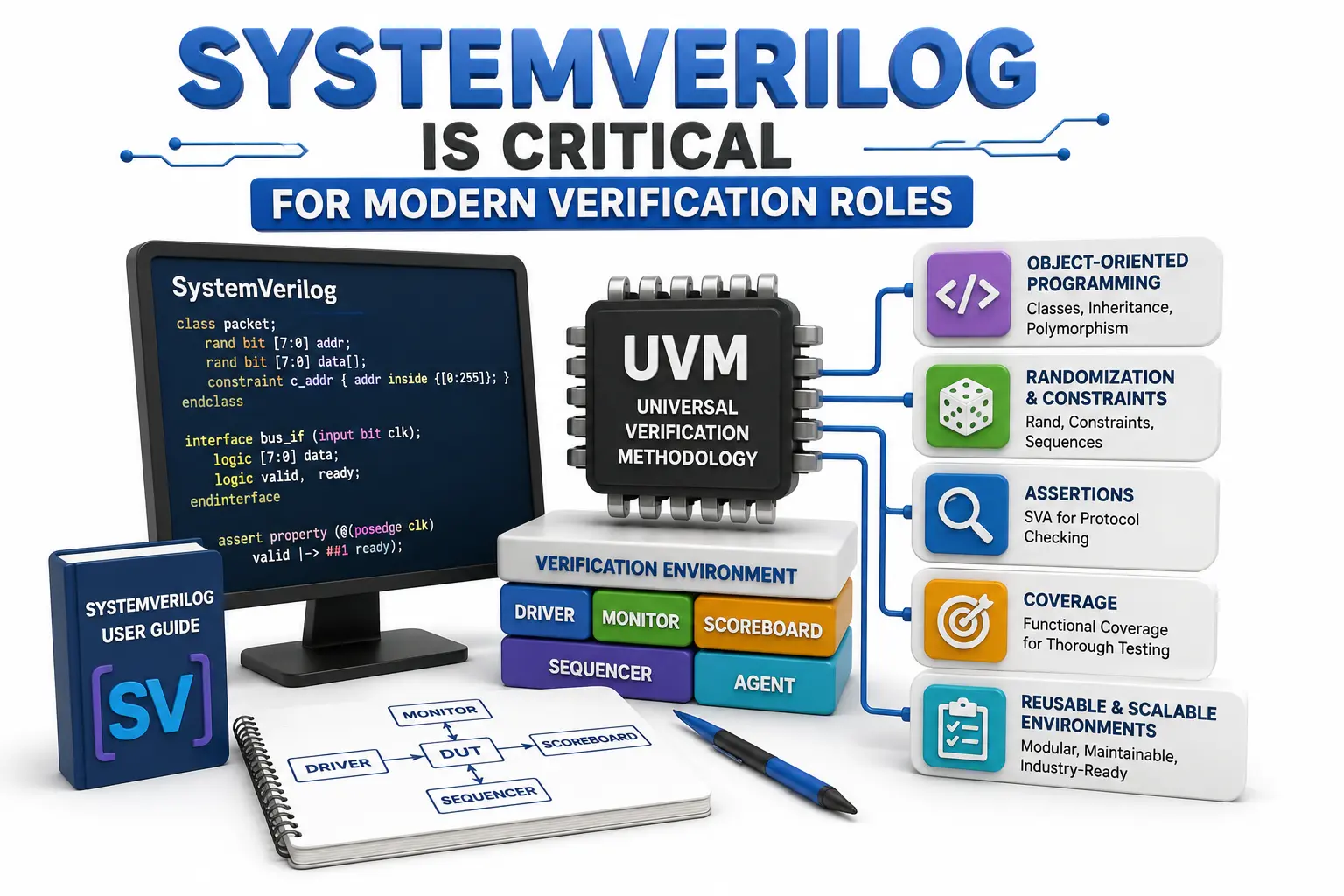
Verilog provides the foundation, but SystemVerilog becomes particularly important when you move toward design verification. Modern verification requires much more than applying inputs and checking outputs manually. Engineers build reusable environments capable of generating scenarios, monitoring interfaces and finding corner-case bugs.
Freshers interested in verification should understand SystemVerilog concepts such as classes, interfaces, packages, randomization, constraints, assertions and functional coverage. Object-oriented programming is especially important because modern verification environments depend heavily on reusable components.
UVM should come after this foundation. It is a verification methodology built around SystemVerilog rather than a separate programming language. A sensible learning sequence is:
Digital design fundamentals
Verilog and RTL coding
SystemVerilog
Object-oriented programming concepts
Assertions and functional coverage
UVM architecture
Small verification projects
This progression is more useful than memorizing UVM components without understanding SystemVerilog. Freshers who can explain why a monitor, driver, scoreboard or sequence exists generally demonstrate stronger practical understanding.
C and C++ Connect Hardware With Software
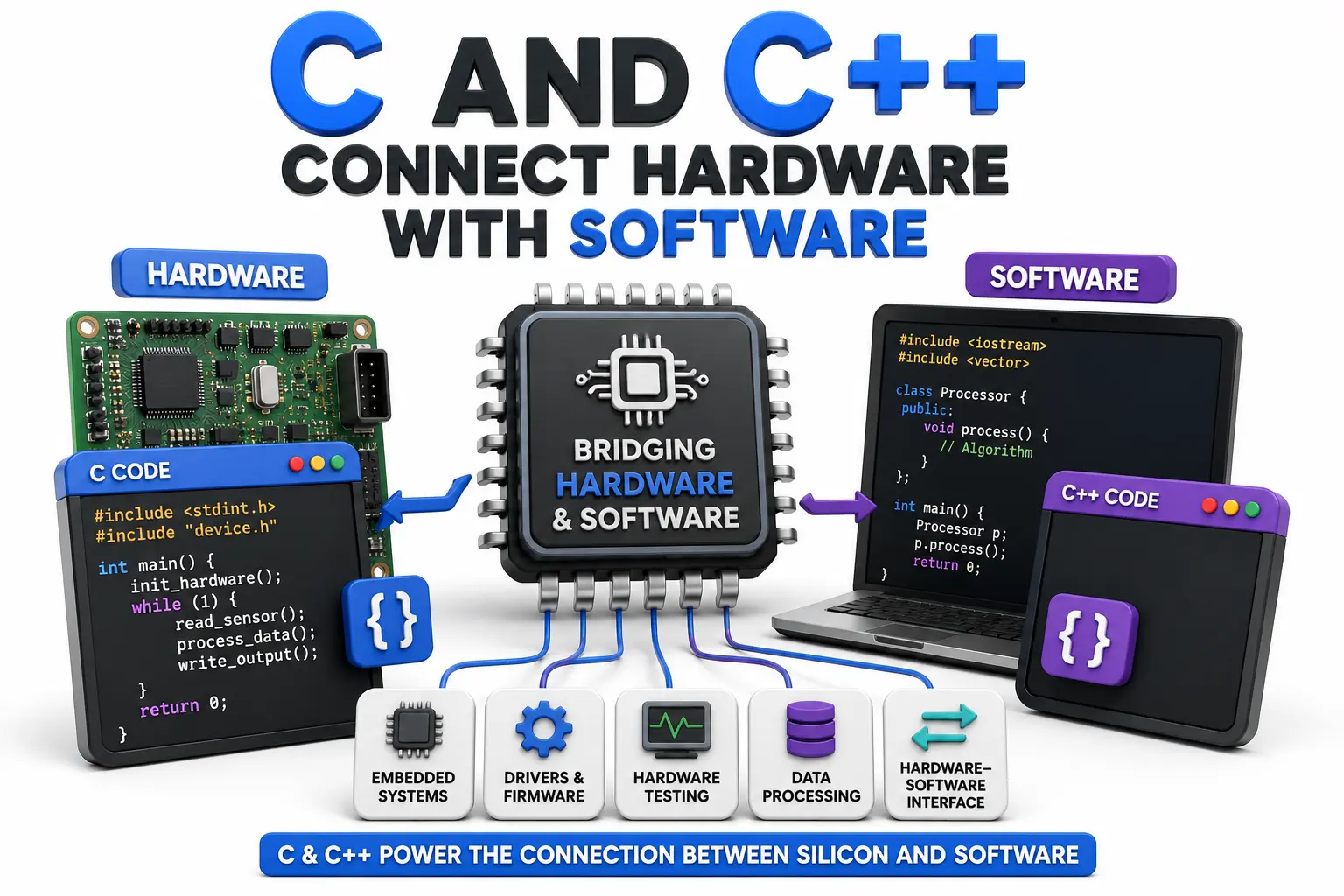
C remains relevant because semiconductor products do not operate as isolated RTL blocks. SoCs include processors, memories, controllers, firmware and peripherals. Engineers working around embedded systems, validation and hardware-software integration therefore benefit from solid C programming knowledge.
Freshers should focus on concepts that connect naturally with hardware: pointers, arrays, structures, bitwise operators, memory handling and debugging. C can become particularly valuable for firmware-oriented testing and post-silicon validation.
C++ becomes more relevant in areas involving object-oriented programming, system-level modeling and sophisticated verification environments. You do not necessarily need advanced software-development expertise for every entry-level VLSI position, but understanding classes, inheritance, polymorphism and data structures can strengthen your profile.
When comparing Programming Languages for VLSI, the important lesson is that there is no universal winner. Verilog and SystemVerilog describe and verify hardware, while C and C++ become valuable when hardware must interact with firmware, models or software-driven validation.
Python, Tcl and Shell Turn Repetitive Work Into Automation
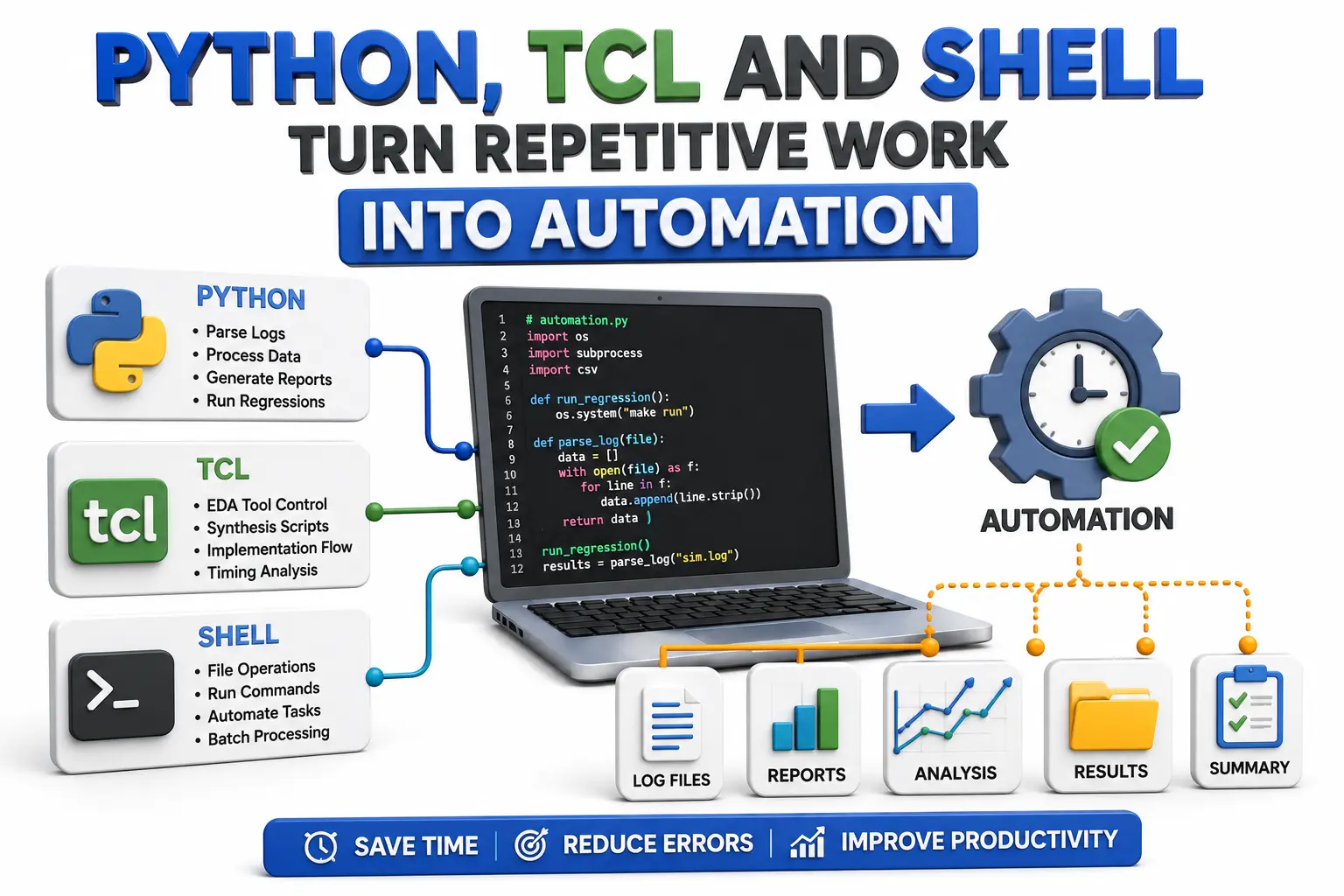
A major mistake is assuming scripting is only for experienced engineers. Semiconductor projects generate simulation logs, regressions, reports, timing data and repetitive tool commands. Automating these operations can save substantial engineering time.
Python has become particularly useful because it is readable and versatile. A fresher does not need to become a Python application developer. Instead, learn practical automation:
Reading and writing files
Parsing simulation logs
Regular expressions
Processing CSV or text reports
Running external commands
Organizing regression results
Creating small engineering utilities
Tcl is another important language because many EDA workflows expose Tcl interfaces. It is especially useful around synthesis, implementation, timing and physical-design tools. Shell scripting complements these skills because Linux-based environments are common across semiconductor engineering.
Perl may still appear in established flows and legacy automation, but freshers generally gain more immediate value by building confidence with Python, Tcl and Linux Shell before expanding further.
The Best Language Depends on Your VLSI Career Track
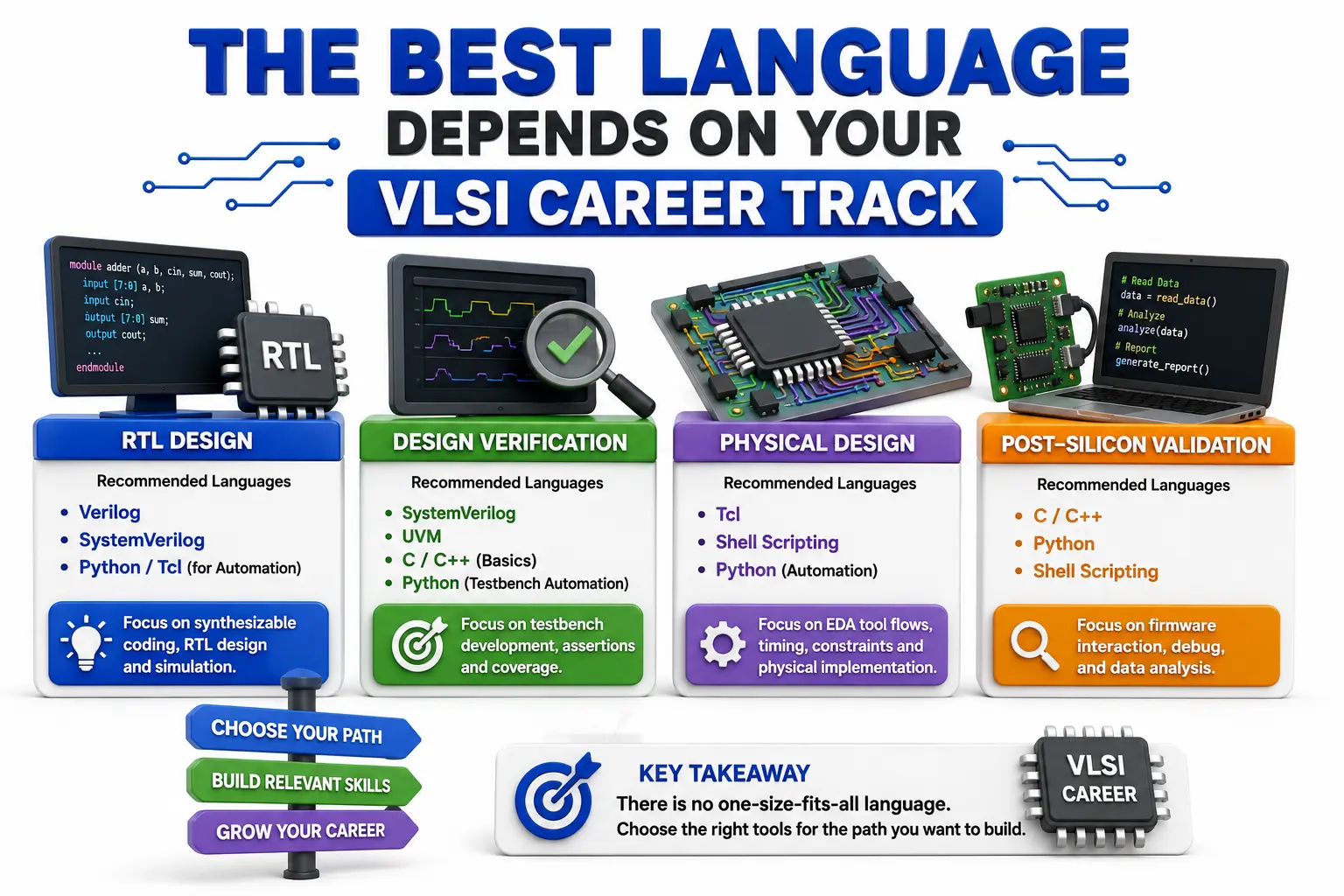
Students often search for the Best programming language for VLSI engineering, but the better question is: which languages support the role you want?
For RTL design, prioritize Verilog/SystemVerilog, digital design and synthesizable coding. Python or Tcl can then support automation.
For design verification, prioritize SystemVerilog, assertions and UVM. Basic C/C++ and Python can improve your ability to handle software interaction and automation.
For physical design, deep RTL coding may be less central than understanding digital design, timing and implementation flows. Tcl and Shell become particularly valuable because backend engineers frequently interact with EDA tools through commands and scripts.
For post-silicon validation, C/C++, Python and scripting can become highly relevant alongside hardware debugging knowledge. These engineers often operate where silicon, firmware, test equipment and software meet.
This role-based approach prevents freshers from collecting languages without developing depth. Employers are more interested in whether you can use a language to solve an engineering problem than whether you can list seven languages on your resume.
Build Your Pune VLSI Learning Roadmap Around Practical Projects
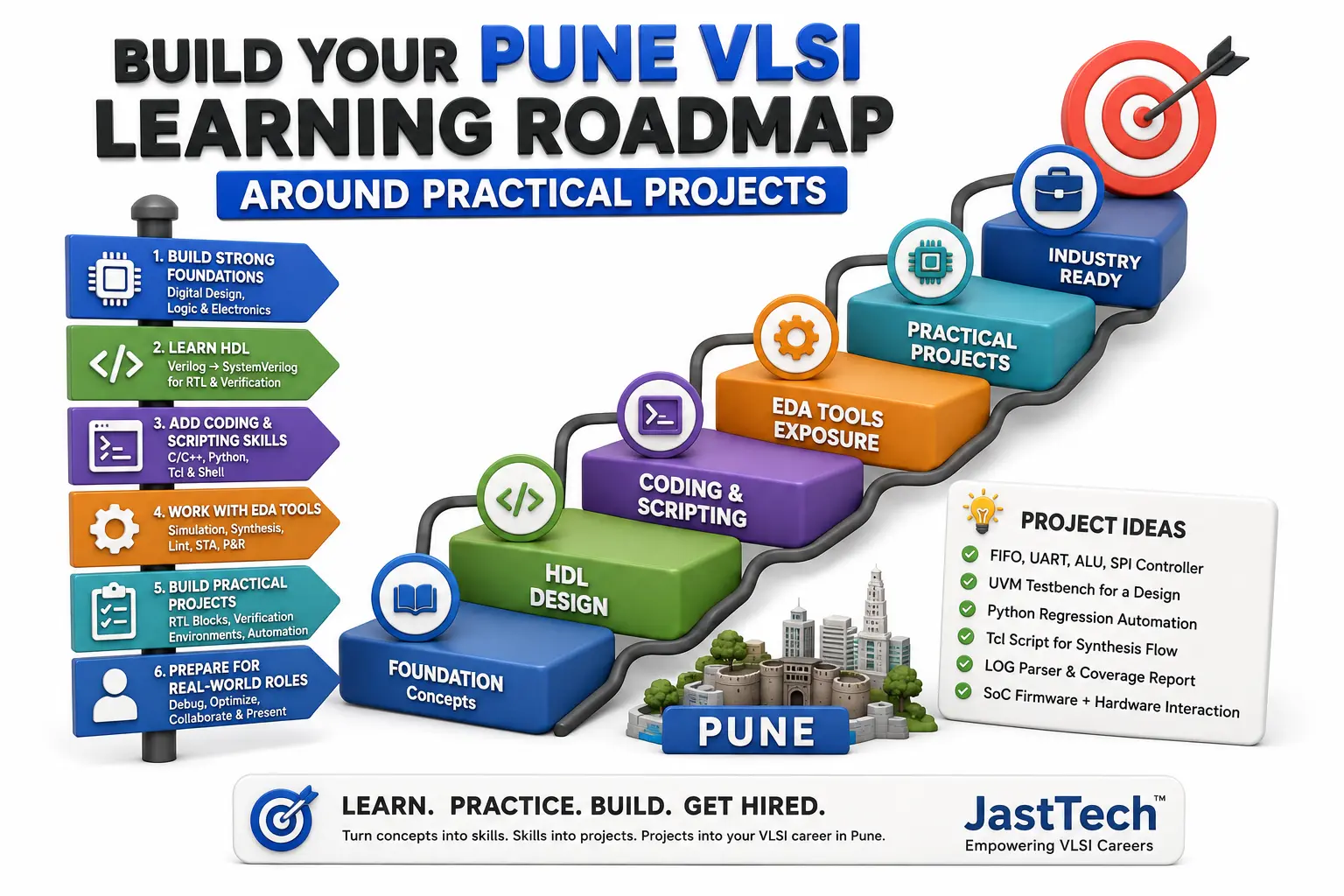
The most effective preparation strategy is to learn languages in stages instead of attempting everything simultaneously. Start with digital electronics and Verilog. Build RTL blocks, simulate them and deliberately debug errors. Then specialize according to the career path you want.
For example, a verification aspirant could design a small RTL module, create a SystemVerilog testbench, add assertions and functional coverage, and eventually develop a UVM environment. A physical-design aspirant could strengthen RTL understanding and then develop Tcl scripts that automate common flow operations.
Students considering a vlsi course in Pune should therefore examine the practical curriculum rather than judging training only by the number of languages mentioned. Look for hands-on RTL coding, SystemVerilog verification, scripting, Linux usage, EDA-tool exposure, debugging exercises and projects that can be explained confidently during interviews.
JastTech can support this industry-oriented approach by helping learners connect theoretical VLSI concepts with practical design and verification skills. The objective should be job readiness: understanding why code is written, how tools interpret it, what failures mean and how to debug them systematically.
Conclusion
Pune VLSI companies do not expect every fresher to master every coding language. What matters more is having the right combination for a chosen domain. Verilog builds RTL foundations, SystemVerilog supports modern verification, C/C++ bridges hardware and software, while Python, Tcl and Shell strengthen automation and EDA workflows.
Instead of building a resume filled with language names, build evidence of engineering ability. Write RTL, simulate designs, create testbenches, automate repetitive tasks and debug your own mistakes. A smaller skill set demonstrated through strong projects can make a much better impression than superficial knowledge of many technologies.