

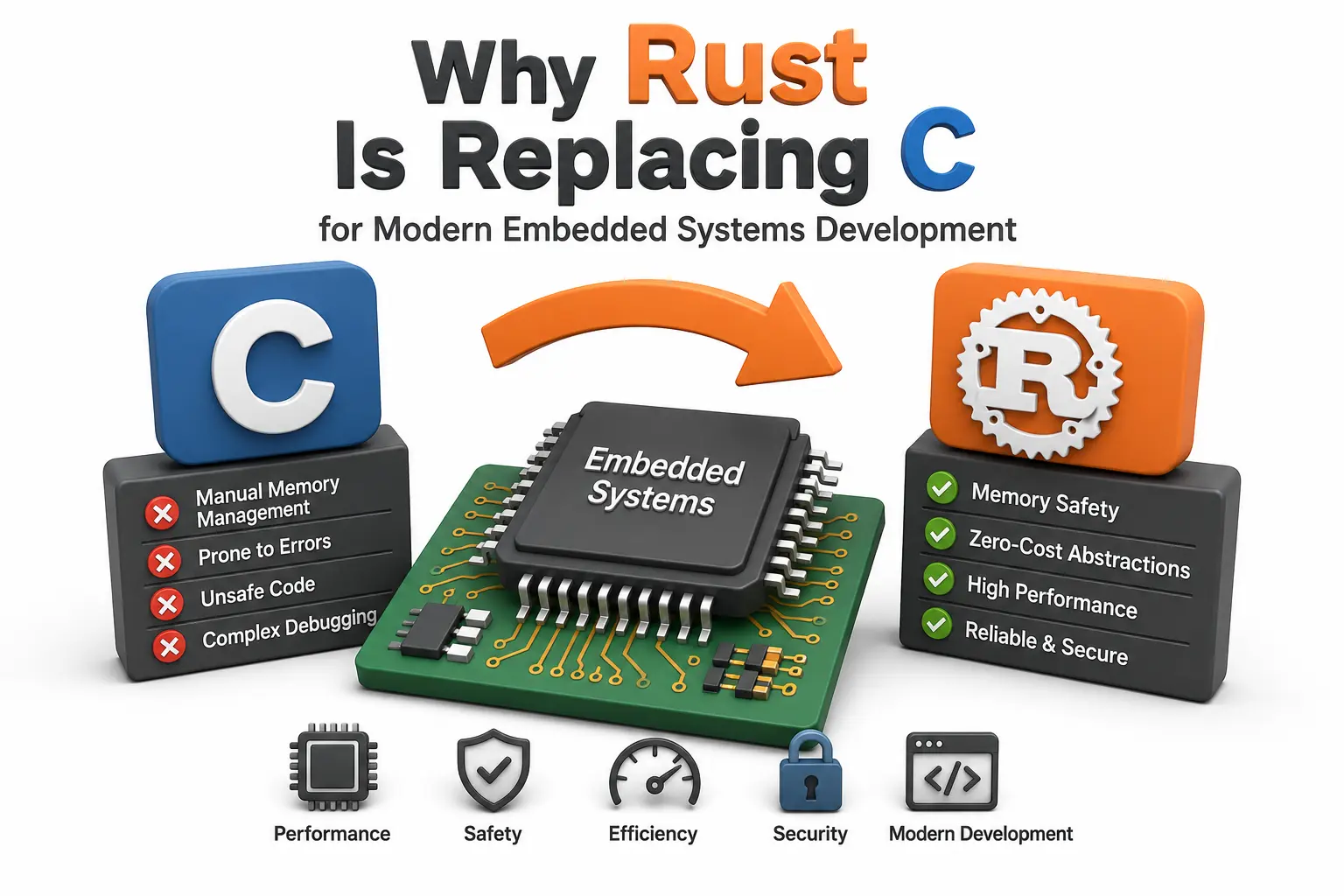
Why Rust Is Replacing C for Modern Embedded Systems Development
Navigate through this article using the table of contents below
Table of Contents
No headings found in this article.
C has dominated embedded firmware for decades because it offers direct hardware access, predictable performance, small binaries, and an enormous ecosystem. But modern firmware is becoming more complex, connected, and security-sensitive.
That creates a difficult question: can engineers keep C's hardware-level control while reducing the memory errors that have traditionally made embedded software difficult to secure and maintain? Rust is emerging as one of the strongest answers.
Why Embedded Development Is Moving Beyond Traditional C
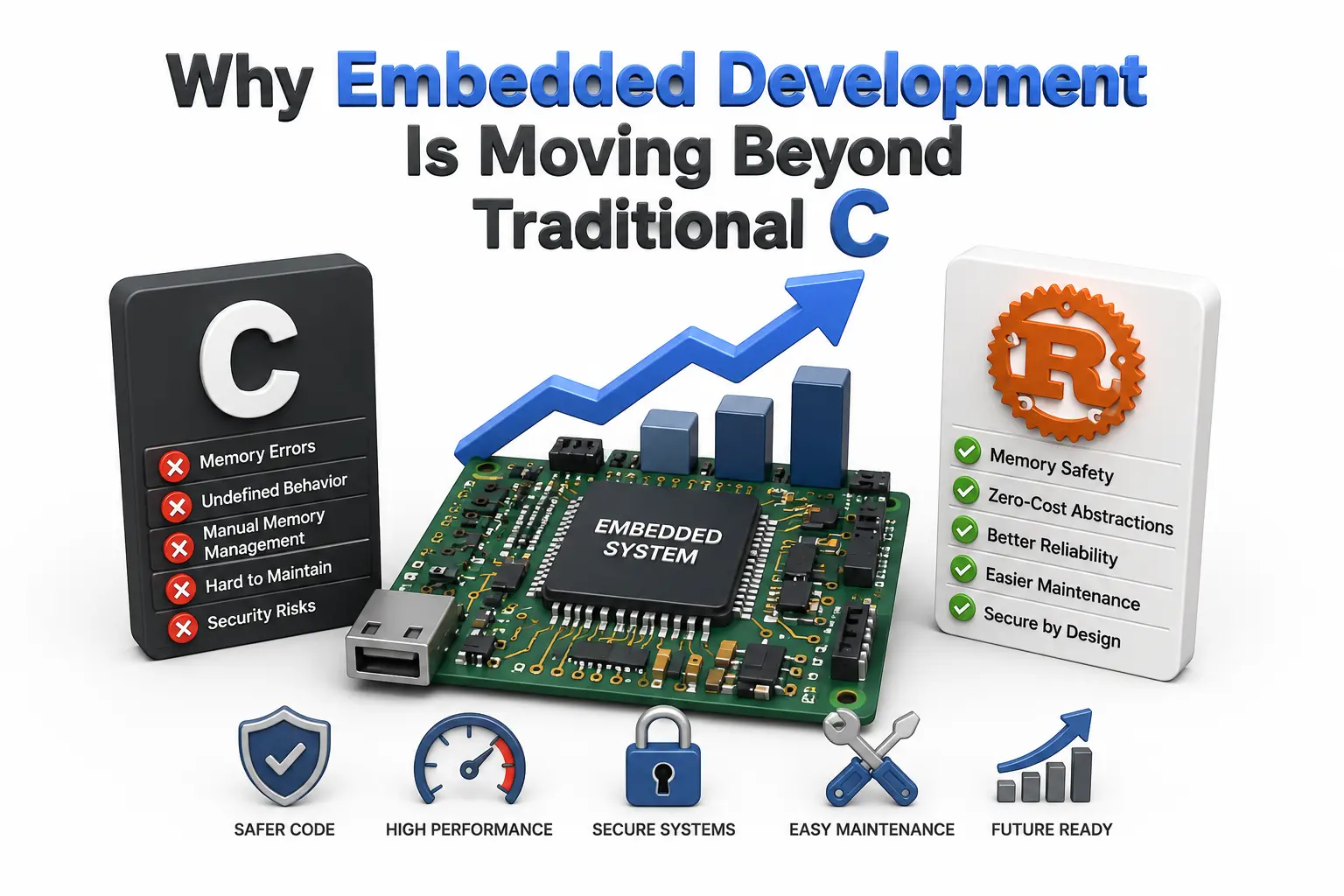
C remains extremely capable, but its flexibility also places substantial responsibility on developers. Pointer arithmetic, manual memory management, buffer handling, and undefined behavior can introduce defects that are difficult to detect during development.
In a small firmware project, one mistake may cause a crash. In connected devices, automotive controllers, industrial equipment, or safety-sensitive products, the consequences can be significantly larger.
Rust approaches the problem differently by enforcing many correctness rules during compilation.
Key advantages include:
Ownership and borrowing rules for memory management.
Compile-time detection of many invalid memory accesses.
Strong type checking.
Reduced dependence on manual resource management.
Concurrency guarantees that help prevent certain data races.
This does not make Rust automatically bug-free. Developers can still write incorrect logic and can deliberately use unsafe code. The difference is that the language makes many classes of programming mistakes harder to express accidentally.
Rust Can Deliver C-Like Embedded Performance
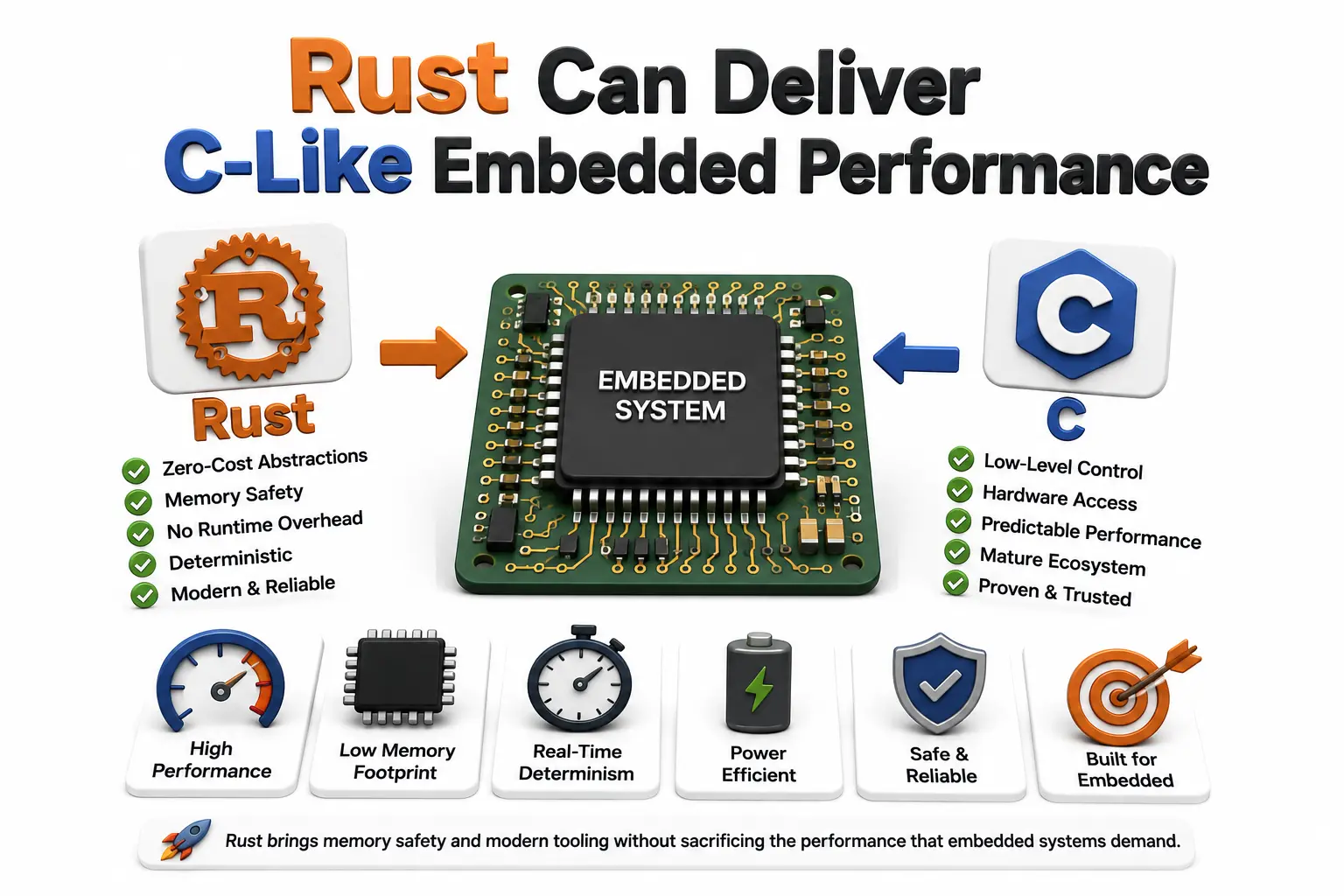
One reason C became dominant in embedded systems is performance. Firmware frequently operates with limited RAM, flash, CPU cycles, and power, so developers cannot simply choose a language based on developer convenience.
Rust was designed as a systems programming language rather than a garbage-collected application language. It therefore fits environments where predictable resource usage matters.
Modern embedded Rust can operate with:
No operating system.
No conventional heap allocation.
Hardware-specific memory layouts.
Interrupt-driven applications.
Direct peripheral access.
Deterministic control over resources.
Recent experimental work comparing equivalent C and Rust implementations on microcontrollers found no strong reason to choose C purely because of memory footprint or execution speed. That is important because it challenges the assumption that adopting Rust necessarily means accepting a performance penalty.
For engineers evaluating Why Rust Is Replacing C for Modern Embedded Systems Development, the key point is that safety and performance are no longer mutually exclusive choices.
The Rust Embedded Ecosystem Is Becoming More Practical
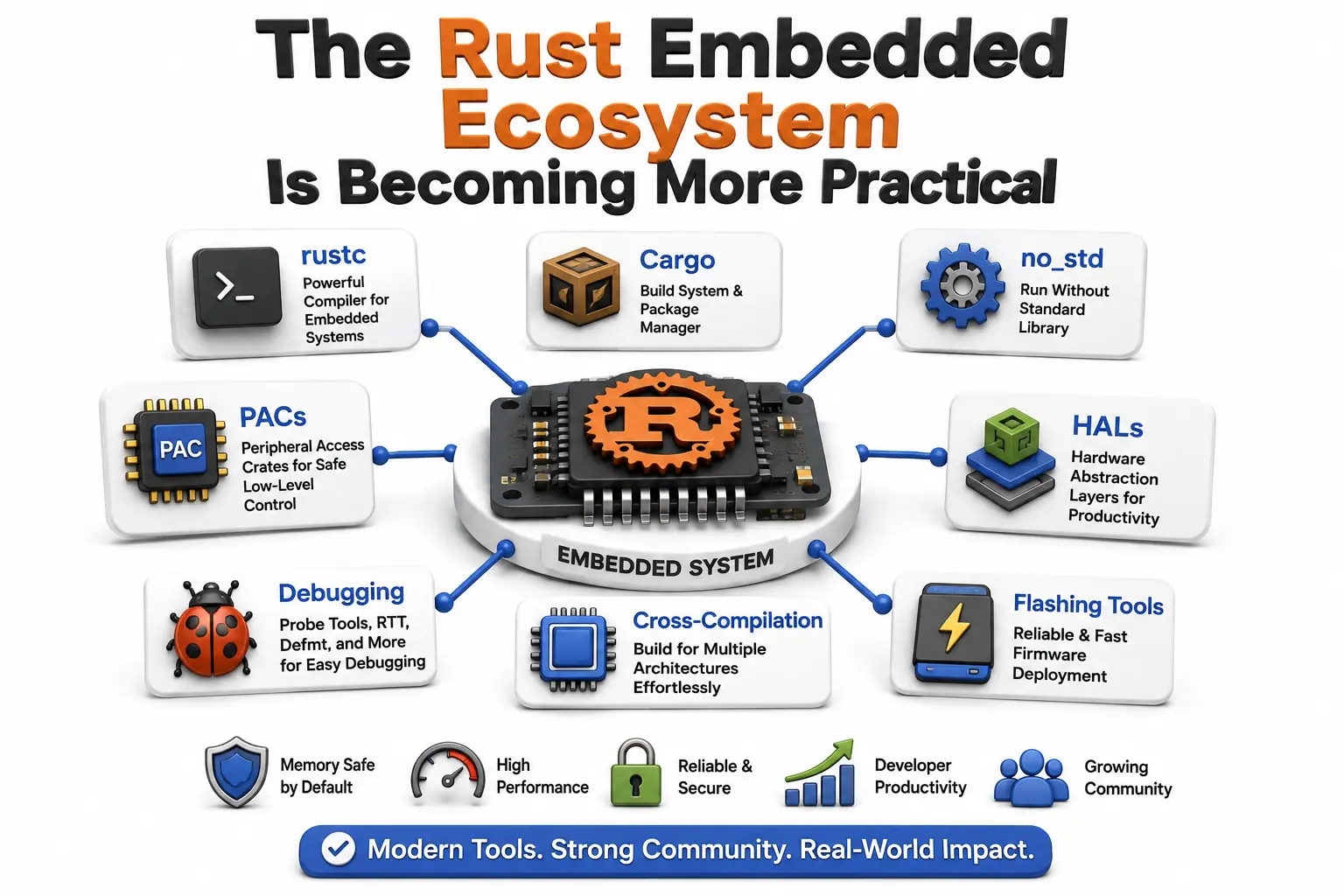
Writing embedded software requires much more than a programming language. Developers need compilers, linker configurations, debugging tools, peripheral libraries, hardware abstraction layers, flashing tools, and device-specific support.
Rust has developed a dedicated embedded ecosystem around these requirements.
A typical workflow can involve:
rustcfor compilation.Cargo for dependency and project management.
no_stdfor environments without the standard library.PACs for low-level peripheral access.
HALs for safer hardware abstractions.
Debugging and flashing tools such as probe-based development workflows.
The Embedded Rust ecosystem also provides documentation specifically for bare-metal microcontrollers and maintains learning resources for developers transitioning into embedded development.
However, ecosystem maturity remains an important consideration. C has decades of vendor libraries, middleware, RTOS integrations, debugging workflows, and legacy code. Rust is improving rapidly, but support is not equally mature across every microcontroller family.
Rust Does Not Mean Throwing Away Existing C Code
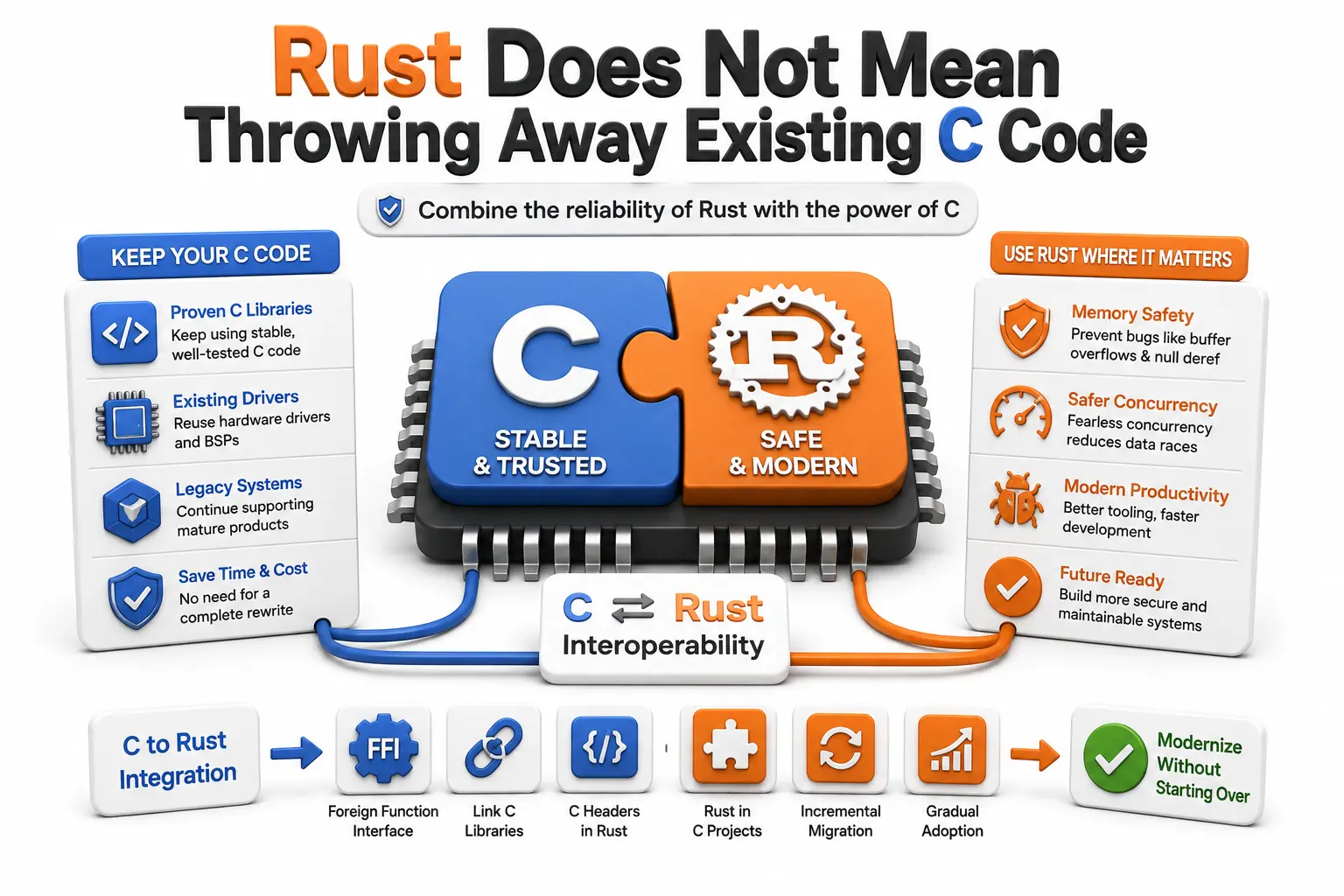
A complete rewrite is rarely the best migration strategy for an established embedded product. Large firmware projects may contain years of tested drivers, bootloaders, middleware, board-support packages, and vendor libraries.
Rust therefore provides interoperability with C.
A practical migration can begin with one isolated component instead of replacing the entire firmware.
For example:
Keep the existing C bootloader.
Maintain stable C-based vendor drivers.
Introduce Rust for a new application module.
Define a clear C-compatible interface.
Test the Rust component independently.
Gradually expand Rust into suitable parts of the system.
The official Embedded Rust documentation describes both approaches: using C libraries from Rust and exposing Rust functionality through C-compatible interfaces.
This hybrid model is particularly valuable for companies that want improved memory safety without accepting the risk and cost of a complete firmware rewrite.
Where Rust Still Has Challenges
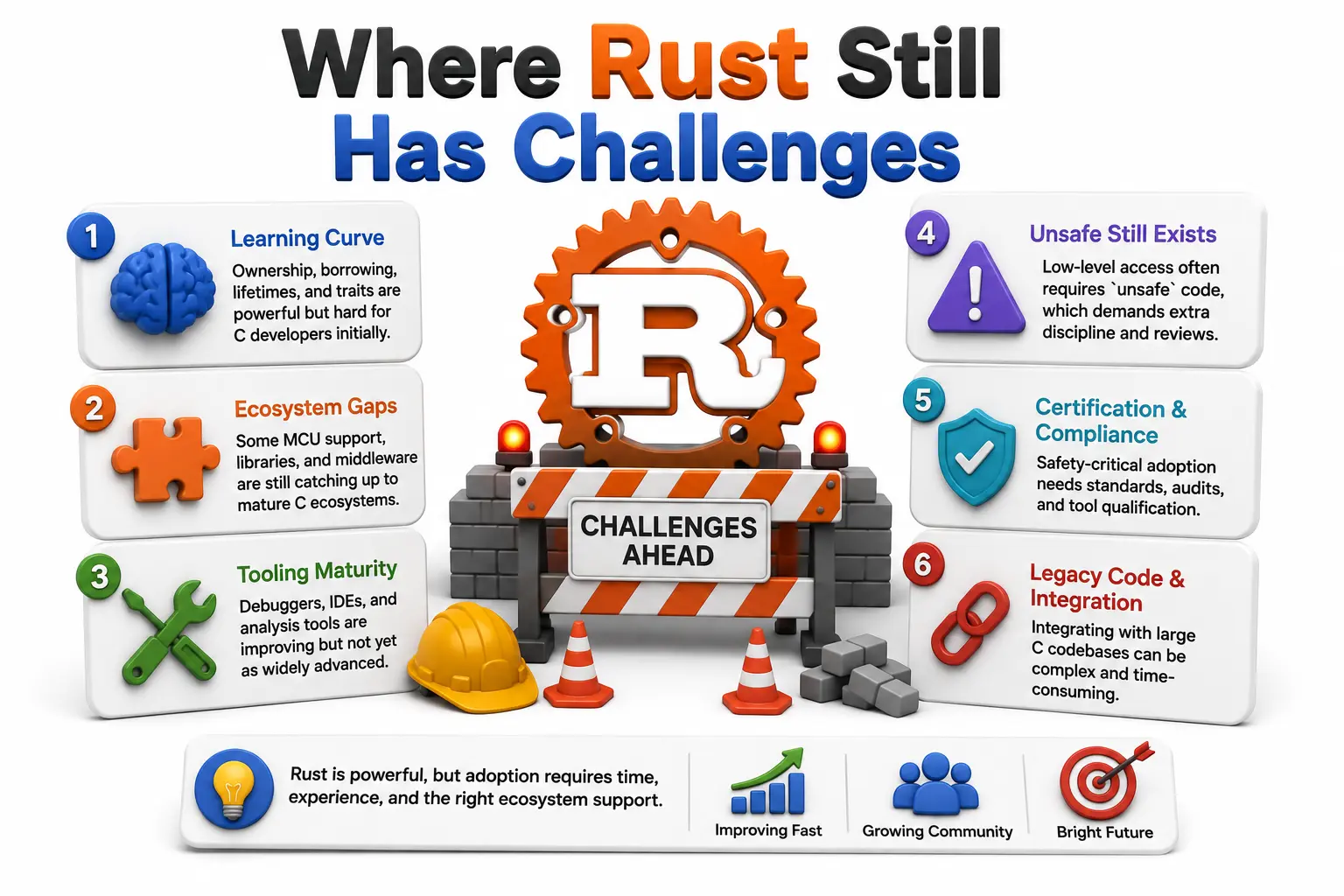
Calling Rust a universal replacement for C would be misleading. The transition involves real technical and organizational challenges.
Developers moving from C may initially struggle with:
Ownership and borrowing.
Lifetimes.
Traits and generics.
Embedded concurrency models.
HAL abstractions.
Cargo dependency management.
Cross-compilation and linker configuration.
Understanding when
unsafeis appropriate.
Hardware support is another concern. C remains deeply integrated with semiconductor vendor SDKs and existing embedded development environments.
Safety-critical adoption also requires more than language-level memory safety. Teams must consider coding standards, certification processes, verification, testing, tool qualification, and organizational experience. Recent research continues to identify ecosystem and tooling challenges in embedded Rust, showing that adoption is progressing but is not completely frictionless.
Therefore, the strongest argument for Rust is not that C has suddenly become obsolete. It is that modern embedded teams now have a credible alternative when safety, maintainability, and long-term reliability become priorities.
What Embedded Engineers Should Learn Next
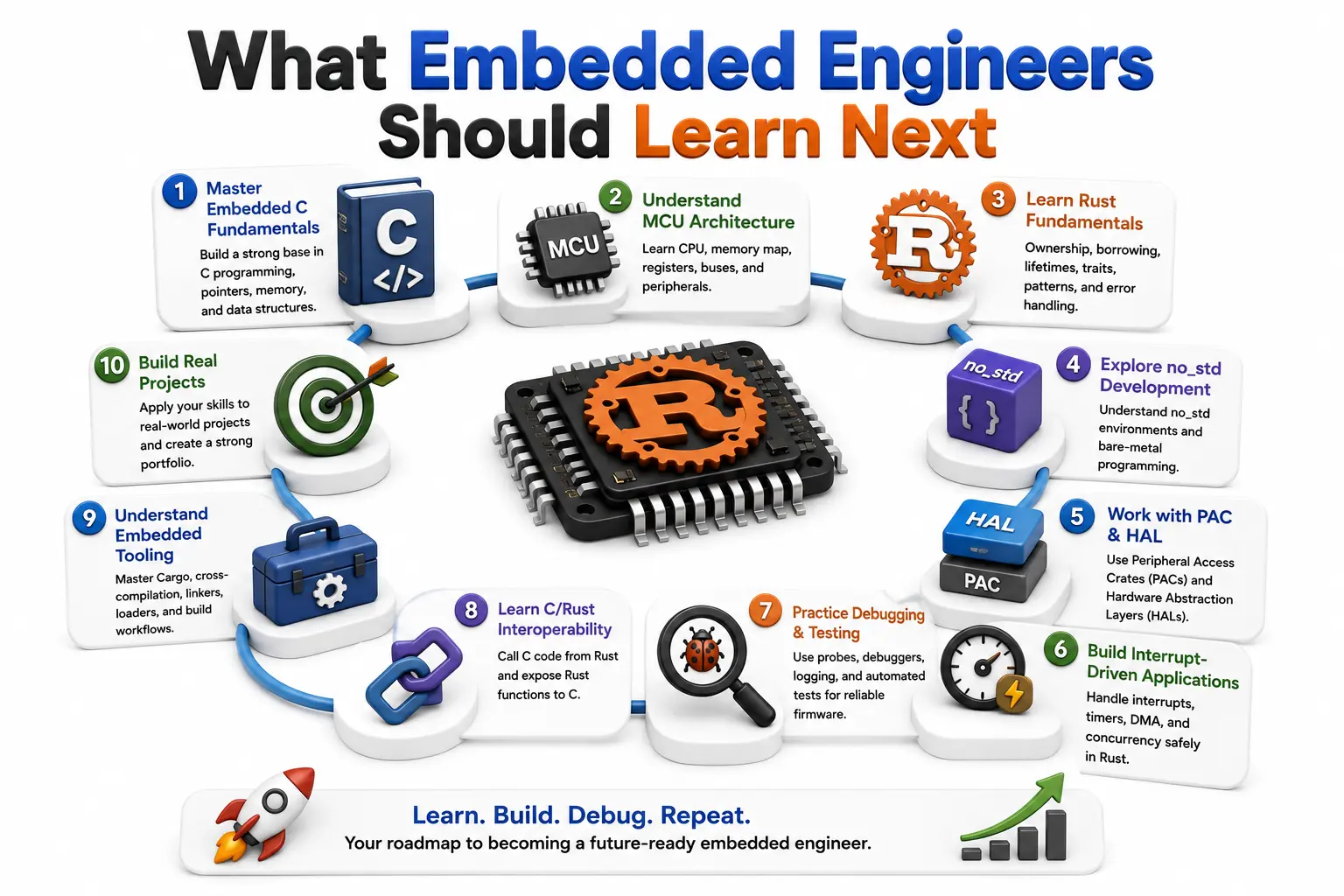
The rise of Rust changes the skill profile expected from future embedded developers. Learning only syntax is not enough. Engineers need to understand the relationship between software, compilers, memory, peripherals, and hardware.
A practical learning path includes:
Master embedded C fundamentals first.
Understand microcontroller architecture and memory maps.
Learn Rust ownership, borrowing, traits, and error handling.
Study
no_stddevelopment.Work with a Cortex-M or another supported microcontroller.
Learn PAC and HAL concepts.
Build interrupt-driven applications.
Practice C/Rust interoperability.
Learn embedded debugging and testing.
Develop projects that demonstrate real hardware interaction.
For learners and professionals, JastTech can complement this transition with industry-focused technical learning that connects programming concepts with practical engineering skills.
The most valuable engineers will not necessarily be those who abandon C completely. They will be those who understand when C is appropriate, when Rust provides a better engineering trade-off, and how both languages can coexist inside real products.
Conclusion
Rust is not replacing C because C suddenly stopped being useful. The shift is happening because embedded software has evolved. Connected devices, security requirements, increasingly complex firmware, and long product lifecycles are forcing teams to reconsider how software reliability is achieved.
Rust offers a compelling combination of low-level control, strong compile-time guarantees, and performance suitable for constrained hardware. At the same time, C retains major advantages through ecosystem maturity, vendor support, legacy code, and engineering familiarity.
The future of embedded development is therefore unlikely to be an overnight switch from C to Rust. Instead, the industry is moving toward a more selective model where Rust is increasingly used for new firmware and safety-sensitive components while C continues to power established systems. Engineers who understand both technologies will be better positioned for this transition.