

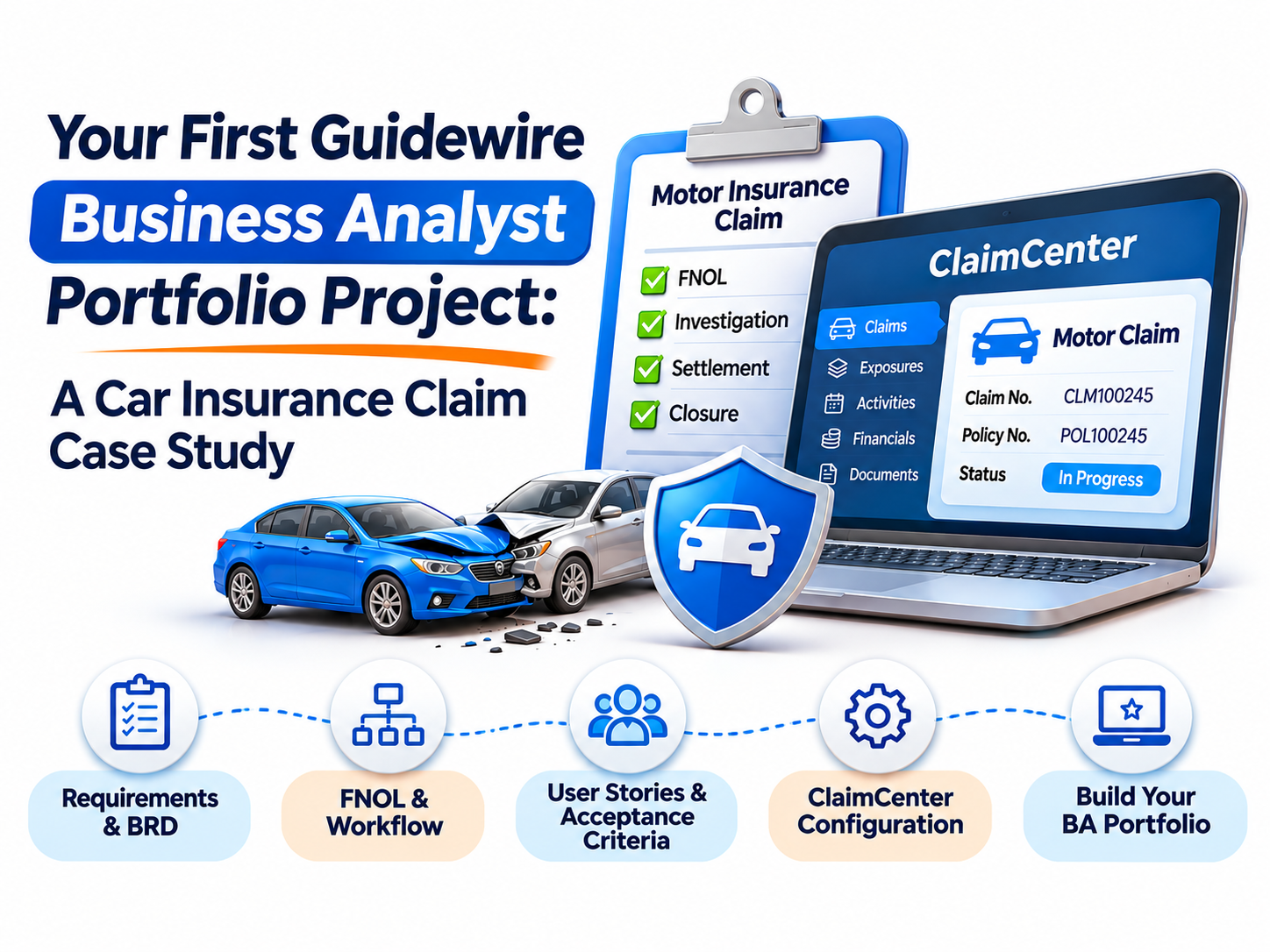
Your First Guidewire Business Analyst Portfolio Project: A Car Insurance Claim Case Study
Navigate through this article using the table of contents below
Table of Contents
No headings found in this article.
What if you could demonstrate your Guidewire Business Analyst skills without having years of professional project experience? A well-designed portfolio project can help you showcase your understanding of insurance workflows, business requirements, documentation, and ClaimCenter functionality.
Imagine a customer involved in a car accident who needs to register an insurance claim and receive compensation. Behind this simple situation is an entire business process. Let's explore how to transform it into your first practical Guidewire Business Analyst portfolio project.
Understanding the Car Insurance Claim Business Scenario

Every successful business analysis project starts with understanding the business problem. For this case study, consider a fictional insurance company called SecureDrive Insurance that wants to improve its car insurance claim management process using Guidewire ClaimCenter.
Currently, customers report accidents through phone calls and emails. Claims employees manually collect information, verify policy details, assign adjusters, and coordinate settlements. This creates delays, duplicate information, and difficulties tracking claim progress.
The business wants a centralized system that improves claim registration, validation, investigation, and settlement.
Project overview:
Project Name: SecureDrive Motor Claims Management.
Application: Guidewire ClaimCenter.
Business Domain: Personal Auto Insurance.
Primary Objective: Improve claims processing efficiency.
Main Users: Claims representatives, adjusters, supervisors, and customers.
The expected solution should allow employees to register claims, validate insurance coverage, assign investigations, manage financial transactions, and track claim status.
As a beginner, your responsibility is to understand these requirements and translate them into clear business documentation.
Identifying Stakeholders and Gathering Business Requirements
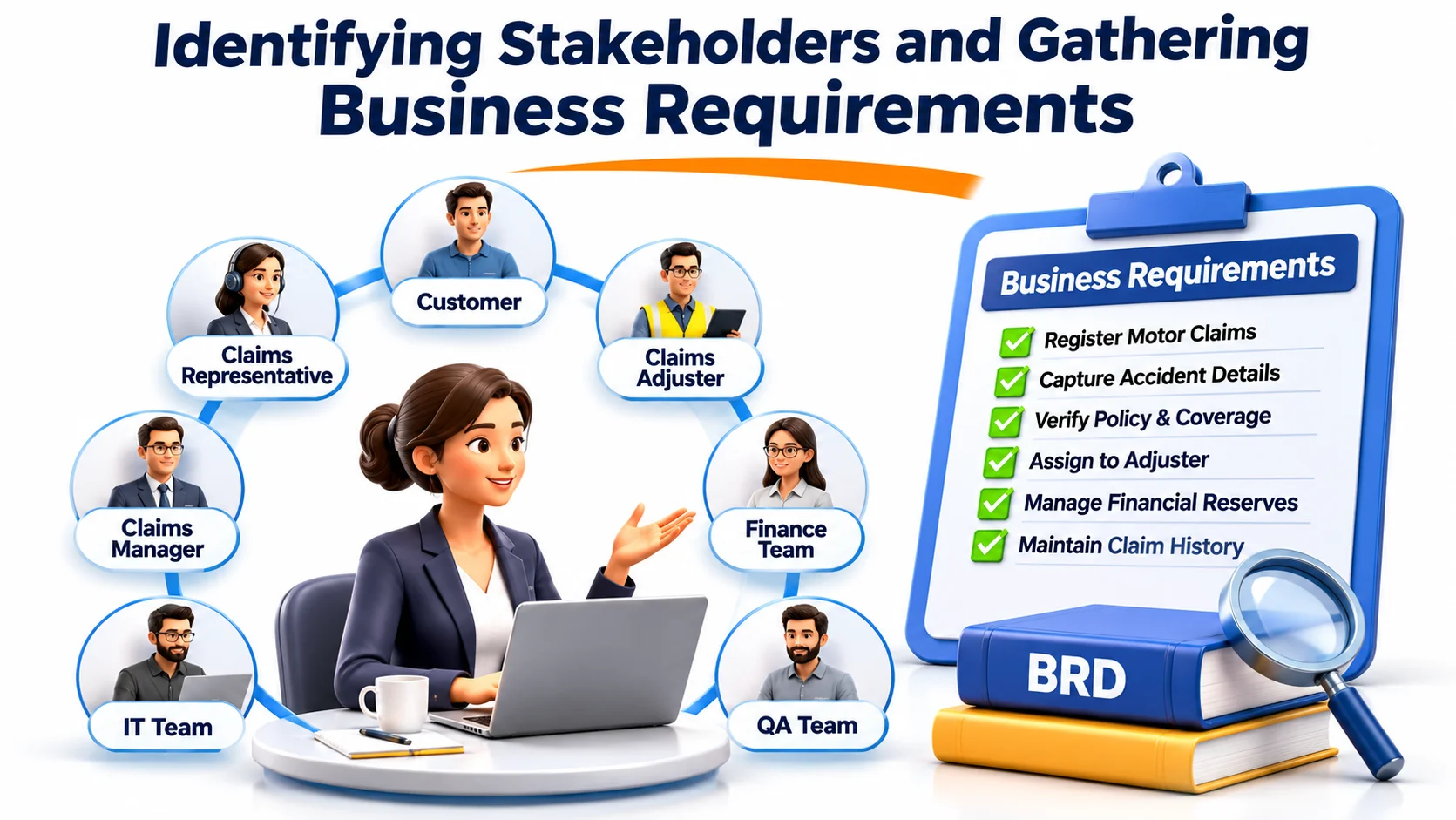
A Business Analyst must understand what different stakeholders expect from the application. Each stakeholder interacts with the claims process differently, so collecting their requirements is an important project activity.
For the SecureDrive project, identify the following stakeholders:
Customer: Reports the accident and provides incident information.
Claims Representative: Registers claims and verifies initial information.
Claims Adjuster: Investigates accidents and evaluates damages.
Claims Manager: Reviews escalated cases and approves transactions within authorized limits.
Finance Team: Coordinates approved claim payments.
IT and QA Teams: Implement and validate the documented requirements.
After identifying stakeholders, conduct requirement-gathering sessions through interviews, workshops, and process discussions.
Sample business requirements:
The system must allow authorized employees to register new motor insurance claims.
Users must be able to capture accident date, location, vehicle details, and incident description.
The application must support policy and coverage verification.
Claims must be assigned to appropriate adjusters.
Authorized users must be able to create and update financial reserves.
The system must maintain claim activities and transaction history.
Document these requirements in a Business Requirement Document (BRD). Your BRD should include project objectives, scope, stakeholders, business rules, assumptions, and expected outcomes.
This document becomes the foundation for functional analysis and development discussions.
Designing the FNOL and ClaimCenter Workflow
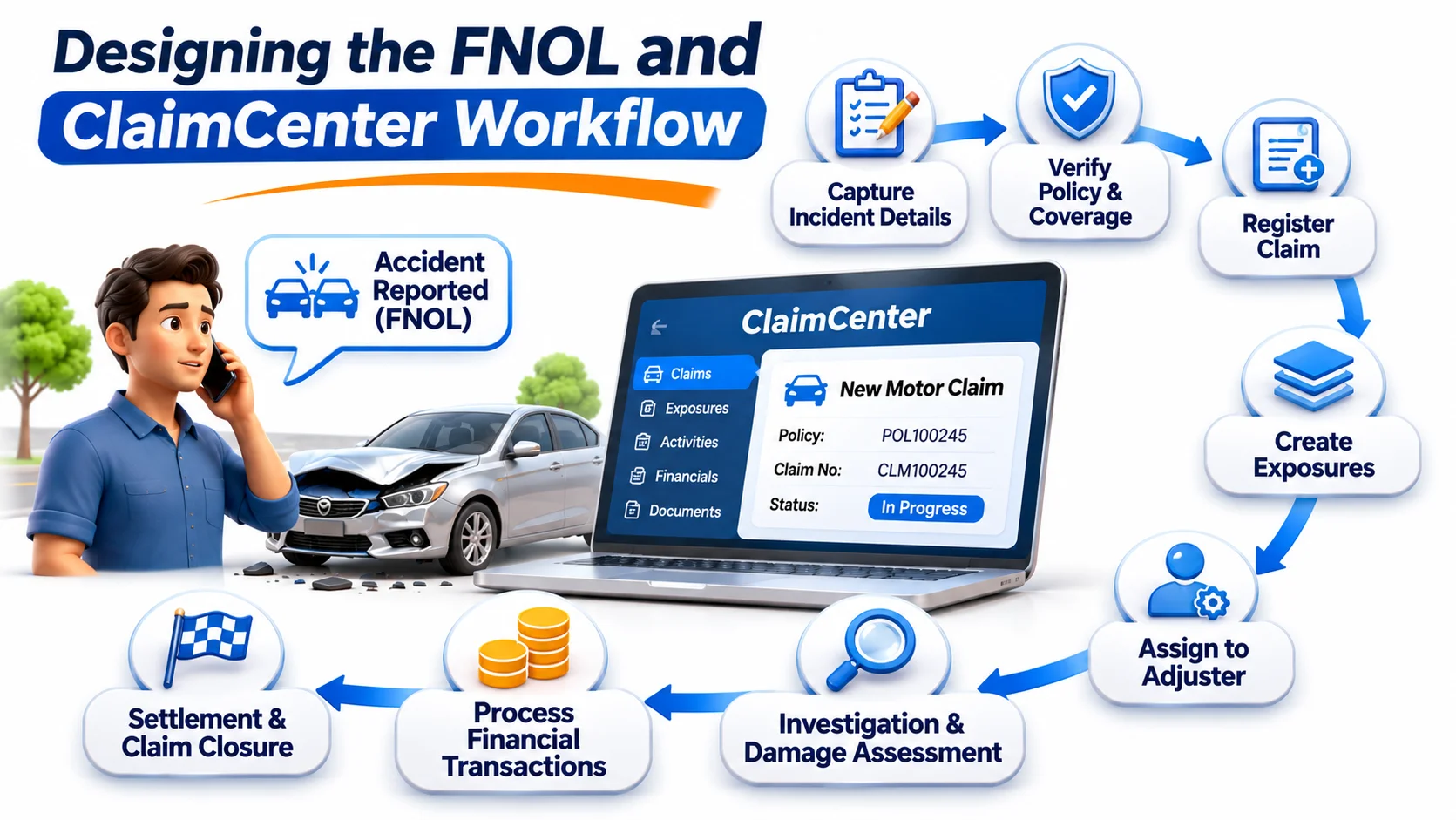
First Notice of Loss (FNOL) is one of the most important stages of insurance claims management. It represents the initial reporting of an incident to the insurance company.
For the portfolio project, imagine that a customer named Rahul reports a car accident that occurred on a city road. His insured vehicle was damaged after colliding with another vehicle.
The claims representative collects the necessary information and initiates the claim registration process.
Sample FNOL information:
Policy Number: POL100245.
Customer Name: Rahul Sharma.
Vehicle Registration: MH12AB1234.
Accident Date: 15 November 2026.
Incident Type: Vehicle Collision.
Damage Description: Front bumper and headlight damage.
Incident Location: Pune, Maharashtra.
The Business Analyst must translate this information into a structured workflow.
Proposed ClaimCenter workflow:
Receive the accident notification.
Capture customer, vehicle, and incident details.
Search for the relevant insurance policy.
Verify policy validity and applicable coverage.
Register the claim.
Create relevant exposures.
Assign the claim to an appropriate adjuster.
Initiate investigation and damage assessment.
Process approved financial transactions.
Complete settlement and close the claim when all closure conditions are satisfied.
Remember that claim registration does not automatically mean payment approval. Coverage, liability, deductibles, exclusions, and supporting evidence must be evaluated according to the policy and business rules.
Your portfolio should include a simple process flow diagram showing how information moves between customers, claims representatives, adjusters, and finance teams.
Creating User Stories and Acceptance Criteria
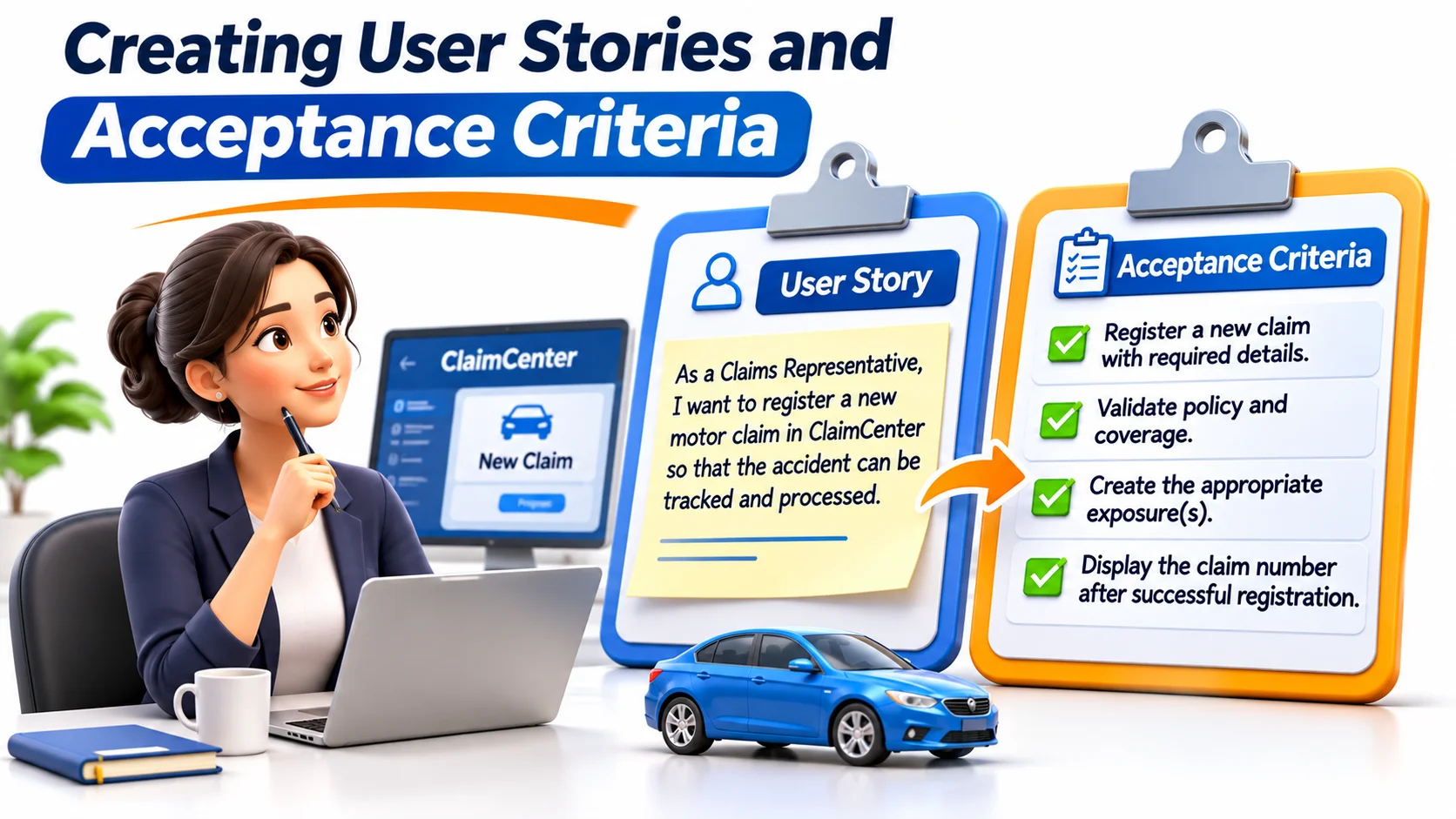
Once requirements are understood, the next responsibility is translating them into actionable user stories.
User stories explain what a particular user wants to accomplish and why the functionality is important.
For example:
User Story: Register a New Motor Claim
As a claims representative, I want to register a new motor insurance claim so that the customer's accident can be investigated and processed.
Acceptance Criteria:
The system should allow authorized users to initiate a new claim.
Mandatory customer and incident information must be provided.
The system should validate the selected policy.
The claim should not proceed through coverage-dependent processing if the policy is invalid or relevant coverage cannot be established.
A successfully registered claim should receive a unique claim reference.
Additional user stories:
Policy Verification: As a claims representative, I want to verify policy coverage so that I can determine whether the reported incident is potentially covered.
Claim Assignment: As a claims supervisor, I want to assign claims to suitable adjusters so that investigations can be managed efficiently.
Reserve Management: As an authorized claims user, I want to create and update financial reserves so that expected claim liabilities can be monitored.
Payment Processing: As an authorized finance user, I want to process approved claim payments so that eligible customers receive settlements.
You should also maintain a Requirements Traceability Matrix (RTM) connecting business requirements, user stories, and corresponding test cases.
This demonstrates that you understand how business expectations are translated into system functionality.
Preparing UAT Scenarios and Managing Defects
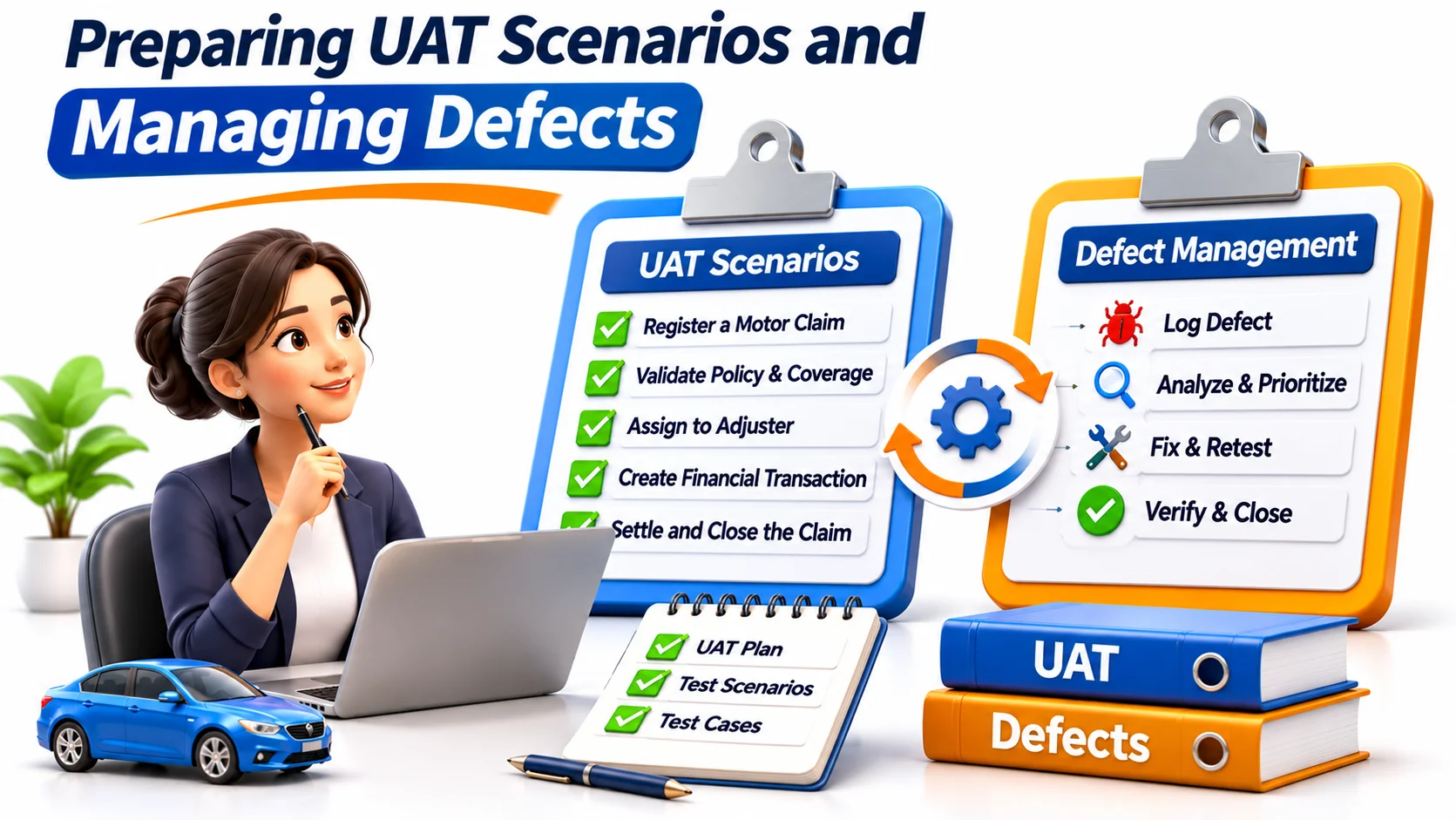
A business requirement is not complete simply because developers implement it. The functionality must also be validated against business expectations.
User Acceptance Testing (UAT) helps business stakeholders determine whether the implemented solution supports the intended operational processes.
For your car insurance portfolio project, prepare test scenarios covering normal transactions, invalid information, and exceptional situations.
Sample UAT scenarios:
Test Case 1: Successful Claim Registration
Enter valid customer, vehicle, and accident information.
Select a valid policy.
Expected Result: Claim registration completes successfully and generates a claim reference.
Test Case 2: Invalid Policy
Enter a policy number that cannot be found.
Expected Result: The application displays an appropriate validation message and prevents incorrect policy association.
Test Case 3: Missing Accident Information
Attempt registration without providing mandatory incident details.
Expected Result: The system identifies missing mandatory information.
Test Case 4: Claim Assignment
Assign a registered claim to an eligible adjuster.
Expected Result: The assigned adjuster and relevant claim activity are recorded.
Test Case 5: Payment Authorization
Attempt to process a payment without the required approval.
Expected Result: The transaction is prevented according to configured authorization rules.
During testing, maintain a defect log containing the defect ID, description, severity, reproduction steps, expected result, actual result, and current status.
A Business Analyst should coordinate with developers, QA engineers, and business stakeholders to clarify defects, validate fixes, and obtain business acceptance.
Building and Presenting Your Guidewire BA Portfolio
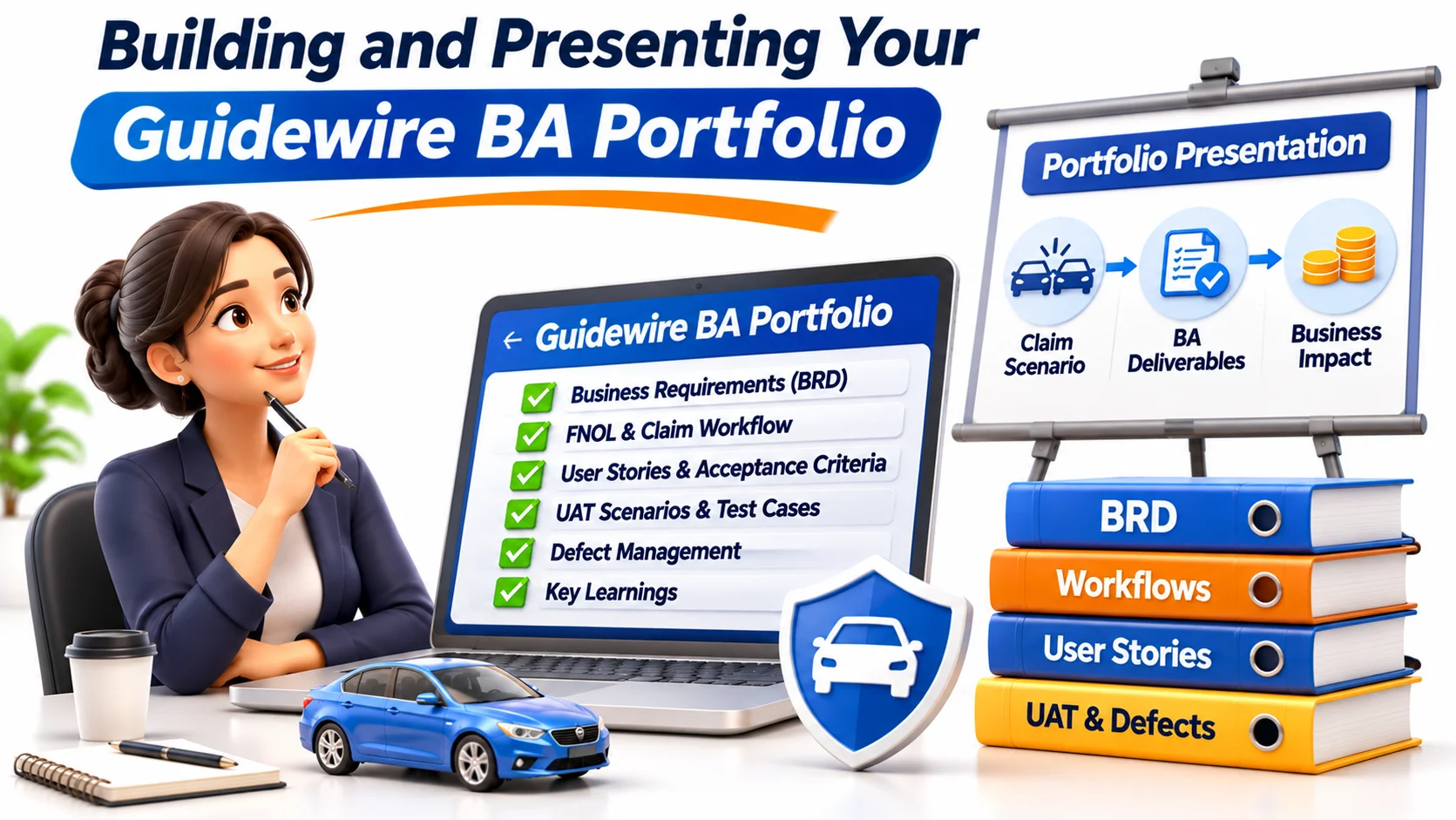
After completing the case study, organize your deliverables into a professional portfolio. Your objective is to demonstrate your analytical thinking and ability to connect insurance operations with technology.
A strong portfolio should contain:
Project overview and business problem statement.
BRD with functional and business requirements.
Stakeholder analysis.
Current-state and future-state process diagrams.
FNOL and claims lifecycle workflow.
User stories and acceptance criteria.
Requirements Traceability Matrix.
UAT test scenarios and defect log.
Final project summary and business benefits.
You can prepare these documents using Microsoft Word, Excel, PowerPoint, Visio, or similar documentation tools. Jira can also be used to organize user stories and track project activities.
Importantly, clearly identify the project as a simulated learning case study if you have not worked on an actual insurance implementation. Never present fictional client experience as professional employment experience.
For learners interested in developing practical skills, JastTech can be considered as a learning resource for understanding technical training and industry-oriented project preparation. Similarly, Guidewire Business Analyst Training can help learners build knowledge of insurance workflows, requirements documentation, ClaimCenter functionality, and testing concepts.
A portfolio becomes more valuable when you can explain why you selected particular requirements, how you handled exceptions, and how your test cases validate the expected business behavior.
Conclusion
Your first Guidewire Business Analyst portfolio project does not need to be a complicated enterprise implementation. A carefully documented car insurance claim scenario can demonstrate essential skills such as requirement gathering, stakeholder analysis, FNOL workflows, user story creation, acceptance criteria, and UAT. What matters most is showing how you convert a business problem into a structured technology solution.
If you are preparing for a career in insurance technology, focus on practical documentation, insurance domain knowledge, and the ability to explain ClaimCenter workflows confidently. Learners exploring Guidewire Training in Hyderabad should prioritize hands-on case studies alongside theoretical learning. A well-presented portfolio can strengthen your interview preparation and provide a meaningful starting point for your Guidewire Business Analyst career.