

Complete Guidewire Integration and Web Services Roadmap for Beginners 2026
Navigate through this article using the table of contents below
Table of Contents
No headings found in this article.
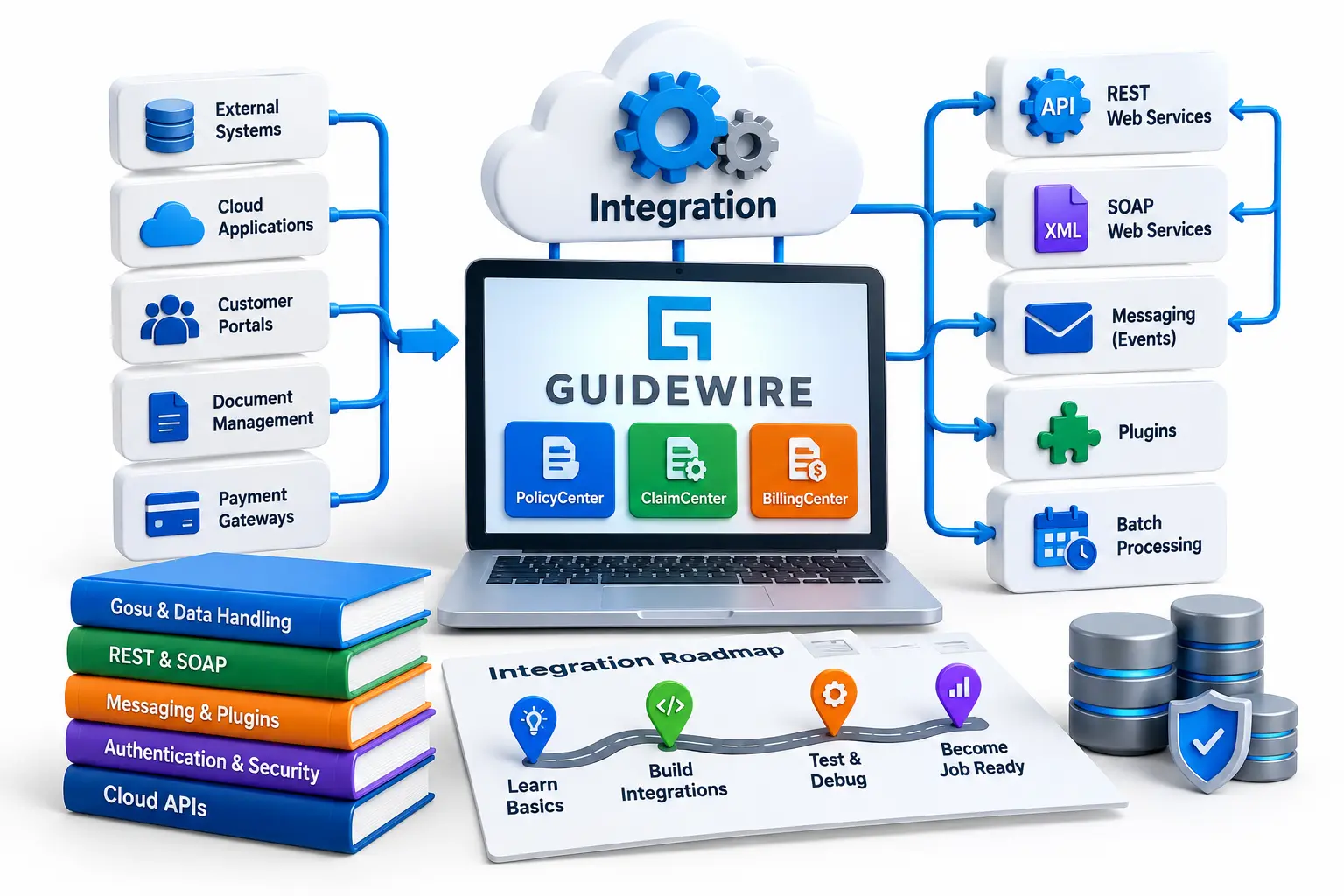
Guidewire integration can look overwhelming when you first encounter APIs, Gosu, SOAP, REST, messaging, plugins and cloud services at the same time. The real challenge is not learning every technology separately—it is understanding how they connect to move insurance data reliably between systems.
For beginners entering Guidewire in 2026, randomly studying integration topics can create more confusion than progress. A structured roadmap can take you from InsuranceSuite fundamentals to building, testing and debugging realistic integrations while developing skills that make sense in actual implementation projects.
Build Your Guidewire Foundation Before Learning Integration
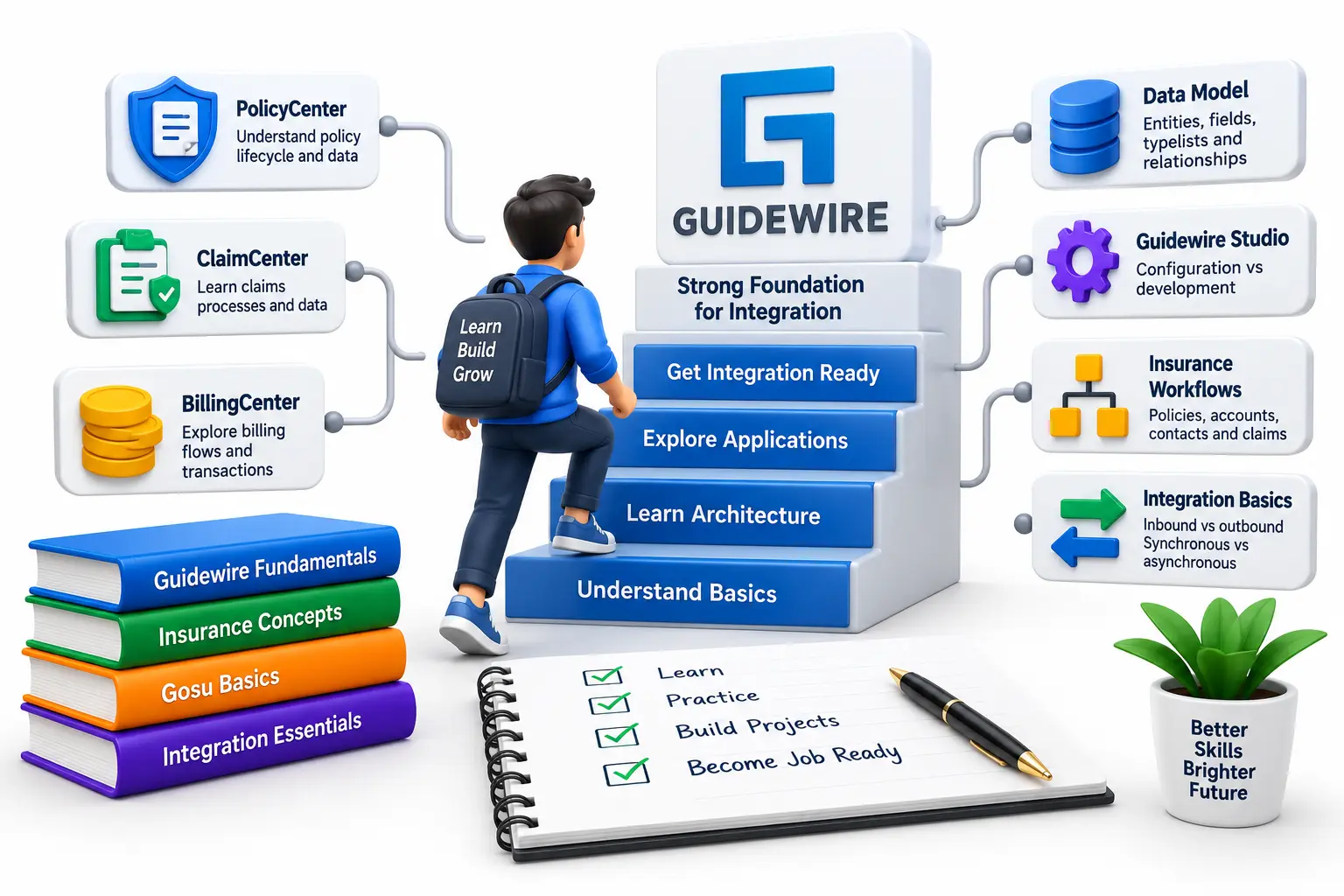
Before creating integrations, understand what you are integrating. Guidewire InsuranceSuite revolves around major insurance applications such as PolicyCenter, ClaimCenter and BillingCenter. Integration developers need enough functional understanding to recognize what business data is moving, why another system needs it, and what should happen when an exchange succeeds or fails.
Start by learning basic insurance workflows. PolicyCenter handles policy-related processes, ClaimCenter supports claims operations, and BillingCenter manages billing-related activities. You do not need to become a business analyst first, but understanding policies, accounts, contacts, claims, payments and transactions makes technical integration much easier to follow.
Your foundation should include:
Guidewire InsuranceSuite architecture
PolicyCenter, ClaimCenter and BillingCenter basics
Entities, fields, typelists and relationships
Basic insurance workflows
Guidewire Studio fundamentals
Configuration versus integration
Inbound versus outbound integration
Synchronous versus asynchronous communication
Think of integration as a bridge. Guidewire may need to communicate with payment gateways, document systems, customer portals, external databases, rating services or other enterprise applications. Understanding both ends of that bridge should come before learning how to build it.
Master Gosu, Queries, Bundles and Data Handling
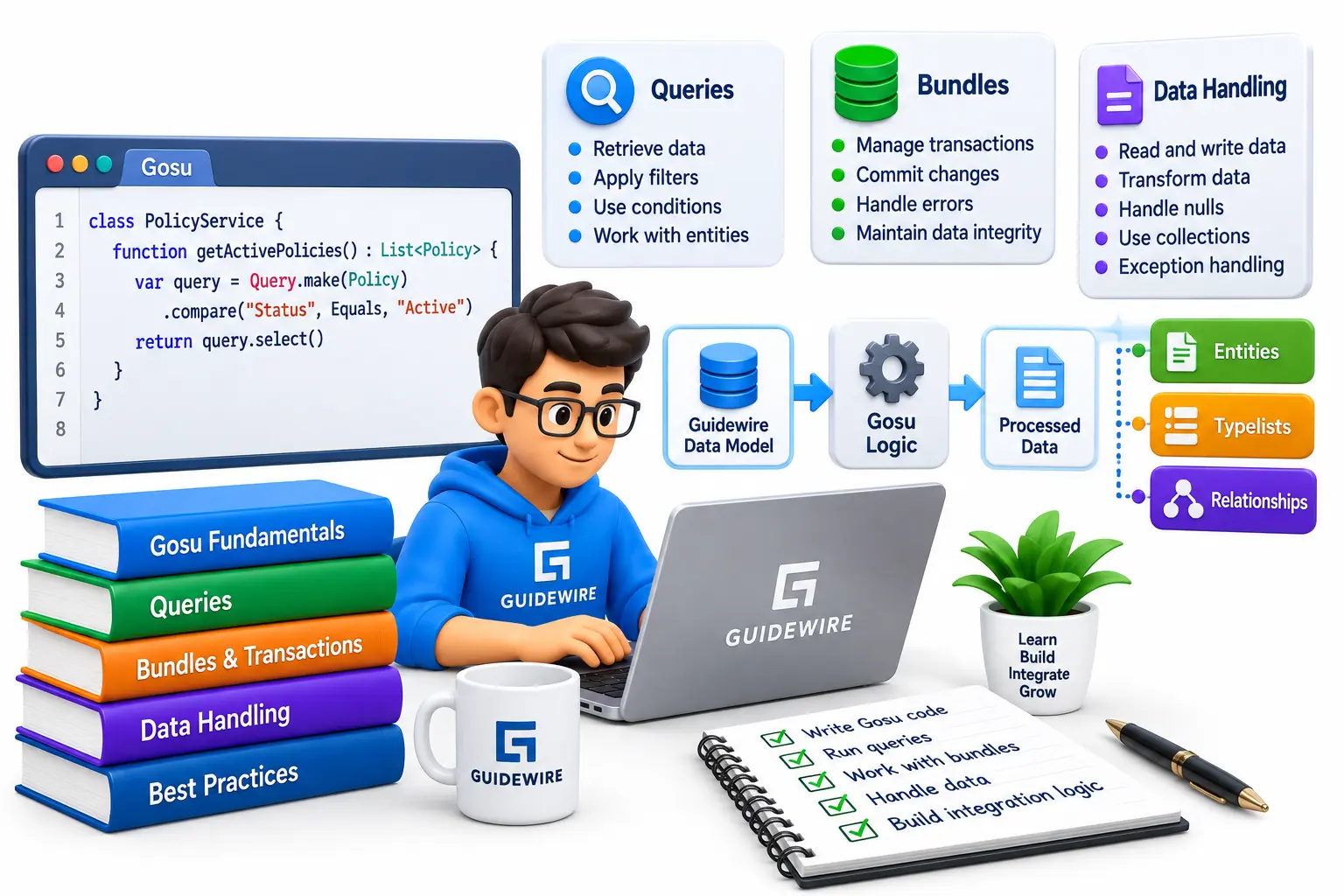
The next stage is learning how Guidewire data is accessed and manipulated. Gosu is central to Guidewire development, so beginners should become comfortable with variables, classes, functions, collections, conditions, loops, exception handling and object-oriented concepts before attempting complex integration logic.
Then move into Guidewire-specific data operations. Learn Gosu queries to retrieve information and understand bundles and transaction boundaries when data is changed. This matters because an integration is rarely just “send an API request.” Data often needs to be retrieved, validated, transformed and safely processed before or after communicating with another system.
A practical progression is:
Learn core Gosu syntax
Work with Guidewire entities
Write simple Gosu queries
Understand bundles and transactions
Handle nulls and exceptions
Transform data into required payload structures
Practice logging and debugging
This stage turns theoretical programming knowledge into Guidewire-specific engineering ability. A beginner following a Guidewire Integration Complete Guide should be able to trace where information originates, how it is transformed and where it goes before attempting larger external-system integrations.
Learn REST and SOAP Through Real Data Flows
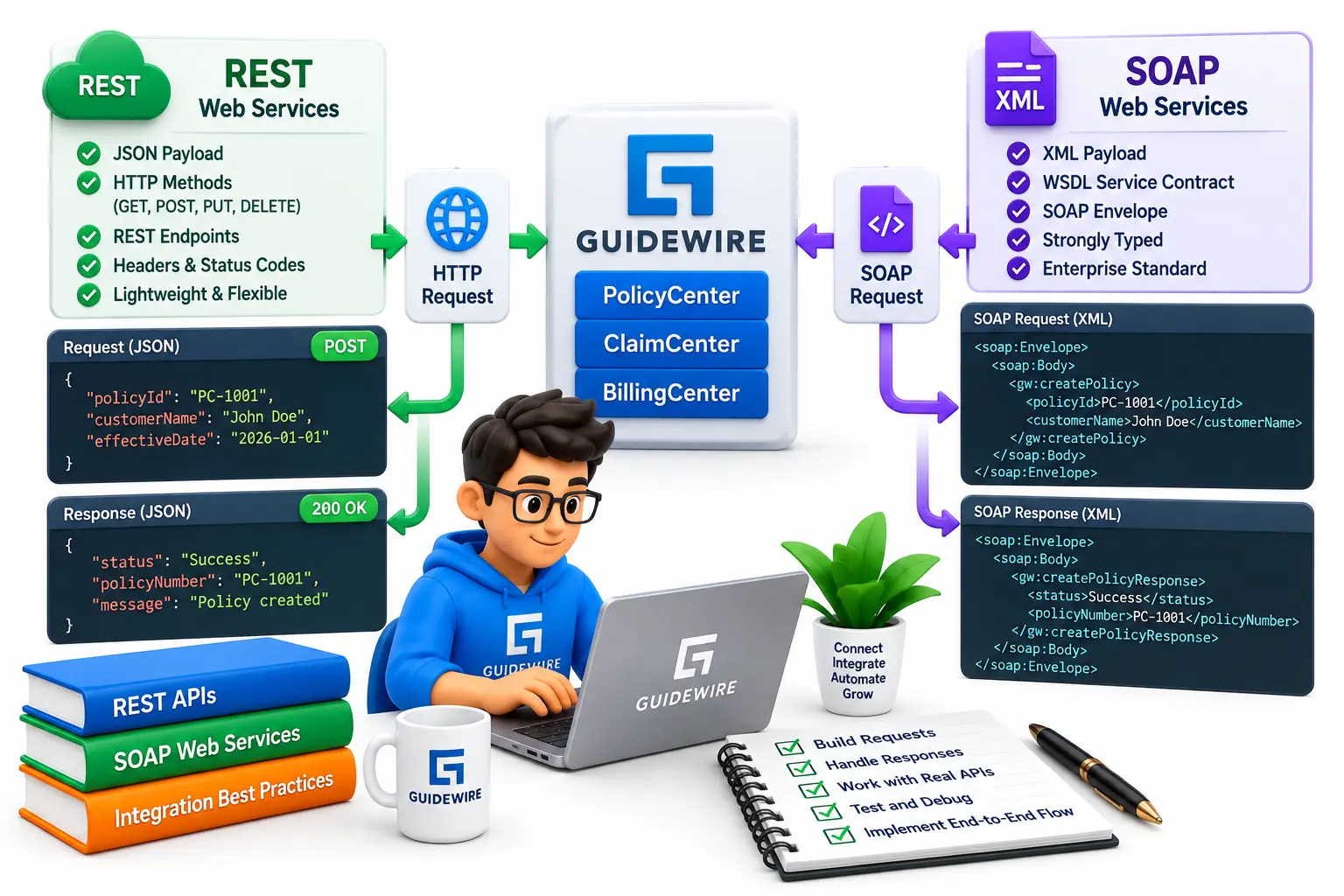
Web services should be learned through use cases rather than definitions. REST commonly works with HTTP methods and resource-oriented APIs, while SOAP uses structured XML messages and formal service contracts. Understanding both gives beginners useful context because enterprise insurance environments can include modern APIs alongside established services.
With REST, learn requests, responses, endpoints, HTTP methods, headers, JSON payloads and status codes. Understand GET, POST, PATCH and DELETE conceptually, but focus more importantly on what happens when a request is invalid, authentication fails, a resource cannot be found, or an external dependency becomes unavailable.
For SOAP, understand:
XML request and response structures
WSDL and service contracts
Publishing and consuming services
Data mapping
Fault handling
Testing service calls
The best way to learn Guidewire Integration & Web Services is to build a small end-to-end scenario. For example, retrieve insurance-related information, transform it into an external service's expected format, send the request, receive the response and handle both successful and failed outcomes. That teaches much more than memorizing API terminology.
Move Beyond APIs Into Messaging, Plugins and Batch Processes
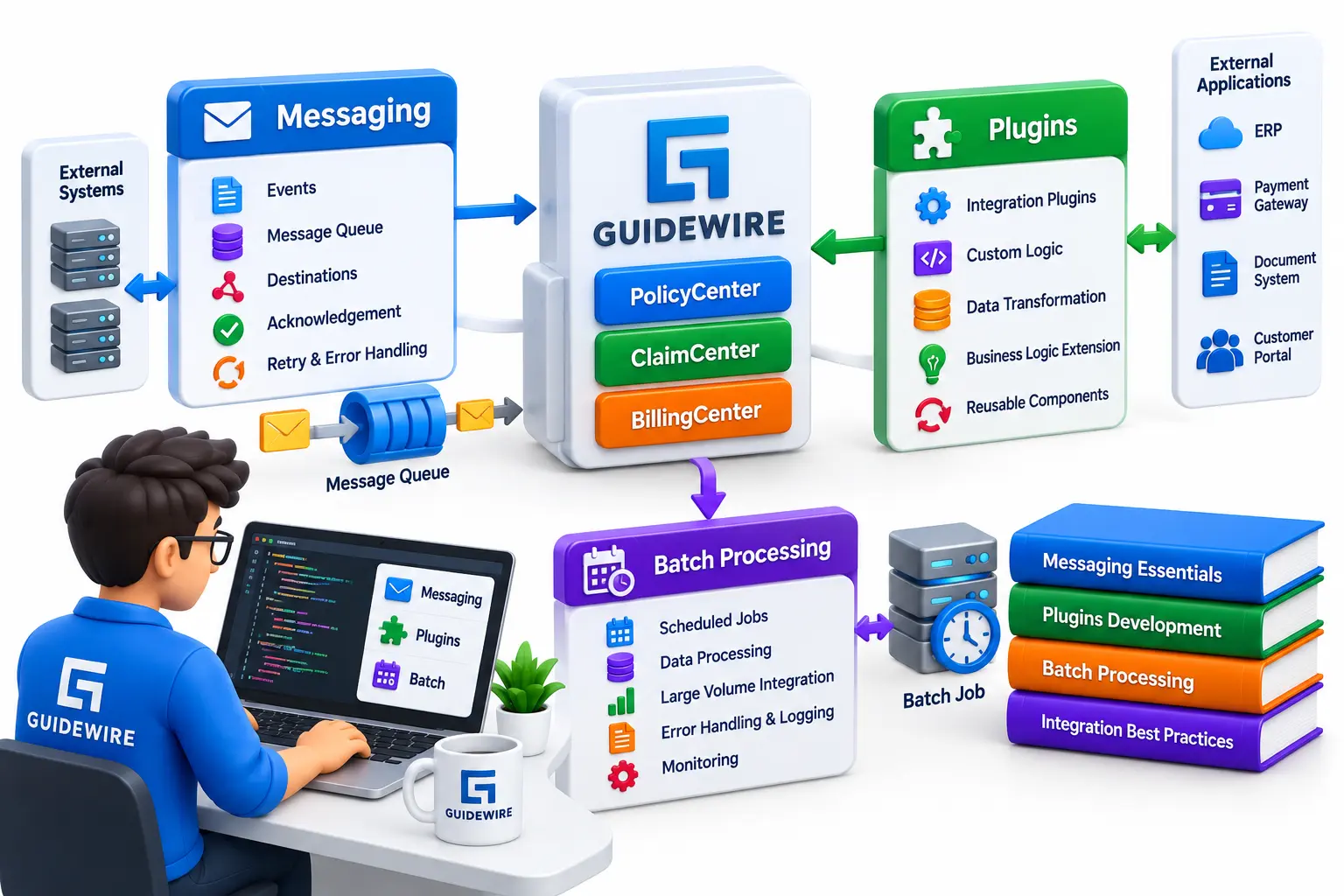
Not every integration should wait for an immediate response. This is where beginners need to understand the difference between synchronous API communication and asynchronous processing. Messaging becomes important when business events need to trigger reliable communication with downstream systems without tightly coupling every operation.
Study the messaging lifecycle from event generation through payload creation, transport, acknowledgement and failure handling. Ask practical questions: What happens if the destination is unavailable? Can the message be retried? How do you identify the failed transaction? How can duplicate processing be avoided?
Plugins and batch processes expand your toolkit further. Plugins help connect application behavior with implementation-specific services, while batch processing is useful when work needs to be processed in scheduled or larger-volume operations.
A strong learning sequence covers:
Messaging architecture
Message creation and payload transformation
Destinations and transport
Acknowledgement and retry concepts
Plugin configuration
Batch processing
Logging and exception handling
Failure investigation
At JastTech, learners preparing for Guidewire careers can benefit from approaching these concepts as connected parts of an integration workflow rather than isolated syllabus modules. That project-oriented approach helps bridge the gap between knowing terminology and understanding implementation behavior.
Add Authentication, Cloud APIs and Modern Integration Patterns
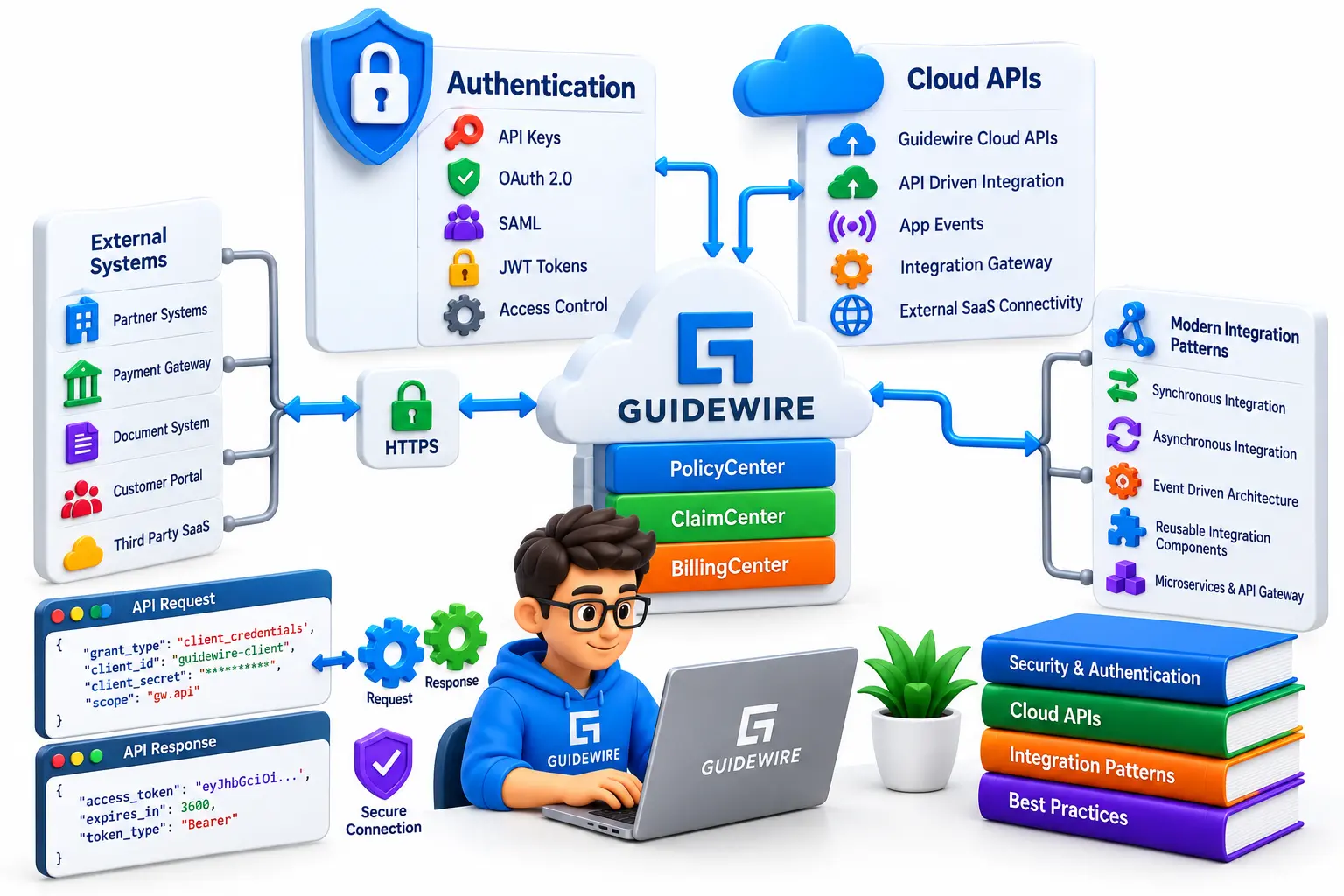
Integration development in 2026 should not stop at traditional SOAP and REST exercises. Guidewire's current integration direction includes Cloud APIs, App Events and Integration Gateway, making cloud-oriented integration concepts increasingly important for learners who want their roadmap to reflect the modern platform.
Start with API security fundamentals. Understand authentication versus authorization, credentials, tokens, access control and why sensitive information should not simply be embedded into application logic. You should also learn how API failures are logged and diagnosed without exposing confidential information.
Then explore modern integration concepts such as:
Guidewire Cloud APIs
API-driven application communication
App Events
Event-driven integration
Integration Gateway
Integration mediation
Reusable integration patterns
External SaaS connectivity
Do not rush into these concepts without the earlier foundations. Cloud tools become much easier to understand once you already know requests, responses, payload transformation, asynchronous events and failure handling. The objective is not to memorize product terminology but to recognize which integration approach fits a specific business requirement.
Turn Your Knowledge Into an End-to-End Integration Project
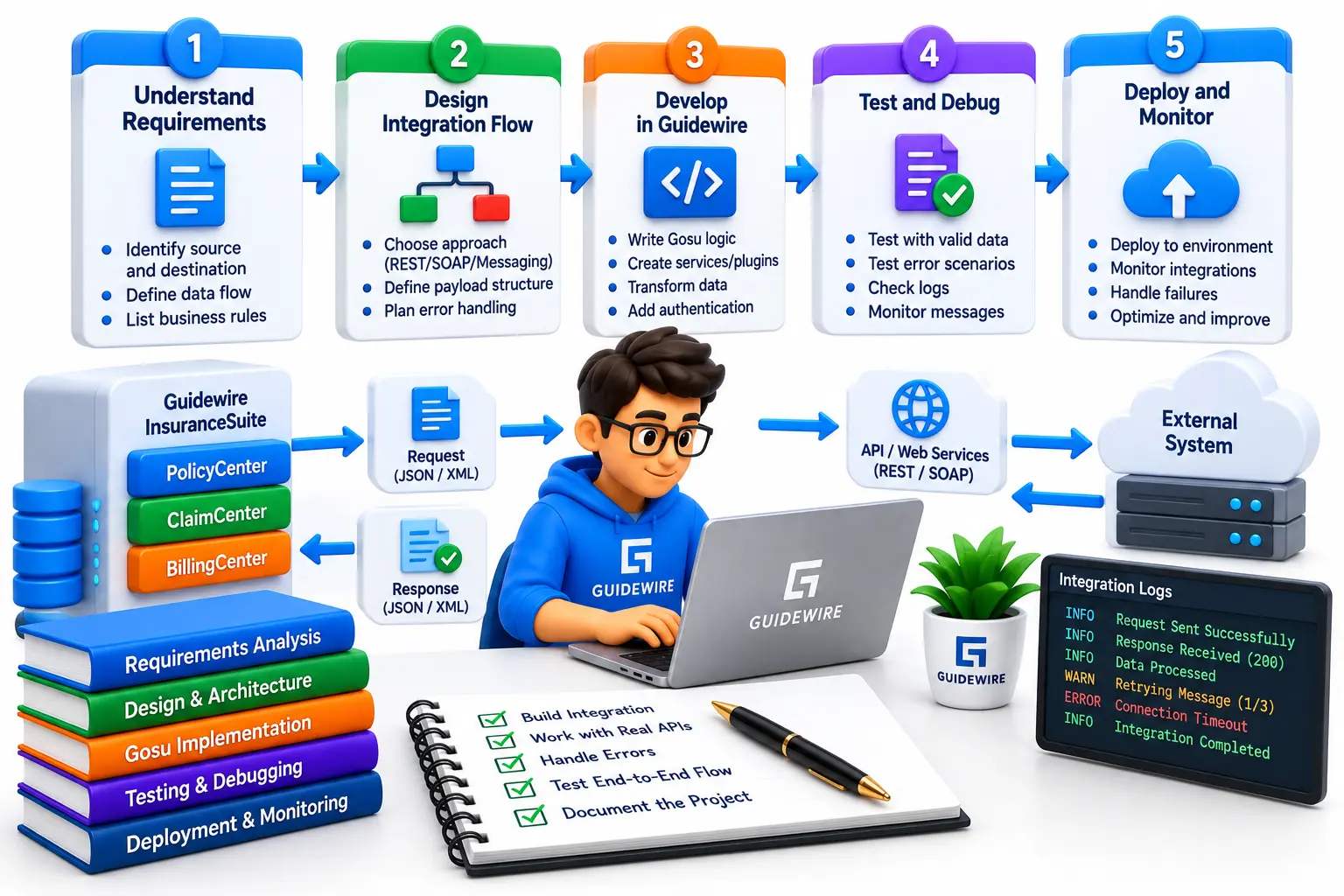
The final stage is where beginners become job-ready: stop studying individual concepts and build a complete workflow. Choose a realistic insurance scenario such as connecting a claims process with an external service, exchanging policy information, integrating document processing, or simulating communication with a payment provider.
Document the flow before coding. Identify the source, destination, trigger, payload, authentication requirement, expected response, transformation rules and failure scenarios. Then implement as much of the workflow as your learning environment permits.
Your project evidence should demonstrate:
Business requirement understanding
Data-model knowledge
Gosu implementation
API or service communication
JSON or XML handling
Authentication awareness
Error handling and logging
Testing with successful and failed requests
Debugging methodology
Clear technical documentation
Do not measure progress only by whether an API returns a successful response. Explain why you selected a particular integration approach, how the data moves, where failures can occur and how you would troubleshoot them. Those questions reveal engineering understanding far better than simply saying that you have studied REST, SOAP or Guidewire integration.
Conclusion
Learning Guidewire integration in 2026 is less about collecting disconnected technical topics and more about understanding the complete movement of data across an insurance ecosystem. Begin with InsuranceSuite and the data model, strengthen Gosu and transaction handling, master web services, then progress into messaging, plugins, batch processing, authentication and cloud-oriented integration.
The strongest roadmap ends with implementation. Build small integrations, deliberately test failure conditions, inspect payloads, trace data and document your architectural decisions. Whether you are a fresher or an IT professional moving into Guidewire, structured hands-on learning can turn a long syllabus into a practical skill set that is easier to demonstrate in projects and technical interviews.