

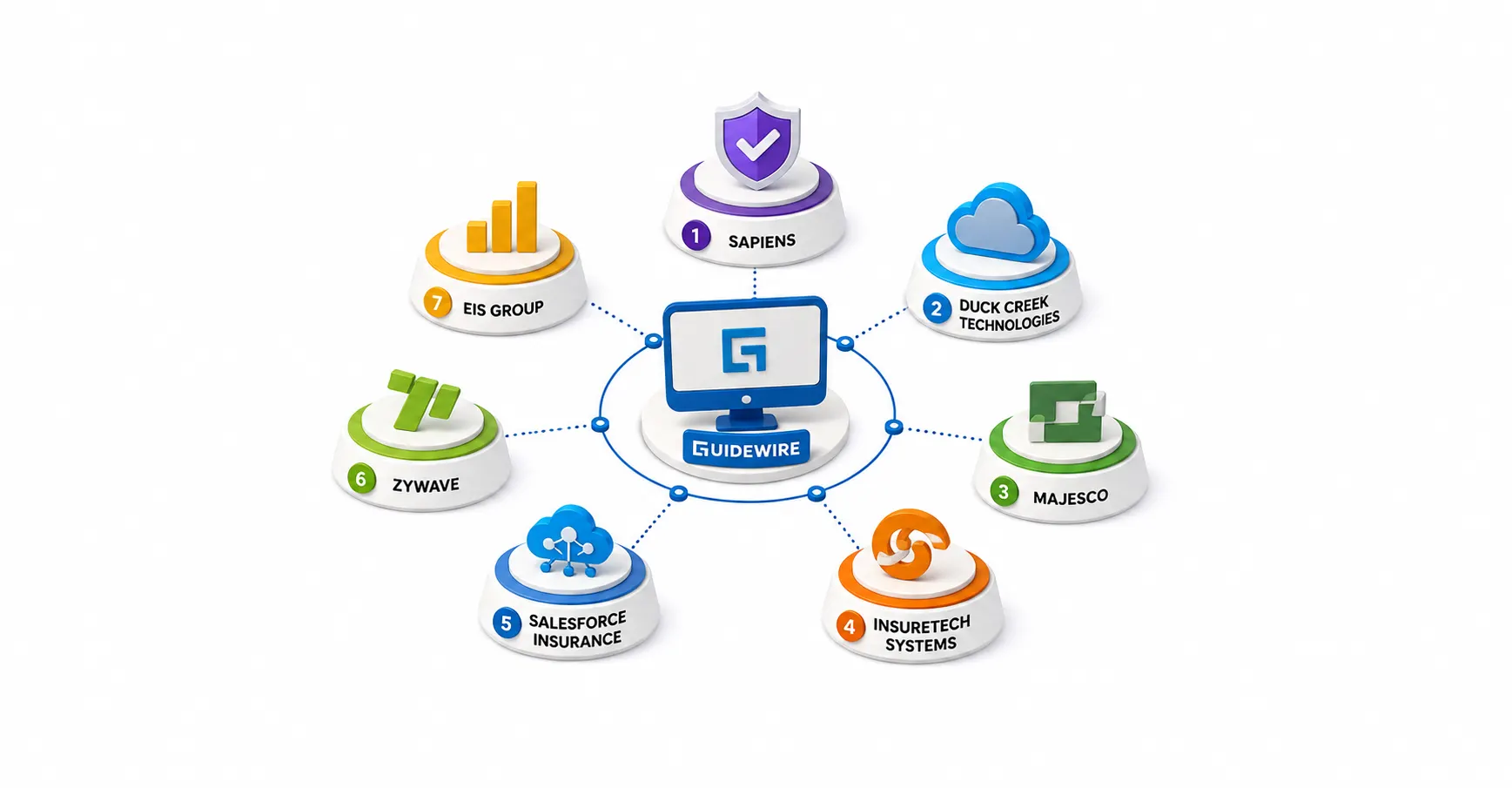
Guidewire Competitors: 7 Best Alternatives Compared
Navigate through this article using the table of contents below
Table of Contents
No headings found in this article.
Picture an insurer stuck mid-implementation, six months behind schedule, watching the budget balloon while the go-live date keeps slipping. That's the story behind a lot of searches for Guidewire competitors — not curiosity, but necessity.
Guidewire built its reputation as the heavyweight of core insurance platforms, but "biggest" and "best fit" aren't always the same thing. If you're weighing Guidewire alternatives for your team, here's what actually separates the contenders.
Why Are Insurers Even Looking at Guidewire Alternatives?

Guidewire's PolicyCenter, ClaimCenter, and BillingCenter suite is one of the most widely adopted core insurance platforms in the world. Its scalability, deep insurance functionality, and mature ecosystem make it a strong choice for many large insurers—but it also comes with trade-offs.
Implementations often stretch into multi-year digital transformation projects, and licensing plus implementation costs can place the platform beyond the reach of smaller carriers, MGAs, and regional insurers. That's the practical reason many insurance organizations begin evaluating Guidewire alternatives before making a long-term technology investment.
There's also a flexibility question. Guidewire was designed for large, established insurers with dedicated IT teams and structured implementation roadmaps. In contrast, fast-growing MGAs and niche specialty insurers frequently need faster configuration, shorter deployment cycles, and solutions that require fewer specialized consultants for ongoing maintenance.
For professionals entering the insurance technology industry, this demand has created a growing need for Guidewire training courses in India. Many software engineers, Java developers, QA professionals, and insurance domain specialists enroll in Guidewire courses to build skills in PolicyCenter, ClaimCenter, BillingCenter, Gosu, integrations, and Guidewire Cloud, preparing for implementation and support roles across global insurers and consulting companies.
Cloud-native competitors have taken advantage of this market gap by offering low-code configuration, faster go-live timelines, and pricing models that scale with business growth rather than requiring a large enterprise commitment upfront. For many mid-sized insurers, that can reduce deployment time from years to just a few months.
None of this means Guidewire is the wrong choice. For large, complex insurance carriers with the resources to support enterprise-scale transformation, it remains one of the industry's leading platforms. The real question isn't whether Guidewire is powerful—it's whether it's the right fit for your organization's size, budget, implementation timeline, and long-term business strategy.
Duck Creek vs Guidewire: The Classic Rivalry
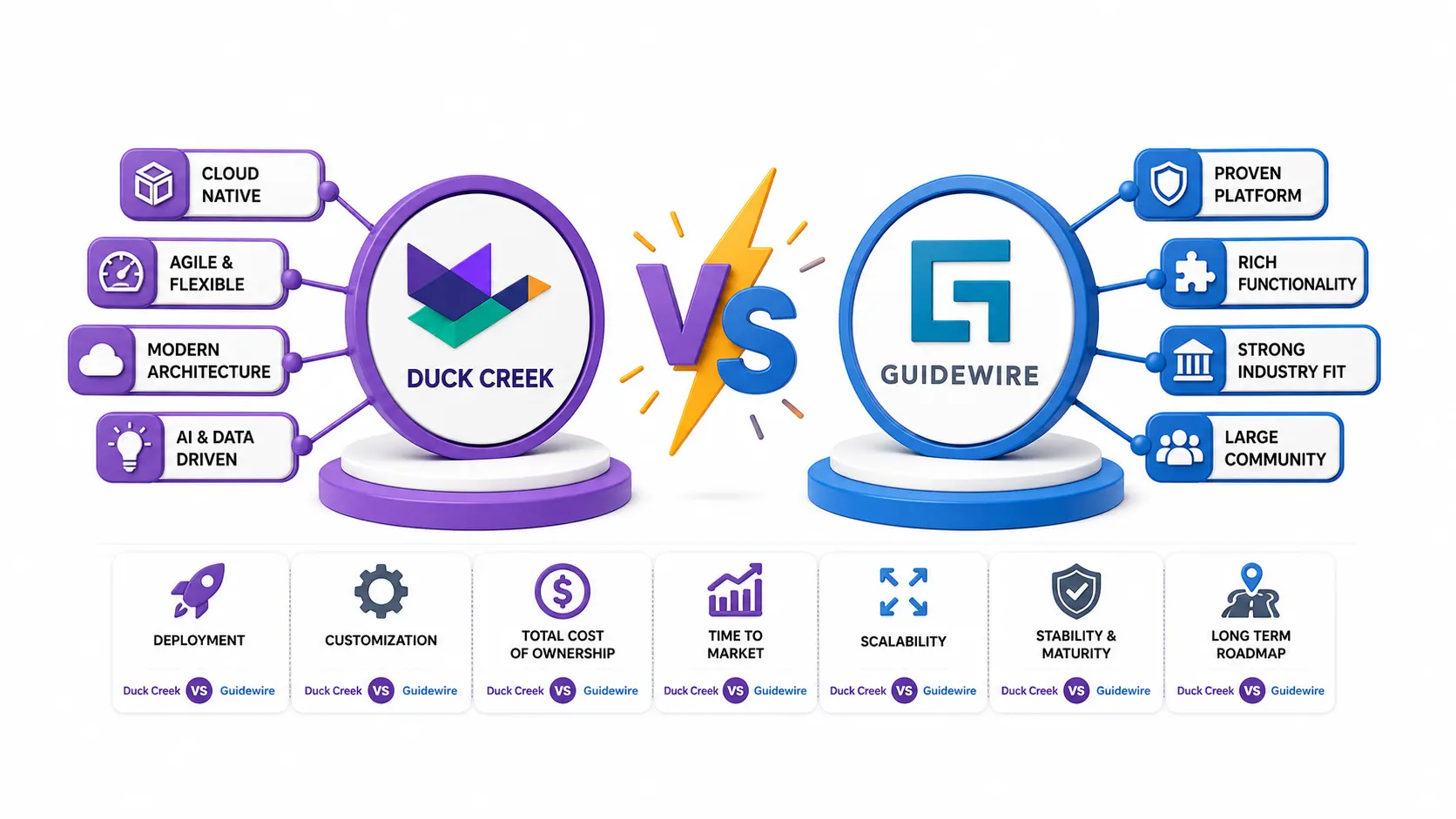
Duck Creek vs Guidewire: The Classic Rivalry
| Feature | Guidewire | Duck Creek |
|---|---|---|
| Primary Market | Large Property & Casualty Insurers | Mid-sized to Enterprise P&C Insurers |
| Core Products | PolicyCenter, ClaimCenter, BillingCenter | Policy, Claims & Billing Platform |
| Deployment Model | Guidewire Cloud & On-Premise | Cloud-native SaaS Platform |
| Implementation Time | 12–36 Months | 6–18 Months |
| Customization | Highly Customizable Using Gosu | Low-code Configuration Tools |
| Ideal For | Complex Enterprise Insurance Operations | Faster Digital Transformation Projects |
| Developer Ecosystem | Strong Global Consulting Ecosystem | Growing Partner & Developer Network |
| Learning Curve | Steeper with Specialized Guidewire Skills | Generally Easier for Configurable Workflows |
If there's one comparison insurance buyers research more than any other, it's Duck Creek vs Guidewire. Both are established core system providers, both target established carriers, and both have decades of implementation history behind them — which is exactly why the choice is so hard.
Duck Creek tends to get praised for its configurability. Its low-code environment lets business analysts, not just developers, adjust rating rules and workflows, which can shorten certain enhancement cycles. Guidewire, by contrast, is often seen as more comprehensive out of the box, particularly for claims handling on complex commercial lines.
Cost structures diverge too. Duck Creek's cloud-first pricing has historically appealed to insurers wary of Guidewire's implementation overhead. That said, neither platform is what anyone would call cheap, and total cost of ownership depends heavily on how much customization your book of business demands.
We've broken this rivalry down in far more detail in our dedicated comparison of Guidewire and Duck Creek, which is worth a read if this is your top contender. For now, know this: Duck Creek usually wins on agility, Guidewire on depth.
Instanda vs Guidewire: Speed Versus Scale
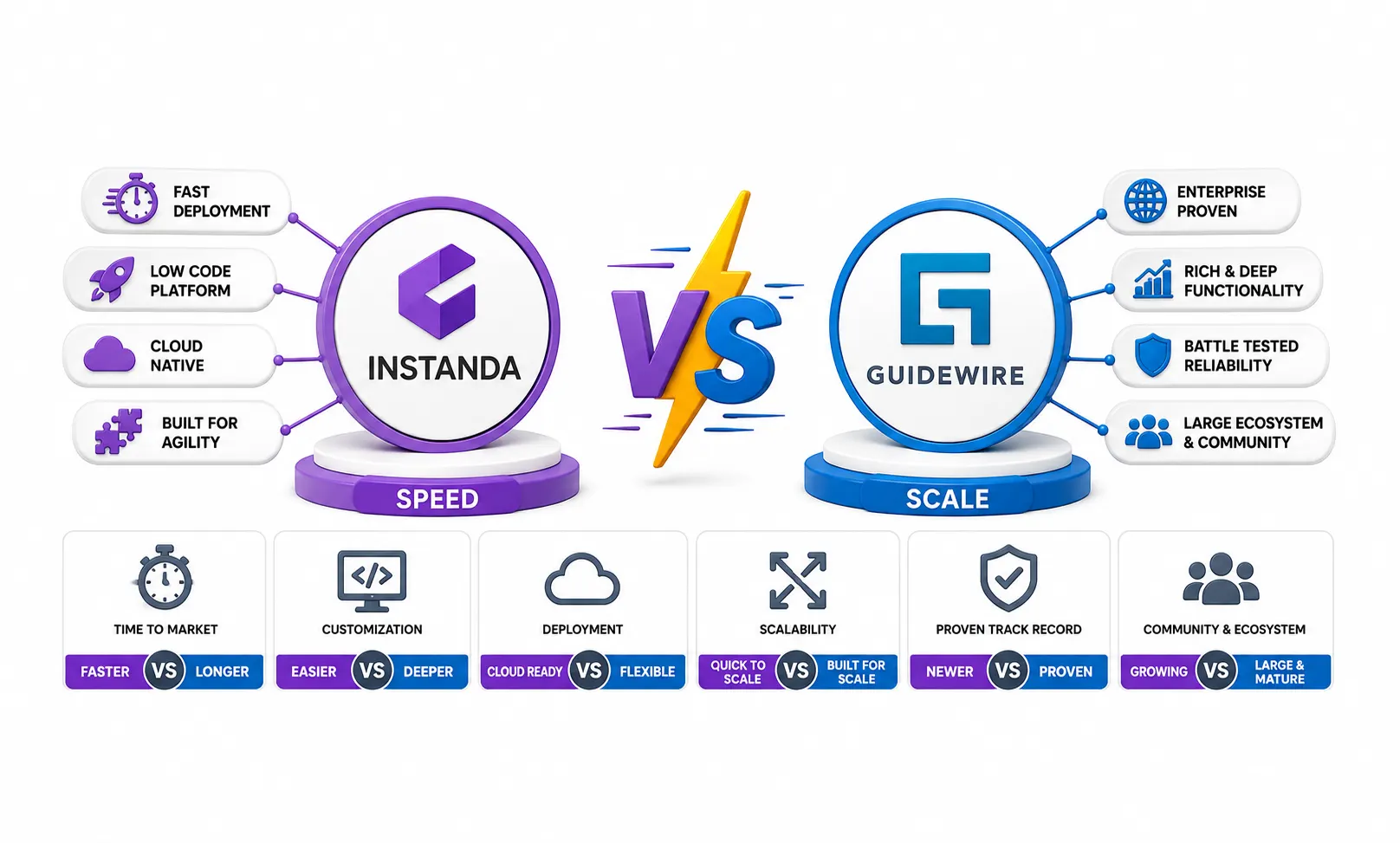
Instanda vs Guidewire is a different kind of matchup entirely — it's not two giants circling each other, it's a nimble challenger against an established incumbent. Instanda built its platform around one core idea: insurance products should be launchable in weeks, not quarters.
That speed comes from a no-code product builder. Underwriters and product teams can configure new policies, adjust pricing logic, and push changes live without waiting on a development queue. For MGAs and insurtechs testing new products in tight windows, that responsiveness is often the deciding factor.
Guidewire simply wasn't built for that pace. Its strength lies in handling enormous transaction volumes and intricate regulatory requirements across multiple lines of business — the kind of scale a large national carrier needs, not a startup launching a single parametric product.
The honest takeaway: Instanda suits speed-to-market plays, while Guidewire suits carriers already operating at scale who need depth over agility. Choosing between them really comes down to which constraint hurts your business more — slow launches or shallow functionality.
Guidewire vs Federato: Where Underwriting Intelligence Comes In
| Comparison Area | Guidewire | Federato |
|---|---|---|
| Platform Focus | Enterprise P&C insurance platform covering policy, billing, claims, underwriting, and related insurance operations. | AI-native insurance platform designed to connect underwriting, policy administration, billing, claims, and portfolio intelligence. |
| Underwriting Intelligence | Uses data, automation, analytics, and AI to support risk assessment, submission processing, triage, and underwriting decisions. | Places AI-driven underwriting and decision intelligence at the center of the platform, with emphasis on real-time risk and portfolio context. |
| Submission Handling | UnderwritingCenter can help ingest, enrich, summarize, triage, and assess commercial submissions before they move toward policy processing. | Uses AI to process submission information, identify relevant risks, assess appetite, and support underwriting workflows. |
| Risk & Portfolio View | Provides risk analysis and portfolio intelligence through Guidewire's underwriting and analytics capabilities. | Connects underwriting decisions with portfolio-level context, including appetite, controls, and exposure. |
| Core Insurance Operations | Strong emphasis on core insurance operations through PolicyCenter, ClaimCenter, BillingCenter, and the broader InsuranceSuite ecosystem. | Designed to bring policy administration, underwriting, billing, claims, and portfolio workflows together on an AI-native foundation. |
| Best-Fit Context | Particularly relevant for insurers requiring a broad, configurable enterprise P&C insurance platform and an extensive integration ecosystem. | Particularly focused on carriers and MGAs looking for AI-native underwriting workflows and connected portfolio decision-making. |
| Where Intelligence Comes In | Intelligence is increasingly embedded into the underwriting workflow through AI, risk data, analytics, automation, and decision support. | Intelligence is positioned as a foundational part of the platform, connecting underwriting decisions with business rules, portfolio context, and lifecycle data. |
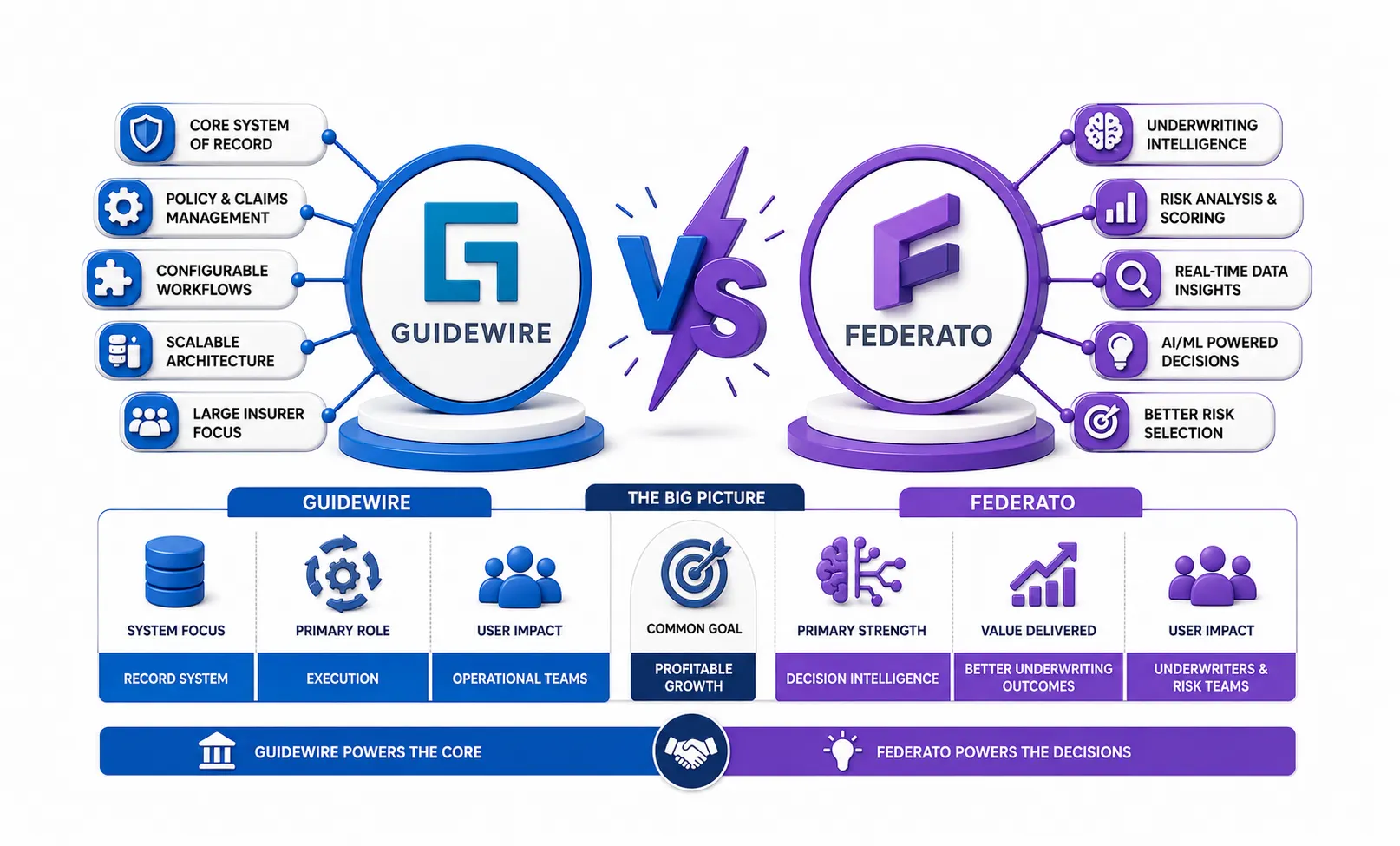
Guidewire vs Federato isn't really an apples-to-apples fight, and understanding why matters. Guidewire is a core system — policy, billing, and claims administration. Federato is a decision-intelligence layer built specifically to optimize underwriting portfolio decisions.
Federato's RiskOps platform helps underwriters prioritize submissions, balance portfolio risk, and make faster, data-informed appetite decisions. It doesn't replace policy administration — it often sits alongside a core system like Guidewire, feeding underwriters better signals rather than processing the policy lifecycle itself.
So when someone frames this as a straight rivalry, they're usually missing the point. The real question isn't "which one do we pick," but whether your underwriting team needs sharper portfolio intelligence layered on top of whatever core system you already run.
For carriers frustrated with underwriter workload and inconsistent risk selection, adding a tool like Federato can solve a problem Guidewire was never designed to address. It's a reminder that "competitor" doesn't always mean "replacement" — sometimes it means "complement."
Read more about ;- Guidewire VS Salesforce Detail Comparison
Guidewire vs Zywave and Guidewire vs Applied Systems: The Agency Side of the Equation
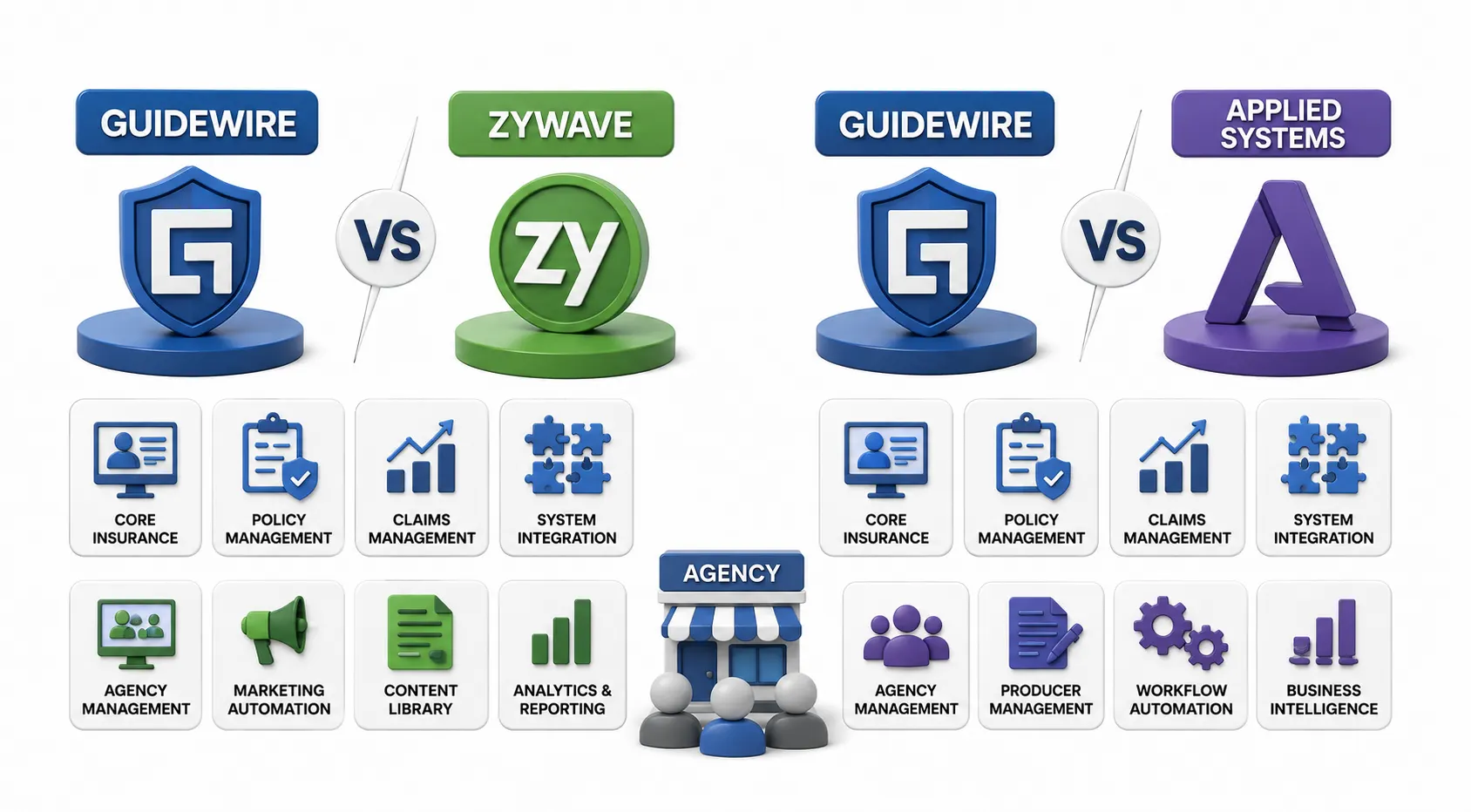
Here's where things get interesting: Guidewire vs Zywave and Guidewire vs Applied Systems aren't really about core insurance administration at all. Zywave and Applied Systems primarily serve the agency and broker side of the business, not carriers running policy and claims operations.
Zywave focuses on agency management tools — content, analytics, and client engagement platforms that help brokers retain business and demonstrate value. Applied Systems, through Applied Epic and related products, dominates agency management systems, handling the day-to-day workflow of independent agencies.
Guidewire, meanwhile, stays firmly on the carrier side. A carrier running Guidewire and an agency running Applied Epic aren't choosing between the same tool — they're solving entirely different operational problems within the same insurance ecosystem.
The confusion usually comes from people assuming "insurance software" is one category. It isn't. Knowing whether you need a core carrier system, an agency management platform, or both prevents a lot of wasted evaluation time — and a lot of awkward vendor calls that go nowhere.
Servicenow vs Guidewire: Workflow Engine or Insurance Platform?
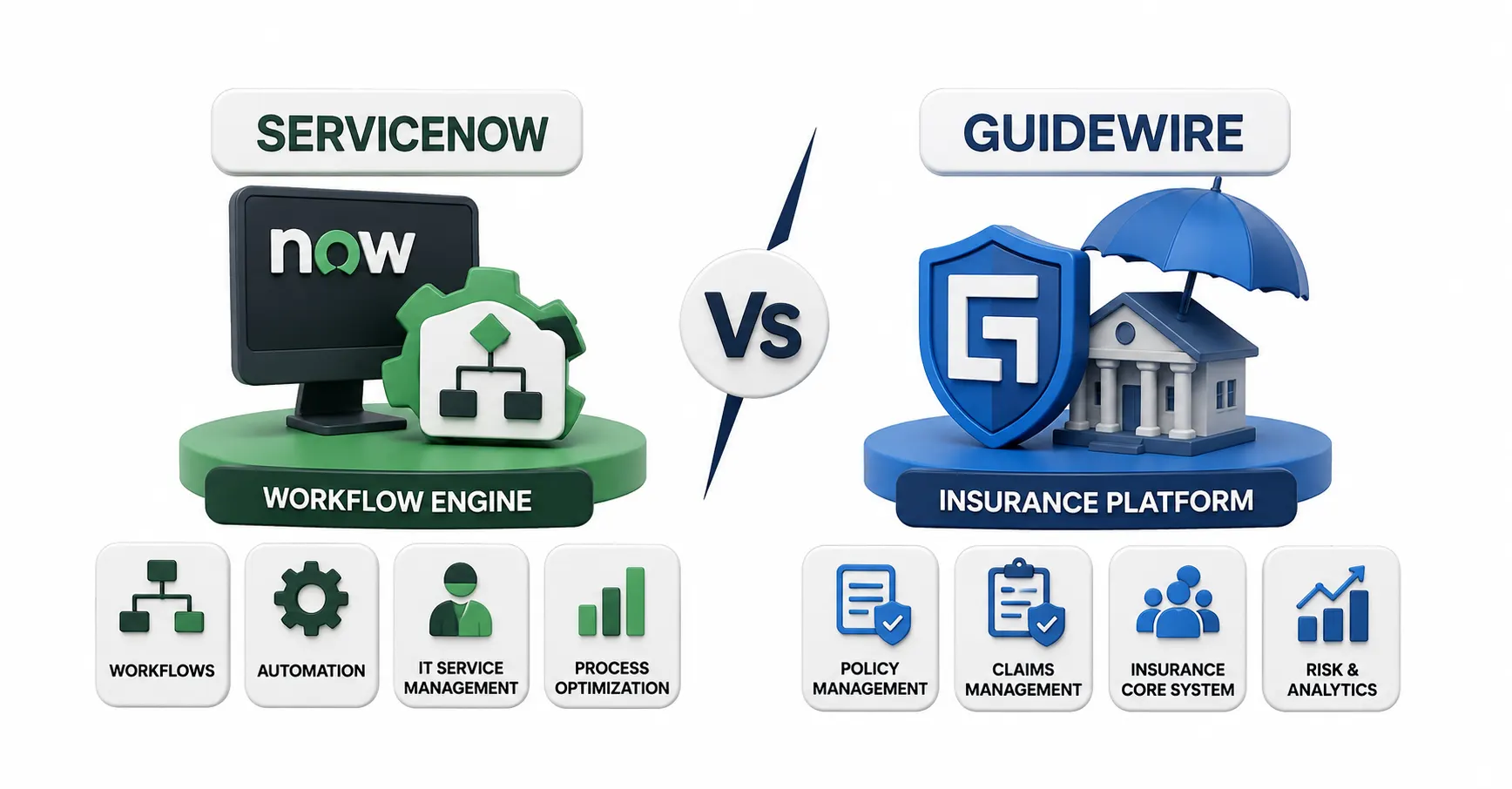
ServiceNow vs Guidewire comes up more often than you'd expect, and it deserves a straight answer. ServiceNow is a workflow and IT service management platform that has expanded into insurance through its Financial Services Operations offering. Guidewire is purpose-built insurance software from the ground up.
ServiceNow's appeal is integration. Large enterprises already running ServiceNow for IT ticketing or HR often like the idea of extending that same platform into claims or underwriting workflows, keeping everything under one operational roof.
But purpose-built usually wins on depth. Guidewire's rating engines, regulatory compliance tools, and insurance-specific data models reflect decades of industry-specific development that a generalist workflow platform can't fully replicate, no matter how configurable it becomes.
If your organization is deeply invested in the ServiceNow ecosystem already, the integration argument has real weight. Otherwise, a dedicated core platform will typically serve an insurance-specific workflow better than a retrofitted enterprise tool. For a broader view of how these platforms stack up, our insurance platform comparison guide covers several more angles worth considering.
Conclusion
Choosing among Guidewire competitors isn't about finding the "best" platform — it's about matching your carrier's size, speed, and complexity to the right tool. Define your priorities first, then let the comparison guide you, not the other way around.