

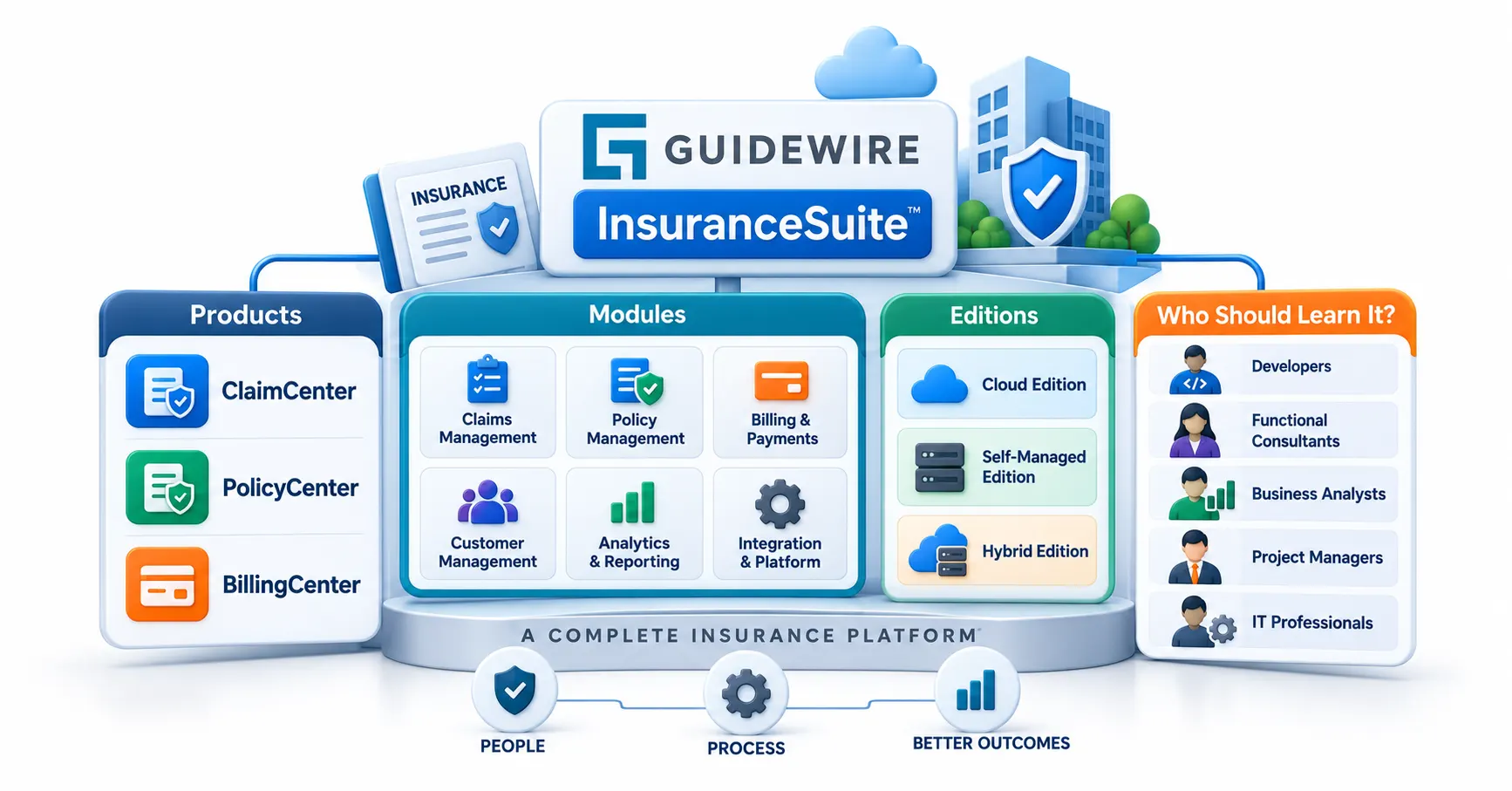
Guidewire InsuranceSuite Overview: Products, Modules, Editions & Who Should Learn It
Navigate through this article using the table of contents below
Table of Contents
No headings found in this article.
Picture an insurance company still running claims through spreadsheets and phone calls while a storm hits three states at once. Chaos, right? That's the exact problem Guidewire InsuranceSuite was built to solve.
Today it quietly powers policy issuance, billing, and claims for some of the biggest insurers on the planet. But what's actually inside this platform, and does learning it make sense for you? Let's unpack it.
What Exactly Is Guidewire InsuranceSuite, and Why Do Insurers Swear By It?
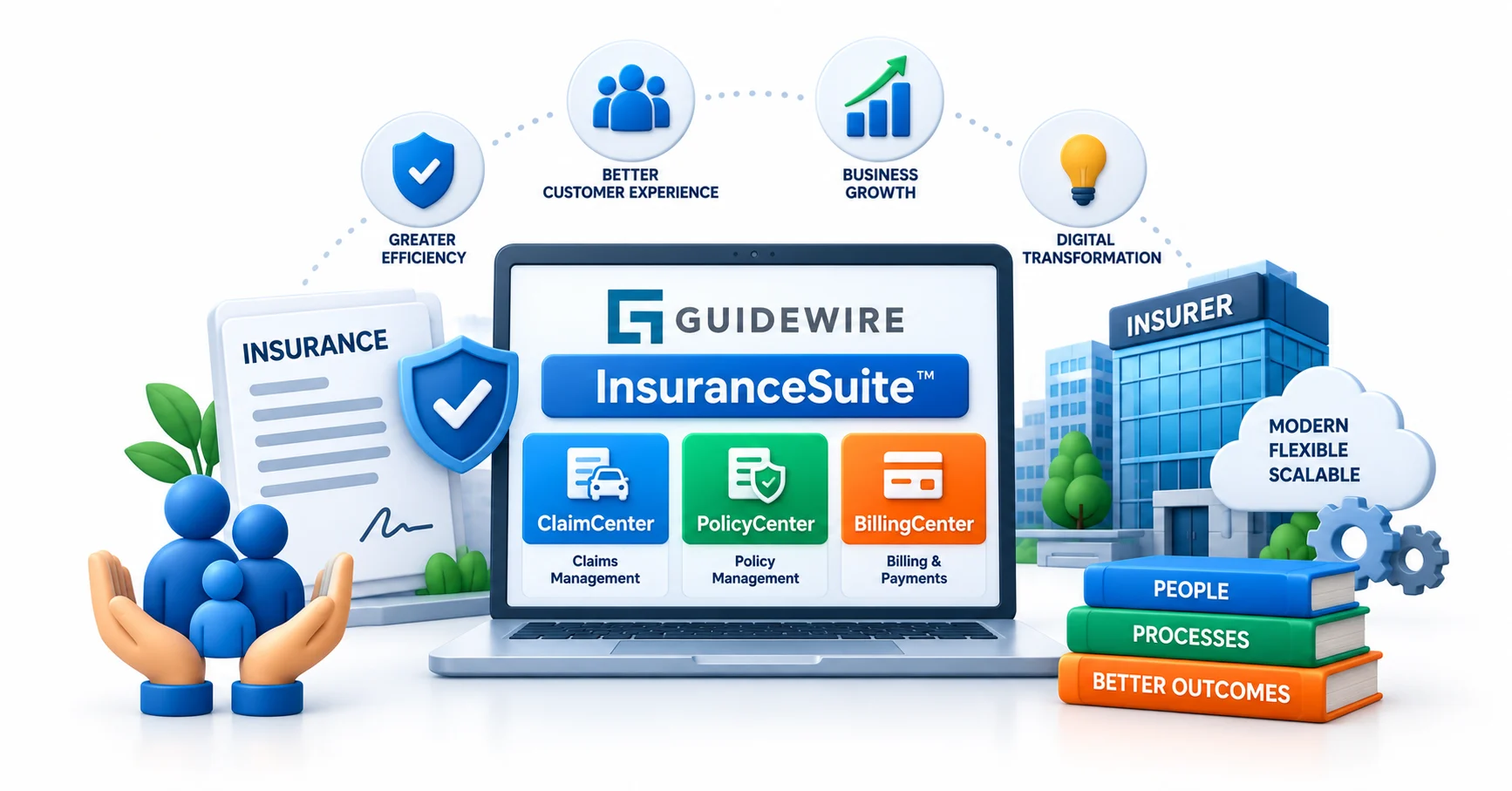
At its core, Guidewire InsuranceSuite is a software platform built specifically for property and casualty (P&C) insurers. Instead of stitching together five different tools for policy management, billing, and claims, insurers get one connected ecosystem. That matters more than it sounds like on paper.
Before platforms like this existed, insurance companies relied on legacy mainframe systems that were expensive to maintain and painfully slow to update. A simple rate change could take months to implement. Guidewire changed that math entirely by giving carriers a configurable, modern architecture.
What really sets it apart is flexibility. Insurers in different countries, handling different lines of business, can configure the same core platform to match their regulatory and operational needs. A commercial auto insurer in Ohio and a homeowners insurer in Australia can both run InsuranceSuite, just configured very differently underneath.
This adaptability is precisely why so many Tier 1 and Tier 2 insurance carriers have standardized on it. It's not the flashiest software in the insurtech world, but it's dependable, scalable, and deeply trusted by an industry that doesn't tolerate downtime well.
Breaking Down the Core Modules: PolicyCenter, ClaimsCenter, and BillingCenter
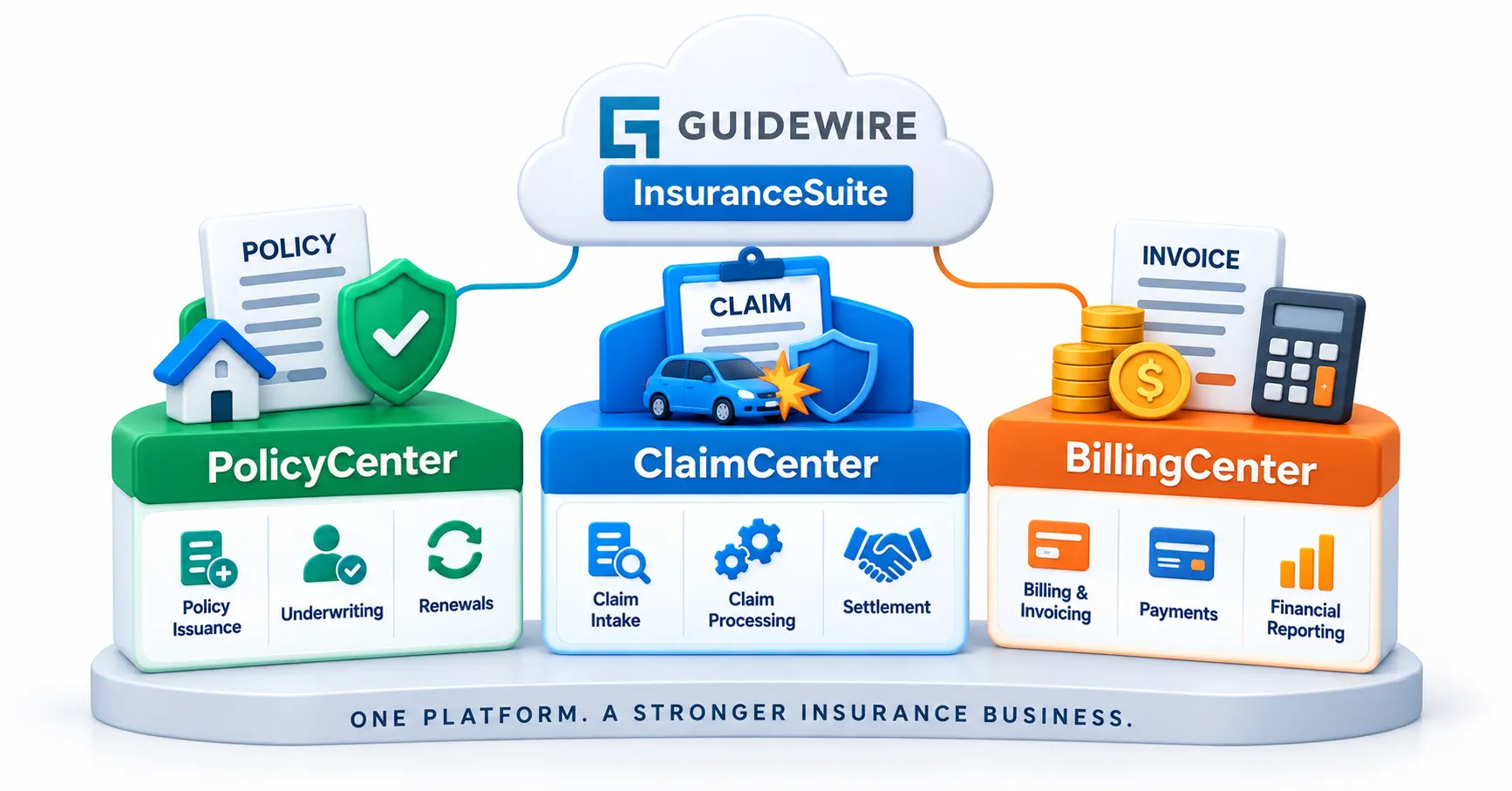
Guidewire InsuranceSuite isn't one monolithic application. It's three major modules working in sync, each handling a distinct piece of the insurance lifecycle.
PolicyCenter manages everything related to policy administration: quoting, underwriting, renewals, and endorsements. It's usually the first module insurers implement because policies are where the customer relationship begins.
ClaimsCenter takes over the moment something goes wrong. Think of a car accident or a flooded basement. This module tracks the claim from first notice of loss all the way through settlement, coordinating adjusters, reserves, and payments along the way.
BillingCenter handles the money side: invoicing, payment plans, collections, and commission tracking. It talks constantly with PolicyCenter and ClaimsCenter so financial data stays accurate across the board.
Here's a practical example: when a customer adds a new driver to their auto policy in PolicyCenter, BillingCenter automatically recalculates the premium and adjusts the next invoice. That kind of real-time synchronization is what makes these Guidewire modules genuinely useful rather than just three separate apps sharing a login screen.
The Hidden Engine Behind Guidewire InsuranceSuite: Gosu and the Platform Layer
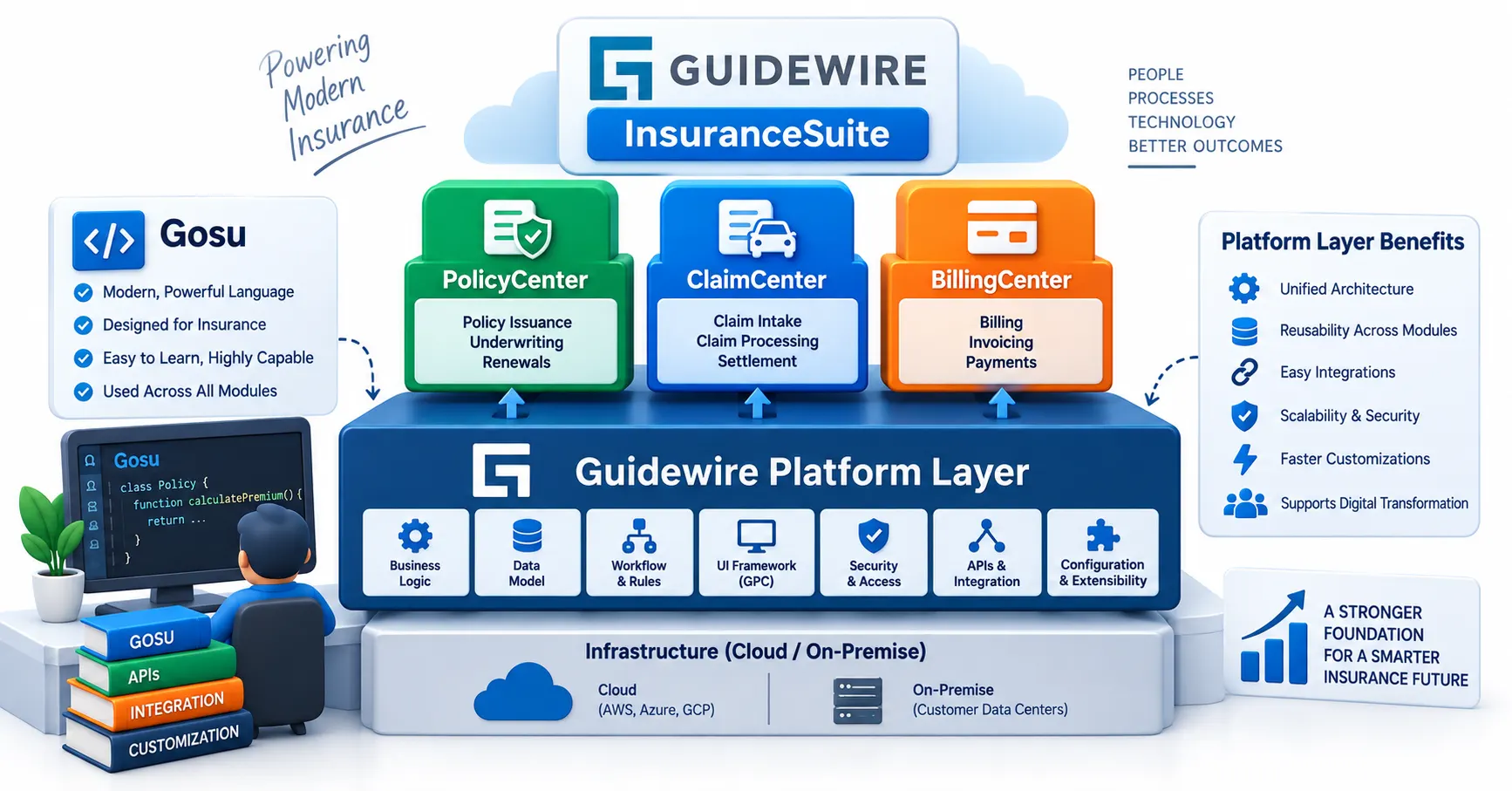
Underneath all three modules sits something most outsiders never hear about: a proprietary programming language called Gosu. It's what makes InsuranceSuite configurable rather than rigid.
Gosu was designed specifically for the insurance domain, borrowing familiar syntax from Java while adding features that make business rule customization faster. Underwriters need different rating algorithms. Claims teams need different workflow rules. Gosu is the language developers use to build all of that without rewriting the platform's core.
If you're curious about how this actually works under the hood, this detailed breakdown of what is Gosu in Guidewire is worth reading before you go any further in your learning path.
Beyond Gosu, there's also the Guidewire Studio (the development IDE), the Configuration and Integration layers, and Guidewire Cloud Platform services like Jutro for UI design. Together, these form what's often called the "platform layer," the plumbing that lets consultants and developers customize InsuranceSuite without touching Guidewire's core codebase.
Understanding this layer is genuinely the difference between someone who can click around the software and someone who can actually build within it professionally.
Cloud vs On-Premise: Which Guidewire Edition Actually Fits Your Business?
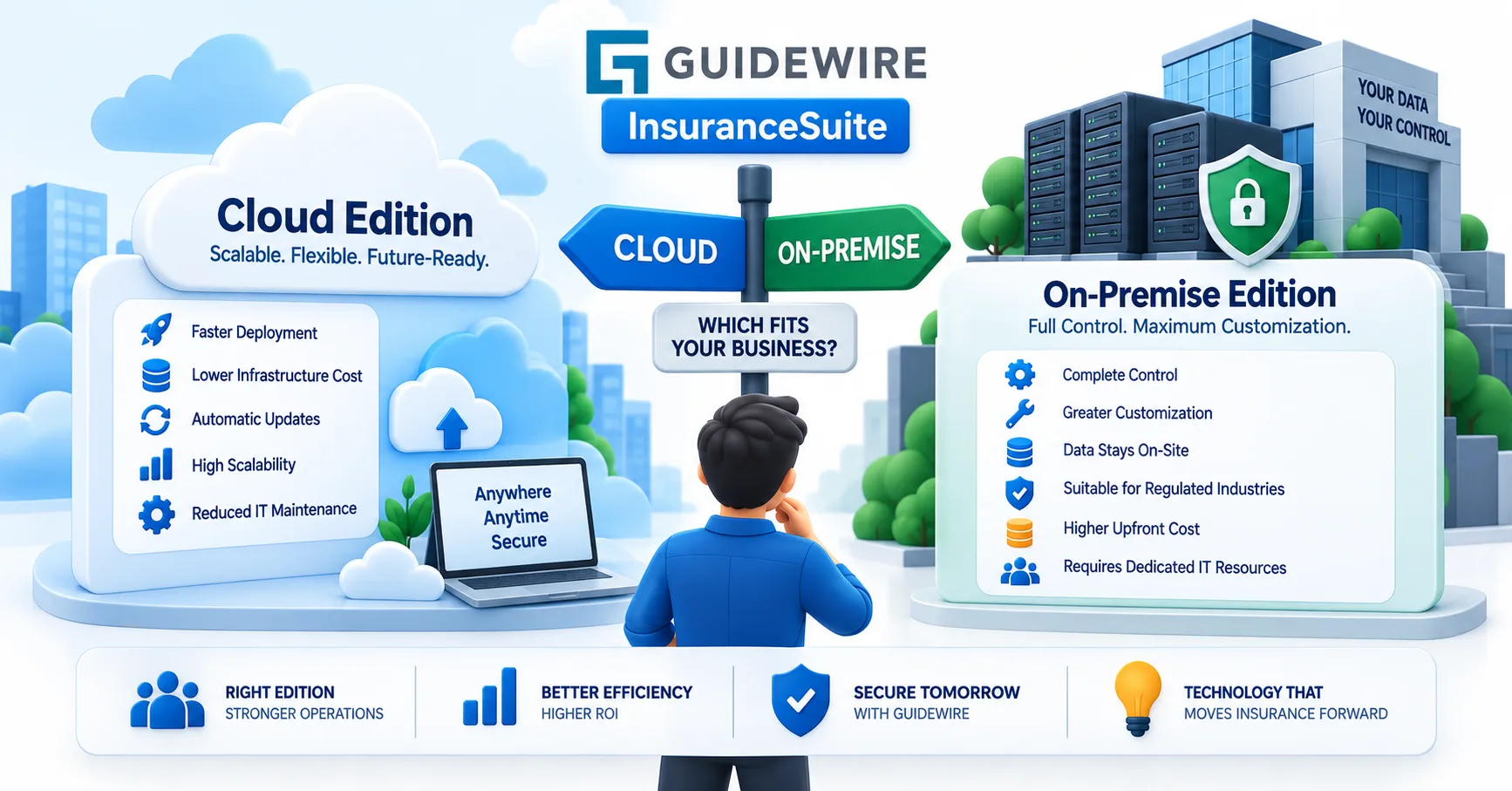
For years, Guidewire InsuranceSuite was primarily deployed on-premise, meaning insurers ran it on their own servers with their own IT teams managing every upgrade. That model still exists, but it's fading fast.
Guidewire Cloud is now the company's flagship offering, and for good reason. Insurers get automatic upgrades, reduced infrastructure overhead, and faster access to new features without a lengthy in-house deployment cycle. Guidewire itself has pushed hard toward a "cloud-first" strategy, encouraging existing customers to migrate their legacy on-premise installations.
That said, on-premise deployments haven't vanished overnight. Some larger, heavily regulated insurers still prefer direct control over their infrastructure, particularly in regions with strict data residency rules.
The practical difference for someone working with the platform is significant. Cloud implementations lean more on standard configuration and pre-built integrations, while legacy on-premise setups often involve deeper, more custom code changes. Neither is objectively "better" for every situation; it depends on the insurer's size, regulatory environment, and appetite for change. But if you're planning a career around this platform, know that cloud skills are increasingly what employers are actively hiring for.
Who Should Actually Learn Guidewire InsuranceSuite (And Who Shouldn't Bother)?
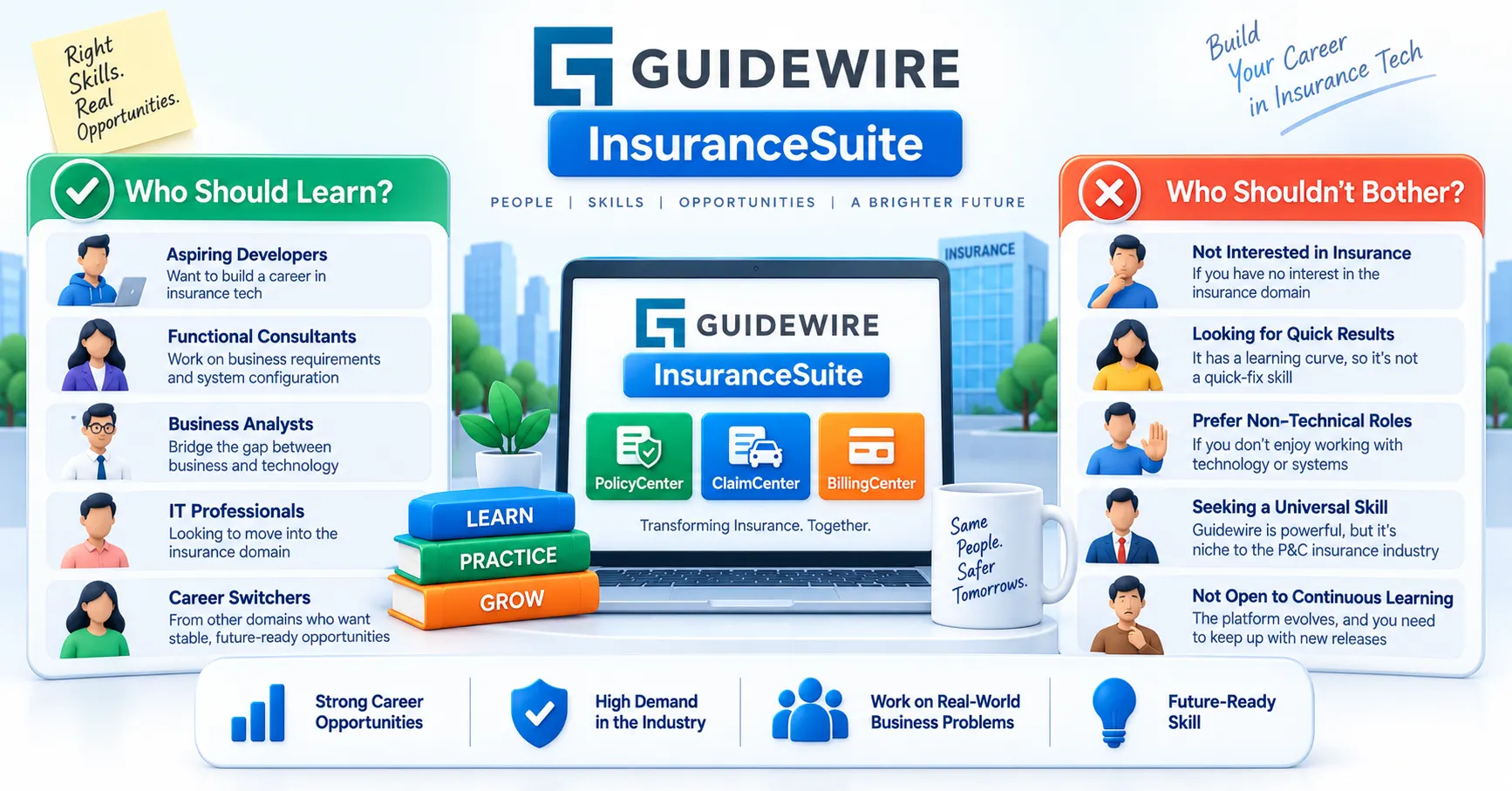
Not everyone needs to learn this platform, and that's worth saying plainly. If you're a general software developer with no interest in the insurance domain, there are probably faster-growing tech stacks to invest your time in.
But for a specific group of people, it makes enormous sense. Developers who already know Java will find Gosu approachable within weeks, not months. Business analysts working in insurance operations gain real leverage by understanding how configuration decisions ripple through underwriting and claims. QA testers, integration specialists, and even project managers benefit from understanding the platform's structure, since insurance IT projects rarely run in isolated silos.
There's also a practical career angle here. Guidewire implementations are large, multi-year projects, and insurers consistently struggle to find enough trained professionals to staff them. That skills gap hasn't closed in over a decade, which tells you something about demand versus supply.
If any of this resonates, structured Guidewire training in India is one of the more direct routes into the ecosystem, especially for professionals transitioning from general IT or insurance operations backgrounds into a specialized, higher-paying niche.
Building a Career Around Guidewire InsuranceSuite: What the Job Market Looks Like
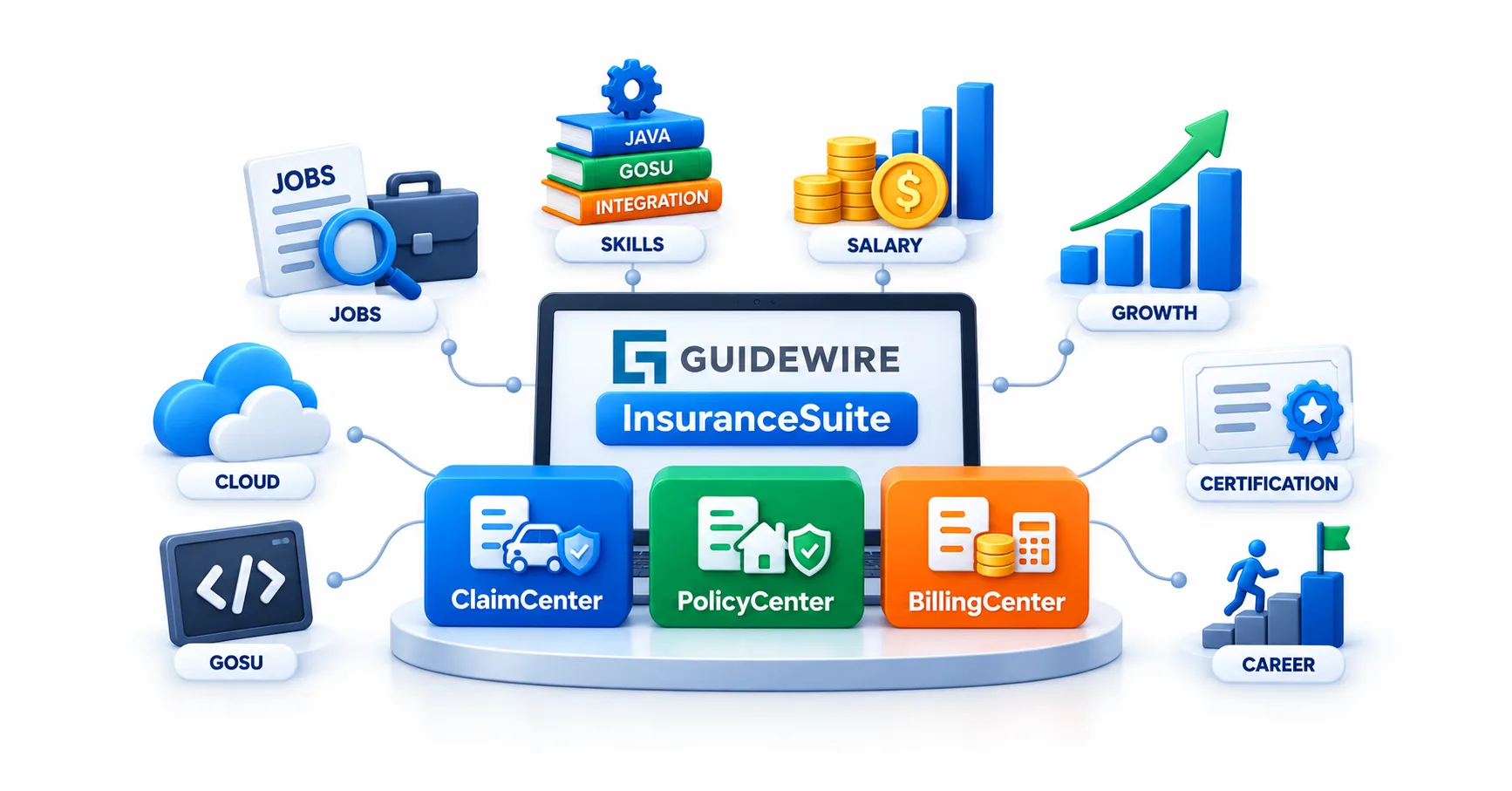
Guidewire consultants and developers aren't cheap to hire, and that's precisely why the career path is attractive. Insurers can't just pull talent from a generic developer pool. They need people who understand both the software and the industry it serves.
Roles typically fall into a few buckets: configuration developers who build within PolicyCenter, ClaimsCenter, or BillingCenter; integration developers who connect InsuranceSuite to external systems like payment gateways or data providers; and business analysts who bridge the gap between underwriters and the technical team.
What's interesting is how the career trajectory tends to work. Most professionals don't start as Guidewire experts; they pivot in from Java development, QA, or insurance operations, then specialize once they see the demand firsthand. This is different from many tech careers where you either start in the niche or never enter it at all.
For anyone weighing this path seriously, this practical guide on how to start your Guidewire career walks through the realistic first steps, without overselling how easy the transition is. Because it isn't effortless, but it is achievable with the right structured approach and consistent practice on real project scenarios.
Conclusion
Guidewire InsuranceSuite isn't just software; it's the operational backbone for insurers managing policies, billing, and claims at scale. Whether you're evaluating it as a business tool or a career skill, understanding its modules and editions gives you a genuine head start in a niche the industry still can't staff fast enough.