


Highest Paying VLSI Job Roles in India and Global market
Navigate through this article using the table of contents below
Table of Contents
No headings found in this article.
The semiconductor industry has entered one of its fastest periods of growth. AI processors, automotive electronics, 5G devices, high-performance computing, and advanced packaging are creating thousands of new engineering opportunities across the world.
For aspiring engineers, the biggest question is no longer whether VLSI is a good career—it is which specialization offers the highest salary and strongest long-term growth. Understanding these roles helps students build the right technical skills from the beginning.
RTL Design Engineer – Building the Digital Brain of Modern Chips
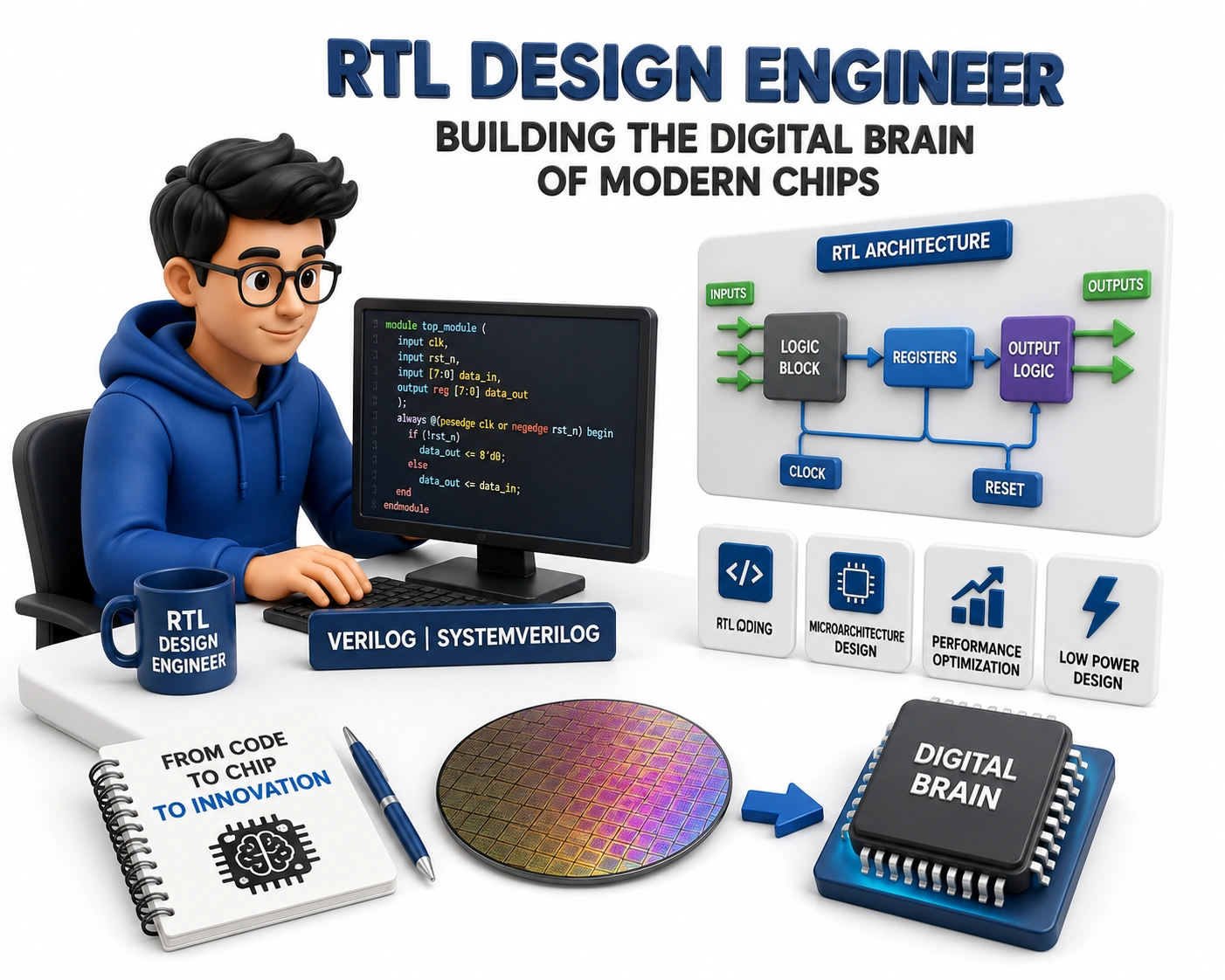
RTL Design Engineers create the digital logic that becomes the foundation of processors, networking chips, AI accelerators, automotive controllers, and consumer electronics. Every semiconductor product begins with a well-designed RTL architecture, making this one of the most valuable engineering roles.
Engineers in this domain primarily work with Verilog, SystemVerilog, finite state machines, pipelining, clock domain management, low-power design, and synthesis-ready coding. Strong problem-solving ability and understanding of digital electronics directly influence career growth.
Typical responsibilities include:
Writing synthesizable RTL
Microarchitecture implementation
Performance optimization
Low-power logic design
Design documentation
Functional debugging
Because product companies continuously develop new chips, experienced RTL engineers often receive attractive compensation packages in both India and international markets.
ASIC Verification Engineer – Ensuring Chips Work Before Manufacturing
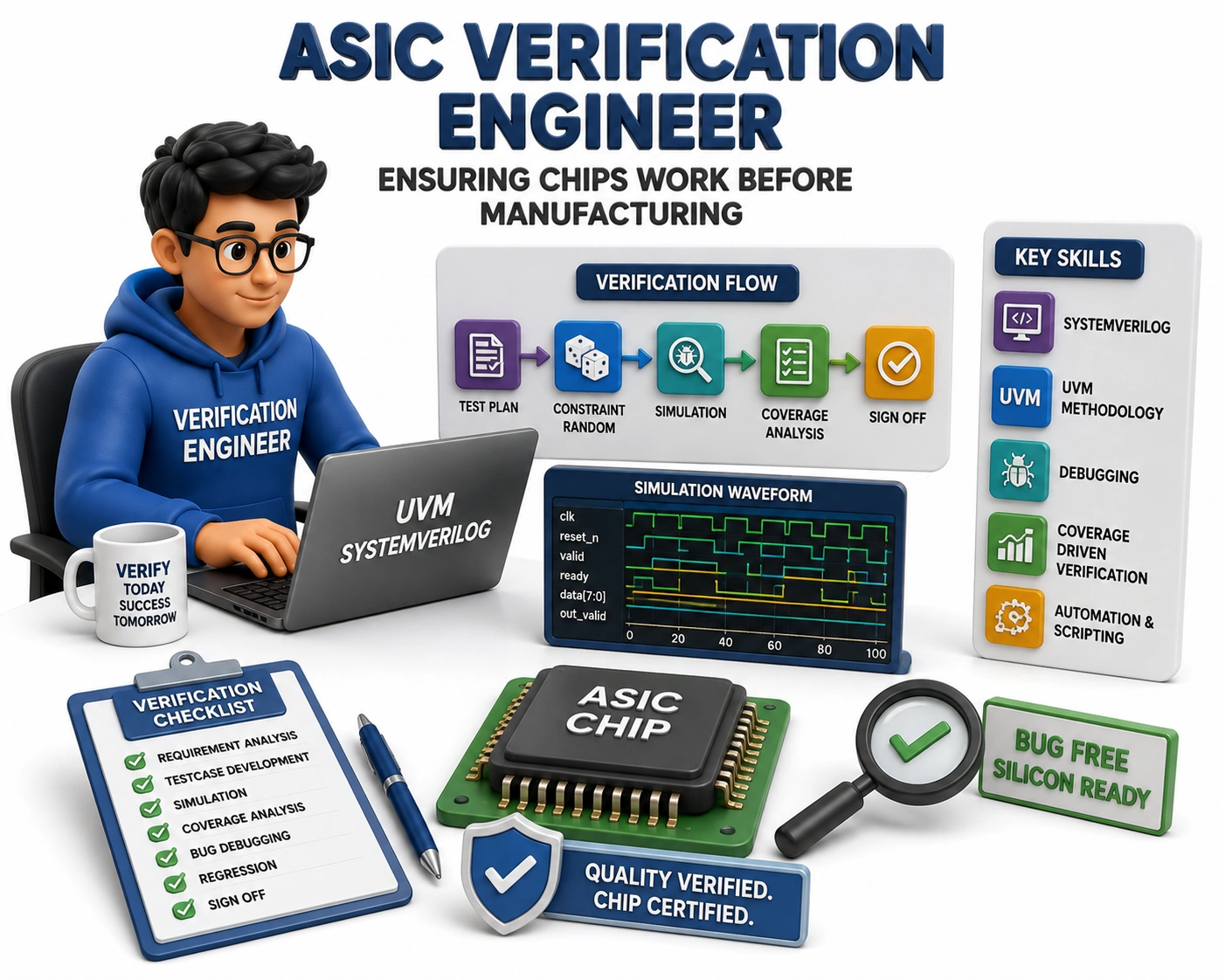
Verification has become one of the largest engineering functions in semiconductor companies because manufacturing errors can cost millions of dollars. Verification engineers ensure every feature behaves correctly before fabrication begins.
Modern verification requires expertise beyond simulation. Engineers work with constrained random verification, SystemVerilog, UVM methodology, assertions, coverage analysis, and regression automation.
High-paying verification professionals usually possess:
UVM expertise
Functional coverage planning
Protocol verification
Debugging complex failures
Automation scripting
Regression management
As chip complexity increases with AI and automotive processors, verification continues to be one of the safest and highest-paying long-term VLSI careers.
Physical Design Engineer – Turning Logic into Silicon
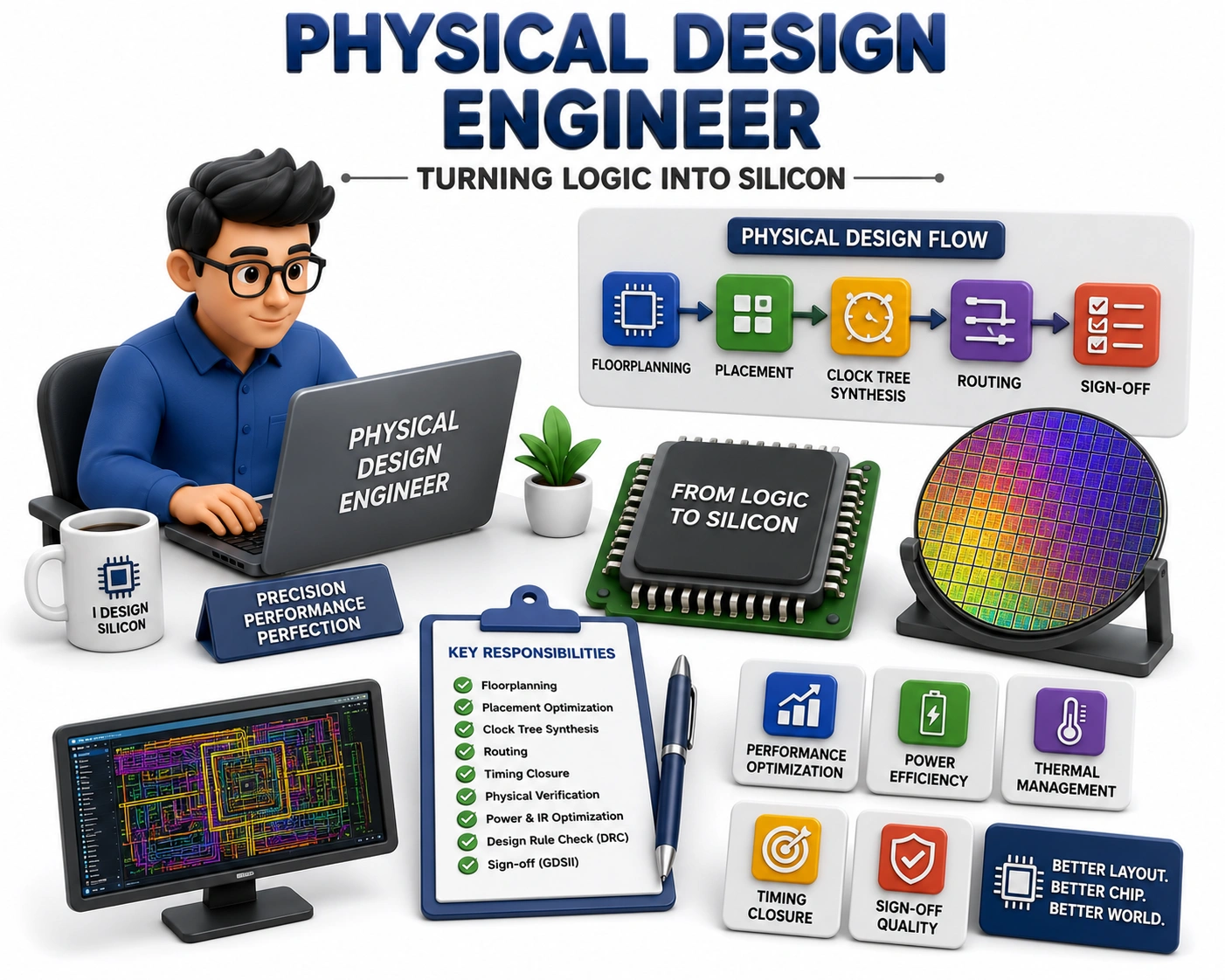
After RTL development, Physical Design Engineers transform logical circuits into manufacturable silicon layouts. Their work directly impacts chip performance, power consumption, thermal efficiency, and manufacturing success.
The role combines engineering precision with optimization techniques across multiple implementation stages.
Major responsibilities include:
Floorplanning
Placement optimization
Clock Tree Synthesis
Routing
Timing closure
Physical verification
Signal integrity optimization
Large semiconductor companies increasingly seek engineers capable of handling advanced technology nodes, where design complexity grows dramatically. These specialists command premium salaries because their expertise directly affects production success.
DFT and Post-Silicon Validation Engineers – Improving Manufacturing Quality
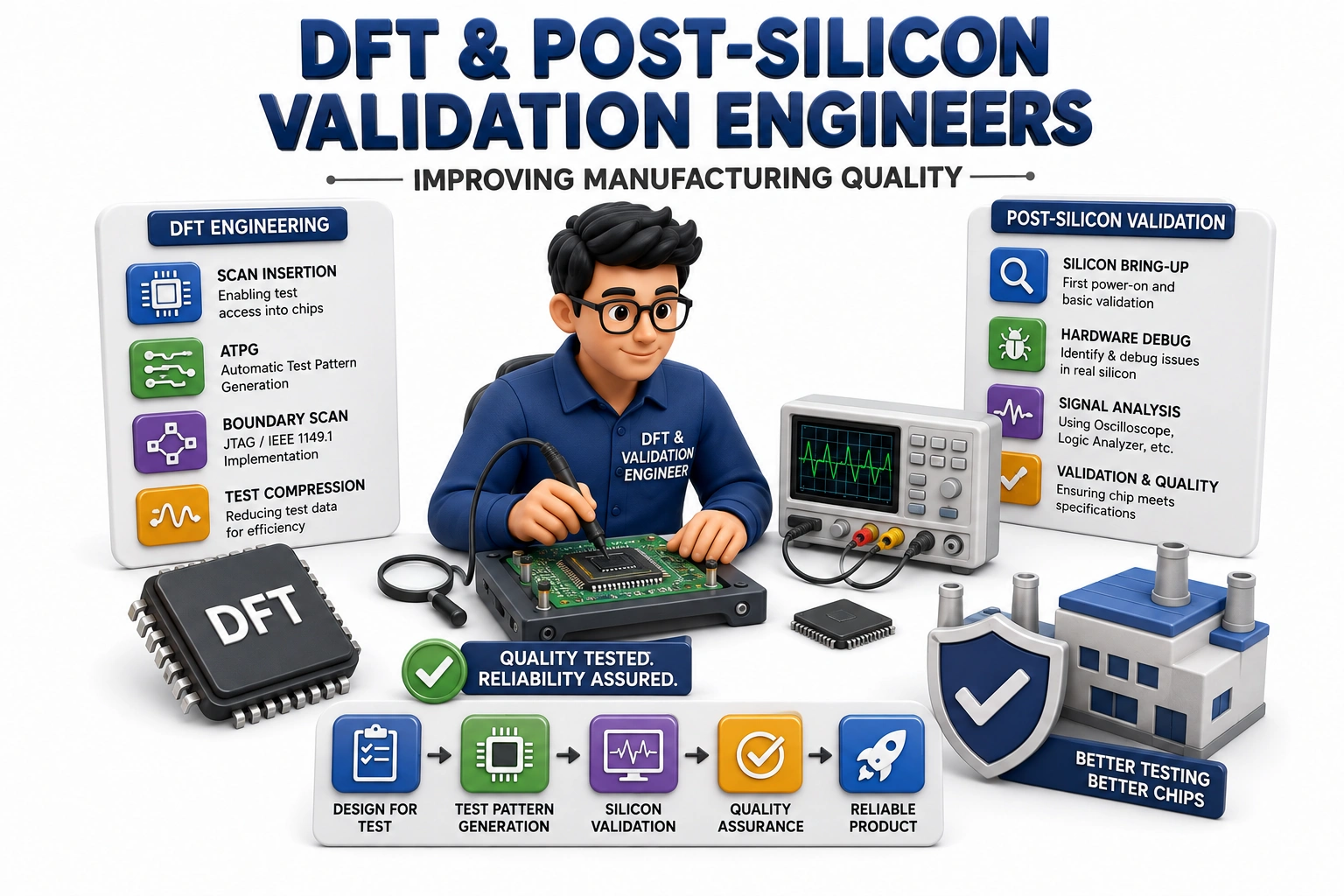
Testing modern integrated circuits requires specialized engineering skills. Design-for-Test (DFT) engineers build test structures inside chips, while Post-Silicon Validation engineers validate hardware after fabrication.
These professionals bridge design and manufacturing, ensuring products meet quality standards before mass production.
Key technical areas include:
Scan insertion
ATPG
Boundary scan
JTAG
Silicon debugging
Lab validation
Hardware debugging
Oscilloscope and logic analyzer usage
Companies developing automotive, aerospace, networking, and AI hardware continue expanding hiring in these domains because hardware reliability remains a competitive advantage.
Analog and Mixed-Signal IC Design Engineers – Specialists in High Demand
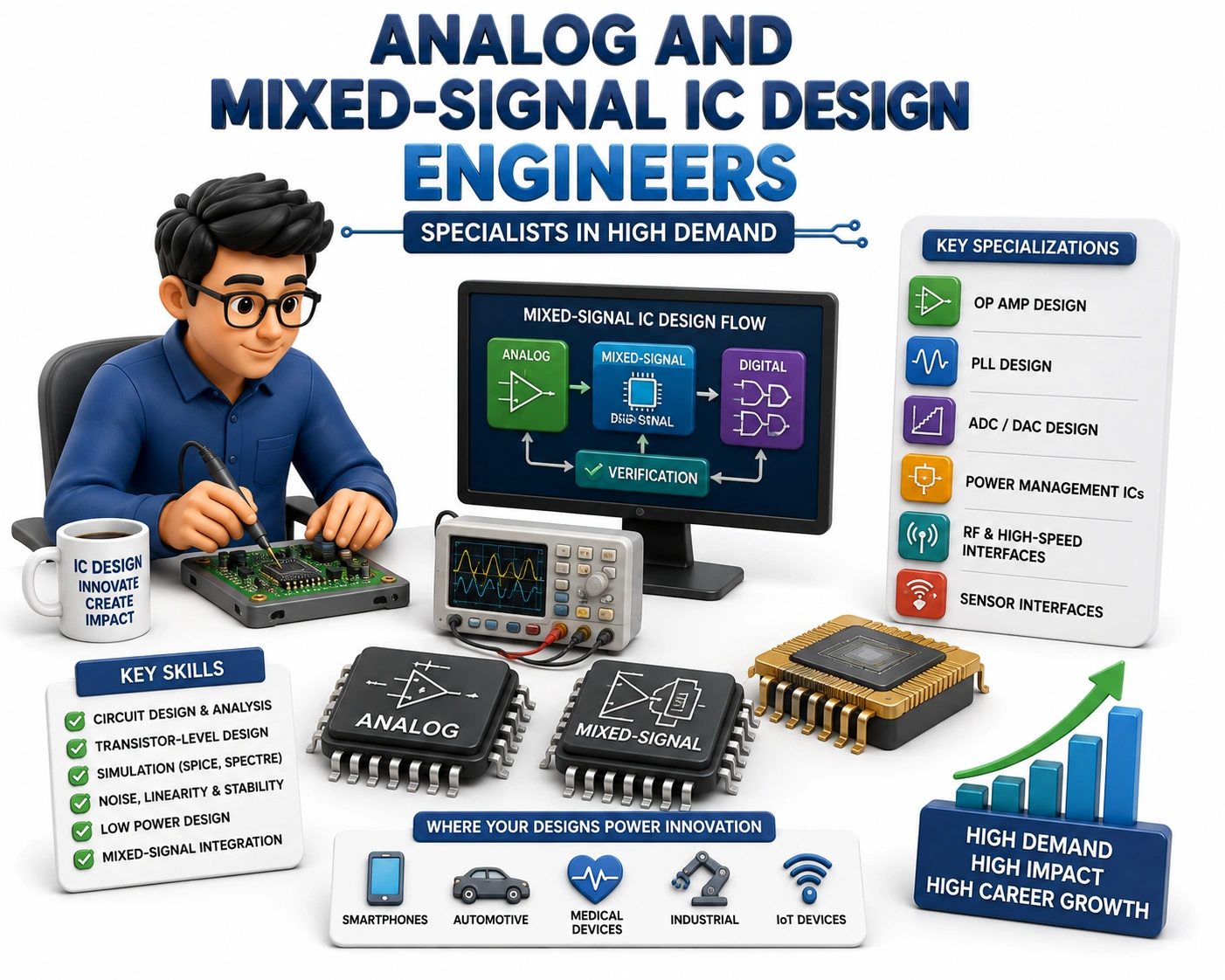
Unlike digital design, Analog IC Design requires deep understanding of transistor behavior, circuit stability, noise analysis, and power optimization. Since fewer engineers master these skills, demand consistently exceeds supply.
Analog engineers design components including:
PLLs
ADCs
DACs
Power management ICs
Voltage regulators
RF front-end circuits
Sensor interfaces
Their expertise is critical in smartphones, medical devices, electric vehicles, industrial automation, and IoT products. Due to the specialized knowledge required, experienced analog designers often rank among the highest-paid semiconductor professionals worldwide.
AI Hardware Architects and Chip Design Specialists – The Future of High Salaries
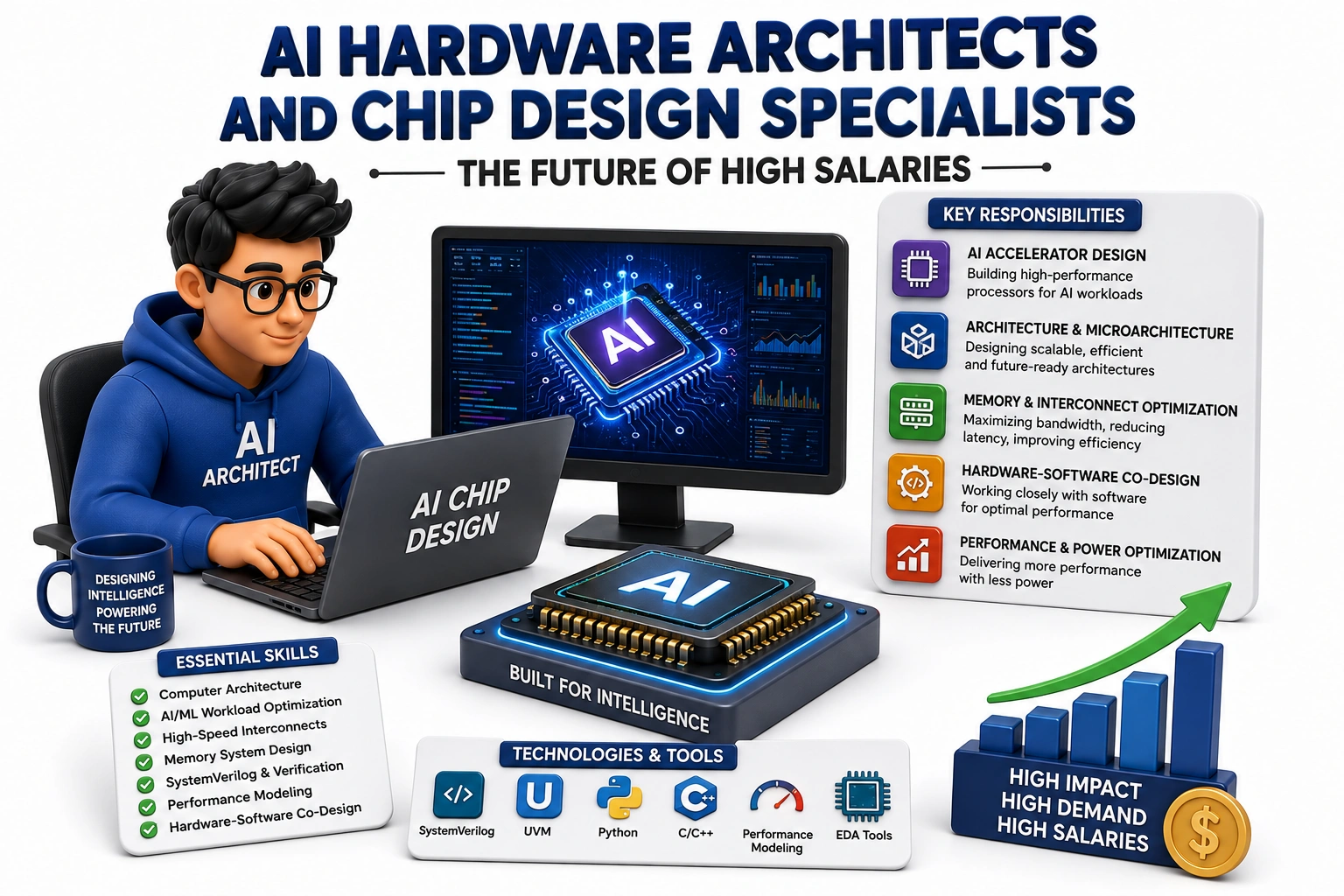
Artificial Intelligence has transformed semiconductor priorities. Companies now require engineers capable of designing processors optimized for machine learning workloads, edge computing, autonomous vehicles, and high-performance computing.
These architects combine digital design with system-level optimization, balancing compute performance, memory bandwidth, energy efficiency, and scalability.
Essential skills include:
Computer architecture
AI accelerator design
High-speed interconnects
Memory subsystem optimization
Hardware-software co-design
Performance modeling
Engineers entering this field today position themselves for some of the industry's fastest salary growth over the next decade.
In today's hiring landscape, many professionals also research VLSI jobs in USA vs India salary comparison, Does VLSI pay more than software engineering?, VLSI engineer salary after 5 years experience, and VLSI classes in India before choosing a specialization, as these topics help evaluate long-term career growth and learning pathways.
Conclusion
The highest-paying VLSI careers are no longer determined solely by years of experience. Employers increasingly reward engineers who solve complex design challenges, understand modern semiconductor workflows, and continuously upgrade their technical expertise. RTL Design, Verification, Physical Design, DFT, Analog IC Design, and AI Hardware Architecture all offer exceptional career opportunities for engineers willing to master advanced tools and methodologies.
For students and working professionals, structured industry-focused learning significantly shortens the journey toward these roles. JastTech provides practical VLSI training that emphasizes real project experience, industry-standard EDA tools, interview preparation, and hands-on implementation. Building strong fundamentals while developing specialized expertise enables engineers to compete confidently in both India's rapidly expanding semiconductor ecosystem and the global chip design market.