

The Complete Guide to Building a GitHub Portfolio for VLSI Projects
Navigate through this article using the table of contents below
Table of Contents
No headings found in this article.
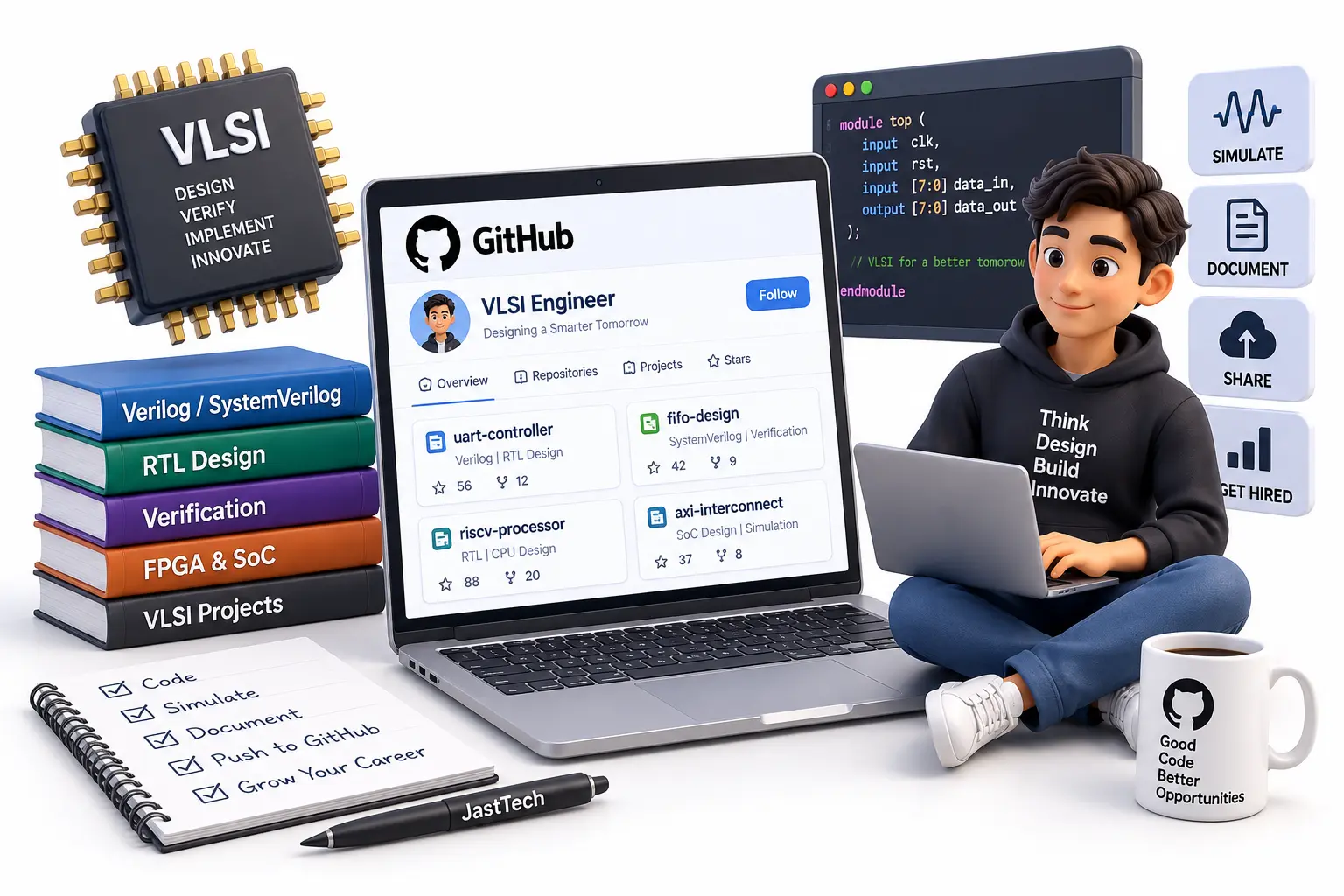
A VLSI project hidden on your laptop cannot prove your engineering skills to anyone. You may have designed an excellent FIFO, verified an ALU or implemented a processor, but recruiters only see a few lines on your resume. A carefully built GitHub portfolio changes that equation.
The goal is not to upload hundreds of Verilog files. Your GitHub should tell an engineering story: what you designed, why you designed it that way, how you verified it and what results you achieved. Done correctly, it becomes evidence behind every technical skill on your resume.
Build Your Portfolio Around the VLSI Role You Want
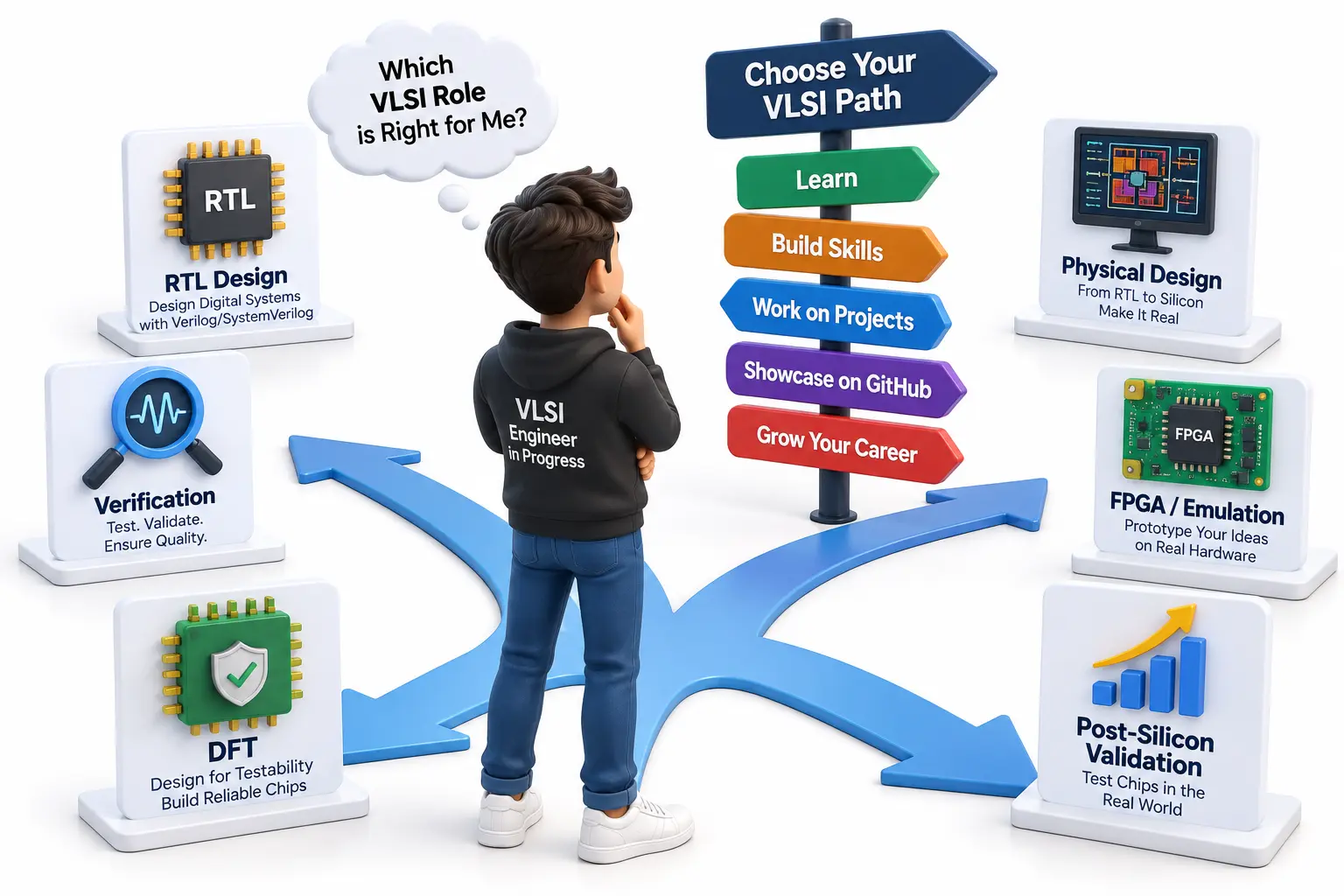
Before creating repositories, decide what engineering profile you want your GitHub to communicate. A candidate targeting RTL design should not build the same portfolio as someone pursuing design verification, DFT or physical design. Random projects create activity, but focused projects establish specialization.
For an RTL-focused portfolio, suitable projects might include an ALU, parameterized FIFO, UART controller, SPI controller, arbiter, cache controller or pipelined RISC-V processor. A verification candidate could take similar DUTs but demonstrate SystemVerilog testbenches, assertions, constrained-random testing, functional coverage and reusable verification components.
A strong project collection could progressively demonstrate:
Digital design and Verilog/SystemVerilog fundamentals
FSM and datapath implementation
Protocol knowledge such as UART, SPI, I2C or APB
FIFO and clock-domain-crossing concepts
Assertions and verification methodology
Synthesis, timing or FPGA implementation
Debugging and engineering decision-making
Three or four carefully completed repositories can communicate considerably more than twenty unfinished practice exercises.
Structure Every Repository Like a Real Engineering Project
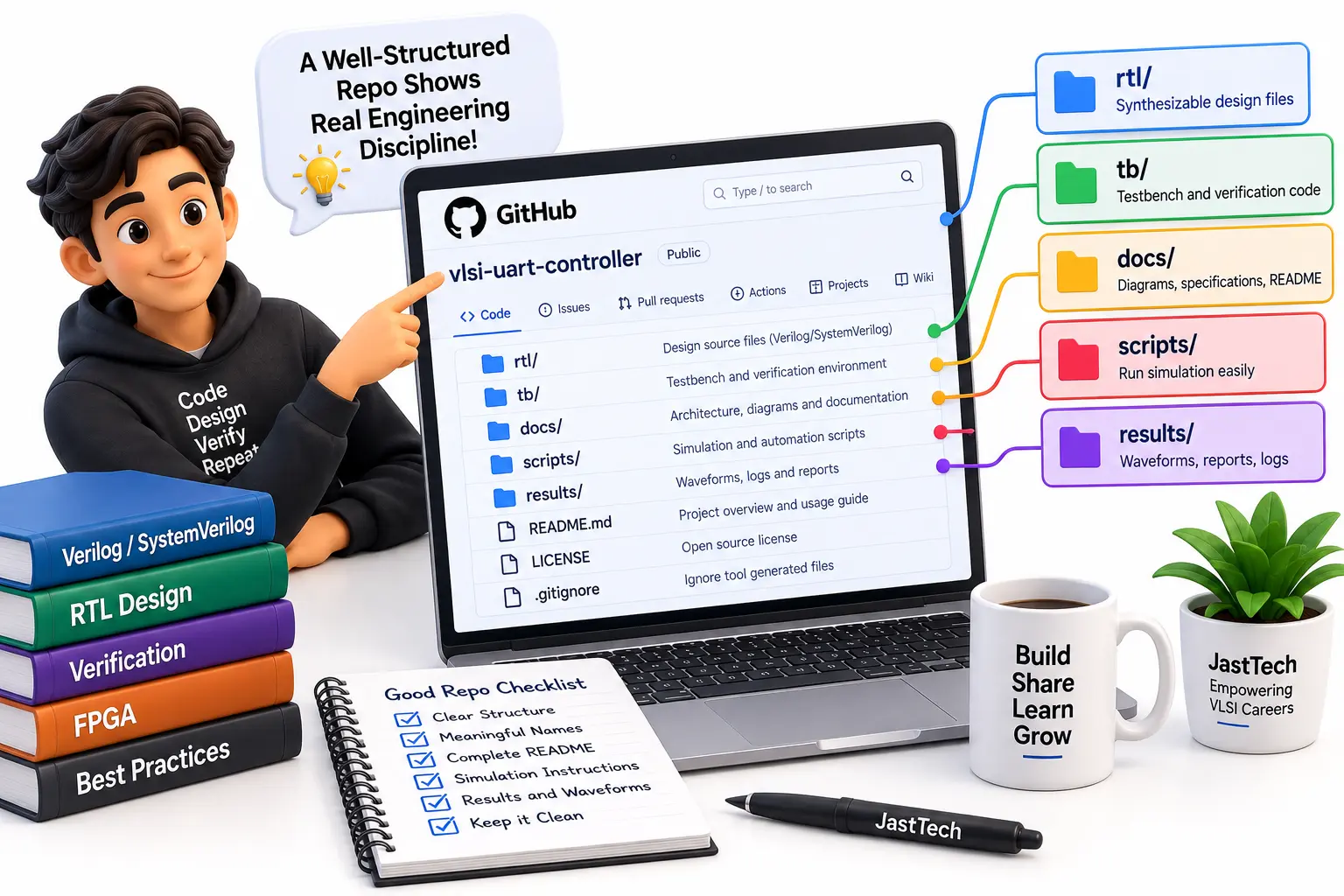
A recruiter opening a repository should understand its organization almost immediately. Avoid uploading everything into one directory with names such as final.v, new_tb.v and final_latest.v. Repository organization itself communicates engineering discipline.
For an RTL project, separate design sources, verification files, documentation and results. Use meaningful filenames such as uart_tx.sv, uart_rx.sv, baud_generator.sv and uart_tb.sv. Include a .gitignore so generated simulation files, temporary logs and tool-specific files do not dominate the repository.
A useful repository can contain:
rtl/for synthesizable design filestb/for testbench and verification codedocs/for architecture informationscripts/for simulation or automation scriptsresults/for selected reports or output evidenceREADME.mdfor complete project documentation
Also include licensing information when appropriate and clearly identify external code or IP. Never publish proprietary company material, licensed training content or confidential design files. Your portfolio should prove what you can engineer, not what you can copy.
Make the README Explain Your Engineering Thinking
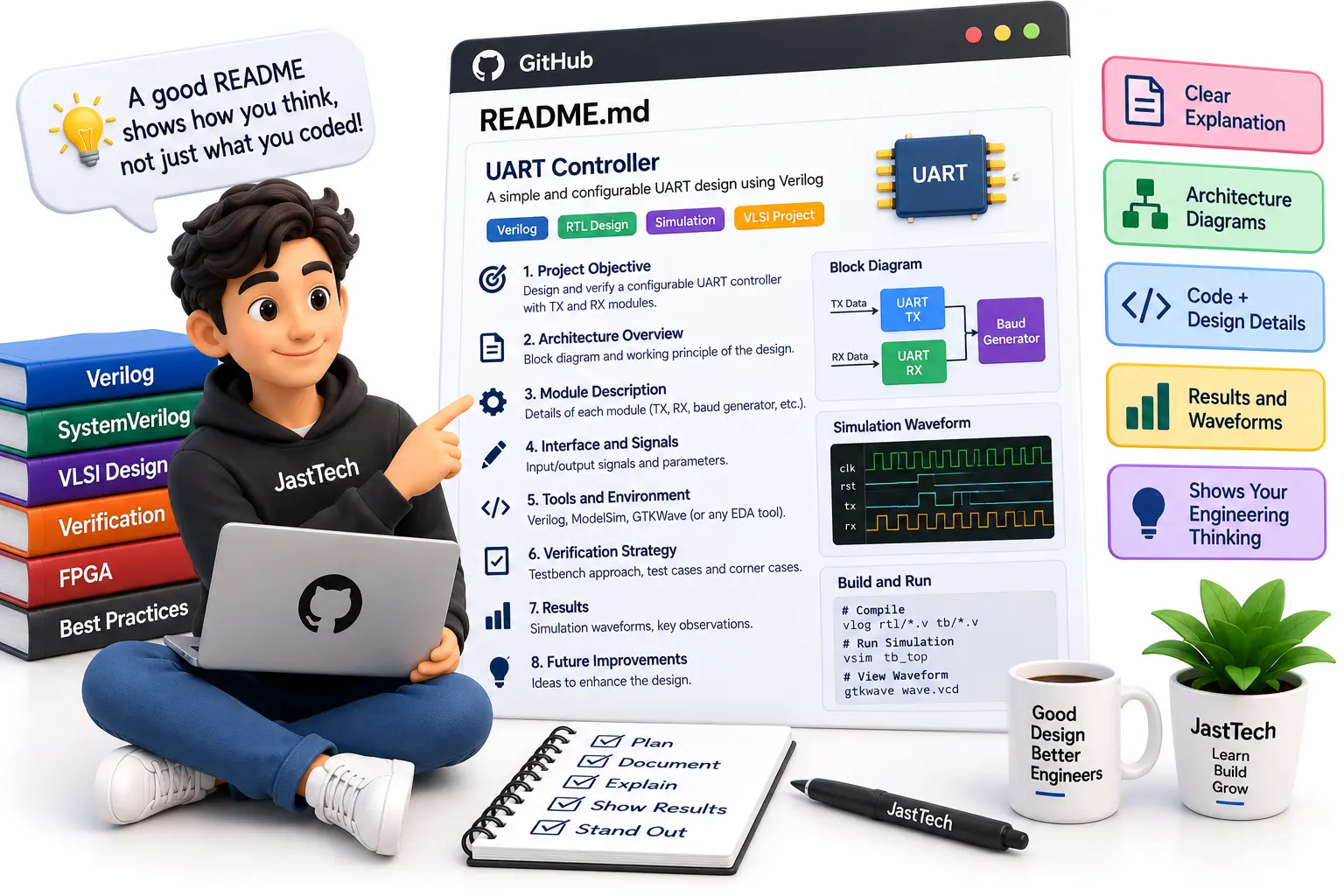
Your README is often more important initially than the RTL itself because it helps someone decide whether your code deserves deeper inspection. Start with a concise description of the project and the engineering problem it solves rather than simply writing, “UART designed using Verilog.”
Explain the architecture. Describe major modules, interfaces, clock/reset assumptions, data widths, state-machine behavior and important design decisions. If you chose a two-flop synchronizer, Gray-code pointers, pipelining or a particular arbitration scheme, explain why.
Students searching for How to Create a GitHub Portfolio for VLSI Projects should understand that documentation needs evidence as well as explanation. Include:
Project objective
Architecture or block diagram
Module descriptions
Interface/signals
Tools and HDL used
Simulation instructions
Verification strategy
Important waveforms
Synthesis or implementation results
Known limitations
Future improvements
JastTech emphasizes practical, industry-oriented VLSI learning, and the same philosophy should appear in a portfolio. Do not merely state that you understand RTL design or verification. Create repositories where another engineer can see that understanding in your implementation.
Show Verification Evidence Instead of Saying “Simulation Passed”
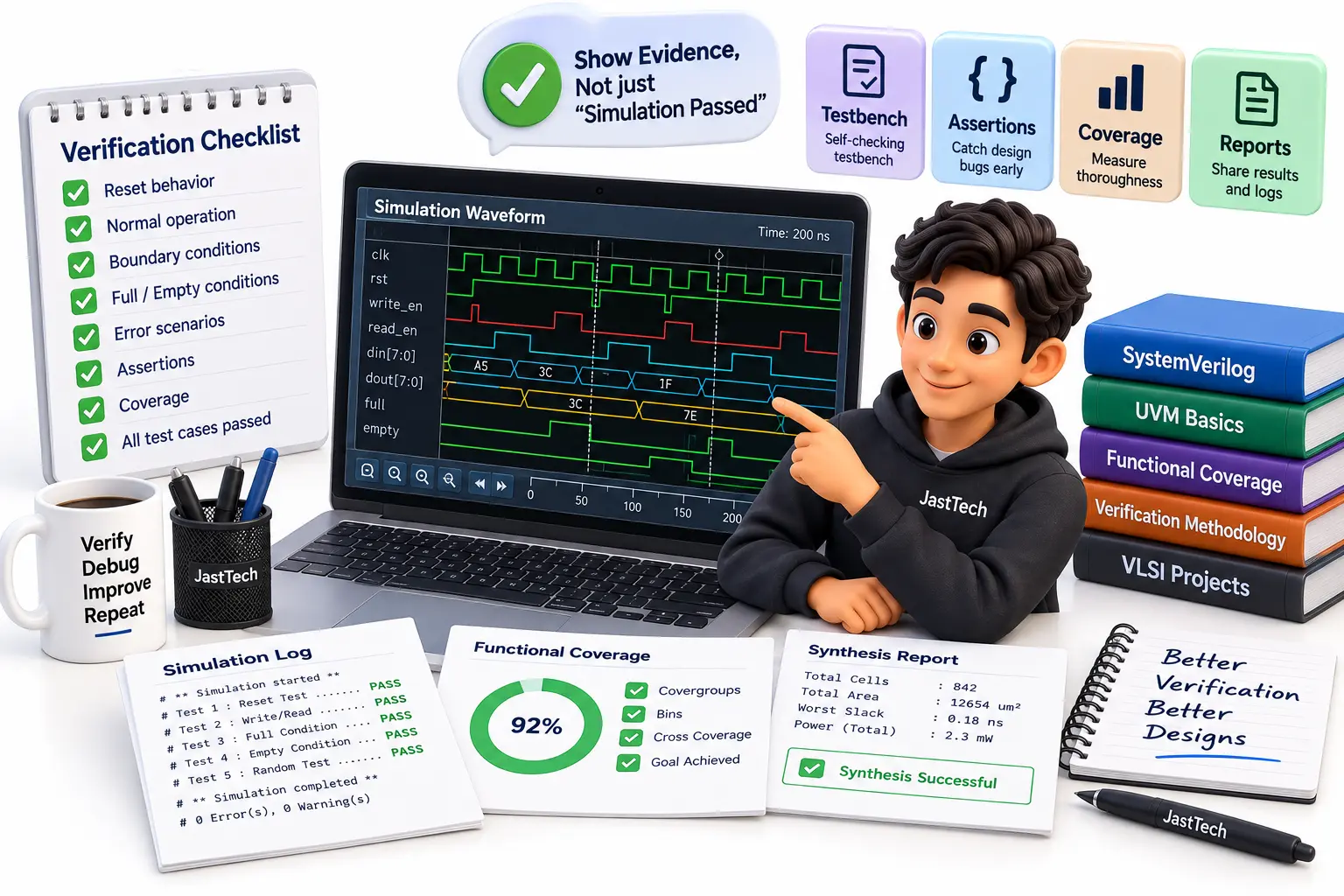
A polished RTL repository without meaningful verification is incomplete. Technical interviewers want to know whether you thought about corner cases, failure scenarios and unexpected input combinations—not merely whether the design compiled successfully.
Suppose you created a synchronous FIFO. Do not stop after showing basic write and read operations. Verify reset behavior, empty reads, full writes, simultaneous read/write operation, pointer transitions and boundary conditions. For an asynchronous FIFO, your documentation can additionally explain clock-domain crossing, synchronizers and Gray-coded pointers.
Include selected waveform screenshots rather than dozens of unexplained images. Annotate or describe what each important waveform proves. When possible, provide self-checking testbenches, assertions, coverage information or automated scripts.
Career preparation requires the same level of investigation. For example, 5 Mistakes Freshers Make When Choosing a VLSI Course in Pune is a useful reminder that students should evaluate hands-on learning rather than relying purely on course labels or certificates. Your GitHub should follow the same principle: demonstrate skills through verifiable engineering output.
Let Your Git History Show How the Project Developed
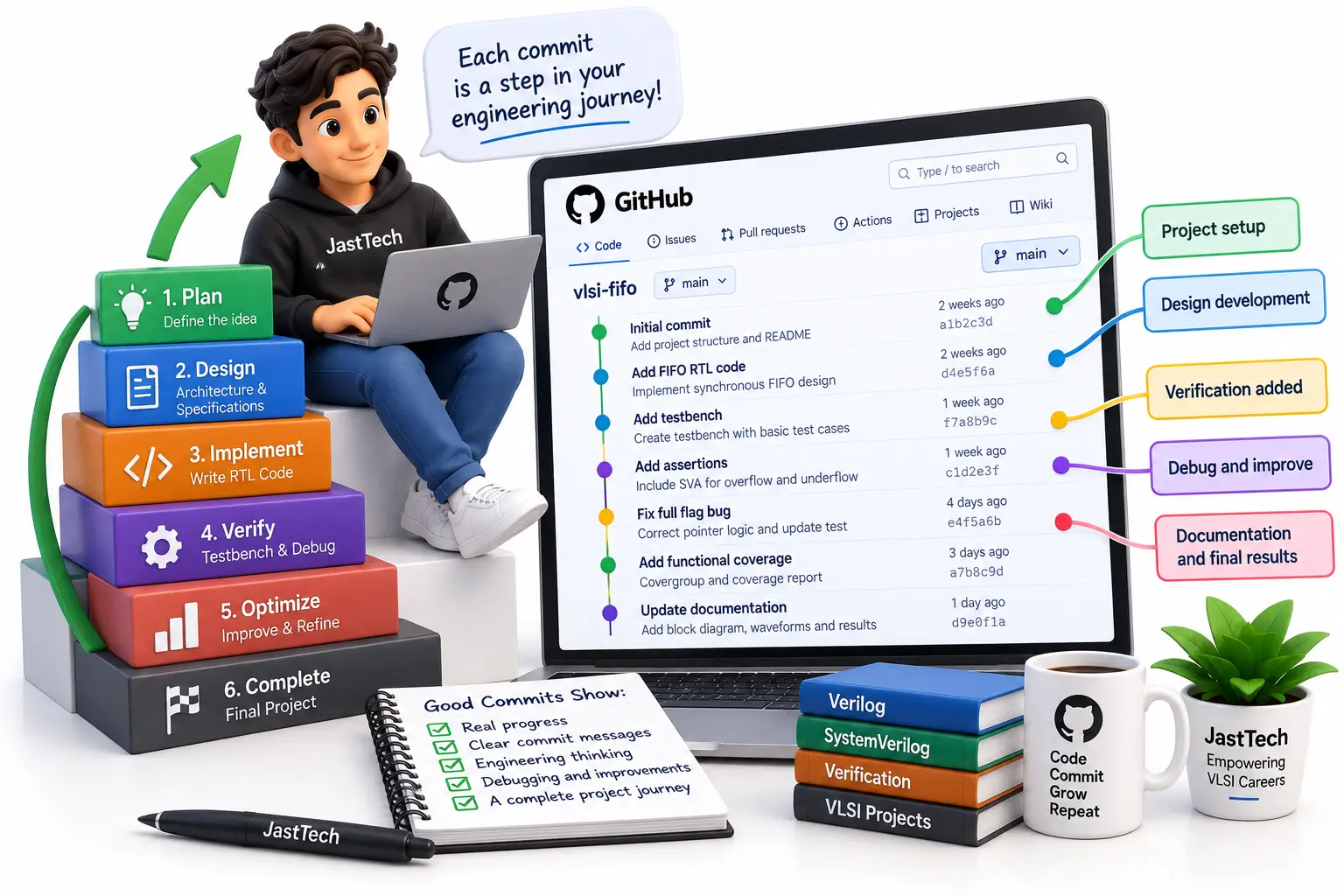
Uploading a complete project in one giant commit wastes an opportunity. Git can show how your engineering work evolved from specification to architecture, RTL, verification, debugging and optimization.
Use descriptive commits such as Implement UART transmitter FSM, Add parity error test, or Fix FIFO full flag logic. This makes development easier to understand and gives your repository the character of an engineering project rather than a folder uploaded just before an interview.
You can also use branches and issues for larger projects. Create an issue for a known bug, document the root cause and close it when the correction is verified. For team projects, pull requests can demonstrate collaboration and review practices.
Authenticity matters more than artificially creating daily contributions. A candidate who develops one serious processor project over several weeks, documents failures and improves the architecture provides stronger engineering evidence than someone with hundreds of meaningless commits designed simply to make the contribution graph look active.
Turn Your GitHub Profile Into an Interview Landing Page
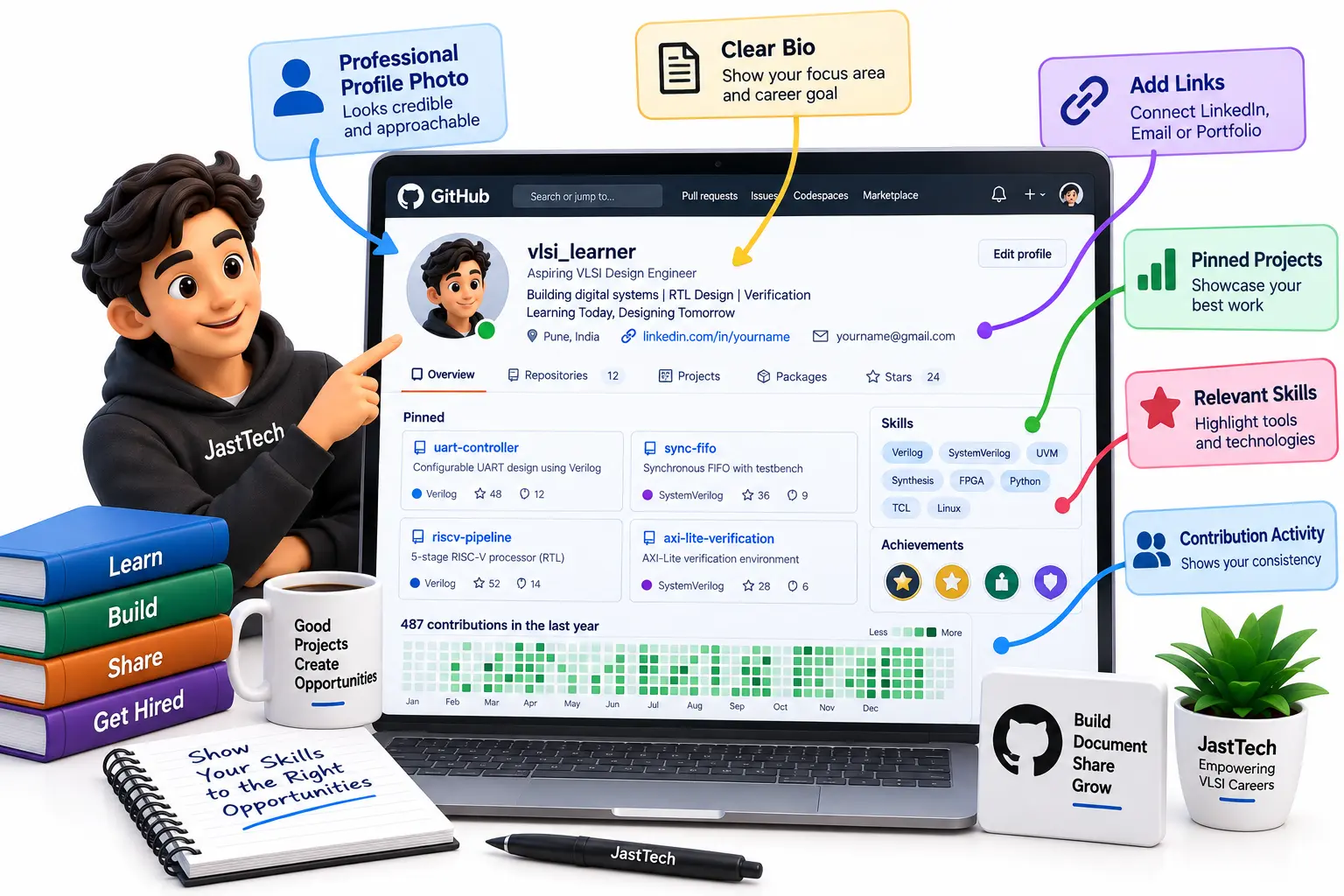
Once individual repositories are strong, optimize the main profile. Create a profile README that immediately tells visitors what kind of VLSI engineer you are becoming. Instead of “Electronics student passionate about technology,” use something specific such as “Electronics graduate focused on RTL Design and Functional Verification using Verilog and SystemVerilog.”
Pin only your strongest projects. Arrange them so a visitor sees progression: perhaps a protocol controller first, an asynchronous FIFO second and a processor or advanced verification project next. Repository descriptions should clearly state what each project demonstrates.
Your profile can briefly highlight:
Target VLSI specialization
Verilog/SystemVerilog skills
Verification and scripting knowledge
EDA or open-source tools used
Three or four flagship projects
LinkedIn or professional contact information
Finally, connect GitHub with your resume. When your resume mentions “Designed and verified an asynchronous FIFO,” provide the repository link. Now the statement is no longer an unsupported claim. During an interview, be ready to open that repository and explain architecture, bugs, verification decisions and improvements.
Conclusion
A strong VLSI GitHub portfolio is not measured by repository count or contribution streaks. Its real value comes from engineering clarity. Every major project should show a logical sequence from problem definition and architecture through RTL implementation, verification, debugging and documented results.
Start small, but finish properly. One deeply documented UART, FIFO, protocol controller or processor project can be more valuable than numerous copied designs. When your resume, GitHub repositories and interview explanations tell the same technical story, your portfolio becomes genuine proof that you can think and work like a VLSI engineer.