

Which Guidewire Module Should You Learn First in Bangalore? ClaimCenter vs PolicyCenter vs BillingCenter
Navigate through this article using the table of contents below
Table of Contents
No headings found in this article.
Walk into any Guidewire training conversation in Bangalore and you'll hear the same question within the first five minutes: ClaimCenter, PolicyCenter, or BillingCenter — which one actually gets you hired faster? The honest answer is that it depends on what kind of insurance IT role you're aiming for, not on which module sounds the most impressive on a resume.
This confusion is exactly why so many freshers end up switching tracks halfway through their preparation, losing weeks they didn't need to lose. If you're weighing your options before enrolling in a Guidewire training program in Bangalore, understanding how these three modules differ — and which one fits your starting point — will save you from that detour.
What Each Guidewire Module Actually Does
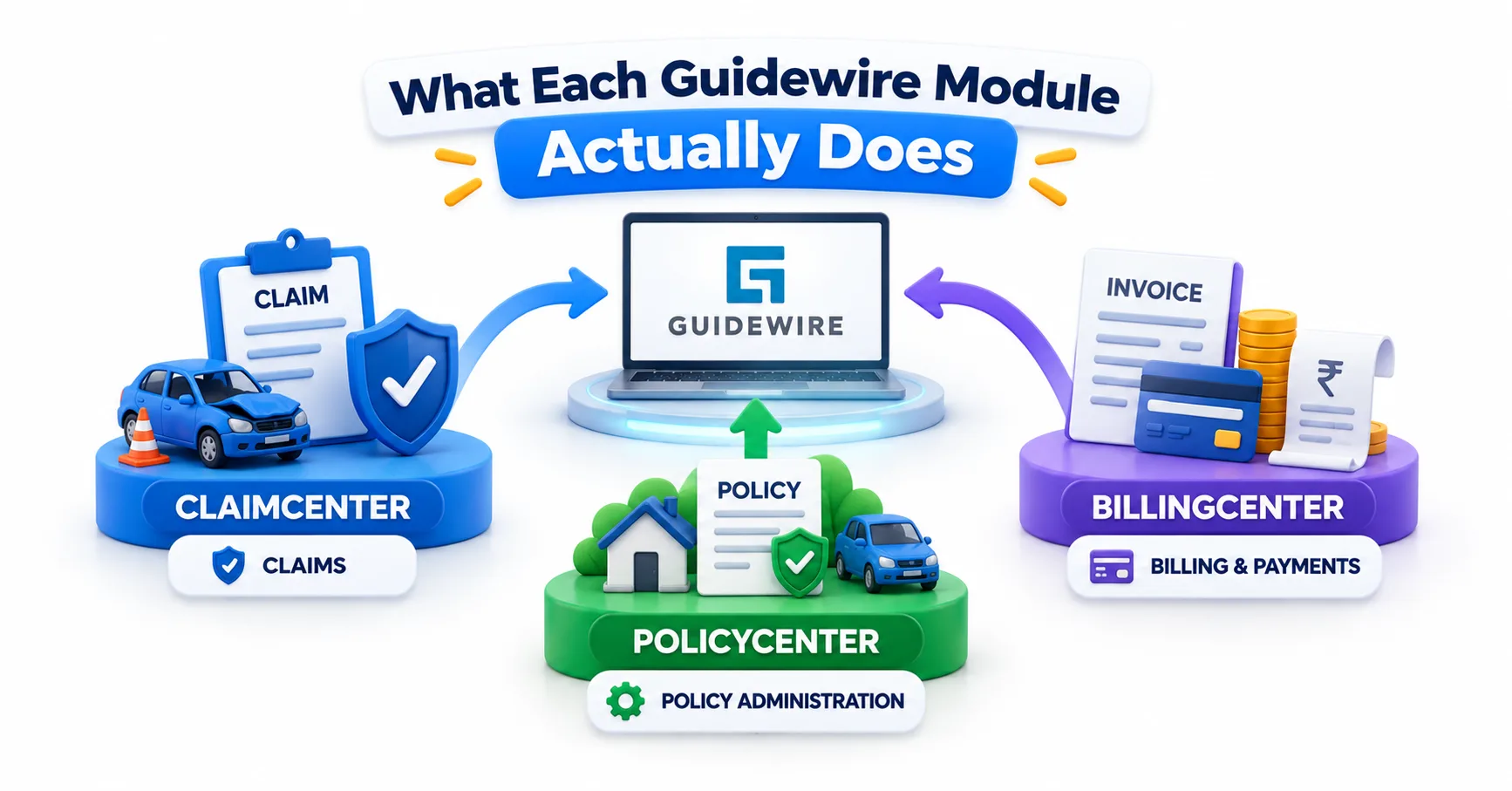
Before comparing them, it helps to know what problem each module solves inside an insurance company, because that's what shapes the skills you'll build.
PolicyCenter handles policy administration — quoting, underwriting, issuing, and renewing insurance policies. It's the system an agent or underwriter touches when a customer applies for coverage or renews an existing one.
ClaimCenter manages the claims lifecycle — from the moment a policyholder reports an accident or loss, through investigation, adjustment, and settlement. It's the module most closely tied to customer-facing claims teams.
BillingCenter takes care of everything financial: generating invoices, processing premium payments, handling commissions, and managing delinquencies. Insurers use it to keep the money side of a policy in sync with what PolicyCenter and ClaimCenter are doing.
All three run on the same underlying Guidewire platform and share configuration concepts like Gosu scripting, PCF files, and business rules — which is why learning one gives you a real head start on the other two.
ClaimCenter vs PolicyCenter vs BillingCenter: Where They Differ
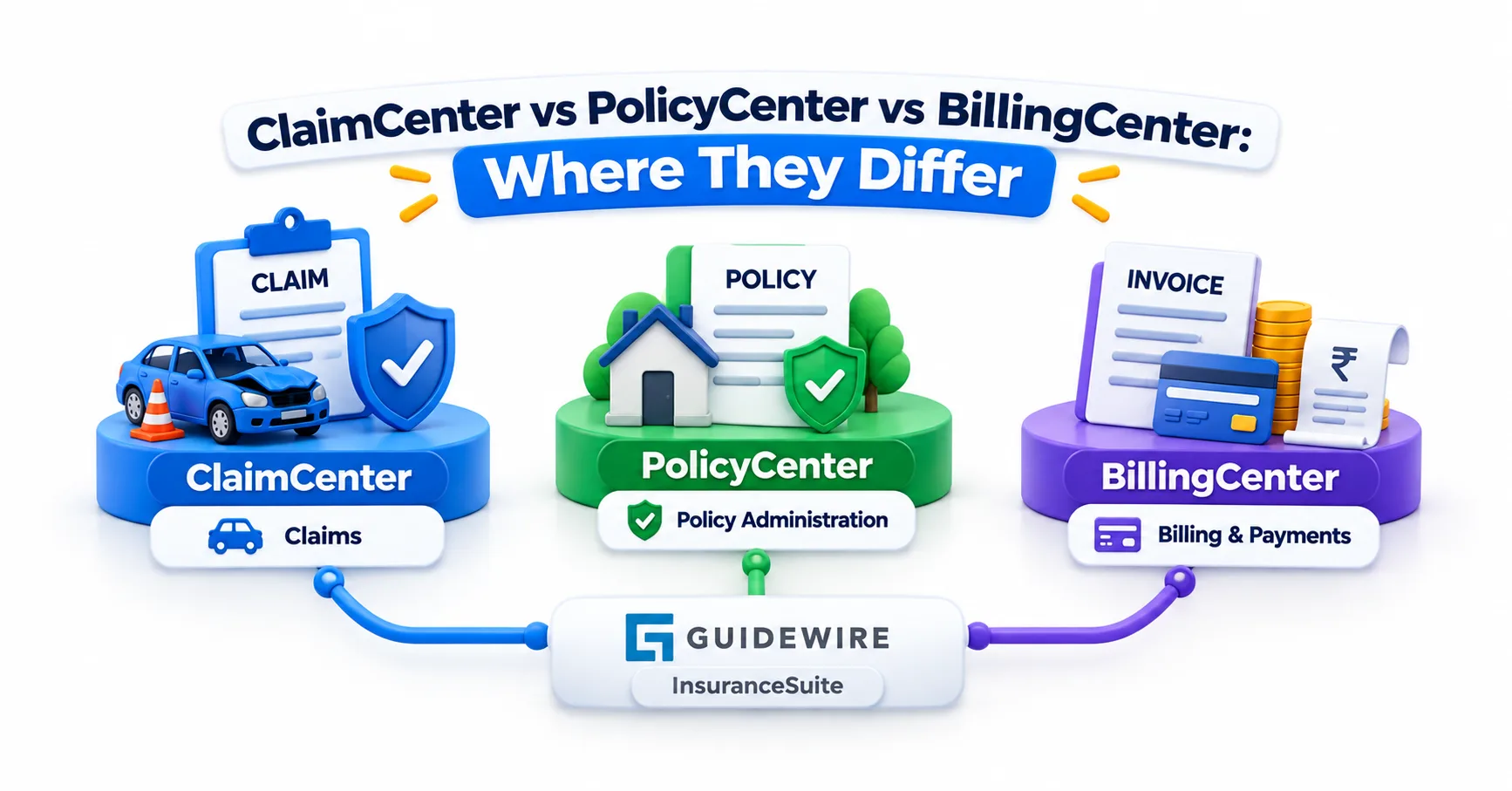
On the surface, all three modules look similar — same platform, same development tools, same general project structure. The differences show up once you get into the workflows each one is built around.
PolicyCenter vs ClaimCenter vs BillingCenter
| Aspect | PolicyCenter | ClaimCenter | BillingCenter |
|---|---|---|---|
| Core focus | Underwriting and policy issuance | Claims intake and settlement | Invoicing and payments |
| Typical complexity for beginners | Moderate to high (product model, rating) | Moderate (workflow-heavy, more intuitive) | Moderate (accounting concepts involved) |
| Business domain knowledge needed | Underwriting rules, rating | Claims handling process | Insurance billing and accounting basics |
| Common starting point for freshers | Sometimes, if rating interests you | Often recommended first | Usually learned after one of the other two |
Notice that PolicyCenter tends to involve the steepest learning curve early on, since it requires grasping product configuration and rating logic before anything clicks. If you want a side-by-side breakdown with more implementation-level detail, this comparison of Guidewire PolicyCenter and ClaimCenter for beginners and job seekers walks through the technical differences in more depth.
Why ClaimCenter Is Often the Easier Starting Point
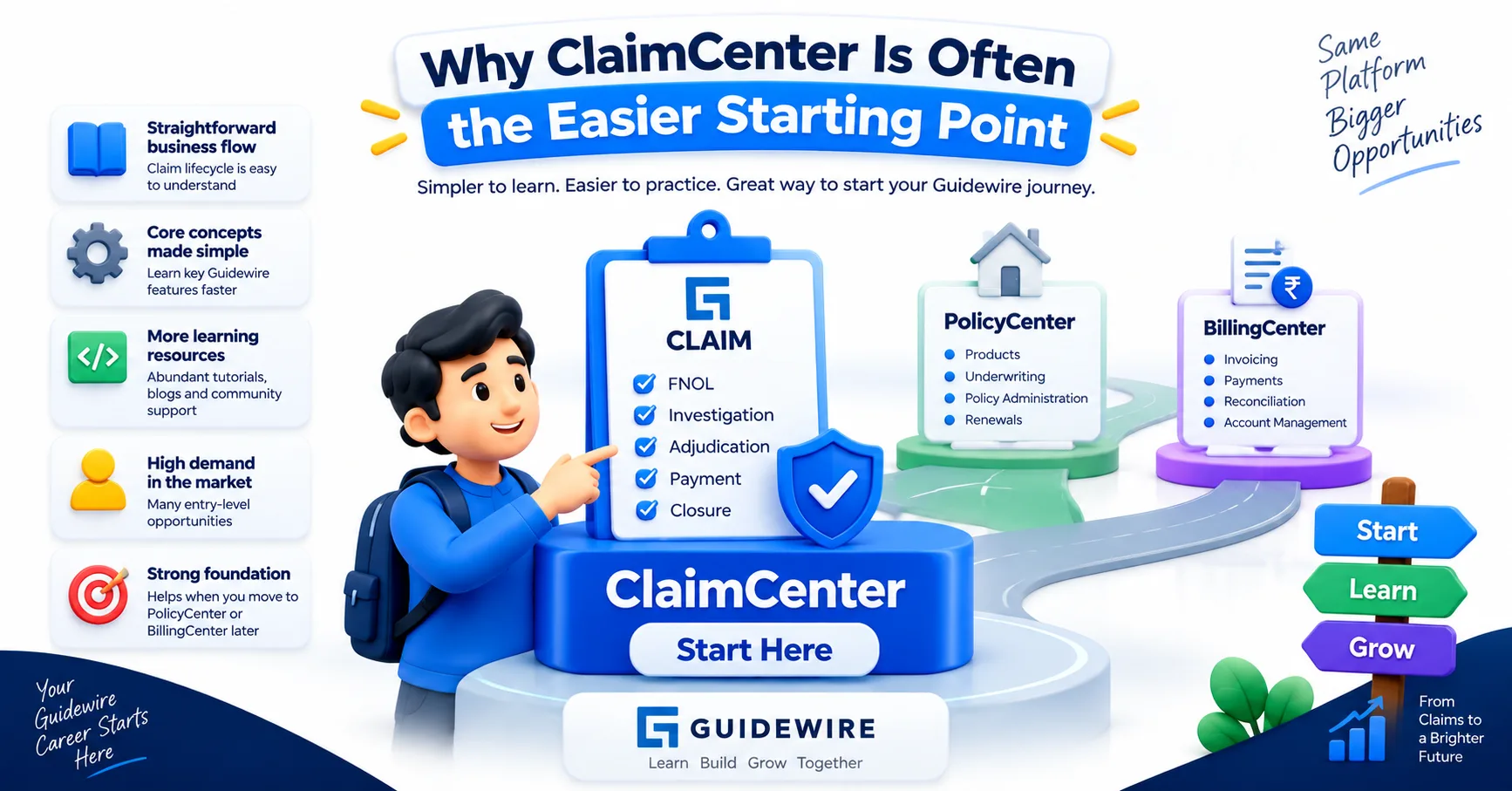
Most training providers in Bangalore lean toward ClaimCenter for absolute beginners, and there's a practical reason behind it rather than just convention.
Claims processing maps closely to something most people already understand intuitively — an incident happens, someone reports it, an adjuster reviews it, and a payout follows. That familiarity makes the workflow easier to internalize compared to underwriting or premium accounting, which involve more insurance-specific jargon before anything makes sense.
ClaimCenter also exposes you early to core Guidewire skills you'll reuse everywhere:
Configuring business rules and workflows
Working with the Gosu programming language
Customizing screens using PCF (Page Configuration Files)
Understanding integration points with external systems
Once these fundamentals are solid, picking up PolicyCenter or BillingCenter later becomes a matter of learning new domain rules on top of tools you already know, rather than starting from zero.
Where the Job Demand Actually Sits in Bangalore
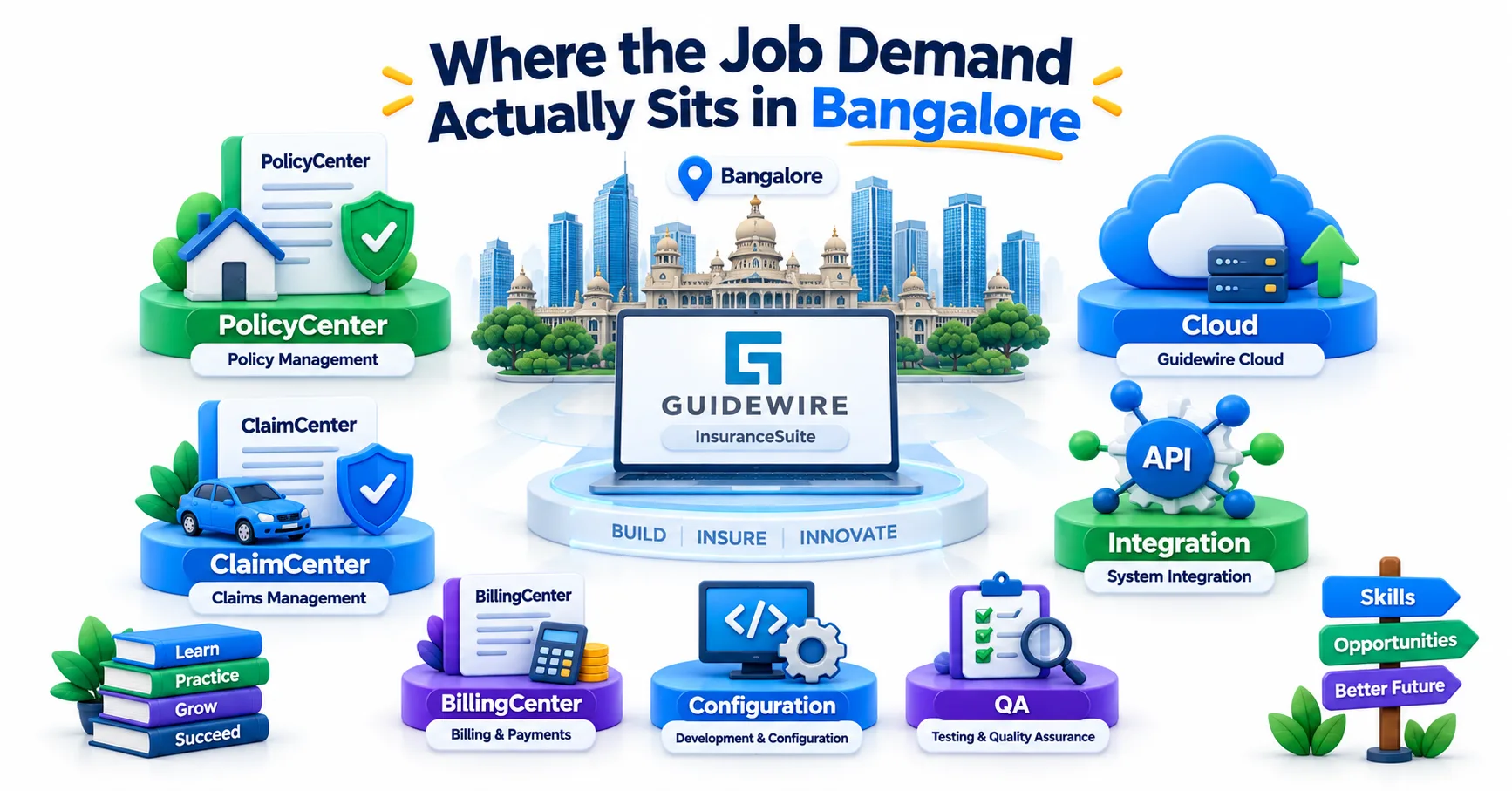
Bangalore's insurance IT hiring is spread across all three modules, since most Guidewire implementations at insurers and consulting firms eventually touch all of them. That said, project staffing patterns tend to favor certain modules at certain career stages.
ClaimCenter and PolicyCenter roles are the two most frequently advertised for developer and configuration positions, largely because they carry the heaviest customization work on most implementation projects. BillingCenter roles exist in steady numbers too, but they're often filled by people who've already worked on one of the other modules and picked up billing and accounting concepts along the way.
For a fresher, this means starting with ClaimCenter or PolicyCenter generally opens more entry-level openings, while BillingCenter skills become more valuable once you're positioning yourself as someone who can support a full end-to-end Guidewire implementation.
How Training Typically Builds Module Skills
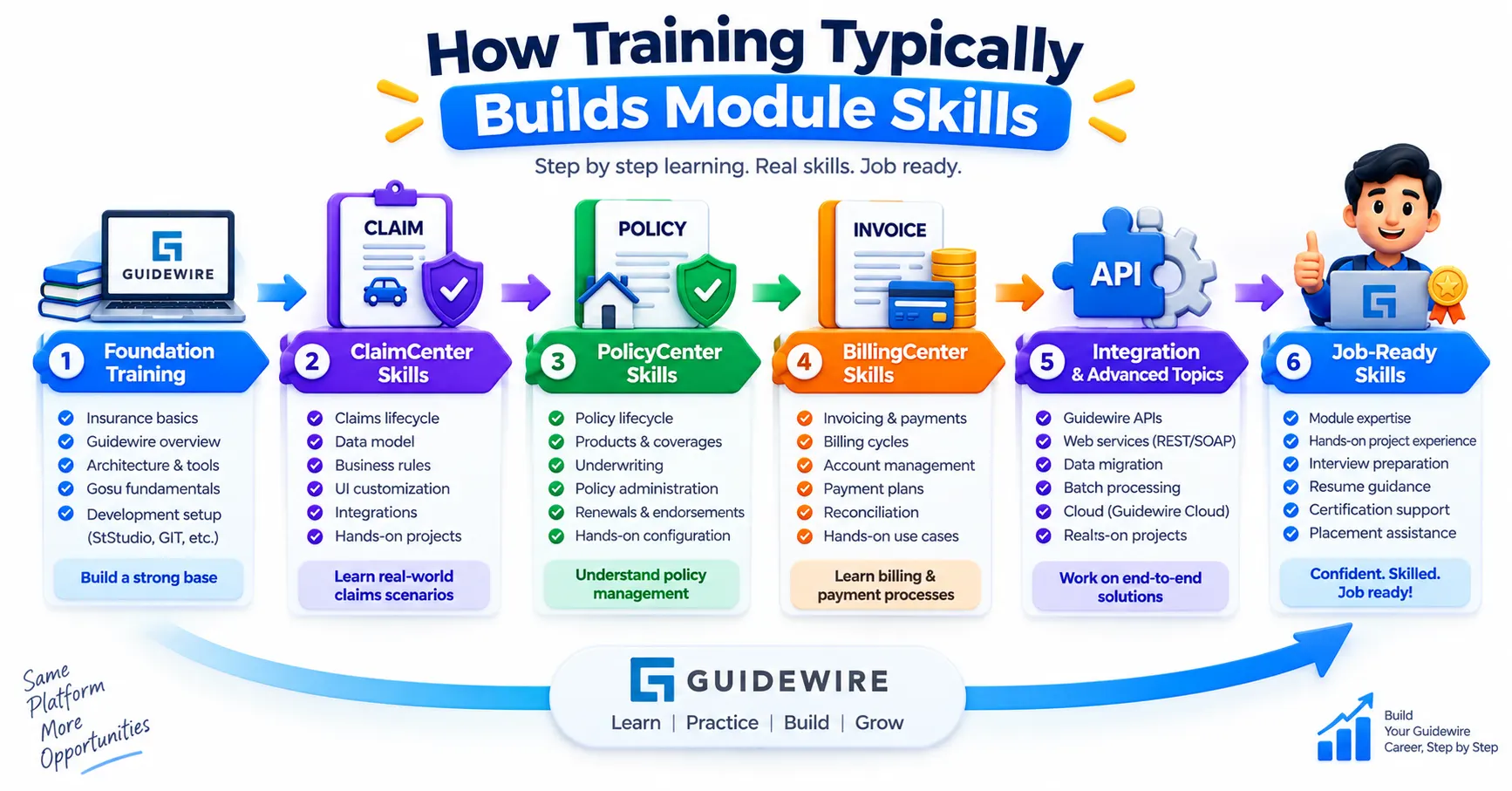
A well-structured Guidewire course doesn't just teach you a single module in isolation — it builds the platform fundamentals first, then applies them to your chosen center.
Early sessions usually cover Gosu scripting, the Guidewire Studio environment, data model basics, and configuration concepts that are common across ClaimCenter, PolicyCenter, and BillingCenter. From there, training narrows into module-specific workflows: claim FNOL and adjudication for ClaimCenter, product model and rating for PolicyCenter, or invoicing and disbursement for BillingCenter.
This layered approach matters because it's what makes learning a second module later much faster. Someone who has completed solid ClaimCenter training can usually pick up PolicyCenter fundamentals in a fraction of the time it took to learn the platform from scratch, simply because the underlying tools are unchanged.
How to Decide Which Module Fits You
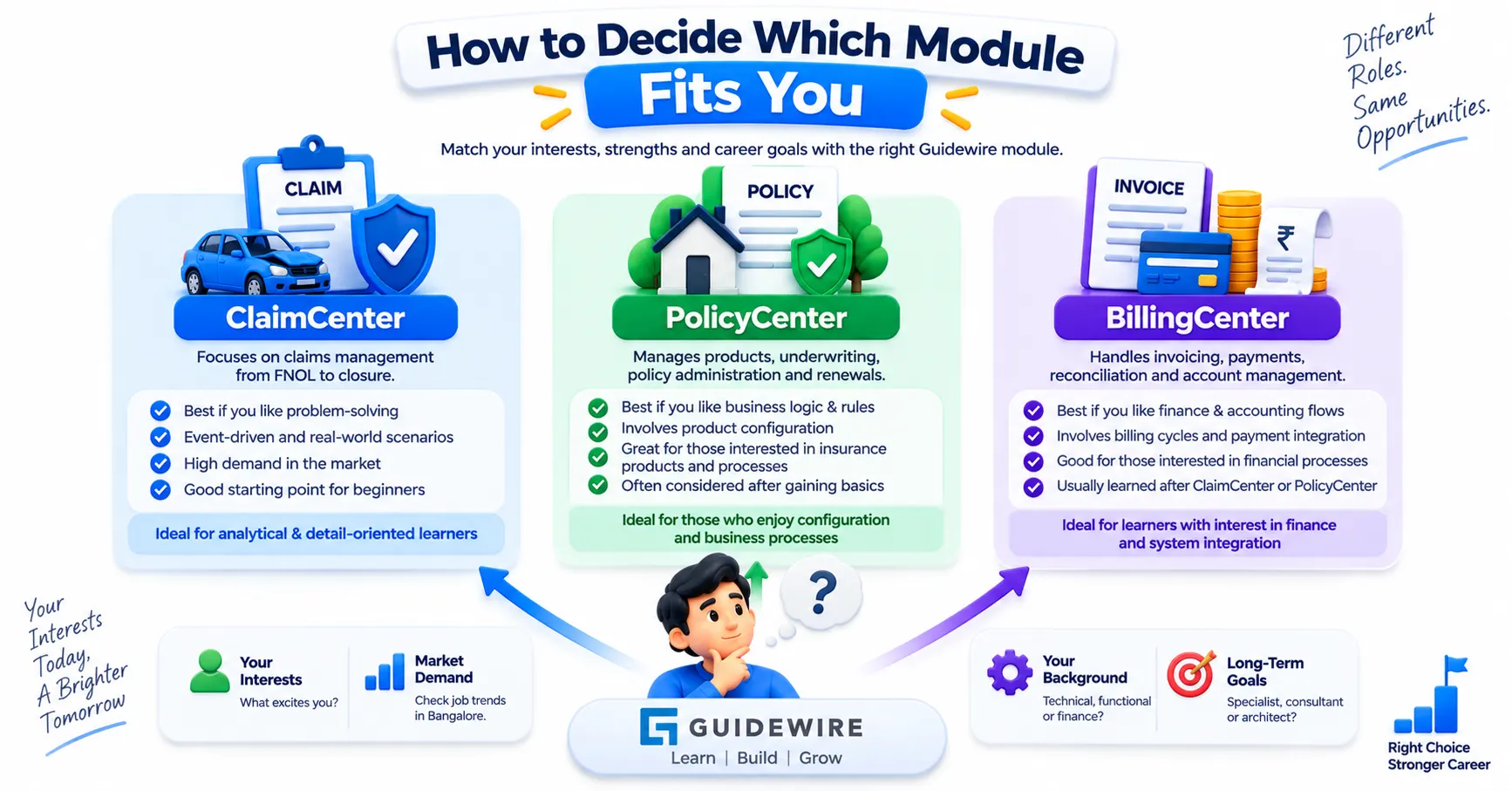
If you're still unsure, the decision usually comes down to three practical questions rather than guesswork.
First, ask what kind of logic you find easier to reason about — sequential processes with clear decision points (claims) generally suit beginners better than rating and product configuration (policy) or accounting cycles (billing).
Second, look at what roles are open near you right now, since hiring patterns shift and a module in high demand this year may not hold that position permanently.
Third, consider your background — candidates coming from a general software or QA role often find ClaimCenter's workflow logic approachable, while those with an insurance operations or finance background sometimes adapt faster to PolicyCenter or BillingCenter.
There's no universally "correct" first module. The right starting point is the one that matches your comfort with the underlying business logic and the opportunities actually available to you.
Making the Choice Work for You
Choosing between ClaimCenter, PolicyCenter, and BillingCenter isn't really about picking a winner — it's about picking the module whose logic you can grasp fastest, because that foundation carries over to the other two. For most beginners in Bangalore, ClaimCenter offers the gentlest entry point, but a fresher with underwriting exposure may find PolicyCenter just as workable. Whichever module you start with, the platform skills you build will make learning the rest of the Guidewire suite considerably easier down the line.