

Guidewire Coding & Gosu Interview Preparation Guide
Navigate through this article using the table of contents below
Table of Contents
No headings found in this article.
A candidate with four years of solid Java experience walks into a Guidewire interview feeling confident. Twenty minutes later, he's stuck explaining why a Gosu enhancement won't compile. It happens more often than most people admit. This isn't a Java problem. It's a Guidewire interview preparation gap — and once you understand where it actually comes from, closing it stops feeling impossible. Guidewire interviews test more than core Java knowledge; they often require practical understanding of Gosu, Guidewire configuration, data models, integrations, and platform-specific concepts.
That is why choosing the right Guidewire class in India can be valuable when your goal is to build practical skills instead of simply memorizing interview questions. A structured learning approach can help you understand how Guidewire works in real-world projects, strengthen your platform-specific concepts, and prepare you to handle technical interview questions with greater clarity.
Why Guidewire Interviews Feel Different From Any Other Java Interview
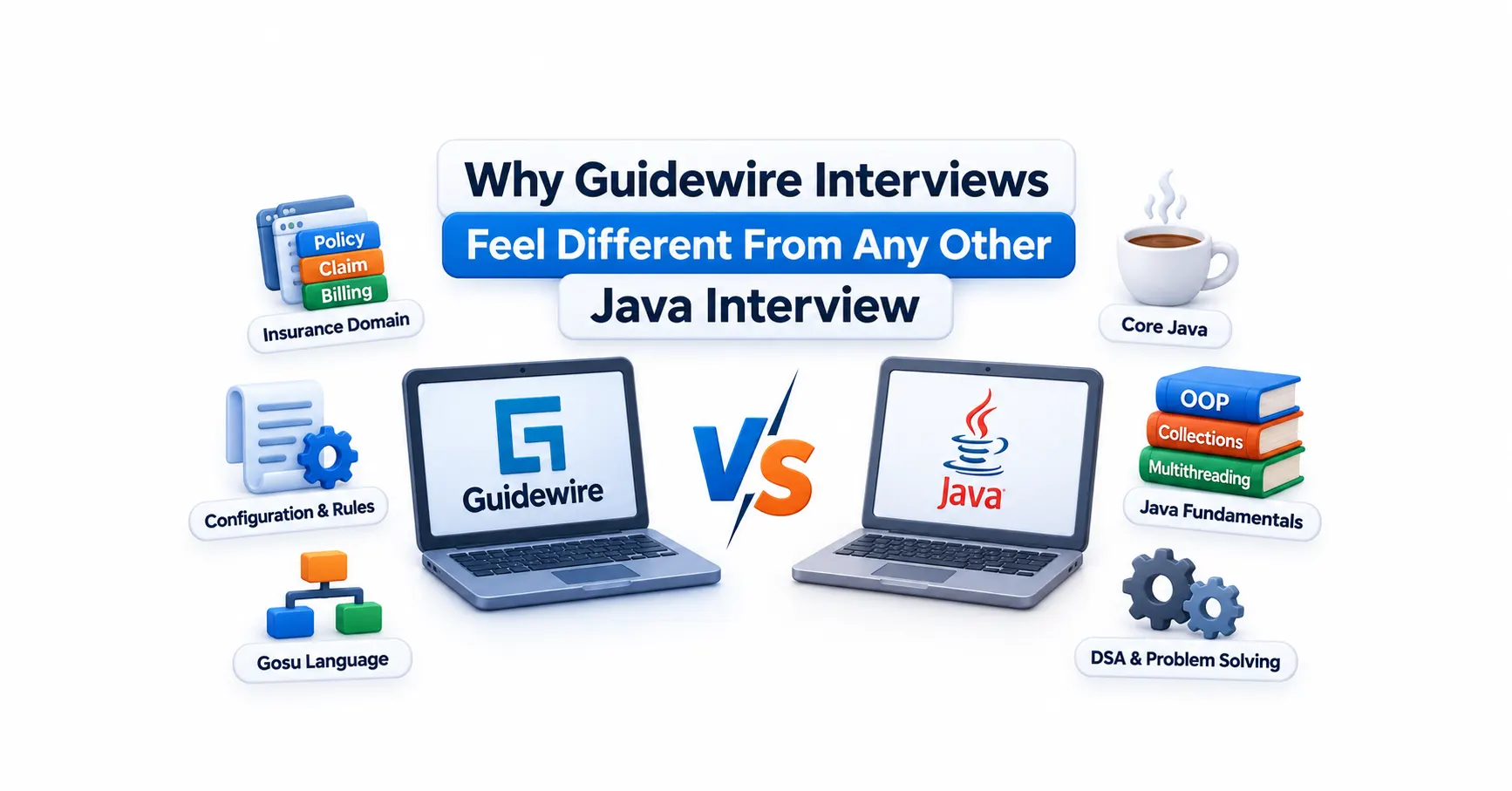
Most developers assume Guidewire interviews will mirror a standard Java or Spring Boot round. They don't. Guidewire built Gosu, its own object-oriented language, specifically to sit on top of the Java Virtual Machine while giving business analysts and developers a way to configure insurance logic without touching core Java classes directly.
That single design choice changes everything about how interviewers test you. They're not just checking whether you can write a loop or reverse a string. They want to see whether you understand enhancements, entities, and how Gosu's type system quietly diverges from Java's in ways that trip up even experienced engineers.
A common example: Gosu allows implicit typing and has its own null-safety operators, which behave differently from what Java developers expect. Interviewers love asking candidates to spot the difference between a Gosu class and a Gosu enhancement, because the answer reveals whether someone has actually written production rules or just skimmed documentation. Preparing for this distinction early saves enormous time later, since nearly every coding round circles back to it in one form or another.
What Exactly Is Gosu, and Why Do Interviewers Love Asking About It?
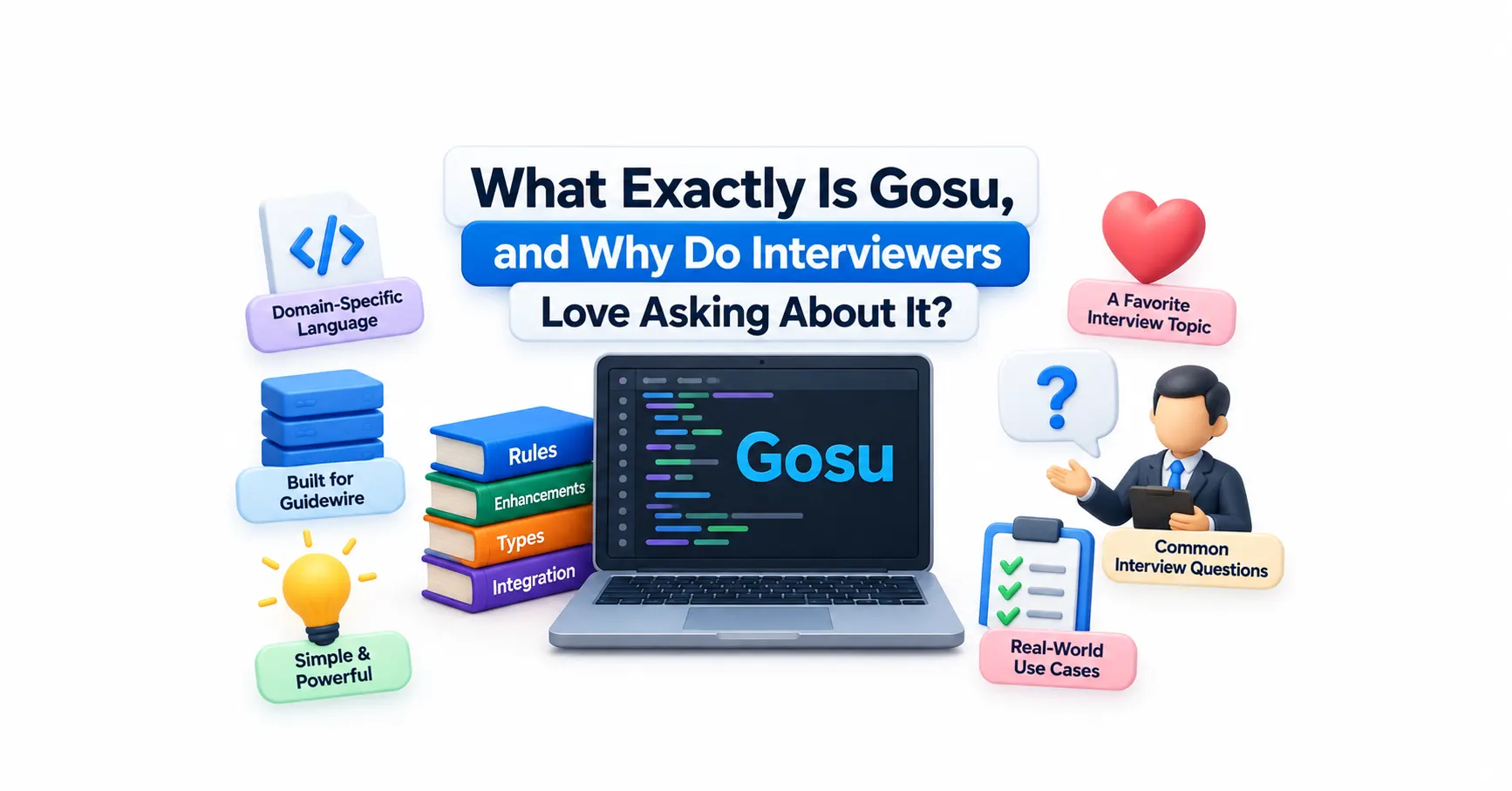
Gosu was introduced by Guidewire to solve a specific problem: insurance configuration changes constantly, and rebuilding Java code for every policy or claims rule is slow and expensive. So Gosu was designed as a statically typed, JVM-compatible language that compiles to bytecode, meaning it runs with Java-like performance while staying flexible enough for frequent business changes.
Interviewers ask about Gosu constantly because it's the clearest signal of hands-on experience. Anyone can memorize Java syntax from a textbook. Far fewer people have actually written a PCF page, debugged a Gosu rule set, or configured an enhancement that extends a core entity without modifying Guidewire's base code.
Expect questions like: "How does Gosu handle type inference compared to Java?" or "What's the difference between extending an entity and enhancing it?" These aren't trick questions — they're testing whether you understand Guidewire's philosophy of non-invasive customization, which is the entire reason insurers choose the platform. Get comfortable explaining that philosophy in plain language, because interviewers consistently reward candidates who can connect technical syntax to business reasoning rather than reciting definitions.
Read more about :- Is Guidewire a Good Career Choice in India?
The ClaimCenter, PolicyCenter, and BillingCenter Question That Trips Up Candidates
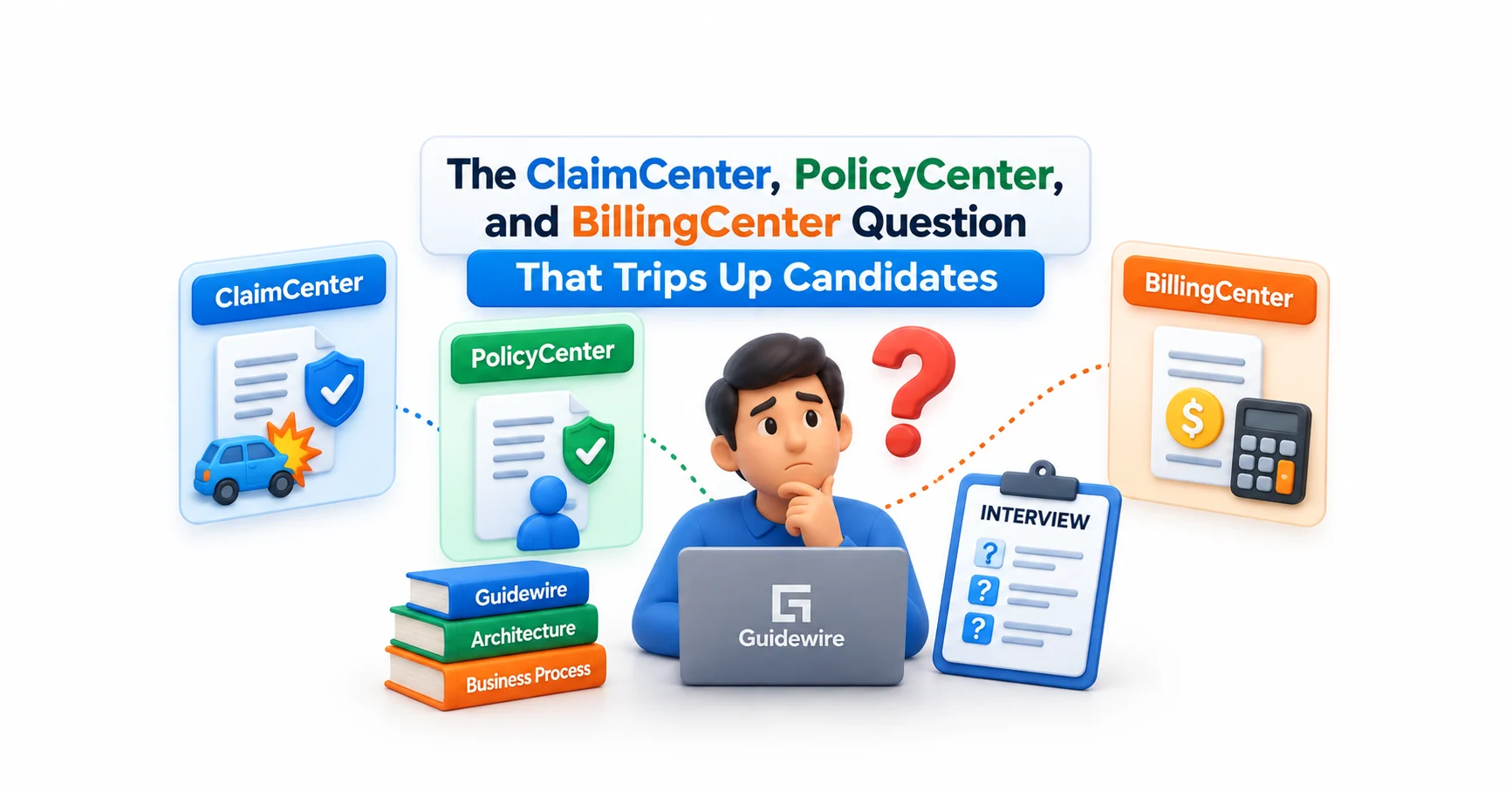
Sooner or later, almost every interview touches this question in some form: which module should you specialize in? It's worth researching this in depth before you walk in, because recruiters genuinely have opinions about which Guidewire module has the best job market, and knowing the current landscape makes you sound informed rather than generic.
Here's the practical reality: ClaimCenter tends to involve more complex business rules around claims handling, while PolicyCenter deals heavily with underwriting logic and rating, and BillingCenter focuses on invoicing, payments, and financial workflows. Each module shares the same Gosu foundation but applies it to very different problems.
Interviewers sometimes ask candidates to compare modules just to see how well they understand the insurance domain itself, not only the code. If you can explain that ClaimCenter often demands more intricate rule chaining because claims scenarios are less predictable than billing cycles, you immediately stand out. Don't pick a module to specialize in purely based on rumors — read up on demand trends, then align your preparation accordingly.
Cracking Gosu Coding Rounds: Syntax Quirks You Can't Afford to Miss
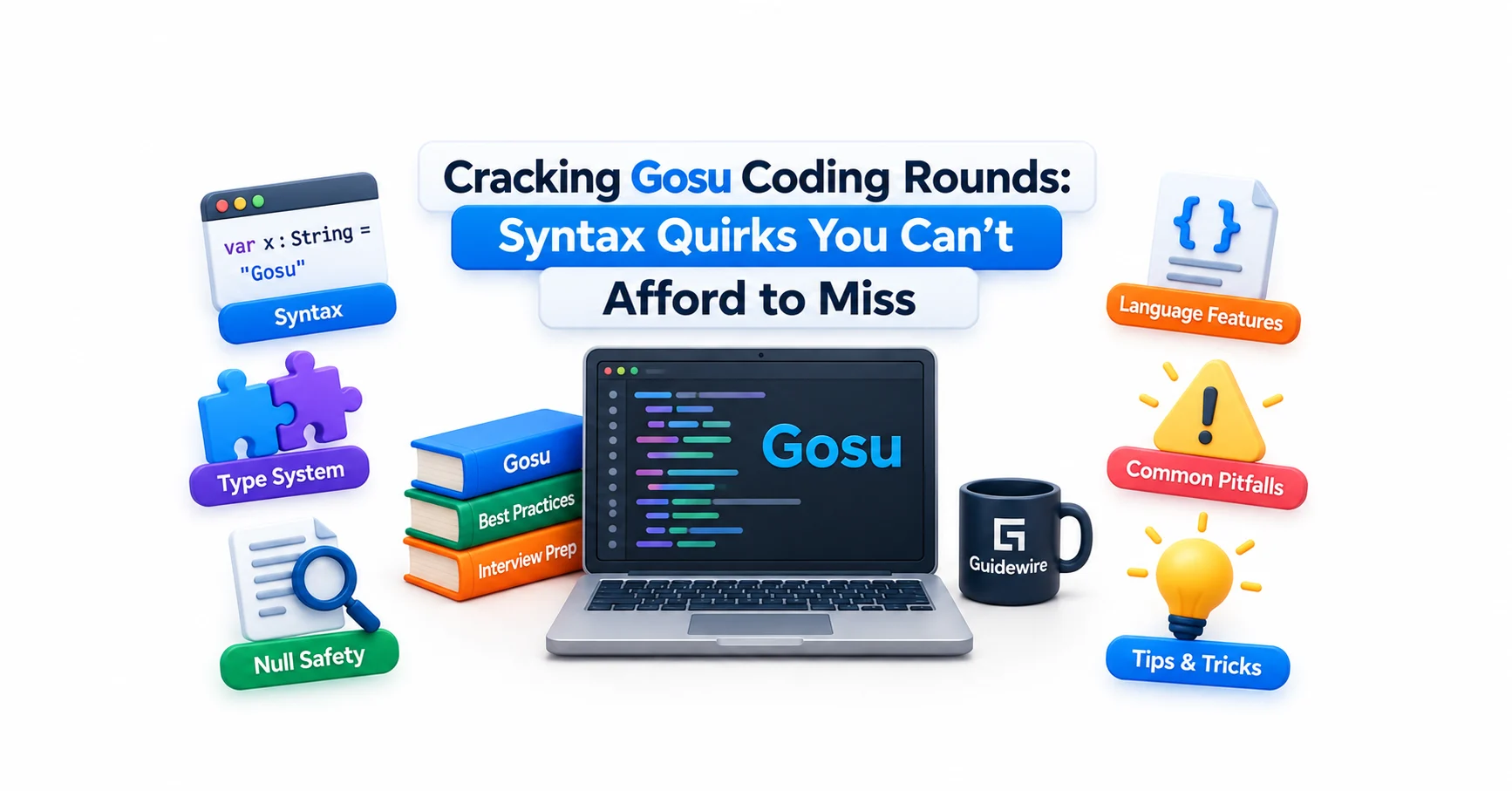
Coding rounds rarely ask you to build something from scratch. Instead, they hand you a broken snippet and ask you to fix it, which is arguably harder because it tests your actual understanding rather than your ability to recall boilerplate.
A few syntax quirks show up repeatedly:
Null-safe navigation using the
?.operator, which Gosu handles differently than some Java-based frameworksTyped collections where Gosu enforces stricter compile-time checks than beginners expect
Implicit variable declarations using
var, which can mask type mismatches if you're not careful
If you've never written a rule before, start with a structured walkthrough rather than guessing. This guide on how to write your first rule in ClaimCenter is a genuinely useful starting point, because it walks through the exact syntax patterns interviewers reference most often — condition blocks, actions, and how rule sets get triggered within the claims lifecycle.
Practice reading code more than writing it at first. Interviewers frequently show a rule with a subtle bug and ask you to explain what will happen at runtime, not just whether it compiles.
Rules, Rule Sets, and the Interview Questions Nobody Warns You About
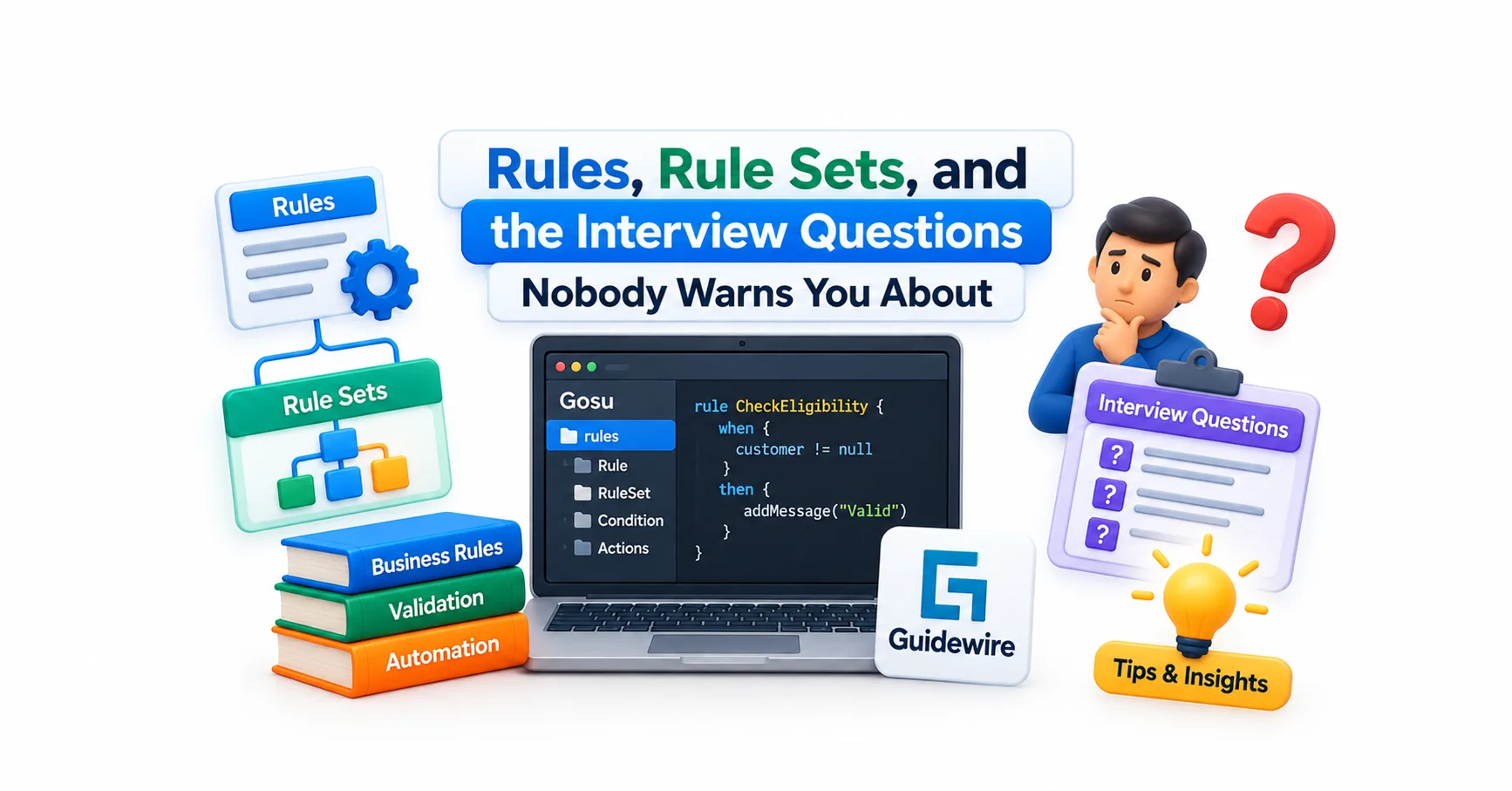
Rules are the heartbeat of any Guidewire implementation, and interviewers know that candidates who understand rule architecture can be trusted with real configuration work. Expect deep questions about how rule sets are organized, how conditions and actions interact, and how rules get triggered by specific events in the policy or claims lifecycle.
One question that catches people off guard: "What happens if two rules in the same rule set conflict?" Guidewire evaluates rules based on execution order and rule set priority, so understanding how to sequence logic correctly matters far more than knowing the syntax alone. A candidate who can walk through a conflict scenario step by step, rather than giving a memorized definition, demonstrates real configuration experience.
Another favorite is scenario-based: "A rule isn't firing as expected — how do you debug it?" The strongest answers mention checking rule set activation, verifying the triggering event, and reviewing any preceding rules that might short-circuit execution. Interviewers aren't looking for a textbook answer here; they want to hear your troubleshooting instinct, because that's what separates someone who's configured rules under deadline pressure from someone who's only read about it.
Data Model and Integration Questions: Where Real Guidewire Experience Shows
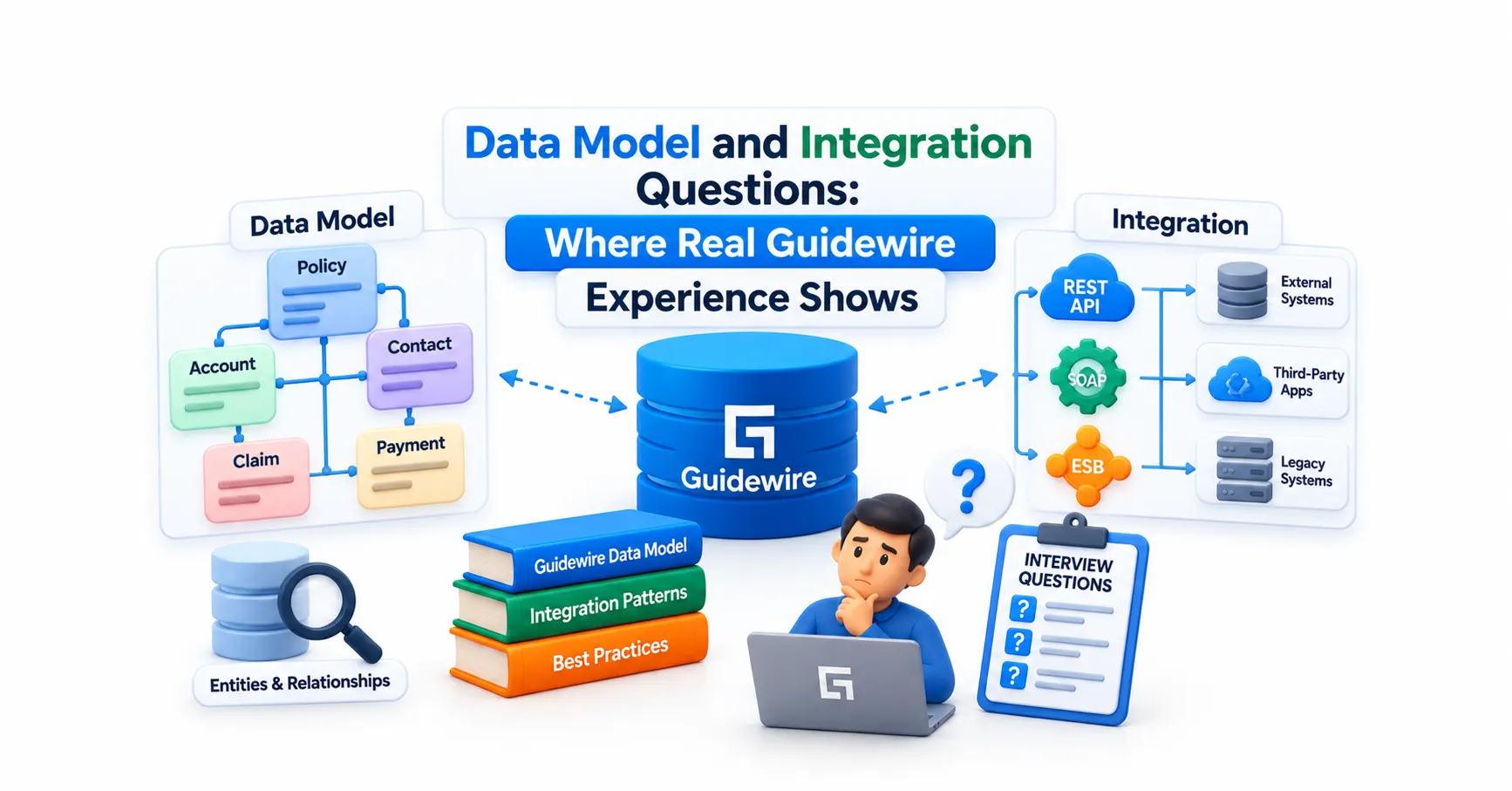
Beyond syntax and rules, interviewers eventually pivot toward the data model — entities, foreign keys, typelists, and how Guidewire structures its underlying schema. This is where candidates who've only done tutorial-level work start to struggle, because production systems involve entity relationships far more layered than any beginner example.
You'll likely face questions about extending entities without breaking upgrade compatibility, since Guidewire's non-invasive customization model exists specifically so insurers can upgrade platform versions without losing custom configurations. Explaining why this matters — and how enhancements support it — shows you understand the business value behind the technical design, not just the mechanics.
Integration questions follow a similar pattern. Expect topics like plugins, batch processes, and how Guidewire communicates with external systems through web services. A common interview scenario involves describing how you'd integrate a third-party rating engine or a document management system into PolicyCenter. Strong candidates mention specific integration points — like Guidewire's messaging framework or REST-based APIs — rather than speaking in vague generalities.
If your background is lighter on integrations, be honest about it, but demonstrate that you understand the architecture conceptually even without hands-on exposure.
How to Actually Prepare: A Guidewire Interview Preparation Guide That Works
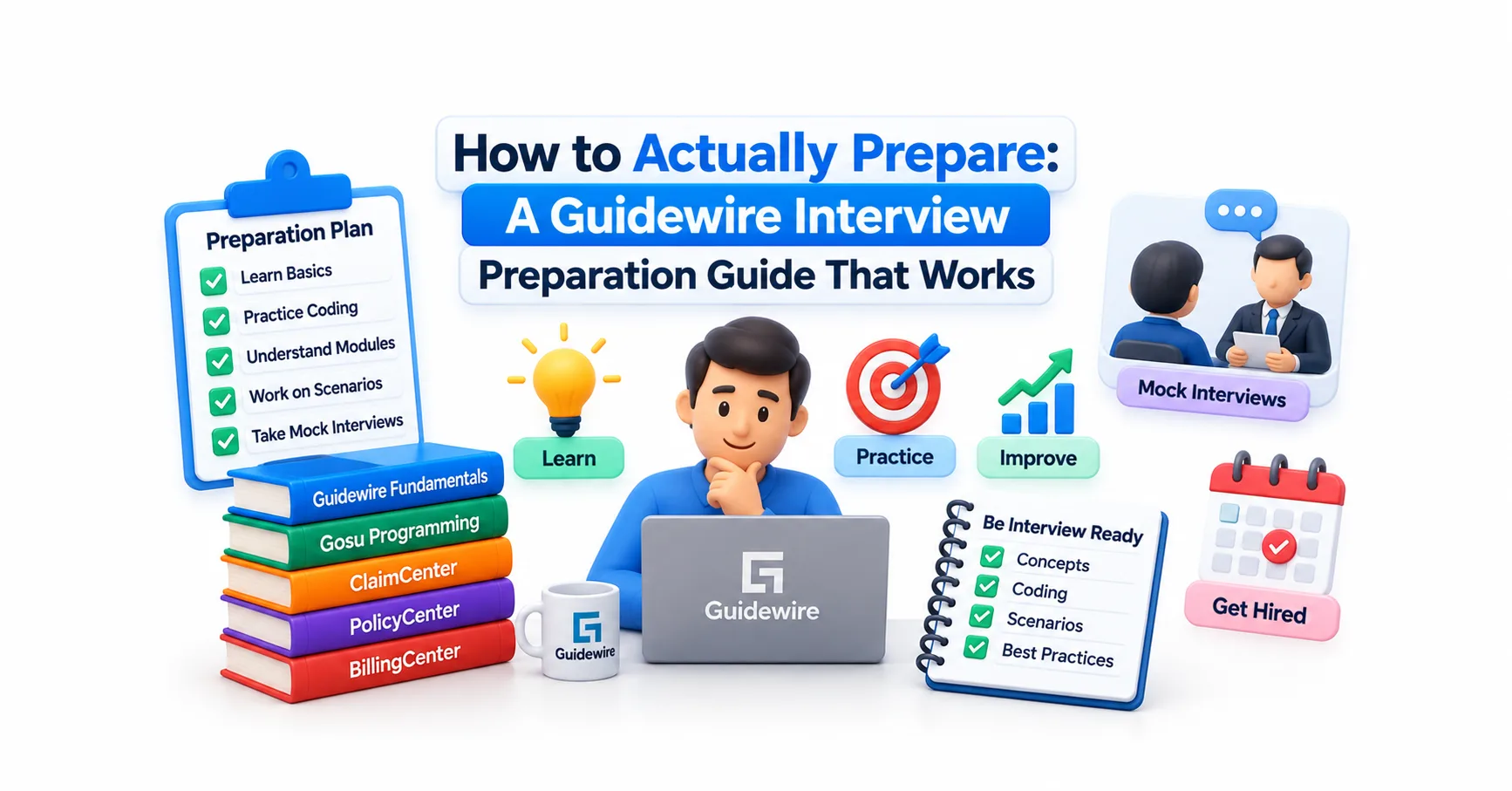
Cramming syntax the night before rarely works for Guidewire interviews, because the questions test applied understanding, not memorization. A better approach spreads preparation across a few focused stages.
Start by writing actual Gosu code, even small rules, rather than only reading about it. Then study one module deeply — ClaimCenter, PolicyCenter, or BillingCenter — instead of spreading yourself thin across all three. Follow that with mock scenarios: debugging a broken rule, explaining an entity relationship, or walking through an integration use case out loud, as if you're already in the interview.
Here's a simple weekly structure that works well:
Days 1–2: Gosu syntax and enhancements
Days 3–4: Rule sets and triggering events
Days 5–6: Data model and one integration scenario
Day 7: Mock interview and review
This kind of structured, hands-on Guidewire interview preparation consistently outperforms passive reading, because interviewers can tell within minutes whether a candidate has actually built something or simply memorized definitions.
Conclusion
Guidewire interviews reward genuine hands-on understanding over memorized syntax. Master Gosu's quirks, know your module's data model, and practice explaining your reasoning out loud — that combination is what turns a nervous candidate into a confident hire.