

How a Post-Silicon Validation Training Institute Can Help You Get Hired
Navigate through this article using the table of contents below
Table of Contents
No headings found in this article.
There are over 900 post-silicon validation jobs open in India right now — and most of them are sitting unfilled because the engineers who could take them were never trained for it.
While RTL design, physical design, and verification get most of the attention in VLSI career conversations, post-silicon validation has quietly become one of the fastest-growing and least-competed tracks in the Indian semiconductor market. Companies like Intel, Qualcomm, AMD, Renesas, and SmartSoC Solutions are actively hiring — and the gap between available roles and available talent is wide enough that a well-trained engineer can walk into this market and stand out immediately. That gap exists because post-silicon validation is not something you absorb from textbooks or online slides. It requires hands-on experience with real lab instruments, real debug workflows, and a structured way of thinking when a chip behaves in ways nobody predicted. That is precisely where a dedicated post-silicon validation training institute changes the outcome.
What Post-Silicon Validation Actually Is — Explained Simply
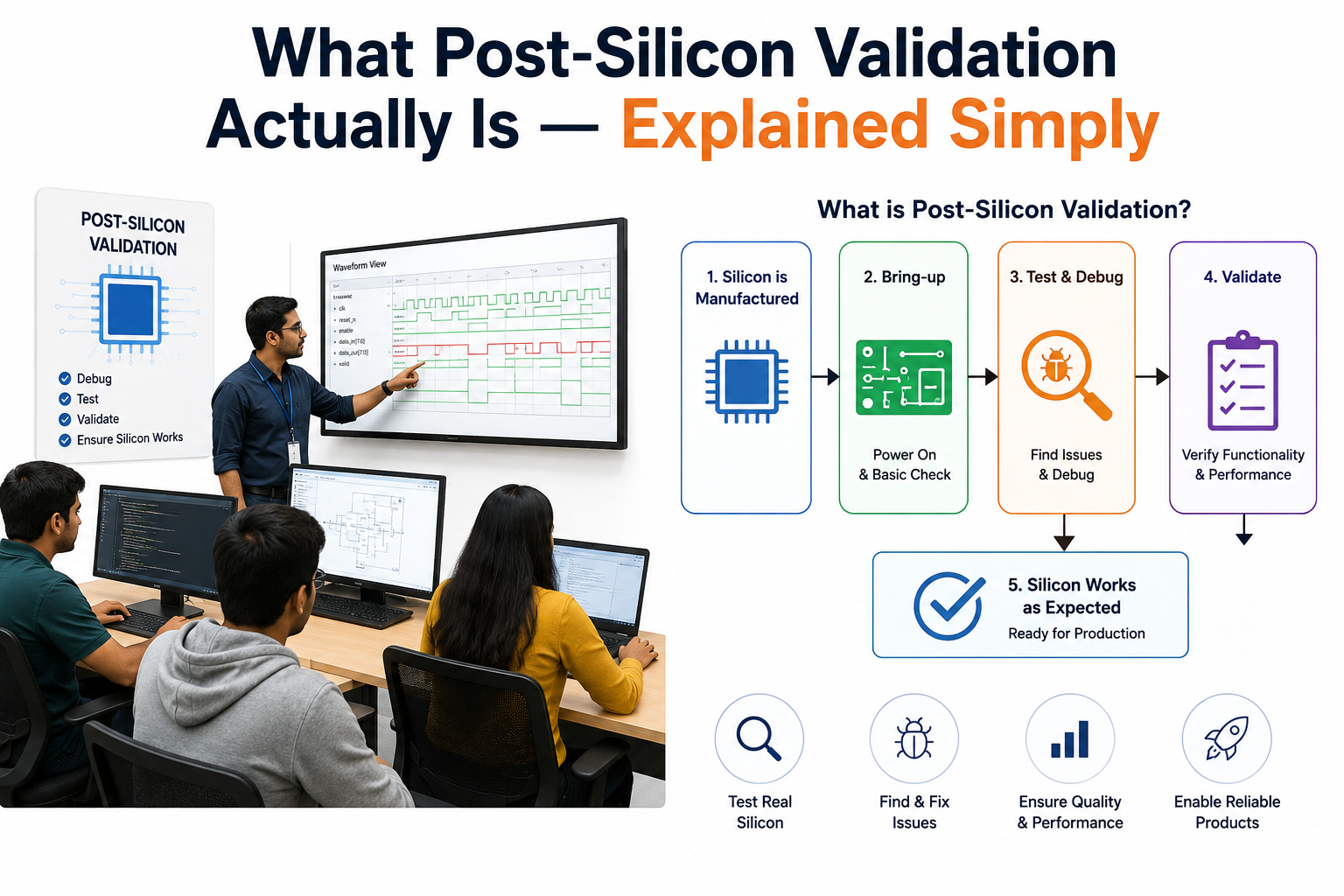
Before exploring how training helps, it is worth understanding exactly what post-silicon validation means — because it is a term that is widely misunderstood even by experienced ECE engineers.
Every chip that goes into your phone, laptop, car, or Wi-Fi router was first designed by engineers as a digital blueprint — lines of code written in hardware description languages like Verilog or SystemVerilog. Before the chip is manufactured, a team of verification engineers runs thousands of simulations to test whether that blueprint is correct. This is called pre-silicon verification, and it happens entirely on computers using simulation tools.
But once the chip is physically manufactured — once silicon wafers come back from the foundry — it enters a completely different world. The real chip behaves differently from the simulated model. Real silicon has voltage noise, temperature-dependent timing behavior, signal integrity effects on PCB traces, manufacturing process variation, and physical interface characteristics that no simulation can fully replicate. Testing and debugging this real chip is called post-silicon validation.
Post-silicon validation engineers work in labs. They connect manufactured chips to test boards, power them up for the first time, use oscilloscopes to measure electrical signals, use JTAG debuggers to access the chip's internal state, run Python scripts to automate test sequences, analyze protocol behavior with specialized analyzers, and track down failures that nobody predicted during design. When a chip passes post-silicon validation, it is ready for mass production. When it fails, validation engineers are the ones who find out why.
Why Post-Silicon Validation Jobs Are Growing So Fast in India
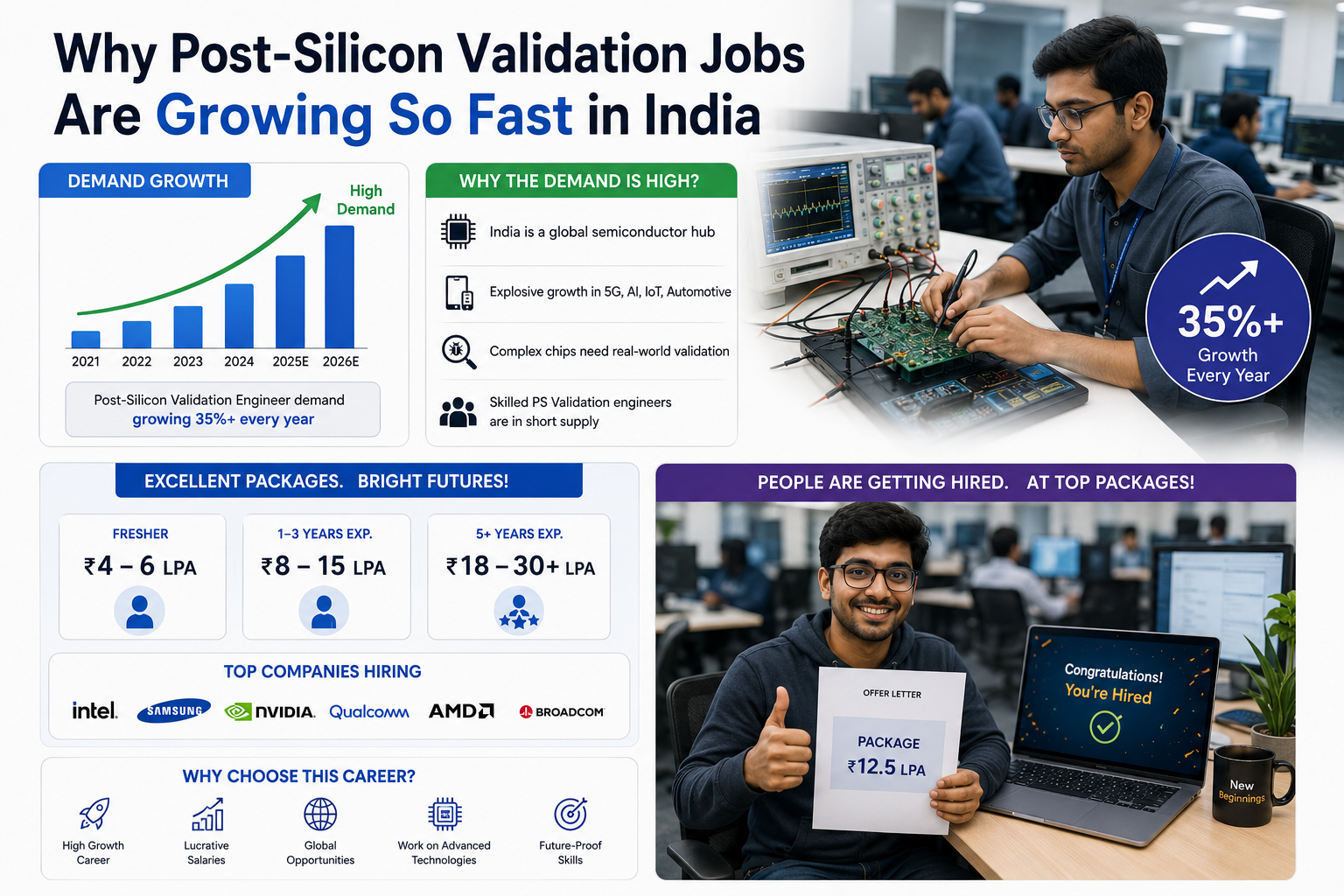
The demand for post-silicon validation engineers in India has accelerated sharply in 2025-26, and the reasons behind this are structural — they are not going away anytime soon.
India's semiconductor industry is in the middle of its biggest build-out phase ever. The India Semiconductor Mission has committed over ₹76,000 crore to building semiconductor manufacturing and design infrastructure. Micron's chip assembly and testing facility in Gujarat, Tata Electronics' chip fabrication plant in Dholera and assembly unit in Morigaon, CG Power's semiconductor unit in Sanand — these are real facilities, currently under construction or already operational. Every chip that comes out of these facilities needs post-silicon validation before it reaches customers. The more chips India manufactures and designs domestically, the more validation engineers the country needs.
On top of domestic manufacturing, India's chip design centers for global companies are growing at a significant pace. Intel, Qualcomm, AMD, Apple, and Renesas all run active post-silicon validation teams in India — primarily in Bangalore, Hyderabad, and Chennai. These teams are expanding. A search on Naukri.com in mid-2026 shows over 1,800 active silicon validation job postings in India. On Glassdoor, over 910 post-silicon validation-specific roles are listed. These numbers do not reflect a short-term hiring spike — they reflect a sustained structural need that will only grow as India becomes more central to global semiconductor production.
The supply side tells the other half of the story. Despite this demand, the number of engineers in India who are genuinely trained for post-silicon validation roles remains very low. Most VLSI training in India focuses on pre-silicon tracks — RTL design, physical design, and simulation-based verification. Very few training institutes offer post-silicon validation as a dedicated track with real lab access. The result is a supply-demand gap that makes trained validation engineers extremely competitive candidates in today's hiring market.
What a Post-Silicon Validation Training Institute Actually Teaches You
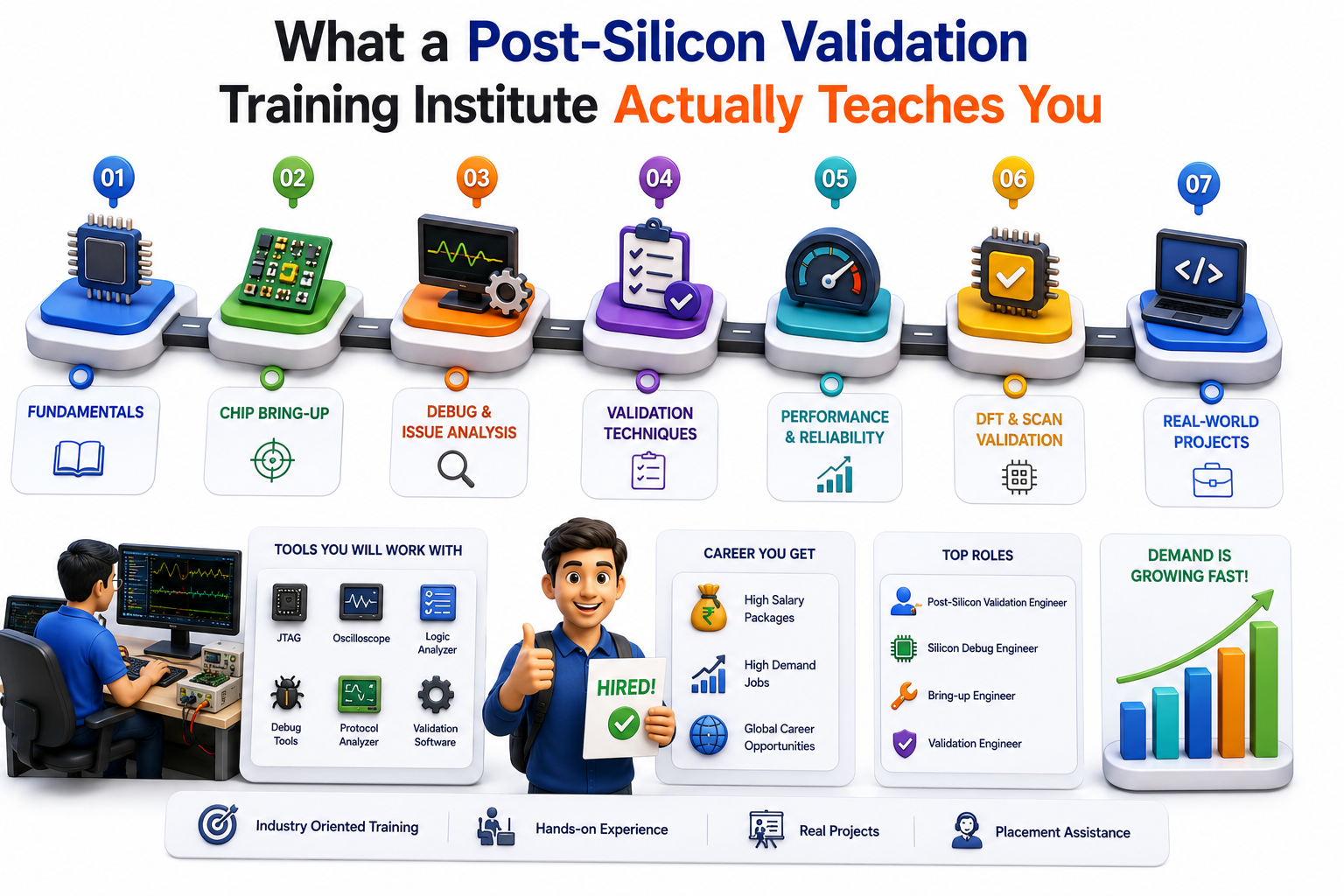
The honest answer to whether post-silicon validation training is worth it comes down to five specific things that no degree program and no self-study routine can deliver as efficiently.
1. Hands-On Lab Instrument Experience
The instruments used in a post-silicon validation lab — oscilloscopes, logic analyzers, protocol analyzers, JTAG debuggers, programmable power supplies — are expensive, specialized, and rarely accessible outside of an actual semiconductor company. Learning how to set up a measurement, capture a useful waveform, trigger on the right event, and interpret what you see is a skill that only comes from doing it repeatedly with real hardware. A dedicated post-silicon validation training institute gives you structured, supervised access to this equipment in a lab environment built to mirror what you will find on the job.
2. Silicon Bring-Up Methodology — The Most Critical First Step
Silicon bring-up is the process of powering on a newly manufactured chip for the first time. It sounds straightforward, but it is one of the most demanding tasks in chip development — because nothing is guaranteed to work, and you need a systematic process to figure out what is failing and why. A proper training program walks you through the exact sequence: checking power supply rails, verifying clock outputs, establishing JTAG connectivity, reading chip identification registers, and running the first boot sequence. Engineers who have been trained in bring-up methodology are immediately productive on day one of a validation job. Those who have not been trained spend weeks learning a process that should have been covered before they joined.
3. Debug Methodology — How to Think When Things Go Wrong
The most common complaint semiconductor companies raise about engineers entering validation roles is not a lack of technical knowledge — it is the inability to approach a problem systematically when a chip does something unexpected. Debug methodology — isolating variables, forming and testing hypotheses, narrowing a failure to a root cause — is a structured thought process that validation engineers apply every day. A good training institute does not just describe this framework; it puts you in situations where you must apply it on real hardware, get it wrong, and learn to correct your approach.
4. Protocol-Level Validation Knowledge
Modern SoCs are full of high-speed interfaces — PCIe for storage and graphics, DDR for memory, USB for peripherals, Ethernet for networking, MIPI for cameras and displays. Post-silicon validation engineers must understand how these protocols work, how to test them using a protocol analyzer, what a good eye diagram looks like versus a failing one, and how to trace a protocol-level failure back to its root cause in hardware or firmware. This knowledge is rarely built through self-study alone, and it is consistently tested in interviews at Intel, Qualcomm, and AMD.
5. Python Scripting for Test Automation
Validation labs do not manually run every test by hand. Hundreds or thousands of test cases need to run automatically across multiple silicon samples, temperature conditions, and voltage points. Python has become the industry-standard language for validation automation — engineers write scripts that send commands to lab instruments via standard interfaces, capture and parse results, flag failures, and generate reports. Training programs that include Python-based automation give you a skill that appears on almost every post-silicon validation job description in India and immediately raises your profile above candidates who only know hardware debug.
What Post-Silicon Validation Interviewers at Indian Semiconductor Companies Actually Test
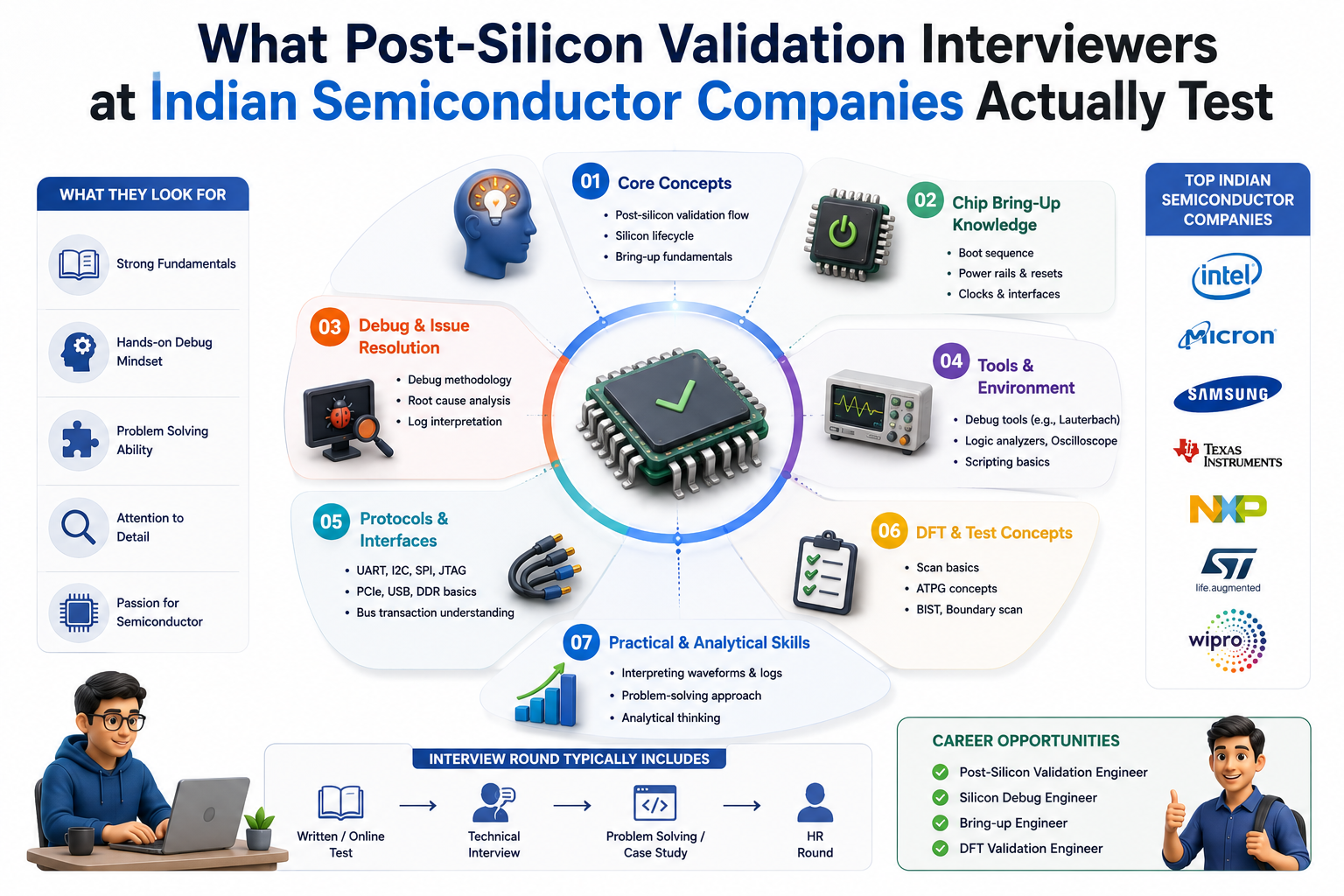
One of the clearest measures of how well post-silicon validation training prepares you is whether it covers what hiring managers actually care about. Based on job descriptions posted by Intel India, Qualcomm India, Renesas India, SmartSoC, and Mirafra, here is what interviewers consistently assess for this role in India.
The first thing most interviews start with is silicon bring-up. Interviewers describe a chip that failed to power on correctly and ask you to walk through your debug approach step by step. This is not a trick question — they want to see whether you follow a systematic, methodical process or whether you guess randomly. Candidates who have trained properly with real bring-up exercises answer this confidently. Candidates who only read about it typically stall.
The second common area is instrument knowledge. Interviewers ask what oscilloscope parameters you would check first when a PCIe link fails to train, or how you would use a logic analyzer to find the source of a DDR data corruption issue. These questions are easy to answer if you have actually used these instruments. They are very hard to fake.
Third is Python scripting for automation. Many interviews include a short scripting exercise or a conceptual question about how you would automate a test sequence — for example, sweeping supply voltage from 0.9V to 1.1V in steps while running a functional test and logging pass/fail results. This is a standard validation lab task, and training programs that include automation exercises prepare you for exactly this.
Finally, most interviewers ask about failure analysis — given a specific chip failure, walk through how you would isolate whether it is a design bug, a timing issue, or a manufacturing defect. This tests whether you understand the different failure mechanisms in silicon and whether you know how to differentiate between them using available tools. It is a question that separates engineers who have been trained in a structured post-silicon validation program from those who have only encountered the concept theoretically.
How to Choose the Right Post-Silicon Validation Training Institute in India
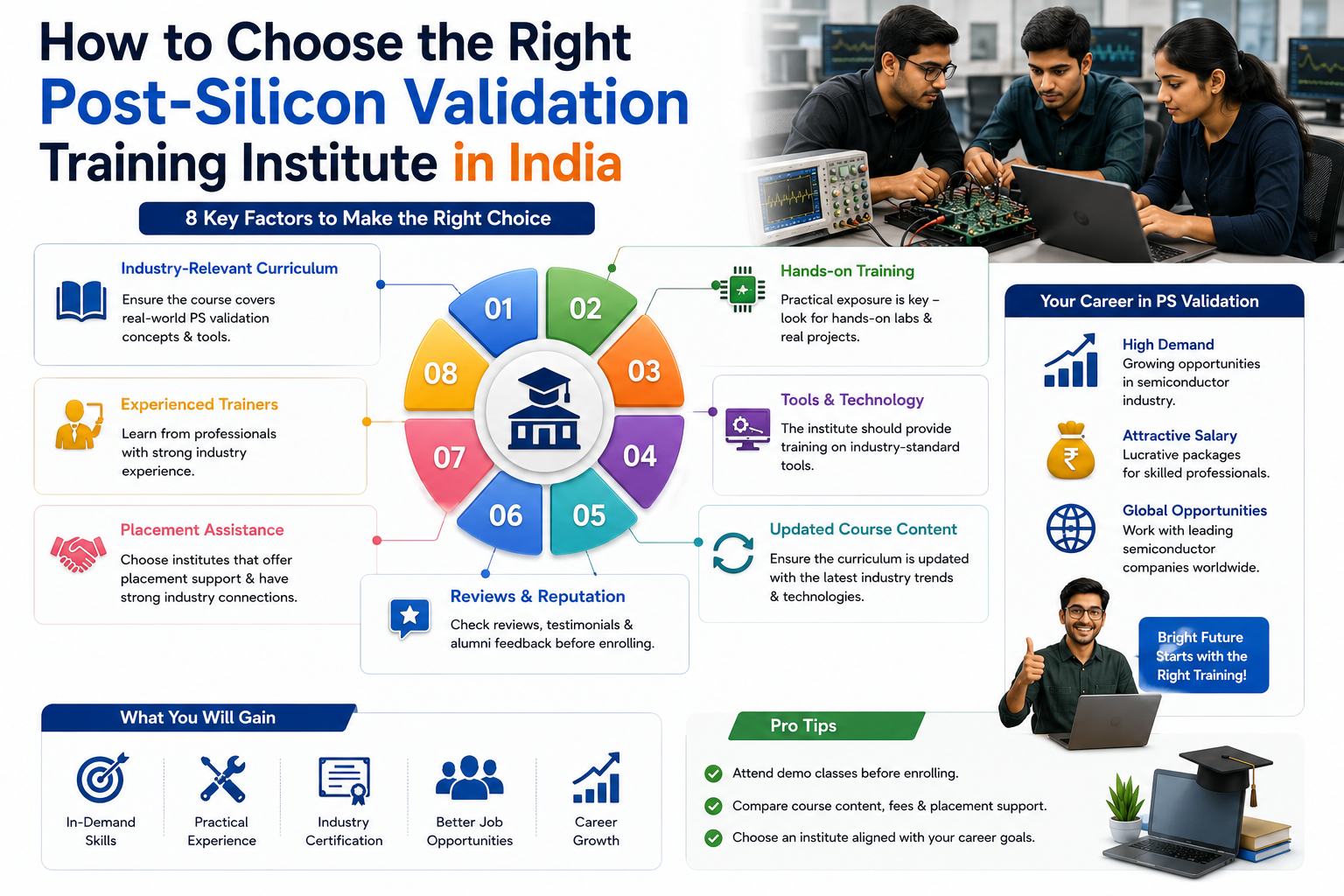
Not every institute that claims to offer post-silicon validation training actually delivers on the promise. The difference between good training and bad training in this field is stark, and it directly affects your career outcome. Here is what to specifically verify before you invest your time and money.
• Real lab equipment, not simulations: post-silicon validation training must include real oscilloscopes, JTAG debuggers, logic analyzers, and protocol analyzers. If the institute only offers simulation-based exercises or slides showing instrument screenshots, you will complete the program without the hands-on experience that every interview and every job requires.
• Trainers with actual validation industry experience: the best validation trainers have personally worked in a semiconductor company lab, performed silicon bring-up on real chips, and debugged real silicon failures. Ask the trainer specifically which company they worked at, on which chip program, and what their role was. This is not an unreasonable question — it is the most important one you can ask.
• Structured curriculum covering the full validation flow: a credible program should cover silicon bring-up, lab instrument operation, DFT-based debug access, high-speed interface validation, power and thermal testing, Python automation, and failure analysis methodology. If the curriculum only covers one or two of these areas, it is not preparing you for what the job actually involves.
• A complete project you build yourself: a genuine validation training project involves working with actual hardware, writing your own test scripts, identifying and debugging a real failure — not watching a pre-recorded demonstration. Ask specifically what the project involves and what role you play in it.
• Placement support with verification you can check: ask for recent placement examples in post-silicon validation roles specifically, not just general VLSI placements. The companies, roles, and approximate packages are reasonable things to ask about before enrolling.
JastTech is an ISO 9001:2015 certified VLSI training institute in India offering post-silicon validation training as a dedicated track, with lab-based training on real instruments, a structured curriculum covering the complete validation flow, and placement support across its centers in Hyderabad, Bangalore, Chennai, Noida, Pune, and Kolkata.
What Your Career Looks Like After Post-Silicon Validation Training in India
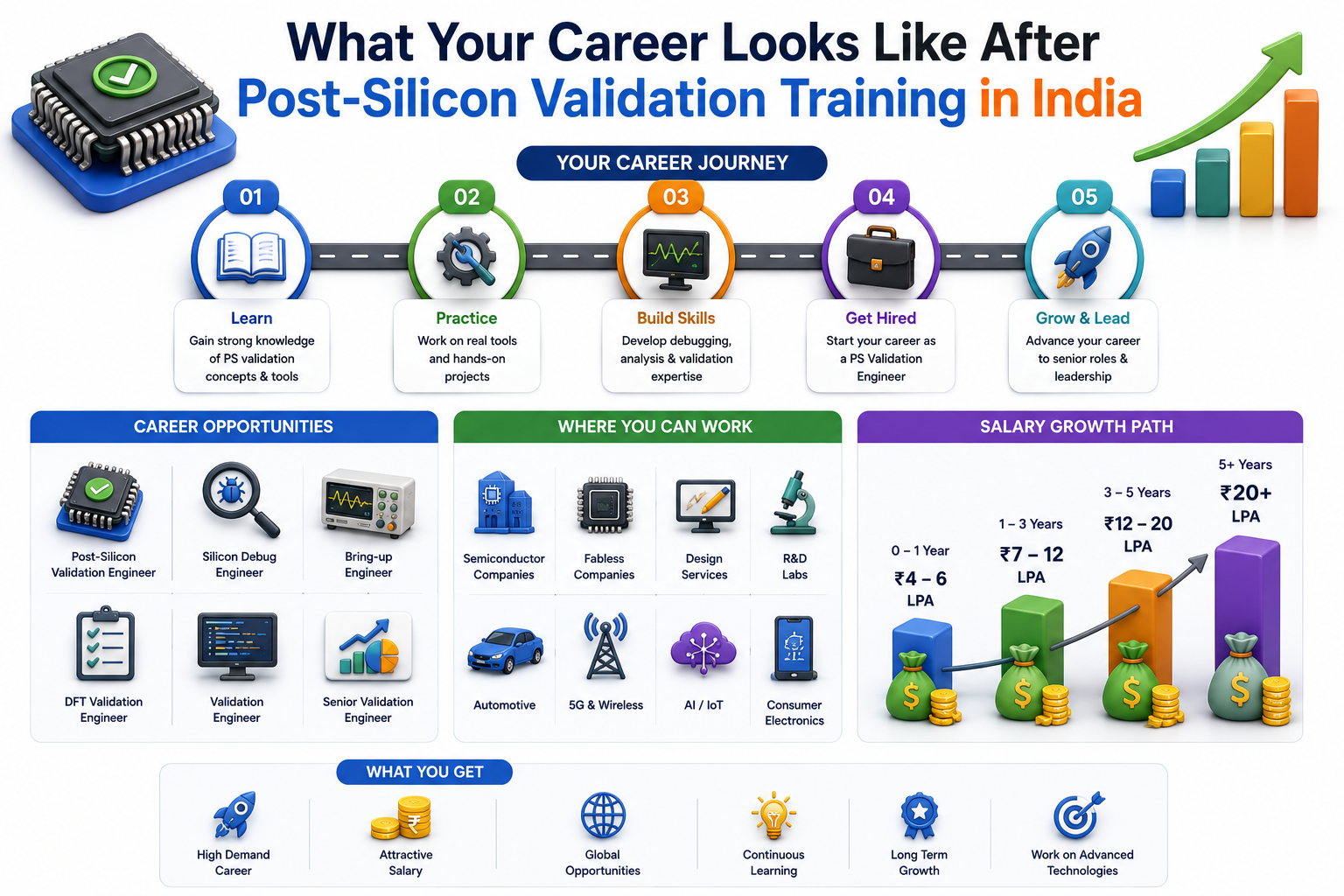
The most important question before investing in any training is: where does this actually lead? Here is an honest picture of what a post-silicon validation career in India looks like in 2026, from the first job to the senior level.
Entry-level post-silicon validation roles in India — at companies like Intel, Qualcomm, AMD, Renesas, and Tata Electronics — typically pay between ₹8 and ₹15 lakh per year for engineers entering the field with solid training and a real project to show. This is above the average entry-level salary for most VLSI tracks, precisely because trained validation engineers are in shorter supply. The entry-level role typically involves running test scripts, operating lab instruments under supervision, assisting with silicon bring-up, and documenting failure observations. Within twelve to eighteen months, engineers who show systematic debug ability take on independent ownership of specific test areas.
At the three to five year mark, experienced validation engineers in India earn between ₹22 and ₹40 lakh, depending on the depth of their specialization. Engineers who specialize in high-speed interface validation — PCIe, DDR, USB — or in power and thermal characterization command the higher end of this range. Engineers who move into validation automation, building scalable Python frameworks for regression testing, become extremely valuable and are often promoted into lead roles.
Senior validation engineers with seven or more years of experience, particularly those who have owned full chip sign-off cycles — taking a chip from first silicon to production release — earn between ₹40 and ₹60 lakh in India. The most experienced specialists in Silicon Valley equivalents of these roles earn in excess of $200,000 per year. The career path from post-silicon validation also branches naturally into product engineering, reliability engineering, test engineering, and ultimately principal or distinguished engineer tracks at large semiconductor companies.
One important long-term point: post-silicon validation expertise is highly portable. A trained validation engineer who understands bring-up methodology, debug tools, and protocol validation can move across chip domains — from mobile SoCs to automotive chips to AI accelerators to networking silicon — because the core skills transfer. This breadth of applicability makes it one of the most career-resilient specializations in the entire VLSI field.
Conclusion
Post-silicon validation is one of the most in-demand and least-trained semiconductor skills in India today. The gap between available jobs and available candidates is real, the salaries at entry level are above most VLSI tracks, and the career growth is long-term and portable across chip domains. A dedicated post-silicon validation training institute gives you what no degree or online tutorial can: real lab instruments, structured bring-up methodology, hands-on debug experience, and the Python automation skills that every hiring manager looks for. For any engineer serious about building a long-term VLSI career in India, this is the track worth committing to.