

RTL Design and Verification Training in India: Why It Is the Top Career Choice in 2026
Navigate through this article using the table of contents below
Table of Contents
No headings found in this article.
If you're an electronics or ECE student scrolling through job portals in 2026, you've probably noticed something strange: almost every 'entry level' chip design job asks for skills that no regular engineering syllabus teaches in depth. Verilog. SystemVerilog. UVM. Testbenches. Coverage closure. That gap between what colleges teach and what semiconductor companies actually need is exactly why RTL design and verification training in India has become one of the most searched, most recommended, and most practical career decisions for engineering graduates right now.
This isn't hype. India's chip industry is in the middle of a real, government-backed build-out, and the companies driving it are hunting for engineers who can read a specification and turn it into working, bug-free silicon logic. This blog breaks down what RTL design and verification actually means, why training built around it is worth your time and money in 2026, and how to choose a program that leads to an actual job rather than just a certificate.
1. What Is RTL Design and Verification?
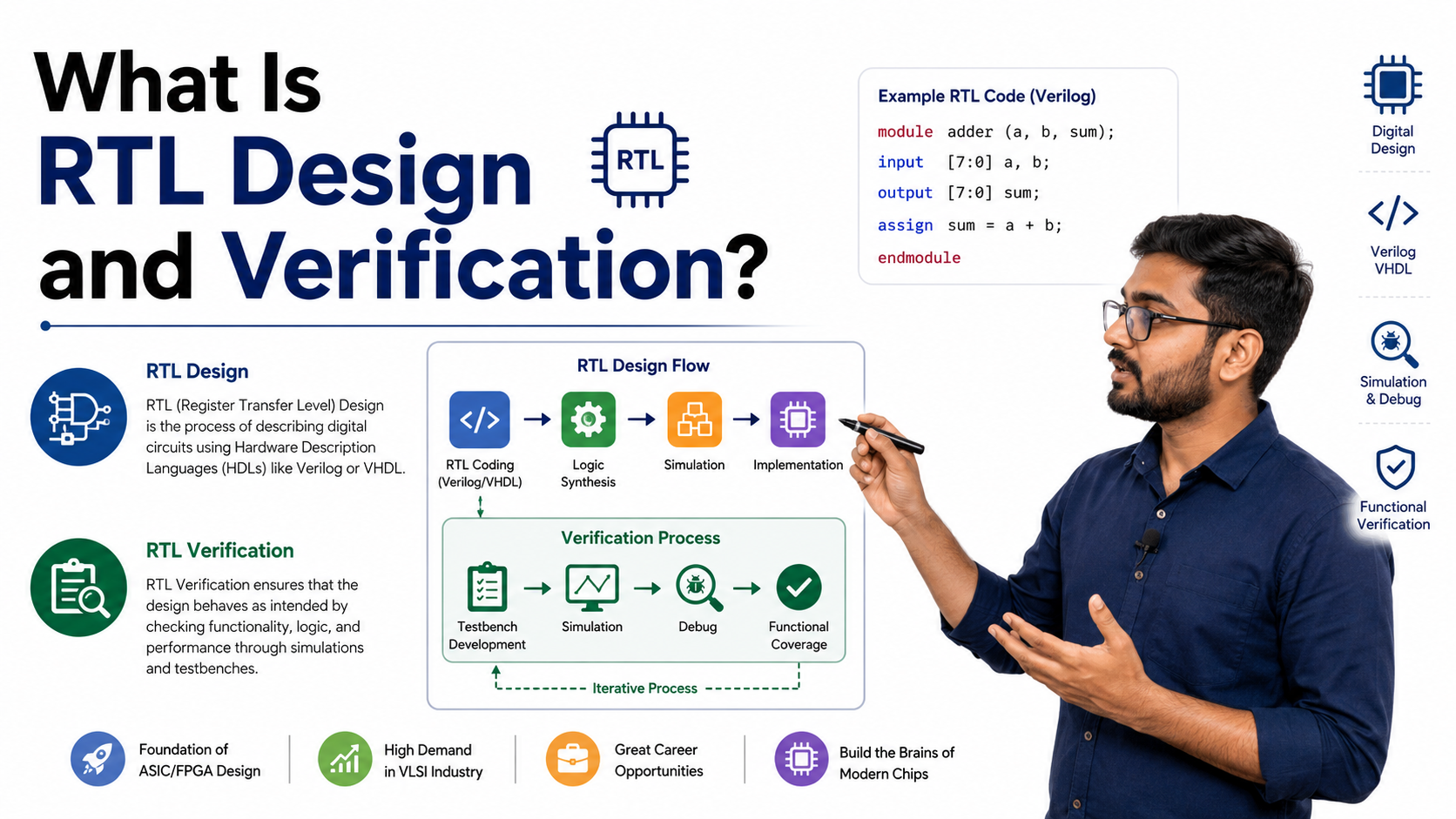
Every chip inside your phone, laptop, car, or smart TV starts life as an idea written in a hardware description language — usually Verilog or SystemVerilog. Engineers describe how a circuit should behave at the 'register transfer level,' meaning how data moves between registers on every clock cycle. This written description is called RTL, and creating it is called RTL design.
But writing RTL is only half the job. A single modern chip can contain billions of transistors, and a single logic error — a wrong condition, a missed edge case, a timing mismatch — can make the entire chip useless after it's manufactured. Unlike software, you cannot push a patch to fix a physical chip. This is where verification comes in: verification engineers build test environments that stress the RTL design with millions of scenarios to catch bugs before the design goes to fabrication.
• RTL Design: You write the digital logic in Verilog/SystemVerilog that defines how the chip behaves.
• Functional Verification: You build testbenches, apply the Universal Verification Methodology (UVM), and hunt for the bugs that RTL design might have missed.
Together, RTL design and verification form the 'front end' of the chip design flow — the stage before the logic is converted into a physical, manufacturable layout. It is the most people-heavy, most hiring-active part of the entire VLSI (Very Large Scale Integration) industry, which is exactly why training in this area gets you closer to a job faster than almost any other specialization in electronics.
2. Why India Is Becoming a Global Hub for RTL Design and Verification Training
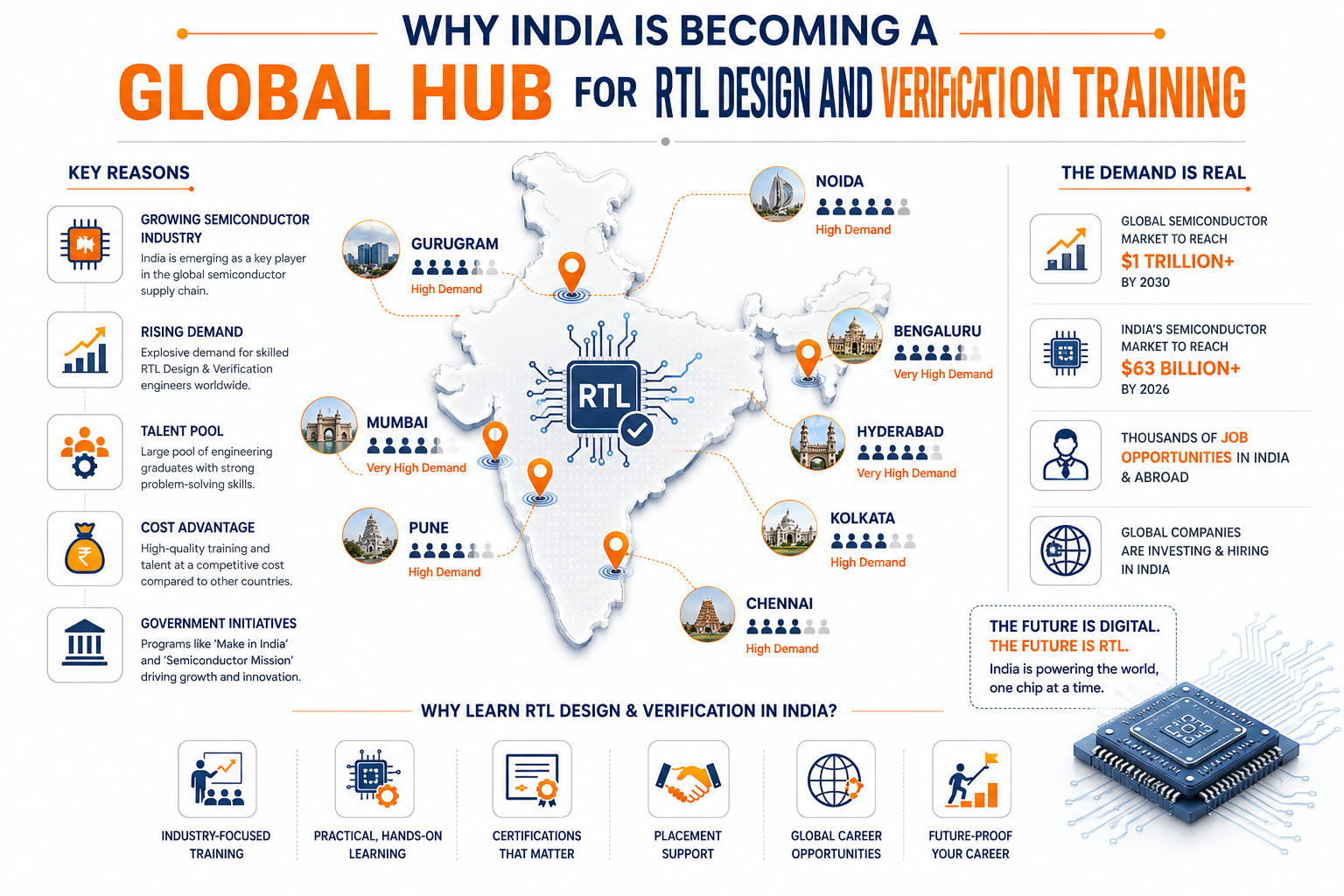
This is not a coincidence — it is the direct result of policy, investment, and global supply chain shifts converging at the same time. Here's what is actually happening on the ground in 2026:
• India Semiconductor Mission (ISM) 2.0: The government has approved a significantly expanded outlay for ISM 2.0, building on the original mission, with a strong push toward chip design capability, not just manufacturing plants.
• Fabs are becoming real: Facilities from Tata Electronics–PSMC in Dholera, Micron in Sanand, and several OSAT/ATMP units across Gujarat, Assam, and Rajasthan are moving from announcements to actual construction and commercial production.
• Global design centres are expanding here: Intel, Qualcomm, NVIDIA, AMD, Texas Instruments, and Samsung all run large India-based design and verification teams, and many are actively hiring for RTL and verification roles.
• Design-linked incentives are fuelling startups: Dozens of Indian fabless design startups have been supported under the Design Linked Incentive (DLI) scheme, creating a fresh wave of hiring beyond the big MNCs.
In simple terms: India already had the world's largest pool of electronics engineering graduates. What changed is that the country now has real semiconductor investment sitting on top of that talent pool, and design work — RTL and verification specifically — is the layer that needs people the most, because it can be done from any design centre in Bengaluru, Hyderabad, Noida, or Pune without waiting for a fab to be built next door.
3. Key Skills You Will Actually Learn in a Good RTL Design and Verification Training Program
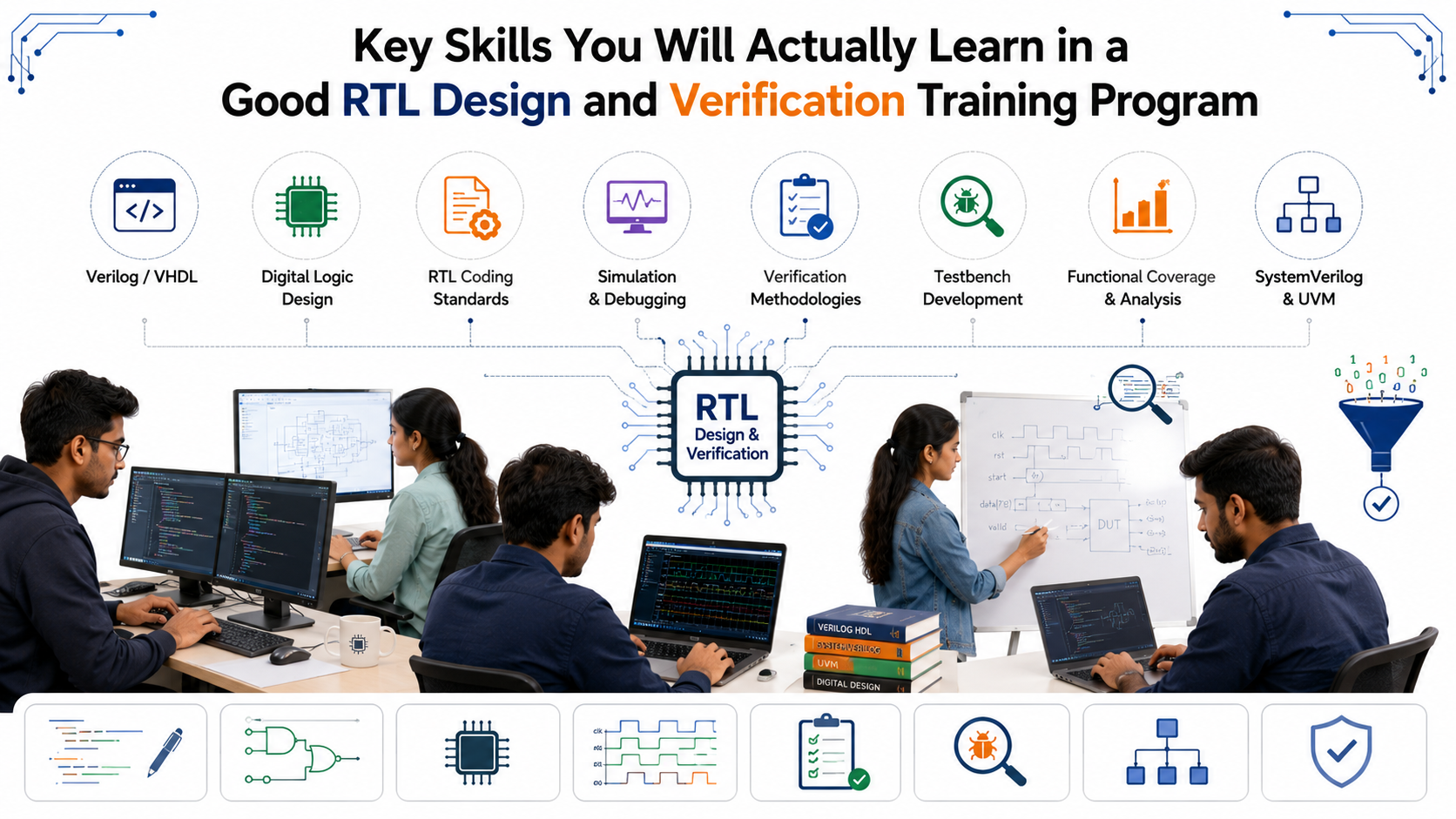
Not all courses are built equally. A training program worth paying for should take you from digital logic fundamentals to a job-ready, tool-tested skill set. Here's what a strong curriculum genuinely covers:
• Digital logic and computer architecture fundamentals — combinational and sequential circuits, FSMs, pipelining, and memory basics.
• Verilog and SystemVerilog coding — writing synthesizable RTL for real modules like FIFOs, arbiters, UARTs, and simple processors.
• Functional verification and UVM — building reusable testbenches, drivers, monitors, scoreboards, and functional coverage models.
• Industry-standard EDA tools — hands-on exposure to simulators like QuestaSim or VCS, and familiarity with Synopsys and Cadence flows.
• Scripting for automation — Python and TCL, which verification and design teams use daily to automate regressions and analyze results.
• A capstone project — something like a RISC-V core, a UART controller, or an AXI-based SoC block, ideally pushed to GitHub as a portfolio piece.
The single biggest differentiator between a training program that gets you hired and one that just hands you a certificate is hands-on lab time. If a course is mostly slides and theory with a handful of screenshots, you'll struggle in interviews the moment a hiring manager asks you to debug a waveform live. Look for programs that give you real simulation tool access and real project debugging, not just lecture videos.
4. RTL Design vs. Verification: Which Career Path Should You Choose?
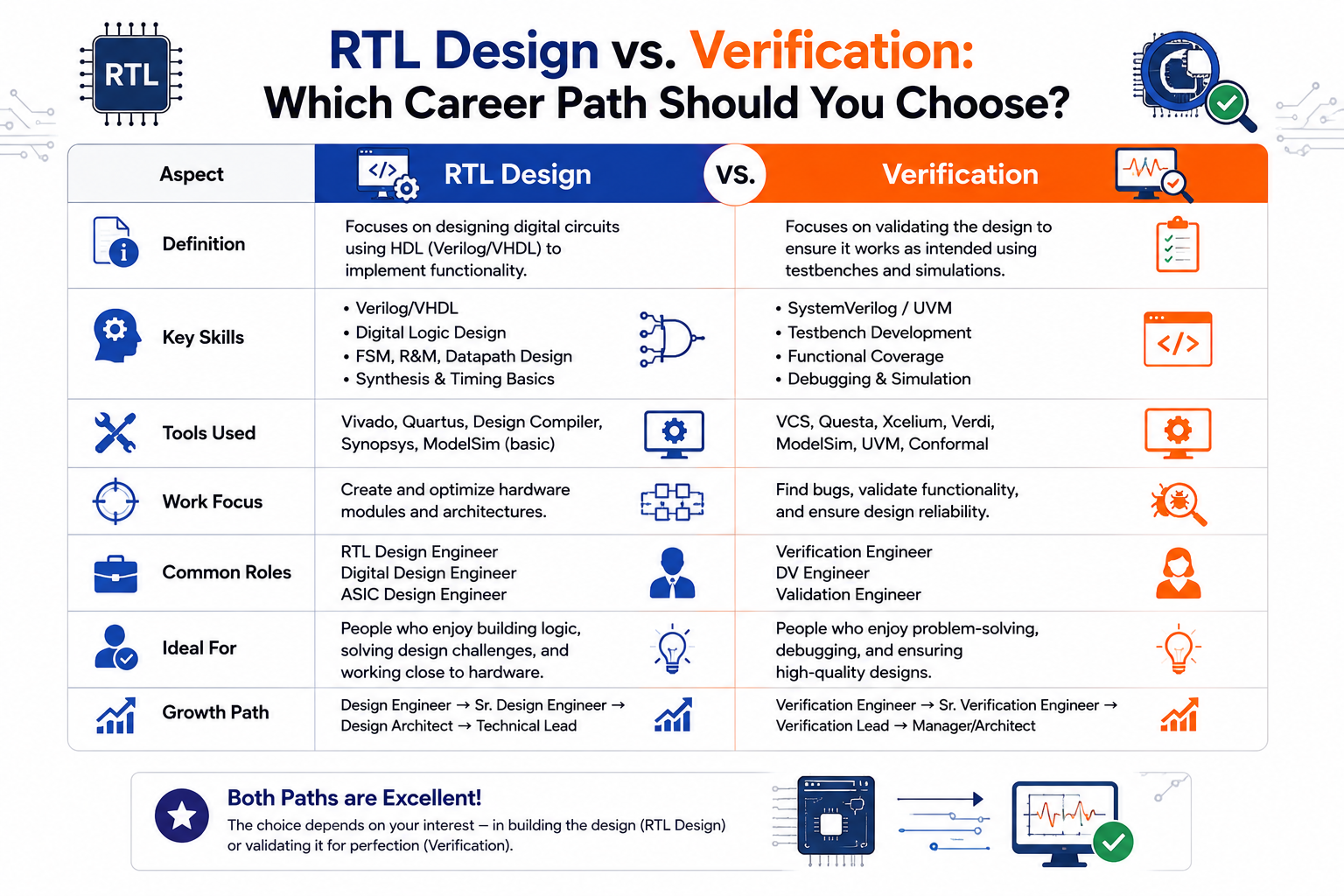
This is one of the most common questions students ask before starting training, and there's no universally 'better' answer — it depends on how you think and work.
Choose RTL Design if you enjoy: building things from scratch, architecting logic, optimizing for power and performance, and thinking in terms of hardware structure. RTL designers are the 'creators' of the chip's behaviour.
Choose Verification if you enjoy: breaking things on purpose, thinking like an attacker or a skeptic, writing structured test plans, and using coding and scripting to automate bug-hunting. Verification is widely considered the most in-demand and most beginner-friendly entry point into VLSI in 2026, since companies always need more verification engineers than the number of chips they tape out.
The good news: the two paths aren't walls, they're doors. Many engineers move between RTL design and verification over their careers, and the logical thinking skills built in one domain transfer well into the other. A strong training program should expose you to both before you specialize, so you choose based on genuine interest rather than a guess.
5. Salary Expectations and Job Roles After RTL Design and Verification Training

Compensation in this field scales quickly with experience, and that's part of what makes it attractive compared to many other core-engineering paths in India.
• Freshers: Roughly ₹3–6 LPA to start, depending on the company type (product companies typically pay more than pure services firms).
• 2–5 years experience: Salaries commonly move into the ₹8–20 LPA range as you gain project ownership and tool depth.
• Senior / Lead roles: Experienced RTL design leads, verification leads, and DFT specialists frequently earn ₹35–60 LPA or more at top semiconductor and MNC design companies.
Typical job titles you'll be eligible for after solid training include RTL Design Engineer, Functional Verification Engineer, ASIC Verification Engineer, Design Verification (DV) Engineer, and — as you progress — Verification Lead or Design Lead. Career growth generally moves from Graduate Engineer to Engineer, Senior Engineer, Staff/Lead, and eventually Principal Engineer or Architect for those who stay technical rather than move into management.
It's worth being clear-eyed here: these numbers reflect a competitive, skill-tested field, not an automatic outcome of finishing a course. What actually moves your salary is demonstrable tool experience, a portfolio of real RTL and verification projects, and the ability to explain your debugging process clearly in an interview — all things good training is specifically designed to build.
6. How to Choose the Right RTL Design and Verification Training Institute in India
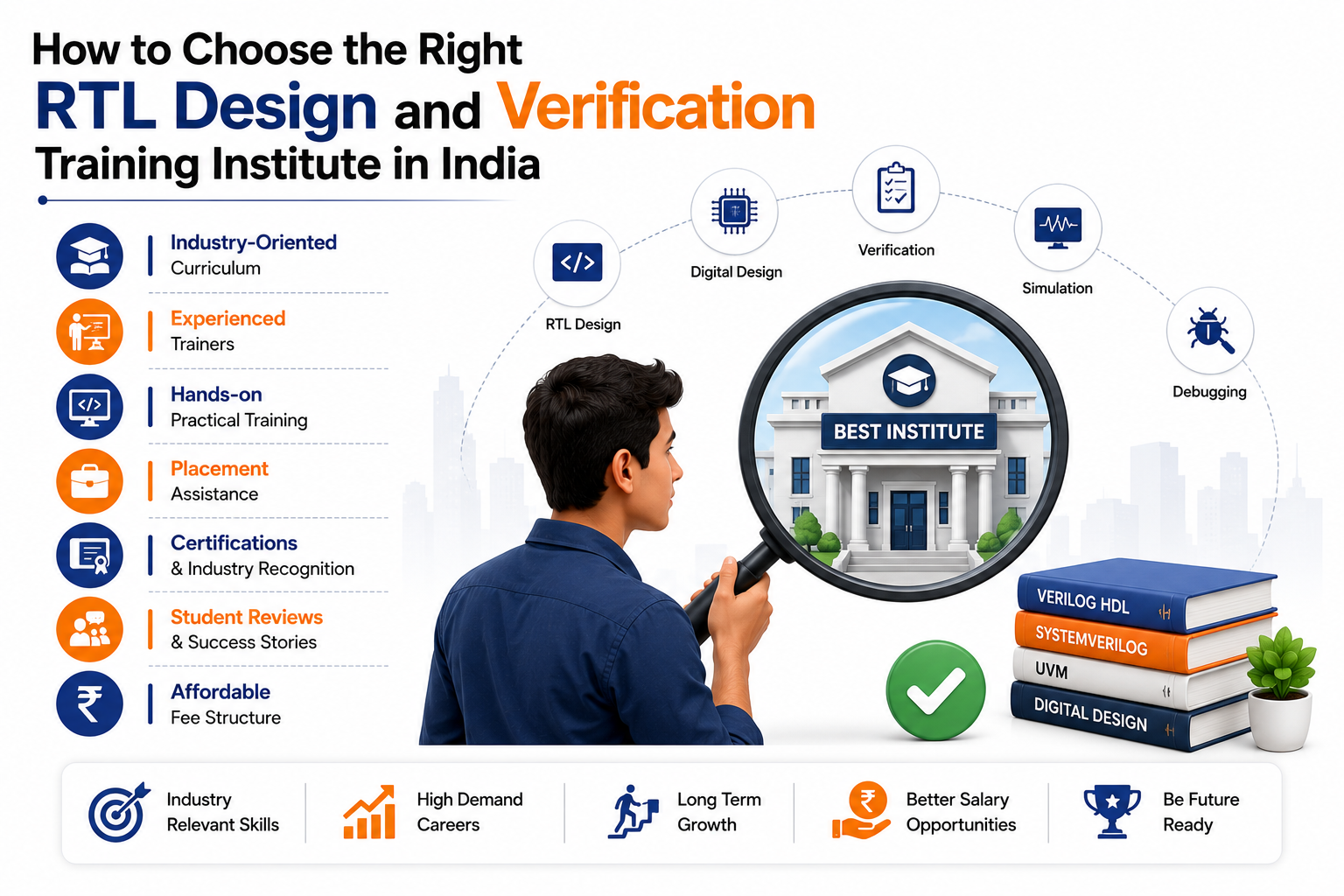
With so many VLSI Training institutes options , picking the right one matters as much as the decision to train at all. Use this checklist before enrolling anywhere:
• Hands-on lab access: Does the program give you real access to simulation and verification tools, or only recorded lectures?
• Project-based curriculum: Will you build and debug actual RTL modules and testbenches, not just watch someone else do it?
• Instructor industry background: Are the trainers currently working, or have recently worked, in real VLSI design or verification roles?
• Placement support and industry connections: Does the institute have a track record of graduates actually placed in RTL design or verification roles, not just a generic 'placement assistance' claim?
• Curriculum currency: Does the syllabus reflect current industry practice — UVM-based verification, SystemVerilog, and exposure to modern EDA flows — rather than outdated material?
• Portfolio outcome: Will you finish the program with a project you can show in interviews and put on GitHub, such as a small RISC-V core or a verified peripheral block?
A simple test: ask any institute to show you a sample project a past student built, and ask what tools that student used. If they can't answer specifically, that's a red flag. The best RTL design and verification training in India treats you like a junior engineer from day one, not a student memorizing slides.
Final Thoughts: Is RTL Design and Verification Training Worth It in 2026?
Given India's expanding semiconductor investment, the ongoing global shift of chip design work into Indian design centres, and the structural shortage of industry-ready engineers (not a shortage of graduates — a shortage of job-ready skills), RTL design and verification training is one of the most reasonable, evidence-backed career bets an electronics, ECE, or CS-with-hardware-interest student can make in 2026. It's a specialized, high-barrier field, which is exactly why it pays well and stays in demand — the barrier keeps the field from getting oversaturated the way many software roles have.
If you're serious about it, start small: learn digital logic fundamentals, pick up Verilog or SystemVerilog on your own time, and then join a training program that forces you to actually build and debug things — not just watch someone else do it. That one decision, made early, is usually the difference between finishing a course and starting a career.
Frequently Asked Questions
Is RTL design and verification training worth it for freshers with no prior VLSI background?
Yes. Most engineers enter this field from a standard ECE, EE, or CS background with no prior chip design exposure. What matters is a strong grasp of digital logic and consistent hands-on practice with Verilog/SystemVerilog and verification tools during training.
How long does it take to become job-ready in RTL design and verification?
With consistent, focused effort — including hands-on projects — most learners can become interview-ready in roughly six to twelve months, depending on prior exposure to digital electronics and coding.
Which is easier to break into as a fresher: RTL design or verification?
Verification is generally considered the more beginner-friendly and currently the most in-demand entry point, since every chip needs more verification effort than design effort, and the skill set overlaps well with programming backgrounds.
Do I need a master's degree to get an RTL design or verification job in India?
No. A B.Tech in Electronics, Electrical, or a related field is sufficient for most entry-level RTL design and verification roles. A master's degree becomes more useful for advanced research-oriented or analog design roles.
What tools should I be comfortable with after training?
At minimum, a simulator such as QuestaSim or VCS, SystemVerilog and UVM for verification, and basic scripting in Python or TCL for automating regressions and analyzing results.