

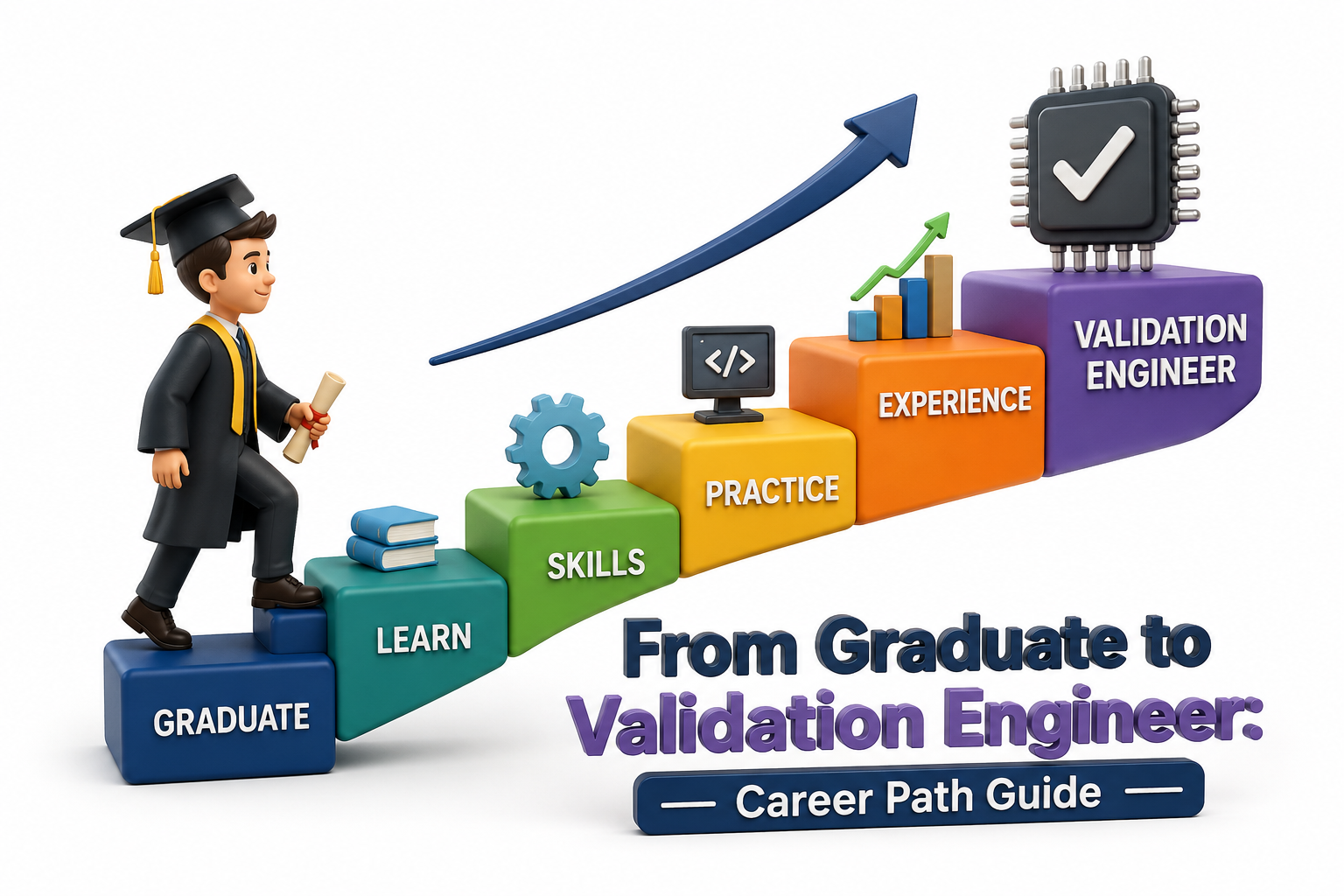
From Graduate to Validation Engineer: Building a Career in Post-Silicon Validation Engineer
Navigate through this article using the table of contents below
Table of Contents
No headings found in this article.
Did you know that a single undetected silicon bug can cost semiconductor companies millions of dollars and delay product launches by months? This is why Post-Silicon Validation Engineers play a critical role in the chip development lifecycle. As the semiconductor industry continues to grow with advancements in AI, automotive electronics, IoT, and high-performance computing, the demand for skilled validation engineers is increasing rapidly. For engineering graduates looking to enter the VLSI industry, pursuing Post Silicon Validation Training can provide the practical knowledge and industry exposure needed to build a successful career. It offers exciting opportunities to work on cutting-edge semiconductor products and ensure their functionality, performance, and reliability before they reach the market.
The journey from graduate to Validation Engineer requires a strong foundation in digital electronics, computer architecture, embedded systems, and validation methodologies. Along with technical knowledge, aspiring professionals must develop expertise in debugging, scripting, test development, hardware-software integration, and industry-standard tools used in semiconductor validation. This guide explores the complete career path of a Post-Silicon Validation Engineer, including essential skills, learning roadmap, job responsibilities, industry opportunities, and strategies to build a successful career in the rapidly evolving VLSI and semiconductor domain.
What Does a Post-Silicon Validation Engineer Do?
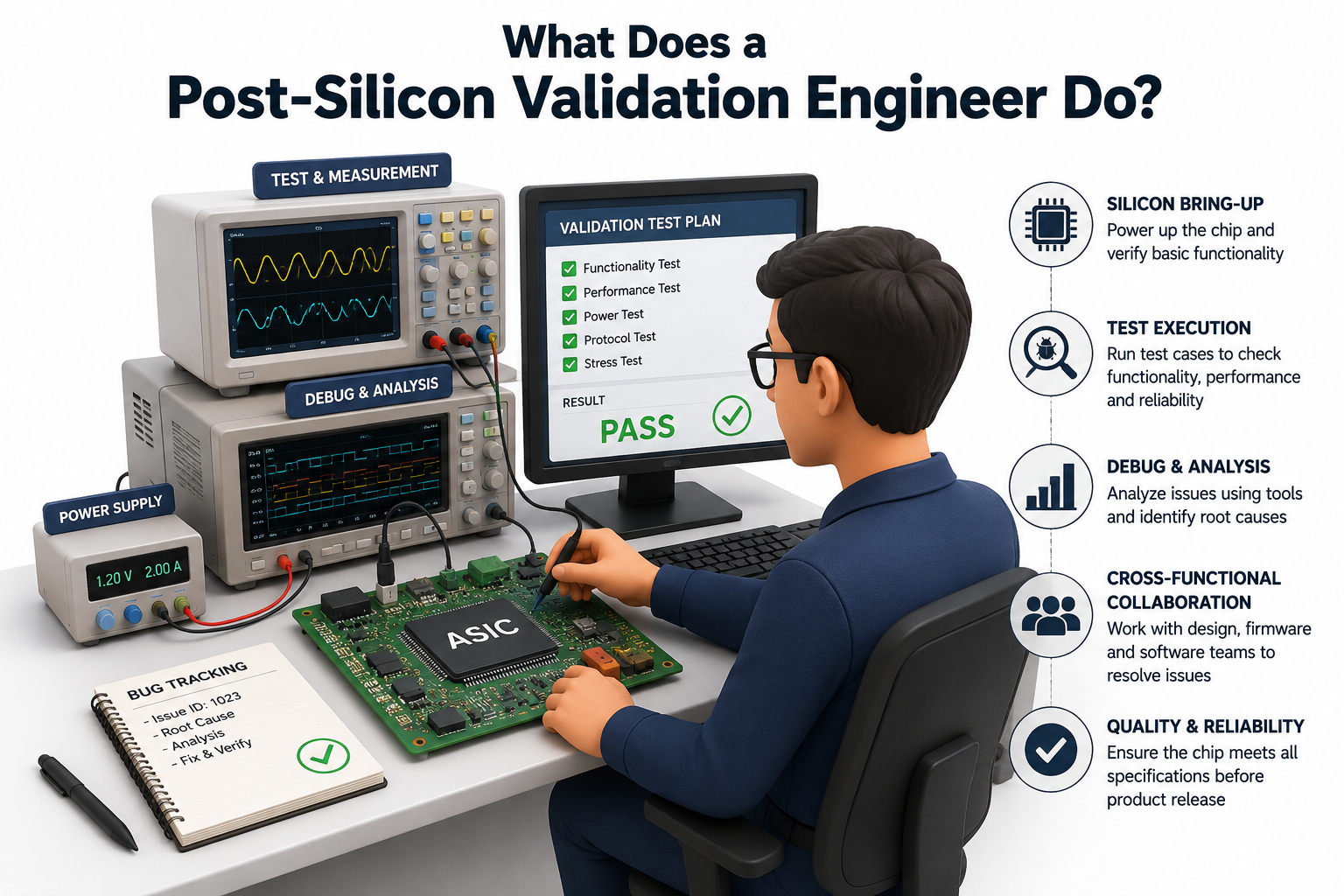
A Post-Silicon Validation Engineer plays a critical role in the semiconductor development process by verifying that a manufactured chip functions correctly in real hardware environments. After the chip is fabricated and returned from the foundry, validation engineers perform extensive testing to ensure that the silicon behaves according to design specifications. Their primary objective is to identify functional issues, performance bottlenecks, power-related problems, and hardware-software integration challenges before the product reaches customers. This stage is essential because any undetected defect in silicon can lead to costly product recalls, delayed launches, and significant financial losses for semiconductor companies.
One of the key responsibilities of a Post-Silicon Validation Engineer is silicon bring-up, which involves powering on the chip for the first time and confirming that its core functions operate as expected. Engineers develop test plans, execute validation test cases, analyze system behavior, and use advanced debugging tools such as oscilloscopes, logic analyzers, protocol analyzers, and JTAG interfaces to investigate issues. They work closely with design, verification, firmware, and software teams to isolate bugs, determine root causes, and implement solutions. Strong knowledge of digital electronics, computer architecture, embedded systems, and scripting languages is essential for efficiently validating complex semiconductor devices.
As semiconductor technologies continue to advance in areas such as artificial intelligence, automotive electronics, 5G communication, and high-performance computing, the importance of post-silicon validation has grown significantly. Modern chips contain billions of transistors and multiple integrated subsystems, making comprehensive validation more challenging than ever. Post-Silicon Validation Engineers ensure product reliability, performance, and compliance with industry standards, ultimately contributing to successful chip deployment in real-world applications. Their expertise helps bridge the gap between chip design and commercial product release, making them indispensable professionals in the VLSI and semiconductor industry.
Read more about :- VLSI Training Institute in India
Educational Requirements and Qualifications for Validation Engineering Careers
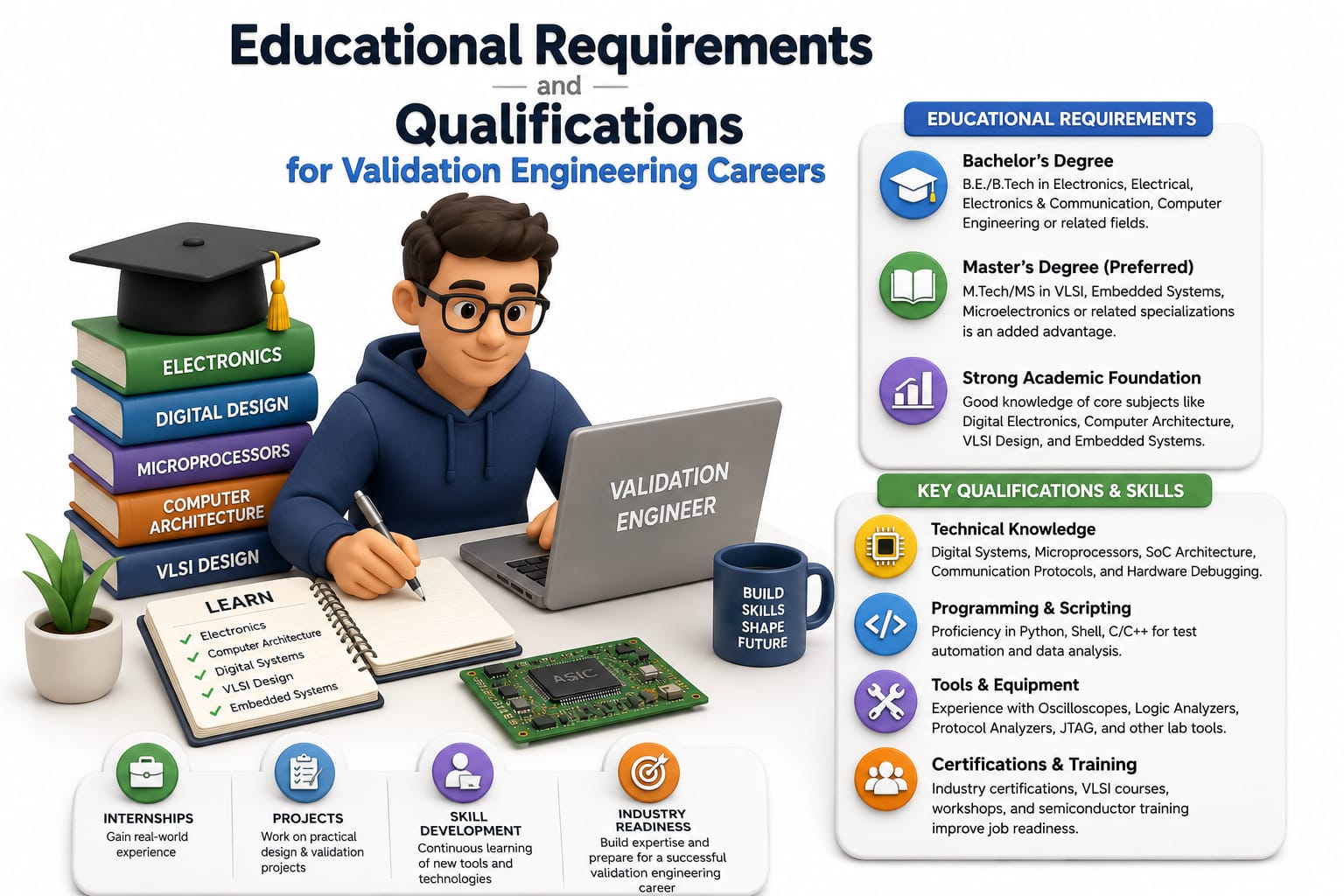
A career in Post-Silicon Validation Engineering typically begins with a bachelor's degree in Electronics and Communication Engineering (ECE), Electrical Engineering (EE), Electronics and Instrumentation Engineering (EIE), Computer Engineering, or a related discipline. These academic programs provide the foundational knowledge required in digital electronics, microprocessors, computer architecture, embedded systems, signal processing, and semiconductor devices. While a bachelor's degree is sufficient for many entry-level validation roles, candidates with a master's degree in VLSI Design, Microelectronics, Embedded Systems, or Semiconductor Engineering often gain an advantage when applying for specialized positions in leading semiconductor companies.
In addition to formal education, employers highly value practical skills and industry-relevant training. Aspiring Validation Engineers should develop proficiency in hardware debugging, silicon bring-up, test development, scripting languages such as Python and Shell, and industry-standard laboratory equipment. Knowledge of communication protocols like PCIe, USB, I2C, SPI, Ethernet, and DDR can further strengthen a candidate's profile. Hands-on projects, internships, VLSI certification programs, and semiconductor validation training help bridge the gap between academic learning and real-world industry requirements, making graduates more competitive for validation engineering careers in the rapidly growing semiconductor industry.
Essential Technical Skills Every Aspiring Validation Engineer Must Learn
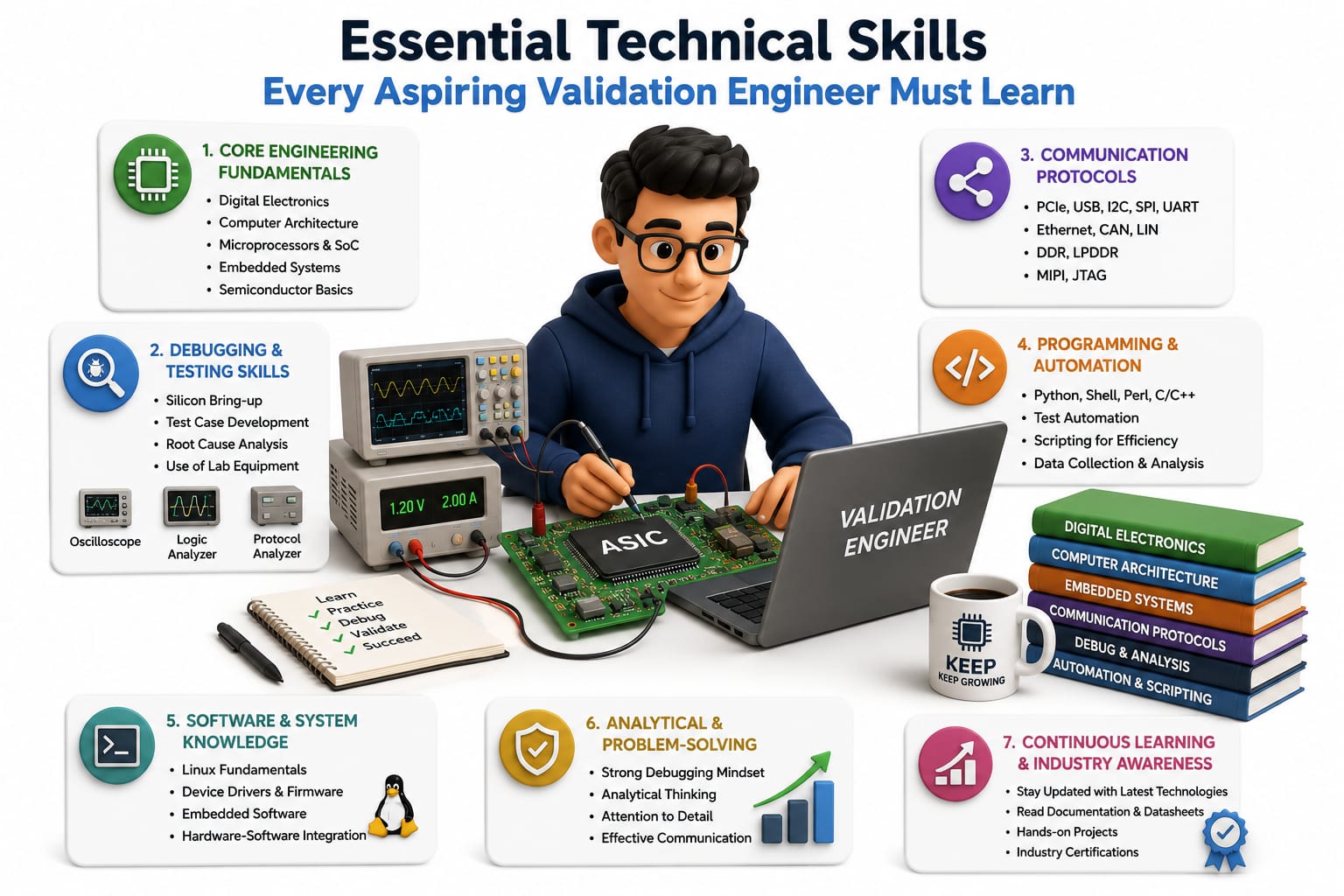
To build a successful career in Post-Silicon Validation Engineering, aspiring professionals must first develop a strong foundation in digital electronics, computer architecture, and semiconductor fundamentals. Understanding concepts such as combinational and sequential logic, finite state machines, memory architectures, processors, buses, and timing analysis is essential for validating complex integrated circuits. Since validation engineers work closely with actual silicon devices, they must also be familiar with hardware operation, chip functionality, and system-level interactions. A solid grasp of these core concepts enables engineers to identify functional issues and effectively troubleshoot hardware-related problems during silicon testing.
Another critical skill for validation engineers is debugging and test development. Post-silicon validation involves executing test cases, analyzing failures, and identifying the root causes of hardware and software issues. Engineers frequently use laboratory equipment such as oscilloscopes, logic analyzers, protocol analyzers, and JTAG debuggers to monitor system behavior and diagnose faults. Knowledge of industry-standard communication protocols including PCIe, USB, SPI, I2C, UART, Ethernet, and DDR is highly valuable because modern semiconductor devices rely on these interfaces for data transfer and system communication. Effective debugging skills help engineers reduce validation time and improve product quality before commercial deployment.
In addition to hardware expertise, validation engineers must possess strong programming and automation skills. Scripting languages such as Python, Shell, and Perl are widely used to automate test execution, collect validation data, analyze results, and improve testing efficiency. Familiarity with embedded systems, Linux environments, firmware interaction, and software-hardware integration is also becoming increasingly important as semiconductor products grow more complex. By combining technical knowledge, debugging capabilities, protocol expertise, and automation skills, aspiring Validation Engineers can position themselves for success in the rapidly expanding semiconductor and VLSI industry.
Step-by-Step Roadmap: From Engineering Graduate to Validation Engineer
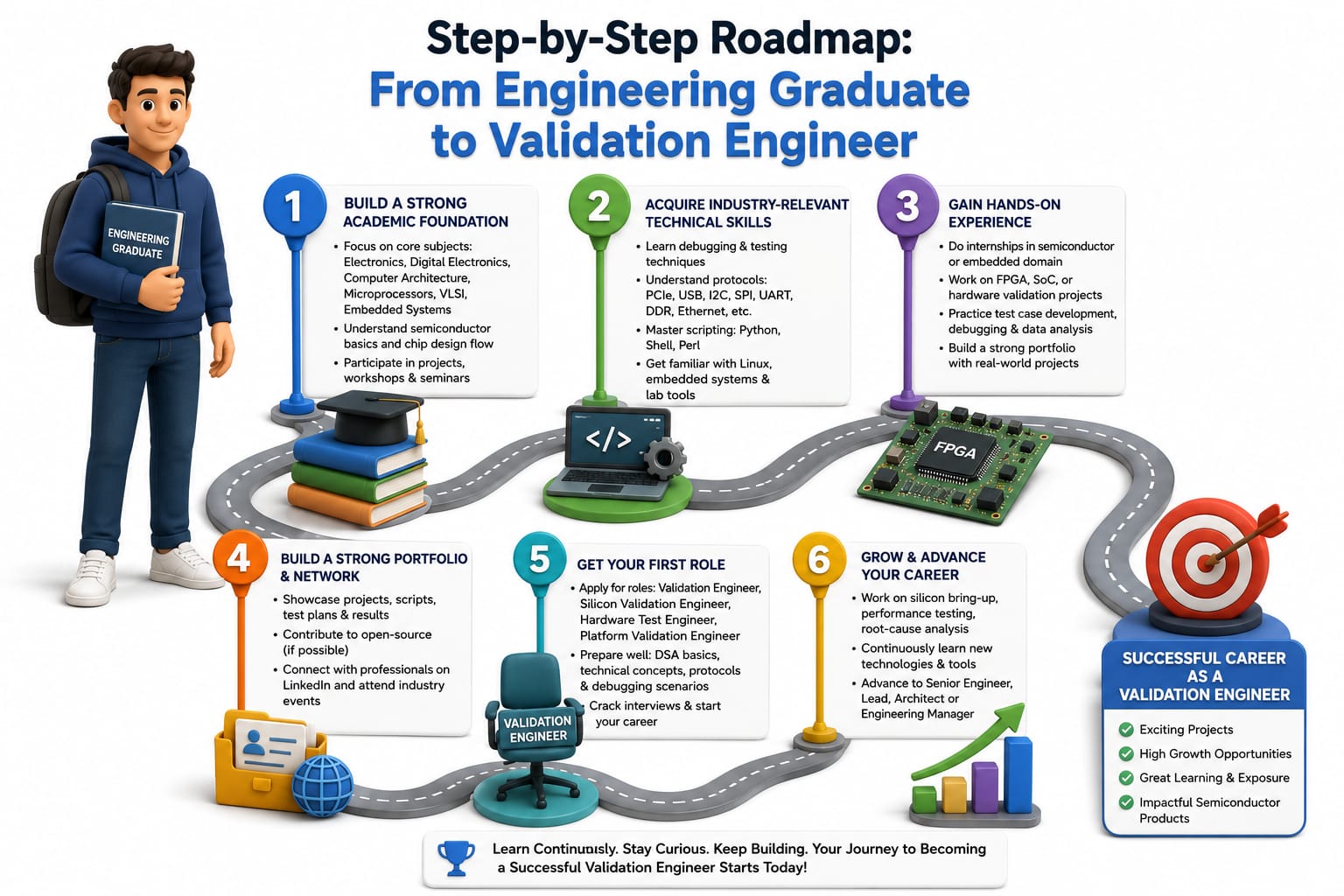
The journey from an engineering graduate to a Post-Silicon Validation Engineer begins with building a strong academic foundation in electronics, computer engineering, or a related field. During college, students should focus on core subjects such as digital electronics, microprocessors, computer architecture, embedded systems, semiconductor devices, and VLSI design. Understanding how integrated circuits are designed and how hardware components interact within a system provides the technical groundwork required for validation roles. Participating in academic projects, technical workshops, and semiconductor-focused training programs can further strengthen both theoretical and practical knowledge.
The next step is acquiring industry-relevant technical skills that are commonly used in silicon validation environments. Aspiring engineers should learn hardware debugging techniques, communication protocols such as PCIe, USB, I2C, SPI, UART, and DDR, as well as scripting languages like Python, Shell, or Perl. Familiarity with Linux operating systems, embedded software concepts, and laboratory equipment such as oscilloscopes, logic analyzers, and protocol analyzers is highly beneficial. Developing these skills helps graduates understand real-world validation workflows and prepares them to handle complex debugging and testing tasks.
After gaining the necessary technical knowledge, candidates should focus on hands-on experience through internships, training programs, and practical projects. Working on FPGA-based designs, embedded systems applications, protocol testing projects, or hardware-software integration assignments allows students to apply their learning in real-world scenarios. Creating a portfolio that demonstrates debugging experience, automation scripts, test development, and validation-related projects can significantly improve employability. Practical exposure not only strengthens technical competence but also helps candidates understand the challenges encountered during silicon bring-up and validation processes.
The final step is securing an entry-level role such as Validation Engineer, Silicon Validation Engineer, Platform Validation Engineer, or Hardware Test Engineer in a semiconductor company. Once employed, engineers continue expanding their expertise by working on silicon bring-up, performance testing, root-cause analysis, and system-level validation activities. With experience, professionals can advance into senior validation roles, silicon architecture teams, product engineering, technical leadership positions, or specialized domains such as AI accelerators, automotive electronics, and high-performance computing. Continuous learning and adapting to emerging semiconductor technologies are key to achieving long-term career growth in the post-silicon validation field.
Understanding Post-Silicon Validation and Its Role in Chip Development
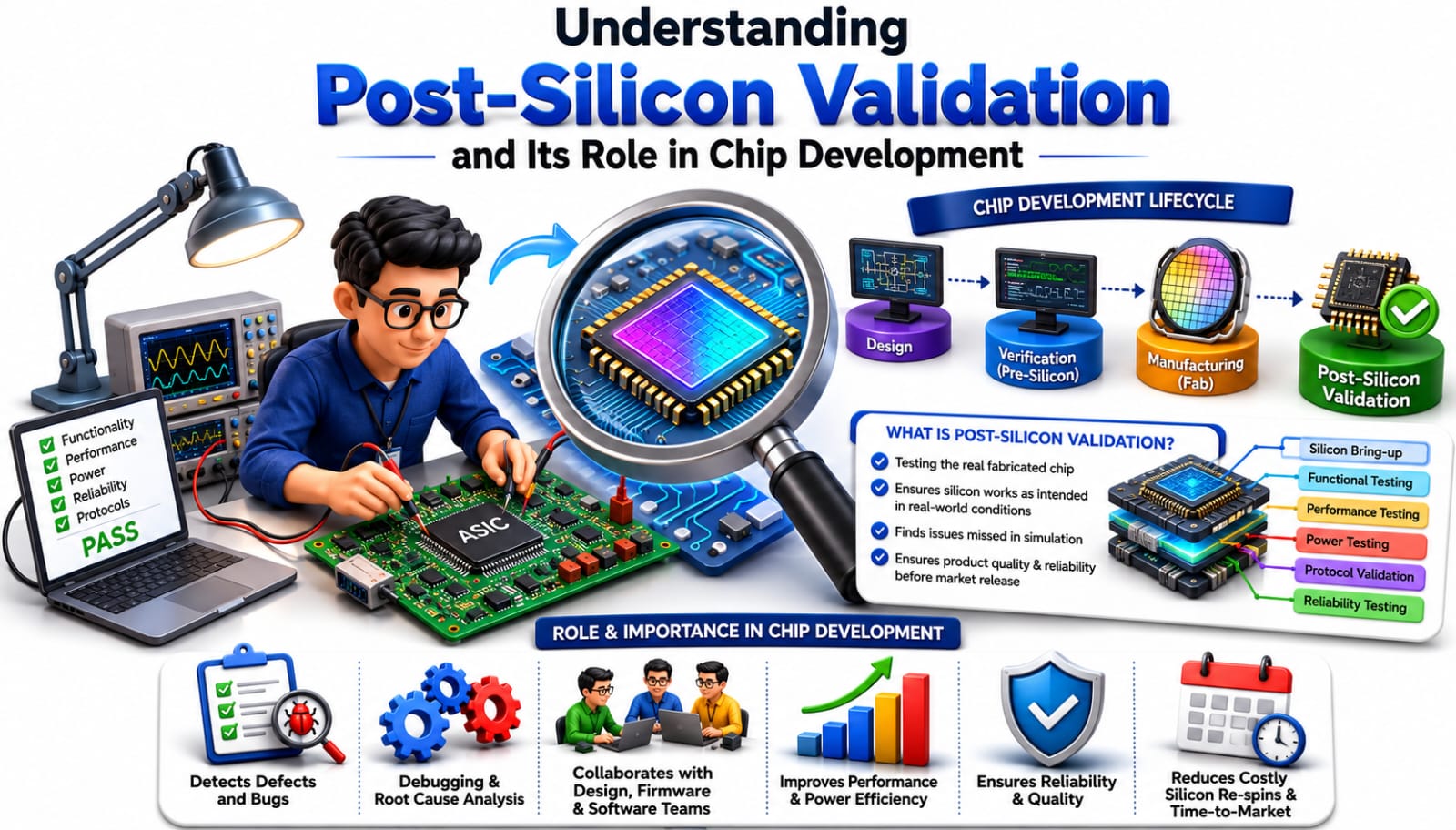
Post-Silicon Validation is a critical phase in the semiconductor product development cycle that takes place after a chip has been fabricated and manufactured. While pre-silicon verification ensures that the design functions correctly in simulation environments, post-silicon validation confirms that the actual silicon operates as intended under real-world conditions. During this stage, engineers test the chip's functionality, performance, power consumption, reliability, and protocol compliance to identify any issues that may not have been detected during simulation. This process helps ensure that the semiconductor device meets design specifications and performs reliably before being released for commercial use.
The role of post-silicon validation in chip development is essential because modern integrated circuits are highly complex, often containing billions of transistors and multiple interconnected subsystems. Validation engineers perform silicon bring-up, execute test plans, analyze system behavior, and debug hardware and software interactions to uncover hidden defects. They collaborate closely with design, verification, firmware, and product engineering teams to resolve issues and optimize chip performance. By identifying and fixing problems early, post-silicon validation reduces the risk of costly silicon re-spins, improves product quality, accelerates time-to-market, and contributes significantly to the success of semiconductor products across industries such as AI, automotive, consumer electronics, networking, and high-performance computing.
Career Opportunities, Job Roles, and Growth Path in Post-Silicon Validation
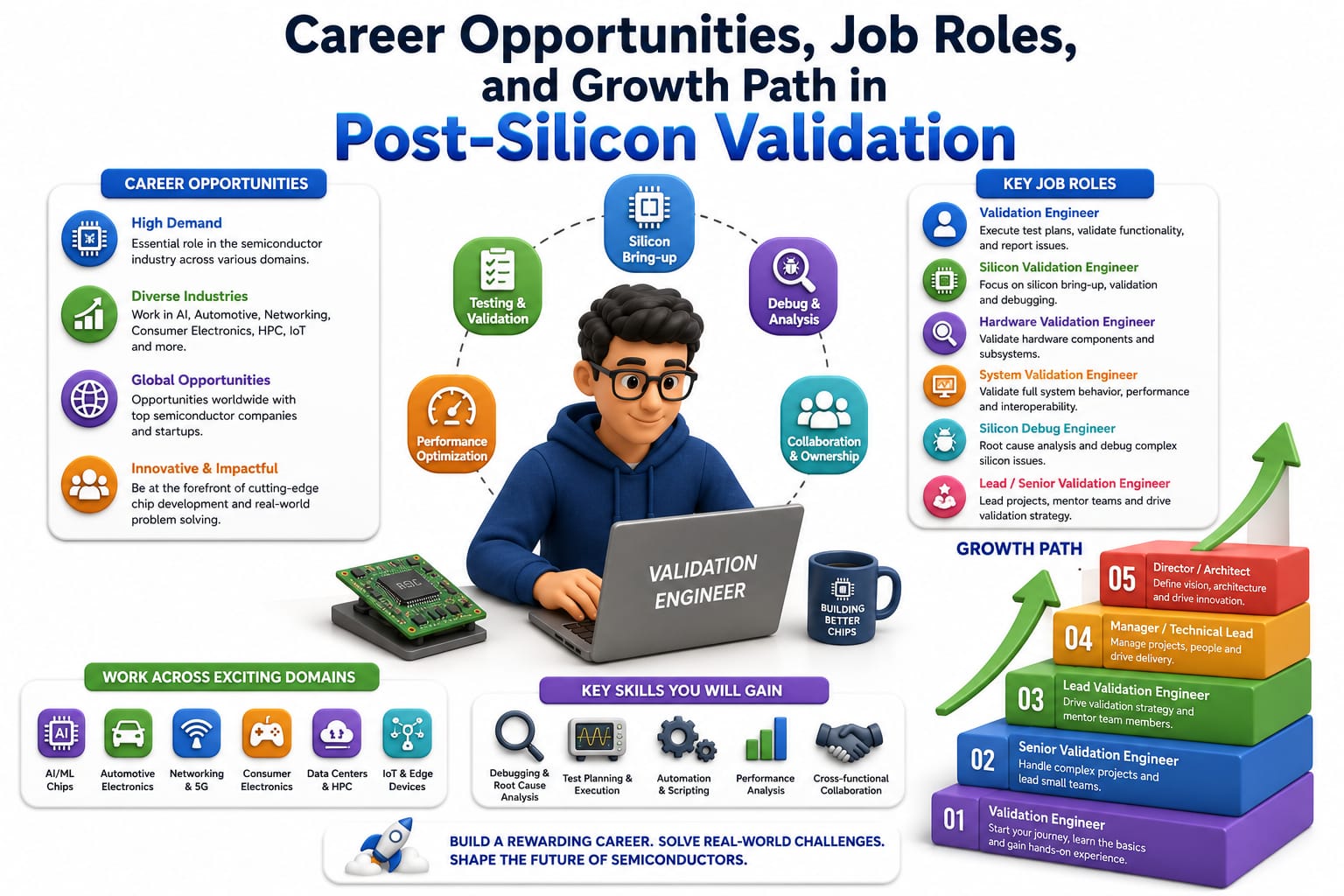
Post-Silicon Validation offers a wide range of career opportunities within the semiconductor and VLSI industry, making it an attractive field for engineering graduates interested in hardware development and chip testing. Entry-level professionals typically begin their careers as Validation Engineers, Silicon Validation Engineers, Hardware Validation Engineers, or Platform Validation Engineers. In these roles, they are responsible for silicon bring-up, functional testing, protocol validation, performance analysis, and debugging hardware-software interactions. As semiconductor companies continue to develop advanced processors, AI accelerators, automotive chips, and communication devices, the demand for skilled validation professionals continues to grow across global markets.
As engineers gain experience, they can move into more specialized and senior positions such as Senior Validation Engineer, Lead Validation Engineer, Silicon Debug Engineer, System Validation Engineer, or Product Validation Specialist. These roles involve designing validation strategies, leading debugging efforts, mentoring junior engineers, and collaborating with design, verification, firmware, and architecture teams. Professionals may also develop expertise in specific domains such as PCIe validation, DDR memory validation, networking protocols, embedded systems, automotive electronics, or high-performance computing platforms. Such specialization often leads to increased responsibilities, higher salaries, and opportunities to work on cutting-edge semiconductor technologies.
The long-term growth path in Post-Silicon Validation extends beyond validation itself into several advanced semiconductor career tracks. Experienced professionals can transition into roles such as Silicon Architect, Product Engineer, Hardware Design Engineer, Technical Program Manager, or Engineering Manager. Some engineers also move into pre-silicon verification, system architecture, firmware development, or semiconductor product management based on their interests and expertise. With the rapid expansion of artificial intelligence, autonomous vehicles, 5G infrastructure, and data center technologies, Post-Silicon Validation Engineers are well-positioned for sustained career growth and leadership opportunities in the evolving semiconductor industry.
Understanding the Complete Post-Silicon Validation Flow
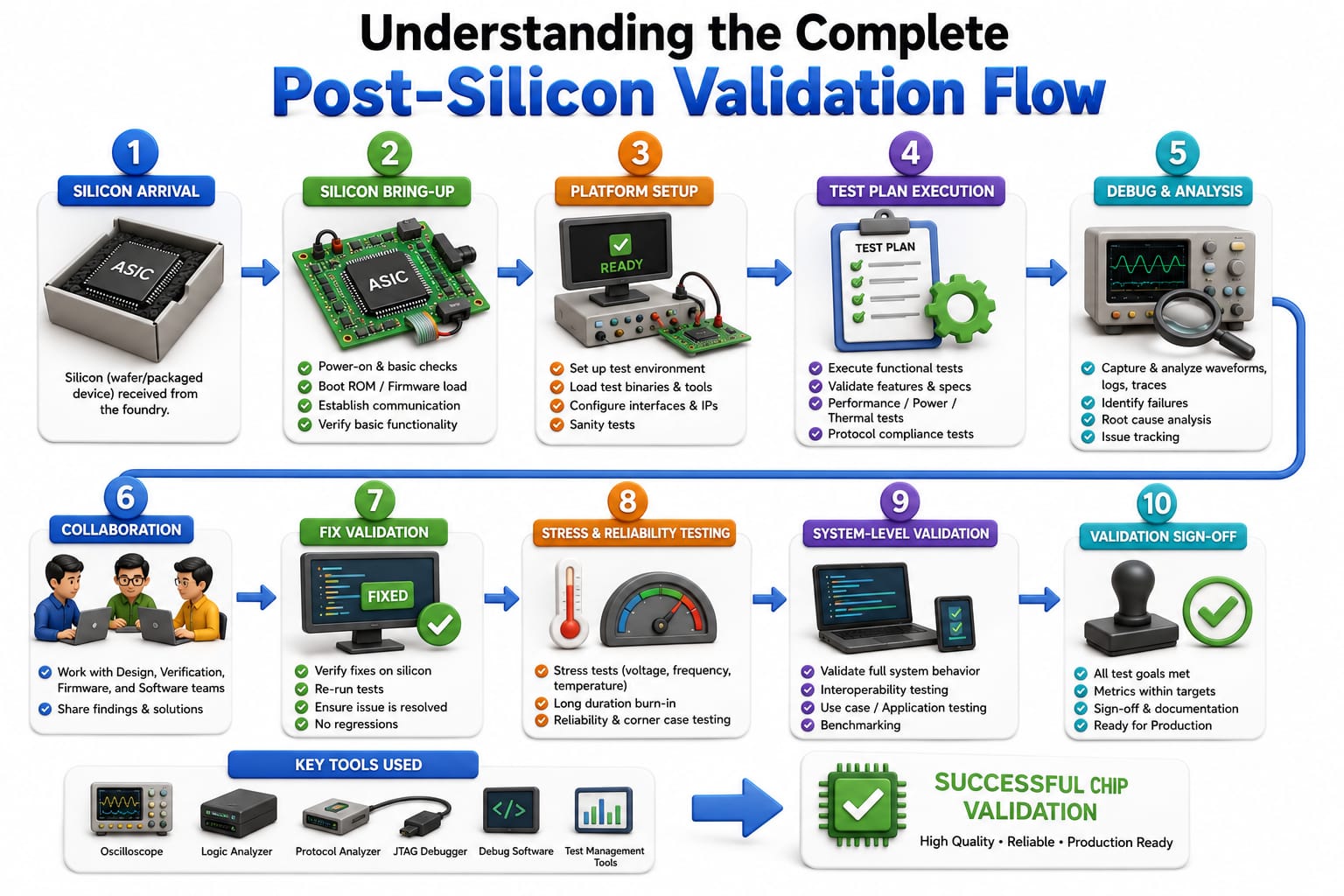
The Post-Silicon Validation Flow begins immediately after a semiconductor chip is manufactured and received from the fabrication facility. The first stage is silicon bring-up, where engineers power up the chip for the first time and verify that fundamental hardware functions operate correctly. This process involves initializing the device, loading firmware, establishing communication with system components, and performing basic functionality checks. Once the chip is operational, validation engineers execute predefined test plans to evaluate key parameters such as functionality, performance, power consumption, thermal behavior, and protocol compliance. These tests help confirm that the silicon meets design specifications and performs reliably in real hardware environments.
After initial testing, the validation process moves into extensive debugging, failure analysis, and system-level validation. Engineers use tools such as oscilloscopes, logic analyzers, protocol analyzers, and JTAG debuggers to identify and investigate issues that may arise during testing. They collaborate closely with design, verification, firmware, and software teams to isolate root causes and implement corrective actions. The final stages include stress testing, performance benchmarking, interoperability testing, and reliability validation to ensure the chip can operate under various real-world conditions. By following a structured post-silicon validation flow, semiconductor companies can improve product quality, reduce the risk of costly silicon re-spins, and accelerate the successful launch of high-performance semiconductor devices.
Conclusion
Post-Silicon Validation Engineering is a rewarding and high-impact career path for graduates who aspire to work at the forefront of semiconductor innovation. From understanding digital electronics and computer architecture to mastering debugging techniques, validation methodologies, and automation tools, the journey requires a combination of technical knowledge and practical experience. As modern chips become increasingly complex, the role of Validation Engineers has become essential in ensuring product functionality, reliability, and performance before semiconductor devices reach the market. By building the right skills, gaining hands-on project experience, and staying updated with industry advancements, aspiring engineers can successfully transition from graduates to skilled validation professionals.
The future of Post-Silicon Validation Engineering remains highly promising, driven by rapid growth in artificial intelligence, automotive electronics, 5G communications, IoT devices, and high-performance computing systems. Companies across the semiconductor ecosystem continue to seek talented engineers who can identify silicon issues, optimize system performance, and contribute to successful product launches. With strong career growth opportunities, competitive salaries, and pathways into leadership and specialized technical roles, post-silicon validation offers a stable and exciting profession within the VLSI industry. For engineering graduates willing to invest in continuous learning and practical skill development, this field provides an excellent platform for long-term success in semiconductor engineering.