

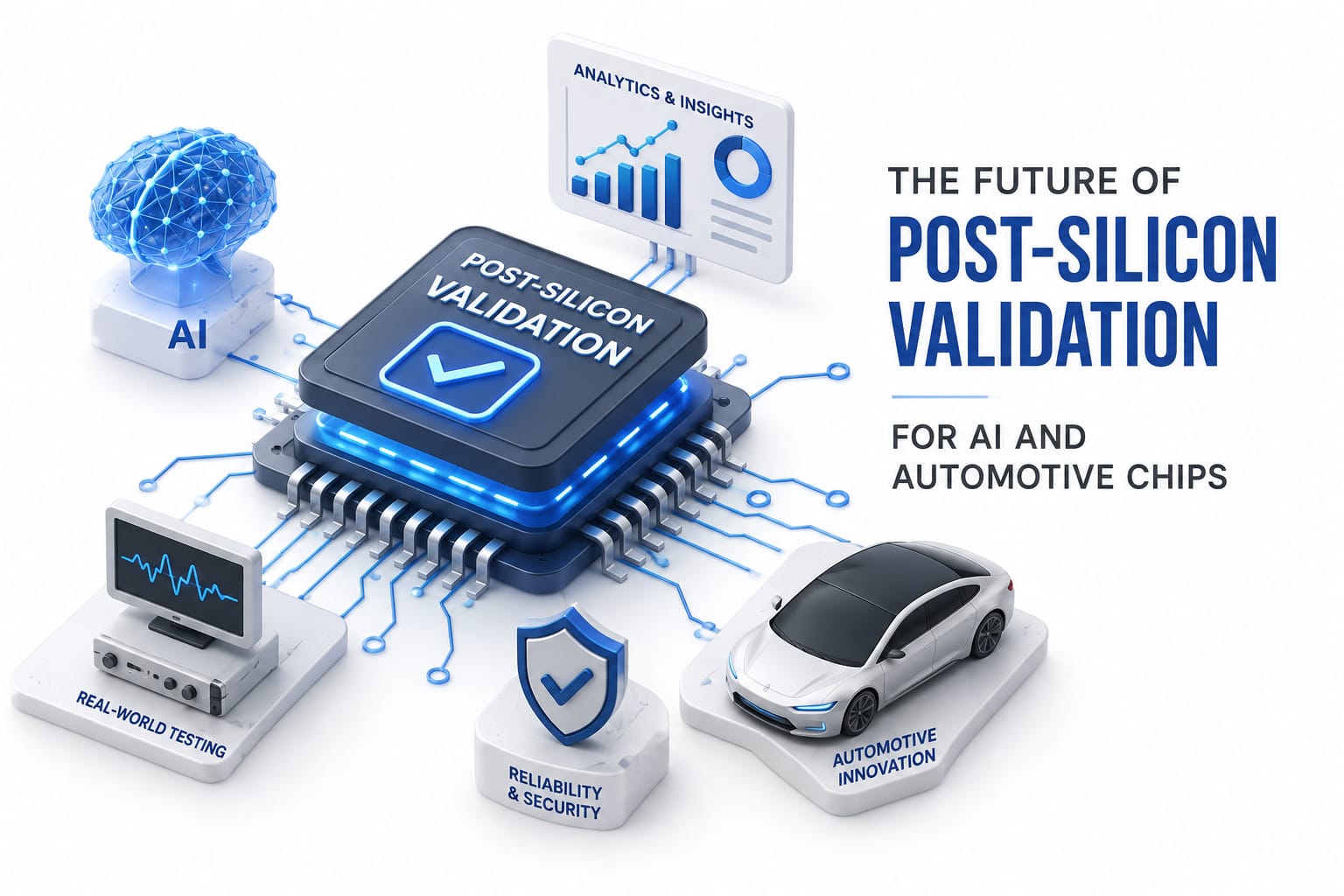
Future of Post-Silicon Validation in AI and Automotive Chips
Navigate through this article using the table of contents below
Table of Contents
No headings found in this article.
Imagine a self-driving car making thousands of decisions every second or an AI accelerator processing trillions of operations in real time. In such high-performance systems, even the smallest silicon defect can lead to critical failures, safety risks, or significant financial losses. This is why Post-Silicon Validation has become one of the most crucial stages in semiconductor development. As AI chips and automotive processors grow increasingly complex, traditional validation techniques are evolving to meet new challenges related to performance, reliability, functional safety, and power efficiency. For aspiring engineers, understanding these evolving methodologies through post silicon validation training can provide valuable insight into the practical challenges of bringing advanced semiconductor devices to market.
The future of Post-Silicon Validation in AI and Automotive Chips is being shaped by advanced analytics, machine learning-driven debugging, automation, and real-time monitoring technologies. Modern semiconductor companies are investing heavily in innovative validation methodologies to ensure that next-generation AI processors, autonomous vehicle SoCs, and edge computing chips perform flawlessly under real-world conditions. With the rapid growth of artificial intelligence, autonomous driving, and connected vehicles, post-silicon validation engineers will play a vital role in delivering safer, smarter, and more reliable semiconductor solutions for the future.
Evolution of Post-Silicon Validation in Modern Semiconductor Design

Post-Silicon Validation has evolved significantly alongside the rapid advancement of semiconductor technology. In the early days of chip design, integrated circuits were relatively simple, containing fewer transistors and limited functionality. Validation primarily focused on verifying basic operations and identifying manufacturing defects after silicon fabrication. As semiconductor devices became more sophisticated, featuring multi-core processors, high-speed interfaces, and complex system-on-chip (SoC) architectures, the importance of comprehensive post-silicon validation increased dramatically. Engineers began relying on advanced debugging tools, automated test environments, and hardware-assisted validation techniques to ensure that fabricated chips performed as expected under real-world operating conditions.
Modern semiconductor designs have introduced new challenges that traditional validation methods cannot fully address. Today's AI accelerators, automotive processors, data center chips, and edge computing devices contain billions of transistors operating across multiple voltage domains and communication protocols. While pre-silicon verification helps identify many design issues, certain bugs only become visible after the chip is manufactured and tested in actual hardware environments. Post-Silicon Validation bridges this gap by enabling engineers to evaluate system performance, power consumption, thermal behavior, protocol compliance, and functional correctness. This stage plays a critical role in detecting hidden silicon defects and ensuring product reliability before commercial deployment.
The evolution of Post-Silicon Validation is also being driven by emerging technologies such as artificial intelligence, machine learning, autonomous vehicles, and heterogeneous computing platforms. Modern validation teams increasingly leverage AI-powered analytics, automated debugging frameworks, FPGA prototyping, and real-time monitoring systems to accelerate issue detection and root-cause analysis. As semiconductor complexity continues to grow with advanced process nodes and chiplet-based architectures, post-silicon validation has transformed from a simple testing phase into a strategic engineering discipline. Its ability to ensure performance, safety, and reliability makes it an essential component of modern semiconductor design and future technology innovation.
Read More About :- Top Skills Required to Become a Post-Silicon Validation Engineer in 2026
Why Post-Silicon Validation is Critical for AI Chips

Artificial Intelligence (AI) chips are designed to process massive volumes of data and perform complex computations at extremely high speeds, making their reliability and accuracy essential for real-world applications. From data centers and cloud computing platforms to autonomous vehicles and edge AI devices, these processors must deliver consistent performance under diverse workloads. While pre-silicon verification helps identify many design flaws before fabrication, certain hardware bugs, timing issues, and performance bottlenecks only emerge when the chip operates in real silicon. Post-Silicon Validation is critical because it allows engineers to test AI accelerators, neural processing units (NPUs), and machine learning processors under actual operating conditions, ensuring that they meet performance, power, and functionality requirements.
As AI chip architectures become more complex, integrating billions of transistors, advanced memory subsystems, and high-speed communication interfaces, the risk of hidden silicon defects increases significantly. Post-Silicon Validation helps engineers evaluate real-world behavior, verify data accuracy, analyze power efficiency, and identify issues that could impact AI model execution. It also plays a key role in validating thermal performance, workload scalability, and hardware-software interaction across different AI applications. By detecting and resolving critical issues before mass production, post-silicon validation ensures that AI chips deliver the reliability, efficiency, and computational performance required for next-generation artificial intelligence systems.
Growing Demand for Post-Silicon Validation in Automotive Electronics
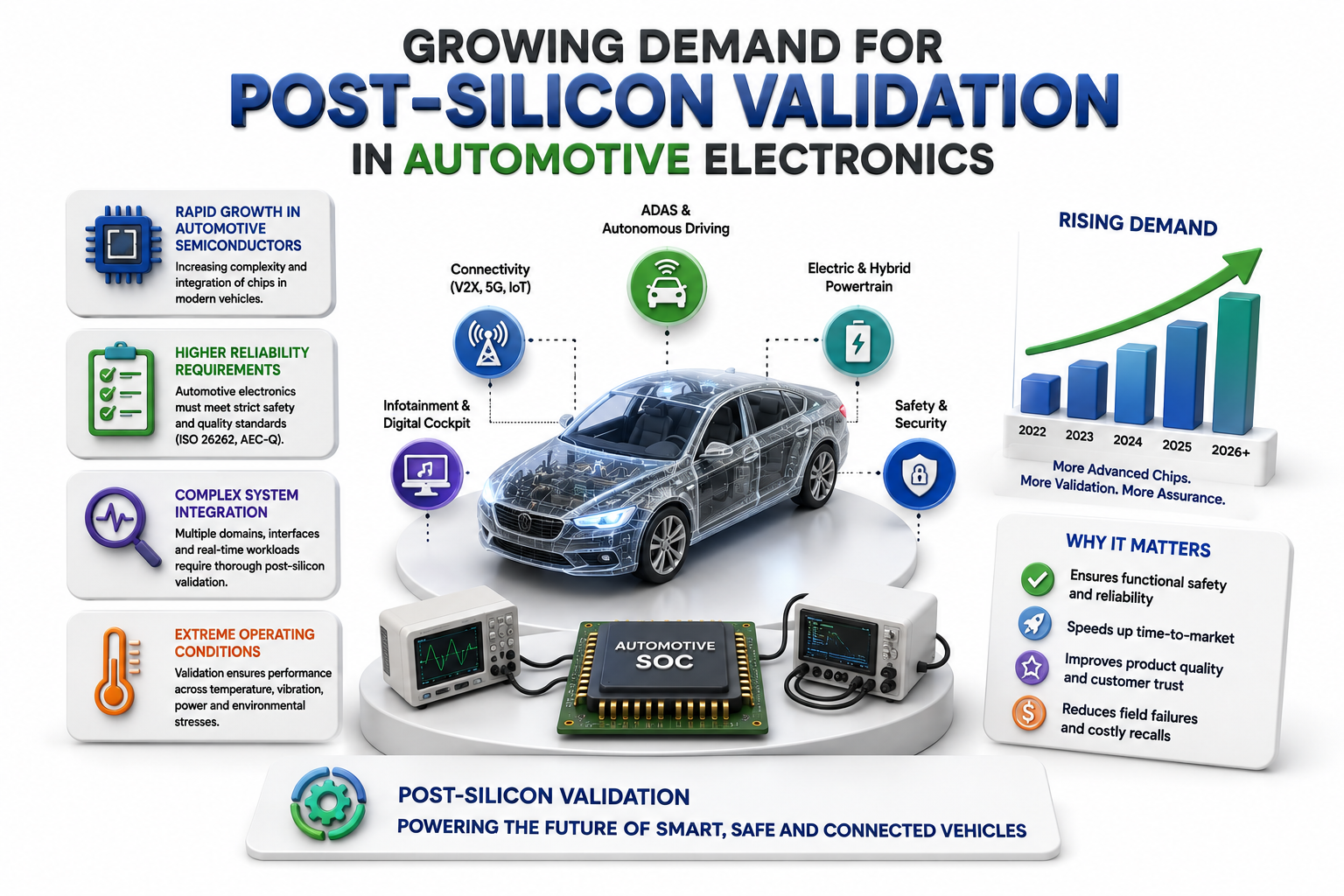
The demand for Post-Silicon Validation in Automotive Electronics has increased rapidly as modern vehicles become more dependent on advanced semiconductor technologies. Today's automobiles incorporate hundreds of electronic control units (ECUs), powerful system-on-chip (SoC) devices, sensors, and processors that manage everything from infotainment systems to critical safety functions. Features such as Advanced Driver Assistance Systems (ADAS), autonomous driving capabilities, electric vehicle power management, and connected vehicle technologies require highly reliable semiconductor components. Post-silicon validation ensures that these automotive chips function correctly in real-world environments and meet strict industry standards for safety, performance, and reliability.
Automotive semiconductors operate under challenging conditions, including extreme temperatures, voltage fluctuations, vibration, and long operational lifecycles. While simulation and pre-silicon verification can identify many design issues, certain defects only become visible when the chip is tested on actual hardware. Post-Silicon Validation enables engineers to verify protocol compliance, signal integrity, functional safety mechanisms, power efficiency, and system-level interactions. This process is especially important for automotive processors handling sensor data from cameras, radar, LiDAR, and vehicle communication networks, where even minor errors can affect system performance and passenger safety.
The rise of autonomous vehicles and software-defined cars is further accelerating the need for advanced validation methodologies. Automotive manufacturers and semiconductor companies are investing heavily in sophisticated validation platforms, automated testing frameworks, and real-time debugging tools to ensure the reliability of next-generation chips. Compliance with functional safety standards such as ISO 26262 has also made comprehensive post-silicon testing a mandatory part of automotive chip development. As vehicles continue to evolve into intelligent, connected computing platforms, post-silicon validation will remain a critical engineering discipline for delivering safe, efficient, and dependable automotive electronics.
Key Challenges in Validating AI and Automotive SoCs
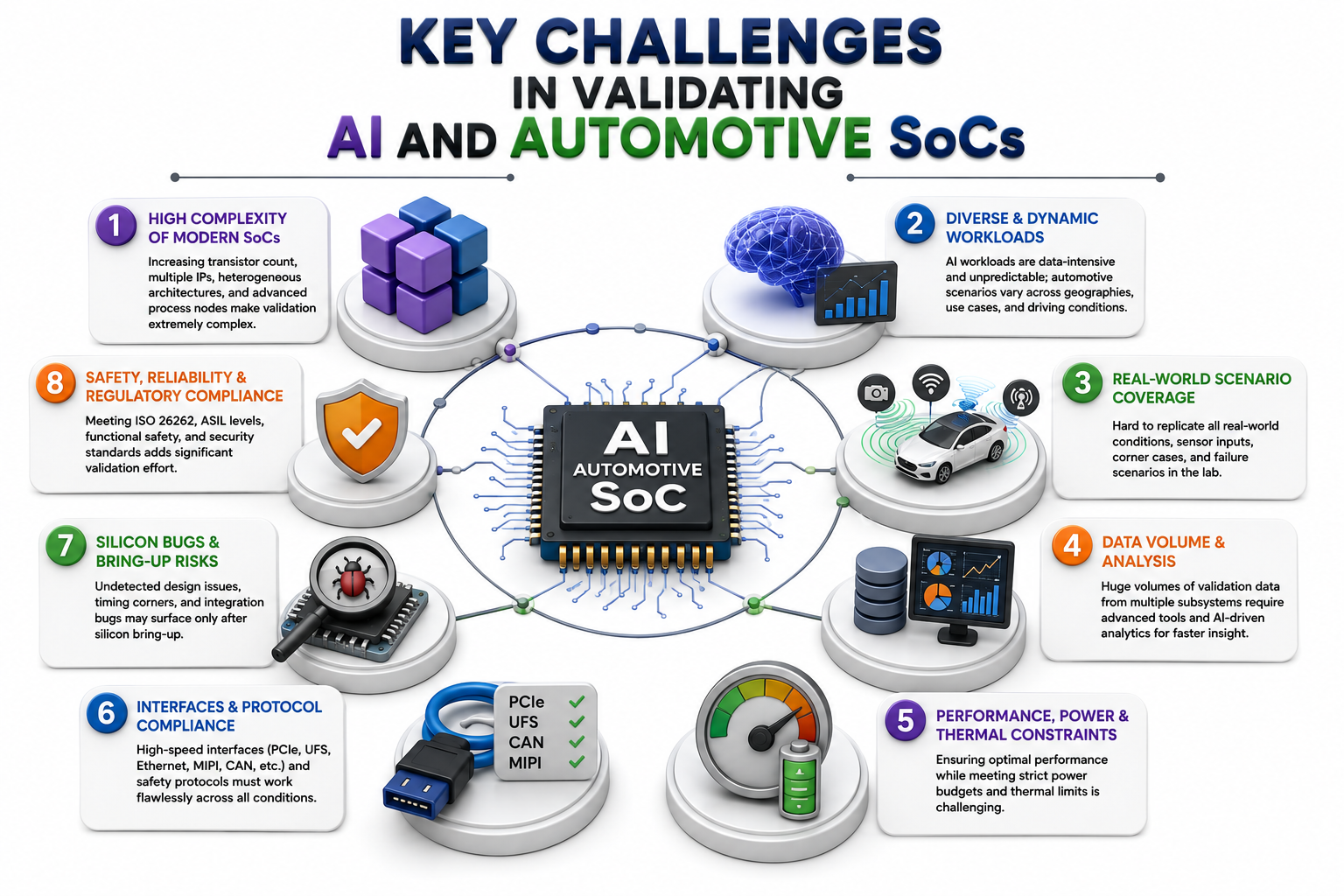
Validating AI and Automotive System-on-Chip (SoC) devices presents unique challenges due to their increasing complexity and performance requirements. Modern AI processors and automotive SoCs integrate billions of transistors, multiple CPU and GPU cores, AI accelerators, memory controllers, security modules, and high-speed communication interfaces within a single chip. These highly integrated architectures must operate seamlessly across a wide range of workloads while maintaining strict power and performance targets. As a result, post-silicon validation engineers face the difficult task of verifying functional correctness, identifying hidden silicon bugs, and ensuring that every subsystem works reliably under real-world operating conditions.
Another major challenge is validating high-speed data communication and hardware-software interaction. AI chips process enormous amounts of data through interfaces such as PCIe, DDR memory, Ethernet, and advanced interconnects, while automotive SoCs must communicate with sensors, cameras, radar systems, LiDAR modules, and vehicle networks. Even minor timing issues, signal integrity problems, or protocol violations can lead to system instability or performance degradation. Since many of these issues are difficult to reproduce in simulation environments, engineers rely on sophisticated post-silicon debugging tools, trace mechanisms, and automated test frameworks to detect and analyze problems on actual silicon devices.
Safety, reliability, and environmental testing add another layer of complexity, particularly in automotive applications. Automotive SoCs must function correctly under extreme temperatures, electrical noise, vibration, and long-term operational stress while complying with stringent functional safety standards such as ISO 26262. Similarly, AI processors deployed in data centers and edge computing systems must deliver consistent performance while managing thermal constraints and power consumption. Validating these conditions requires extensive real-world testing, fault-injection analysis, and performance monitoring. As semiconductor technology continues to advance toward smaller process nodes, chiplet architectures, and autonomous systems, overcoming these validation challenges will remain a critical priority for the semiconductor industry.
Advanced Validation Tools and Technologies Shaping the Future
Advanced validation tools and technologies are transforming the way semiconductor companies approach Post-Silicon Validation for next-generation chips. As AI processors, automotive SoCs, and high-performance computing devices become increasingly complex, traditional testing methods are no longer sufficient to identify all potential issues. Modern validation teams utilize sophisticated tools such as FPGA prototyping platforms, hardware emulators, logic analyzers, protocol analyzers, and silicon debug solutions to monitor chip behavior in real time. These technologies enable engineers to capture critical system data, trace hardware events, analyze performance bottlenecks, and detect functional errors that may not appear during pre-silicon verification, significantly improving validation efficiency and product quality. As demand for skilled professionals continues to rise, many aspiring engineers are also exploring post silicon validation training in Bangalore to gain hands-on experience with these industry-standard tools and workflows.
The future of semiconductor validation is also being shaped by automation, artificial intelligence, and data-driven analytics. AI-powered debugging tools can rapidly analyze large volumes of validation data, identify patterns, and accelerate root-cause analysis, reducing the time required to resolve complex silicon issues. Cloud-based validation environments, automated test frameworks, and machine learning algorithms are helping organizations execute large-scale testing more efficiently while improving coverage and accuracy. As emerging technologies such as chiplets, autonomous vehicles, edge AI devices, and heterogeneous computing architectures continue to evolve, these advanced validation tools will play a crucial role in ensuring reliability, performance, and functional safety across modern semiconductor products.
Impact of Artificial Intelligence on Post-Silicon Validation
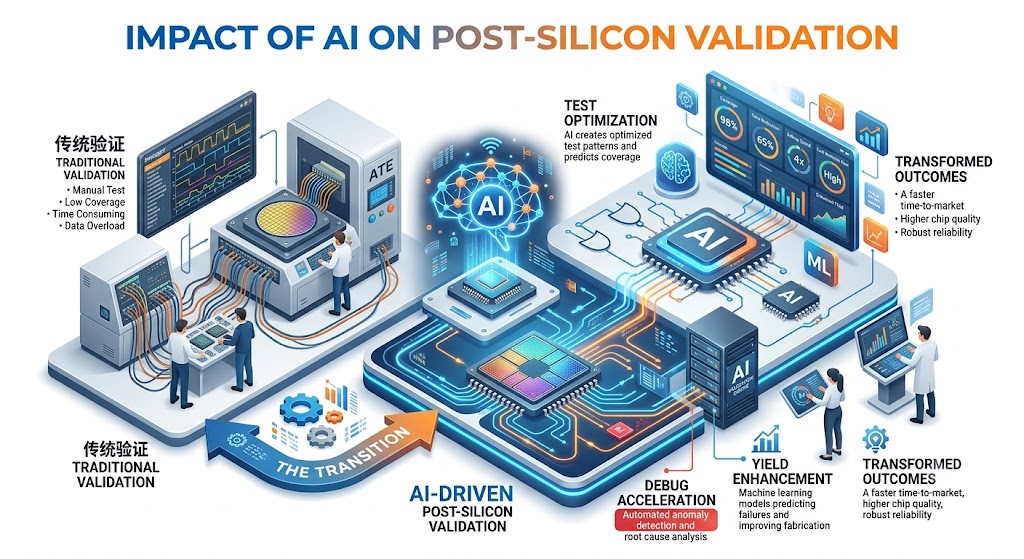
Artificial Intelligence (AI) is significantly transforming Post-Silicon Validation by enabling faster, smarter, and more efficient testing processes. Modern semiconductor devices generate enormous amounts of validation data during testing, making manual analysis increasingly difficult and time-consuming. AI-powered tools can automatically process this data, identify anomalies, detect recurring failure patterns, and prioritize critical issues for engineers. By leveraging machine learning algorithms, validation teams can reduce debugging time, improve test coverage, and accelerate the identification of root causes. This capability is particularly valuable for complex AI processors, automotive SoCs, and high-performance computing chips where traditional validation methods may struggle to keep pace with growing design complexity.
Beyond debugging and failure analysis, AI is also helping to automate test generation, performance optimization, and predictive validation workflows. Intelligent systems can analyze historical validation results, predict potential failure points, and recommend targeted test scenarios before issues impact product development schedules. AI-driven analytics further enhance power, thermal, and reliability validation by continuously monitoring chip behavior under different workloads and operating conditions. As semiconductor companies adopt increasingly advanced AI technologies, Post-Silicon Validation is evolving from a reactive testing process into a proactive and data-driven engineering discipline. This shift is expected to improve product quality, reduce time-to-market, and ensure the reliability of future AI and automotive semiconductor solutions.
Automotive Chip Validation for Autonomous and Connected Vehicles

Automotive Chip Validation plays a vital role in the development of autonomous and connected vehicles, where semiconductor devices serve as the foundation for intelligent decision-making and vehicle communication. Modern vehicles rely on advanced processors to handle tasks such as sensor fusion, object detection, path planning, driver assistance, and real-time data processing. These chips must operate with exceptional accuracy and reliability because even minor hardware failures can impact vehicle performance and safety. Post-Silicon Validation ensures that automotive processors function correctly after fabrication and meet the stringent requirements of autonomous driving systems and connected vehicle applications.
One of the most important aspects of automotive chip validation is verifying the performance of sensors and communication interfaces. Autonomous vehicles continuously collect data from cameras, radar, LiDAR, ultrasonic sensors, and GPS modules to understand their surroundings and make driving decisions. Validation engineers must ensure that automotive SoCs can process this data efficiently while maintaining low latency and high accuracy. In addition, connected vehicles depend on communication technologies such as Vehicle-to-Vehicle (V2V), Vehicle-to-Infrastructure (V2I), and Vehicle-to-Everything (V2X) networks. Thorough validation helps confirm reliable data transmission, protocol compliance, signal integrity, and secure communication between different automotive systems.
Safety and long-term reliability are also critical considerations in automotive semiconductor validation. Automotive chips must function under extreme environmental conditions, including temperature variations, vibration, electrical noise, and extended operational lifecycles. Validation teams perform extensive testing to evaluate power efficiency, thermal performance, fault tolerance, and compliance with functional safety standards such as ISO 26262. As autonomous and connected vehicles continue to evolve, advanced post-silicon validation methodologies, automated testing frameworks, and AI-assisted debugging tools will become increasingly important for ensuring the safety, reliability, and performance of next-generation automotive electronics.
Automation Trends in Post-Silicon Validation Workflows
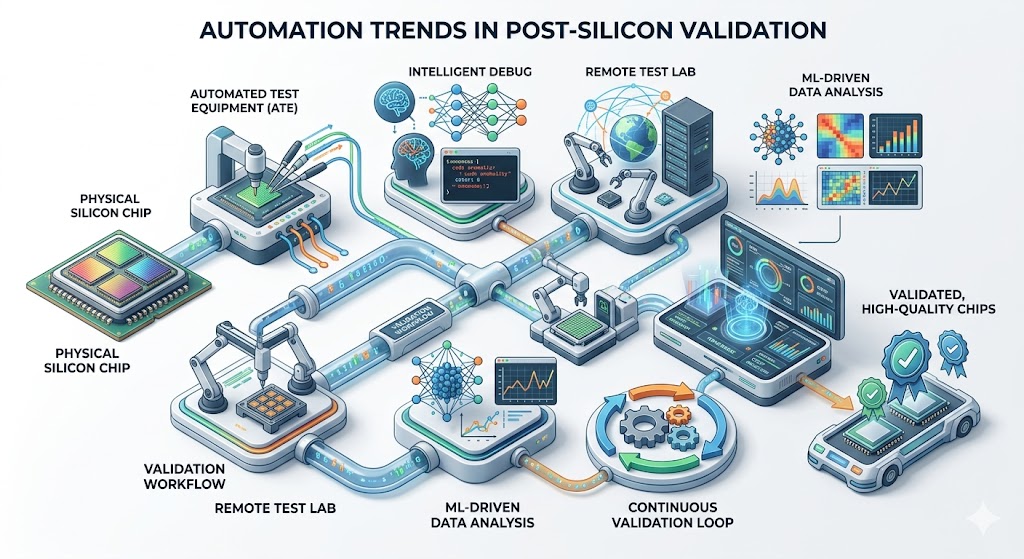
Automation is rapidly becoming a key driver of innovation in Post-Silicon Validation workflows as semiconductor devices grow more complex and validation cycles become increasingly demanding. Traditional manual testing methods often struggle to keep pace with modern AI processors, automotive SoCs, and high-performance computing chips that generate massive amounts of validation data. Automated test frameworks enable engineers to execute thousands of test cases efficiently, collect real-time results, and identify potential issues with minimal human intervention. By reducing repetitive tasks and improving test consistency, automation helps validation teams increase productivity, enhance test coverage, and accelerate time-to-market for semiconductor products.
Recent automation trends include the adoption of intelligent scripting, continuous validation pipelines, cloud-based testing environments, and AI-assisted debugging platforms. These technologies allow validation teams to automate data collection, failure analysis, regression testing, and performance monitoring across multiple hardware configurations. Advanced analytics tools can automatically detect anomalies, classify errors, and provide actionable insights, significantly reducing debugging effort. As semiconductor companies continue to develop next-generation AI and automotive chips, automation-driven validation workflows will play a critical role in improving efficiency, reducing development costs, and ensuring the reliability and quality of future semiconductor devices.
Career Opportunities in Post-Silicon Validation for AI and Automotive Domains
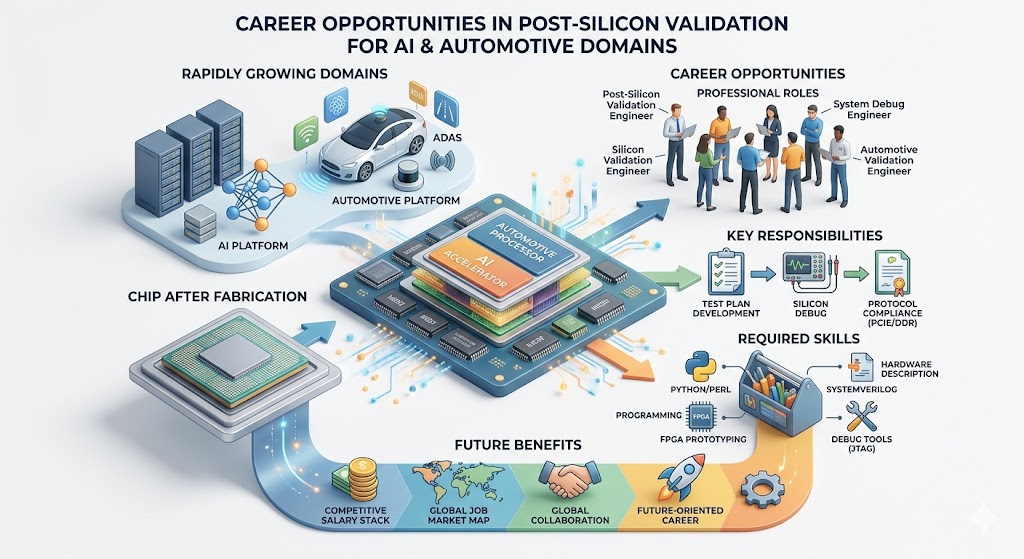
The rapid growth of Artificial Intelligence (AI), autonomous vehicles, and advanced semiconductor technologies has created strong demand for skilled Post-Silicon Validation engineers across the semiconductor industry. Companies developing AI accelerators, automotive processors, edge computing devices, and high-performance System-on-Chip (SoC) solutions require professionals who can validate chip functionality, performance, power efficiency, and reliability after fabrication. As chip complexity continues to increase, organizations are investing heavily in validation teams to ensure that products meet quality standards before reaching the market. This trend has made Post-Silicon Validation one of the most promising and future-oriented career paths in VLSI and semiconductor engineering.
Professionals working in this field can pursue various roles, including Post-Silicon Validation Engineer, Silicon Validation Engineer, Hardware Validation Engineer, Silicon Debug Engineer, System Validation Engineer, and Automotive Validation Engineer. These roles involve tasks such as developing validation test plans, executing hardware tests, debugging silicon issues, analyzing protocol compliance, validating high-speed interfaces, and collaborating with design, verification, and software teams. Employers often seek candidates with expertise in SystemVerilog, scripting languages such as Python and Perl, protocol validation, embedded systems, FPGA prototyping, and debugging tools. Knowledge of AI hardware architectures and automotive standards can further enhance career opportunities in specialized domains.
Leading semiconductor companies, automotive technology providers, and AI hardware manufacturers are actively hiring validation professionals to support next-generation chip development. Organizations working on autonomous driving platforms, Advanced Driver Assistance Systems (ADAS), data center accelerators, and machine learning processors require engineers capable of handling complex validation challenges. With the increasing adoption of AI-powered computing and connected vehicle technologies, demand for post-silicon validation talent is expected to remain strong for years to come. As a result, professionals entering this field can benefit from excellent career growth, competitive salaries, global job opportunities, and the chance to contribute to cutting-edge innovations shaping the future of technology. To prepare for these opportunities, many aspiring engineers seek practical learning experiences from the best VLSI training institute in India, where they can develop industry-relevant skills and hands-on expertise.
Conclusion
As semiconductor technology continues to advance, the importance of Post-Silicon Validation in AI and Automotive Chips is growing more than ever. The increasing complexity of AI accelerators, autonomous vehicle processors, and connected automotive systems demands rigorous validation methodologies to ensure performance, reliability, safety, and compliance with industry standards. From identifying hidden silicon defects to validating real-world functionality, post-silicon validation serves as a critical bridge between chip design and successful product deployment. Emerging technologies such as AI-driven analytics, automated testing frameworks, FPGA prototyping, and advanced debugging tools are further transforming validation workflows and enabling faster, more accurate issue detection.
Looking ahead, the future of post-silicon validation will be defined by greater automation, intelligent data analysis, and support for next-generation semiconductor architectures. As industries continue to adopt artificial intelligence, autonomous driving, edge computing, and software-defined vehicles, the need for robust validation processes will only increase. Companies that invest in advanced validation technologies and skilled engineering talent will be better positioned to deliver high-quality, reliable semiconductor products. Ultimately, Post-Silicon Validation will remain a cornerstone of semiconductor innovation, ensuring that future AI and automotive chips meet the demanding expectations of performance, safety, and reliability in an increasingly connected world.