

How to Crack an RTL Design and Verification Job in 2026 Complete Roadmap
Navigate through this article using the table of contents below
Table of Contents
No headings found in this article.
Every year, thousands of Electronics and ECE graduates apply for RTL design and verification roles—and most get rejected in the first round, not because they lack intelligence, but because they prepare the wrong way. Knowing Verilog is not enough. Interviewers at companies like Qualcomm, MediaTek, Intel, and AMD expect engineers to understand timing analysis, verification methodologies, EDA tools, and waveform debugging under pressure. This is why many aspiring engineers choose structured RTL Design and Verification Training to build practical skills and gain industry-relevant experience.
This roadmap, updated for 2026, provides a clear, step-by-step path to help you progress from foundational knowledge to a job offer, whether you are a fresh ECE graduate or a working professional looking to transition into the semiconductor industry. It covers both RTL design and verification career tracks, allowing you to choose the path that best aligns with your strengths and interests.
1. Understanding the Two Tracks: RTL Design vs. Verification
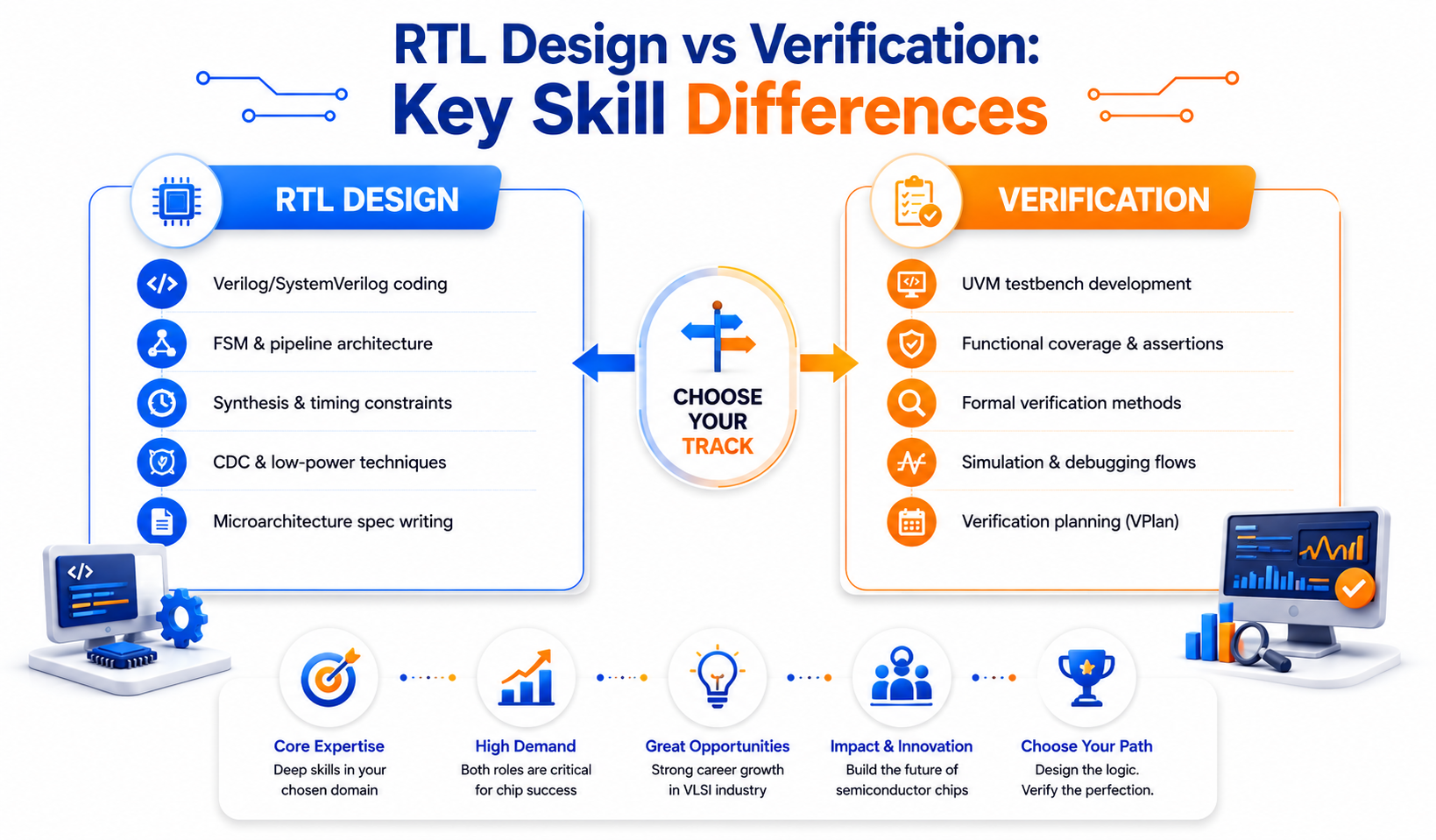
One of the most common mistakes freshers make is treating RTL Design and Verification as the same role. They are fundamentally different in mindset, toolchain, and day-to-day responsibilities. Choosing the wrong track to prepare for is a major reason candidates fail interviews — even when they know the concepts.
RTL Design focuses on translating a microarchitecture specification into synthesizable hardware logic. You write Verilog or SystemVerilog code that becomes actual silicon. The role demands strong skills in:
• FSM and pipeline design with strict synthesis constraints
• Clock domain crossing (CDC) and low-power design techniques
• Writing microarchitecture specifications and reviewing timing reports
Verification, on the other hand, is about breaking the design before silicon does. Verification engineers build intelligent testbenches using UVM (Universal Verification Methodology), write assertions with SystemVerilog Assertions (SVA), and drive the design toward functional and code coverage closure. Key skills include:
• UVM component hierarchy: driver, monitor, scoreboard, sequencer
• Functional coverage modeling and coverage-directed test generation
• Formal verification using tools like Cadence Jasper Gold
Before you start preparing, decide your track. If you enjoy building and designing, RTL is your path. If you enjoy finding bugs and thinking adversarially about hardware behavior, verification is the better fit. Both are in high demand and both offer strong career trajectories.
2. The 5-Stage Preparation Roadmap
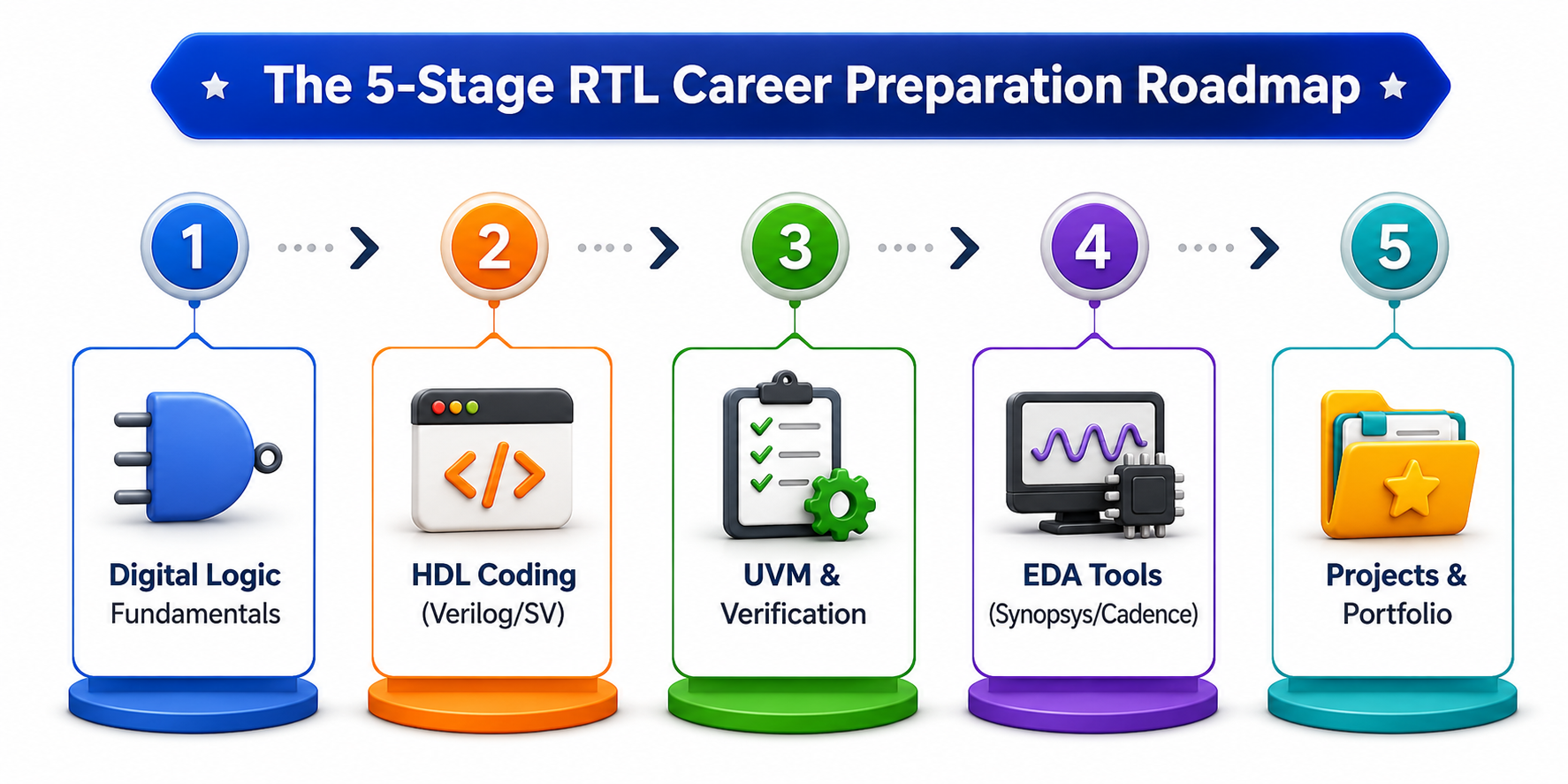
Preparation without structure leads to shallow, unfocused knowledge — which is exactly what interviewers detect within the first 10 minutes. The following five-stage roadmap is designed to build skills progressively so each layer reinforces the next.
Stage 1 — Digital Logic Fundamentals: Before any HDL, you must be solid on combinational and sequential logic, setup/hold time violations, metastability, and basic computer architecture. Every RTL interview starts here regardless of experience level.
Stage 2 — HDL Coding: Write Verilog and SystemVerilog every day. Focus on synthesizable constructs — avoid constructs that simulate but do not synthesize, a classic fresher mistake. Practice:
• Blocking vs. non-blocking assignment rules with waveform-level understanding
• FSMs (Moore vs. Mealy), shift registers, FIFOs, arbiters
• Interface and modport constructs in SystemVerilog
Stage 3 — Verification Methodology (UVM): Even RTL design engineers are expected to write basic testbenches. UVM is the industry standard. Understand the layered testbench architecture, sequences, and how coverage drives verification completeness.
Stage 4 — EDA Tools: Interviews at product companies increasingly include tool-based questions. Get hands-on with at least one simulator (QuestaSim or VCS), one synthesis tool (Synopsys Design Compiler or Cadence Genus), and one linting tool (SpyGlass). Free academic versions exist for most.
Stage 5 — Projects and Portfolio: Nothing differentiates a candidate faster than a working GitHub project with documented RTL code and simulation results. Without this, you are relying entirely on theoretical knowledge — which every other candidate also claims.
3. Must-Know EDA Tools and What Each One Does
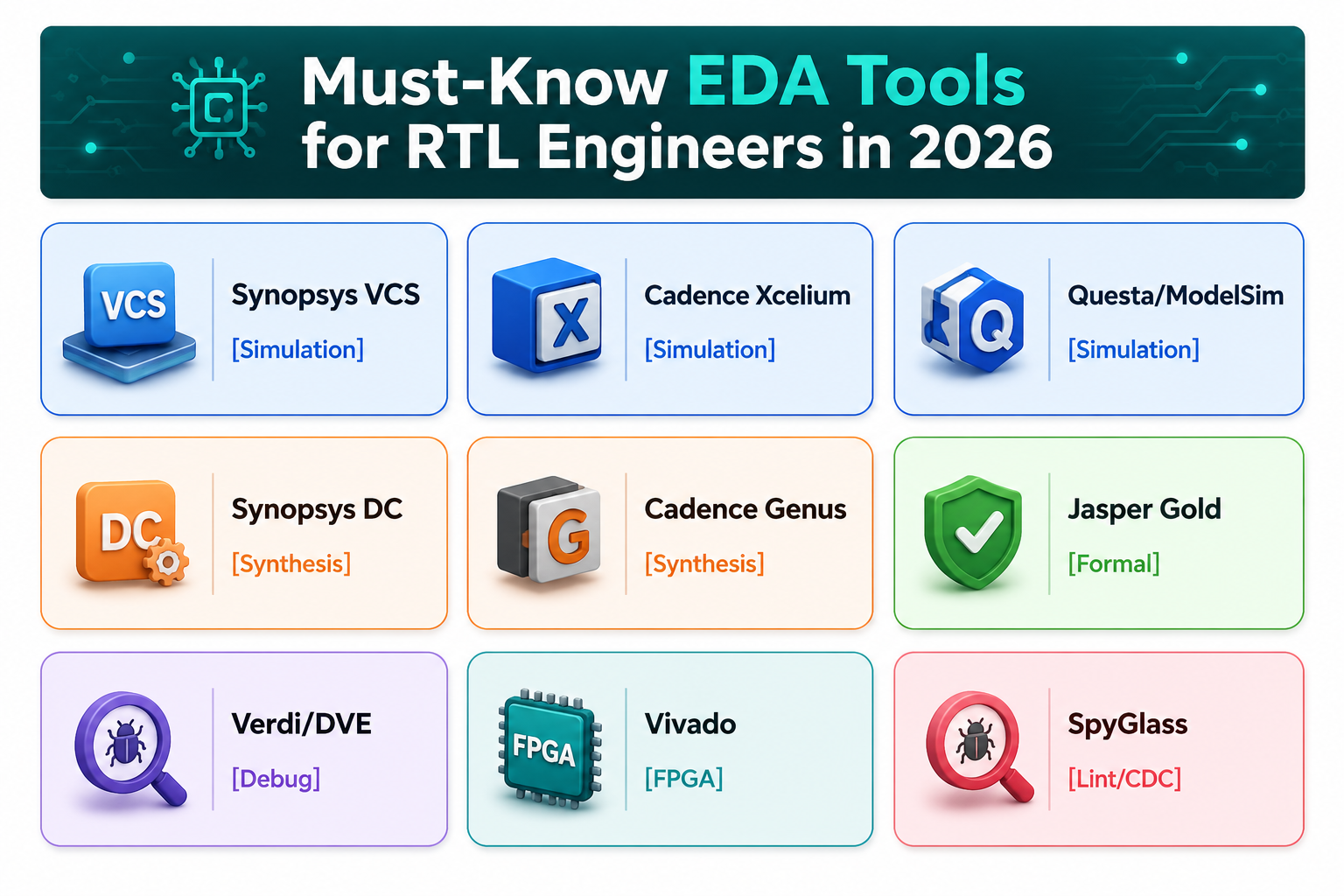
Tool familiarity is one of the fastest ways to signal seniority in an interview. Most articles list "Cadence and Synopsys" without explaining what each specific tool does. Here is the breakdown you actually need:
Simulation Tools — These run your RTL and testbench together to produce a waveform output:
• Synopsys VCS: Most common in US-based semiconductor companies. Used with DVE or Verdi for waveform debugging.
• Cadence Xcelium: Preferred in Cadence-ecosystem companies. Supports mixed-signal and SystemVerilog natively.
•Mentor Questa/ModelSim: Popular in academic settings and European companies. Good starting point for students.
Synthesis Tools — These convert your RTL code into a gate-level netlist:
• Synopsys Design Compiler (DC): Industry gold standard for ASIC synthesis. Generates QoR reports on area, power, timing.
• Cadence Genus: Faster runtime alternative with RTL power estimation capabilities.
Verification and Formal Tools:
• Cadence Jasper Gold: Used for formal property checking and CDC analysis. If you know JasperGold basics, you stand out.
• Synopsys SpyGlass: Lint and CDC tool. Most companies run SpyGlass before synthesis. Knowing common SpyGlass violations is a real interview differentiator.
In 2026, AI-assisted debugging tools are entering workflows. Companies like Synopsys (DSO.ai) and Cadence (Cerebrus) now offer ML-driven design closure tools. While you do not need to be an expert, knowing these exist and being able to discuss their role shows awareness that interviewers appreciate.
4. Building a Portfolio That Gets Shortlisted
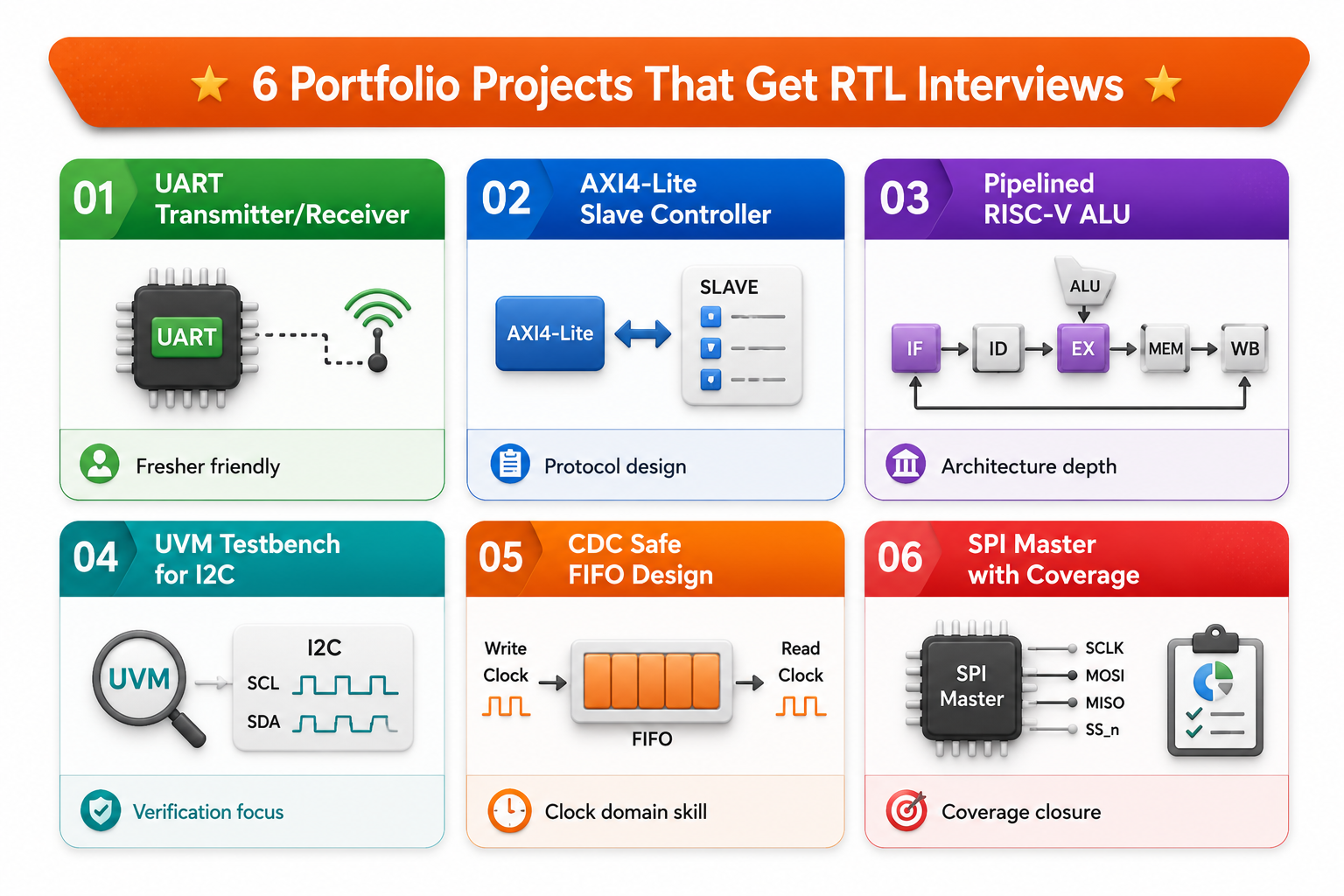
A resume without evidence is just a list of claims. In 2026, with AI-generated resumes flooding job portals, recruiters at VLSI companies are increasingly asking for GitHub links or design documents as a prerequisite for even scheduling an interview. Your portfolio needs to demonstrate breadth, not just a single project.
For freshers and those with less than two years of experience, the following six projects cover the most commonly tested RTL and verification concepts:
• UART Transmitter/Receiver: Classic starter project. Tests your understanding of serial protocols, baud rate generation, and testbench writing. Low complexity, but demonstrates design fundamentals if done with assertions and coverage.
• AXI4-Lite Slave Controller: Protocol design project that directly maps to real SoC integration work. Companies working on custom IPs almost always bring this up in interviews.
• Pipelined RISC-V ALU: Architecture-depth project. Shows you understand instruction decode, hazard detection, and pipeline registers — all common interview questions at companies like Qualcomm and Intel.
• UVM Testbench for I2C Master: Verification-focused project. Having a structured UVM testbench with sequences, a scoreboard, and functional coverage on GitHub immediately separates you from 90% of candidates who only know simulation basics.
• CDC-Safe FIFO Design with Gray Code Pointer: Demonstrates awareness of clock domain crossing — one of the most common RTL interview topics for experienced engineers. Even freshers who add this project signal serious preparation.
• SPI Master with Functional Coverage Closure: Completes the protocol-verification trifecta. More importantly, add a coverage report PDF to your repo — it shows you understand what done means in verification.
Upload all projects to GitHub with a clean README explaining the design intent, block diagram, simulation environment, and known limitations. This alone places your profile in the top 10% of applicants at any VLSI training-focused company or semiconductor firm in India.
5. Navigating the RTL Interview Process Round by Round
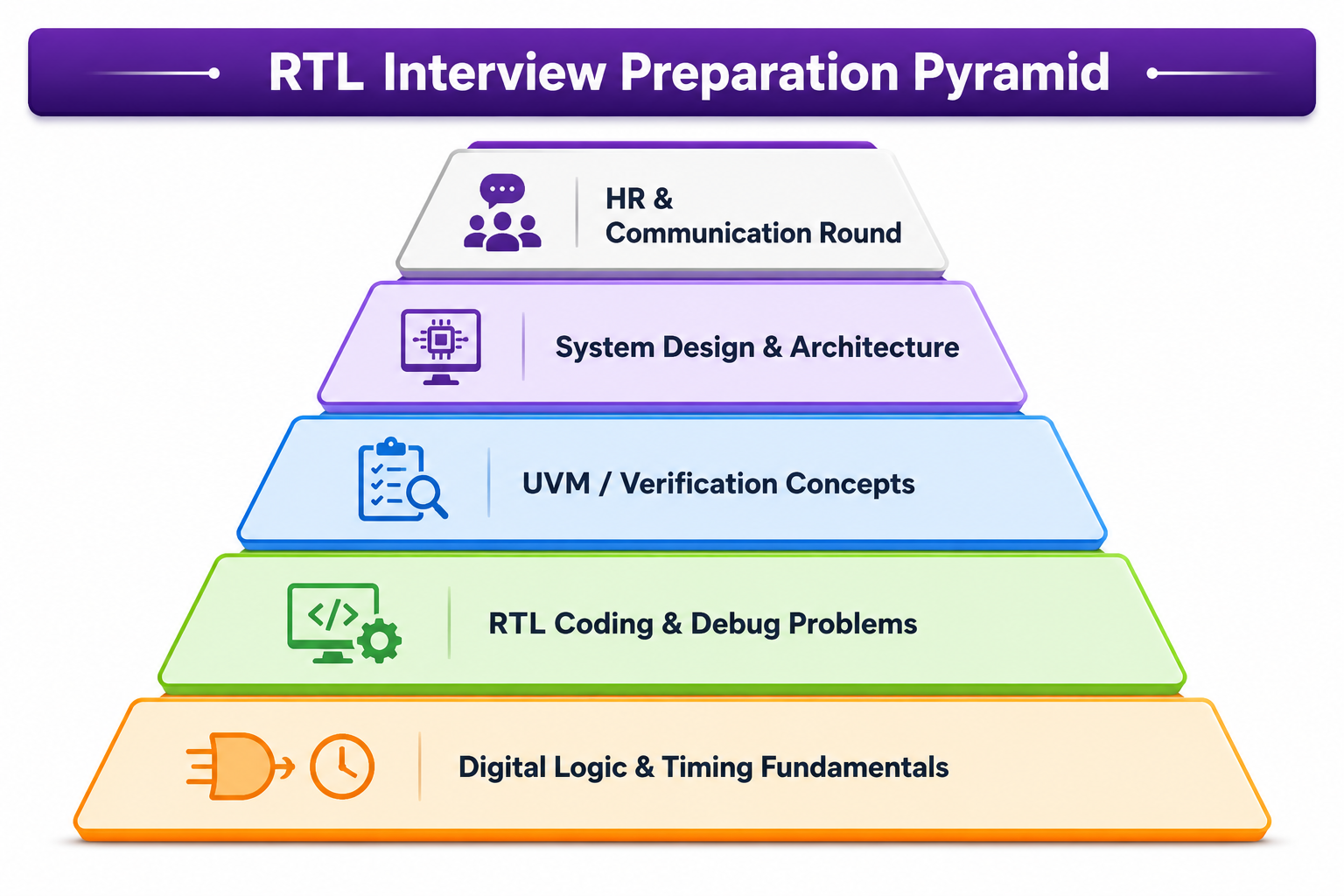
Most interview prep articles throw 50 random technical questions at you. This is the wrong mental model. RTL interviews are structured in layers, and each round tests a different level of the pyramid. Preparing without understanding this structure is why candidates who know the answers still fail.
Round 1 — Digital Logic and Timing Fundamentals: Almost every company starts here regardless of experience level. Expect questions on:
• Setup and hold time: definition, violation causes, and fixes
• Metastability: what it is, when it occurs, and how synchronizers mitigate it
• Glitches in combinational logic and how they affect power
Round 2 — RTL Coding and Debug: You will be asked to write RTL live on a whiteboard or shared editor. Common topics:
• Implement a synchronous FIFO with empty/full flags from scratch
• Find and fix the CDC violation in a given code snippet
• Explain why this non-blocking assignment produces a latch
Round 3 — UVM and Verification Concepts: Even for design roles, expect one round on verification methodology. For verification roles, this is 50% of the interview:
• Explain the UVM component hierarchy and the role of the virtual sequencer
• What is the difference between code coverage and functional coverage?
• How would you verify a pipelined design for a hazard case that only occurs once in 10,000 transactions?
Round 4 — System Design and Architecture: Senior and product-company rounds go here. You will be asked to design a subsystem, estimate area/power trade-offs, or explain a real silicon failure. This round is where domain depth matters — and where reading architecture manuals (ARM AMBA, RISC-V ISA) pays off.
Round 5 — HR and Communication: Often underestimated. Companies like Qualcomm and MediaTek run structured behavioral rounds. Prepare STAR-format answers for project contributions, debugging stories, and how you handle disagreements with design leads.
6. Salary Expectations and Career Progression in 2026
Salary in RTL and verification roles depends heavily on the type of company, city, and depth of domain expertise — not just years of experience. The market in 2026 is stratified across three company types: Indian captive units of global chip companies (Qualcomm India, Intel India), mid-size fabless semiconductor companies, and product-based startups building AI or automotive chips.
Approximate salary bands for India-based RTL roles in 2026:
• Fresher (0-1 year): 5-8 LPA — predominantly at training-to-placement programs and smaller fabless firms. UVM knowledge and projects push you toward the upper band.
• Junior Engineer (1-3 years): 9-13 LPA — significant jump if you have taped-out experience or formal verification exposure.
• Mid-level (3-6 years): 15-22 LPA — at this level, SoC-level design experience and tool ownership (owning the synthesis flow for a block) are the key differentiators.
• Senior Engineer (6-10 years): 25-35 LPA — architecture ownership, cross-functional leadership, and protocol IP design expertise command premiums here.
• Staff/Principal (10+ years): 38-55+ LPA — rare roles at product-first companies. Requires deep specialization in areas like high-speed I/O, AI accelerator design, or power management.
For freshers targeting their first RTL job in India, the cities with the most opportunities in order of volume are: Bengaluru, Hyderabad, Pune, Noida/Gurugram, and Chennai. Bengaluru dominates with the highest density of semiconductor captive units and fabless startups.
One career growth note that competitors consistently miss: the verification-to-design-automation path is emerging fast. Verification engineers who learn Python scripting, coverage closure automation, and AI-assisted bug triage are seeing 30-40% salary premiums over peers who stay in manual UVM-only workflows. If you are entering the verification track in 2026, invest in Python and SystemVerilog automation from day one.
Ready to Start Your RTL Career Journey?
JastTech offers industry-aligned VLSI RTL Design and Verification training with hands-on EDA tool access, project-based curriculum, and placement support across Hyderabad, Pune, Kolkata, and Noida. Visit jasttech.com to explore current batches.