

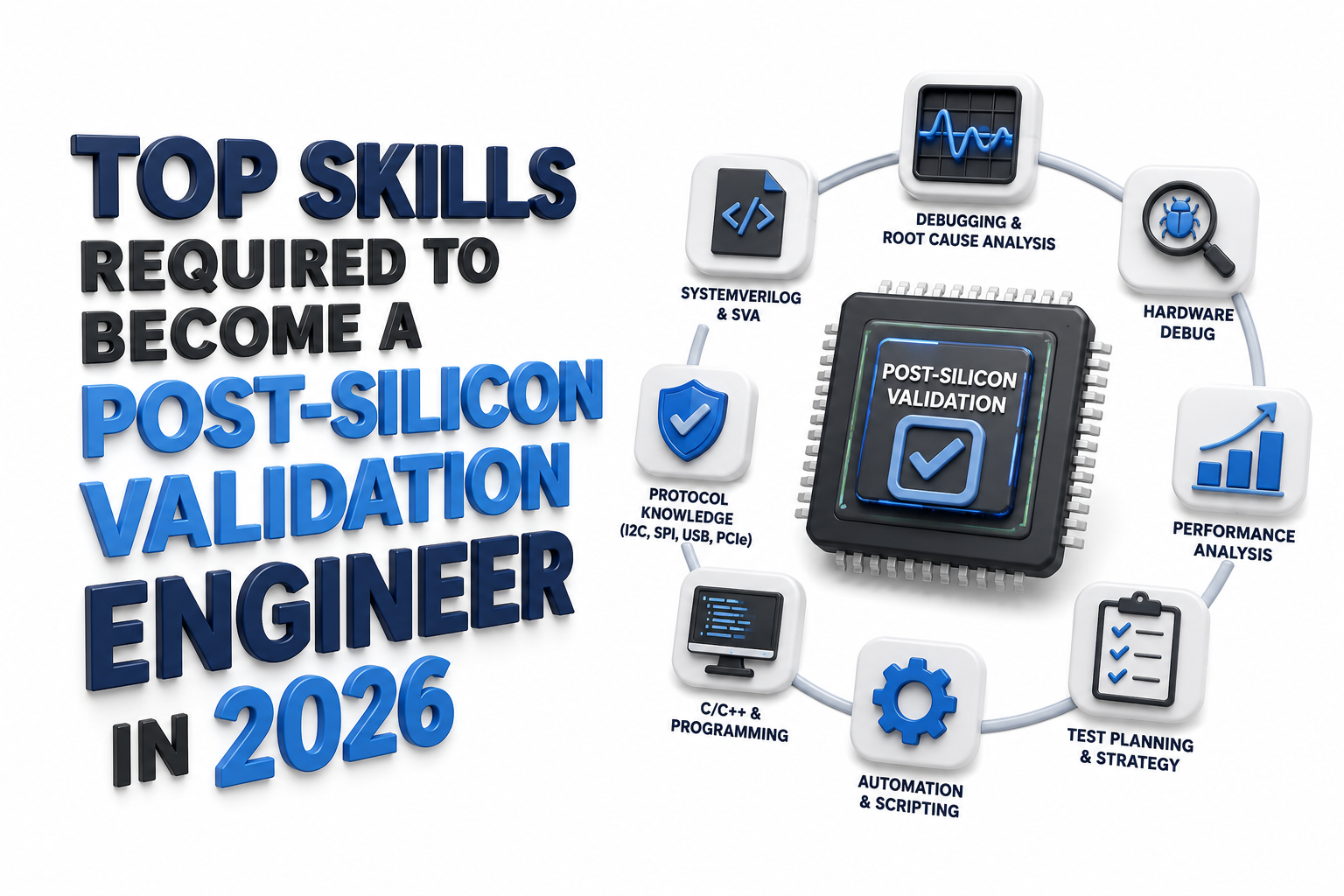
Top Skills Required to Become a Post-Silicon Validation Engineer in 2026
Navigate through this article using the table of contents below
Table of Contents
No headings found in this article.
The semiconductor industry is evolving faster than ever, and companies are racing to launch high-performance, AI-powered chips with zero functional defects. This growing demand has made Post-Silicon Validation Engineers some of the most sought-after professionals in the VLSI industry. If you are planning a career in chip design, semiconductor testing, or hardware validation, understanding the top skills required to become a Post-Silicon Validation Engineer in 2026 is essential. From debugging complex hardware issues to validating real silicon performance, these professionals play a critical role in ensuring that integrated circuits work flawlessly before reaching the market. For aspiring engineers, enrolling in a quality Post Silicon Validation Training in India program can help build the practical skills and industry exposure needed to succeed in this rapidly growing domain.
As semiconductor technologies continue to advance, employers are looking for engineers with expertise in hardware debugging, protocol validation, embedded programming, automation scripting, SystemVerilog, and performance analysis. Modern post-silicon validation jobs require a combination of technical knowledge, analytical thinking, and hands-on experience with industry-standard tools and interfaces. In this guide, we will explore the most in-demand Post-Silicon Validation Engineer skills in 2026, helping students, fresh graduates, and working professionals understand what it takes to build a successful career in post-silicon validation and semiconductor engineering.
What is a Post-Silicon Validation Engineer?
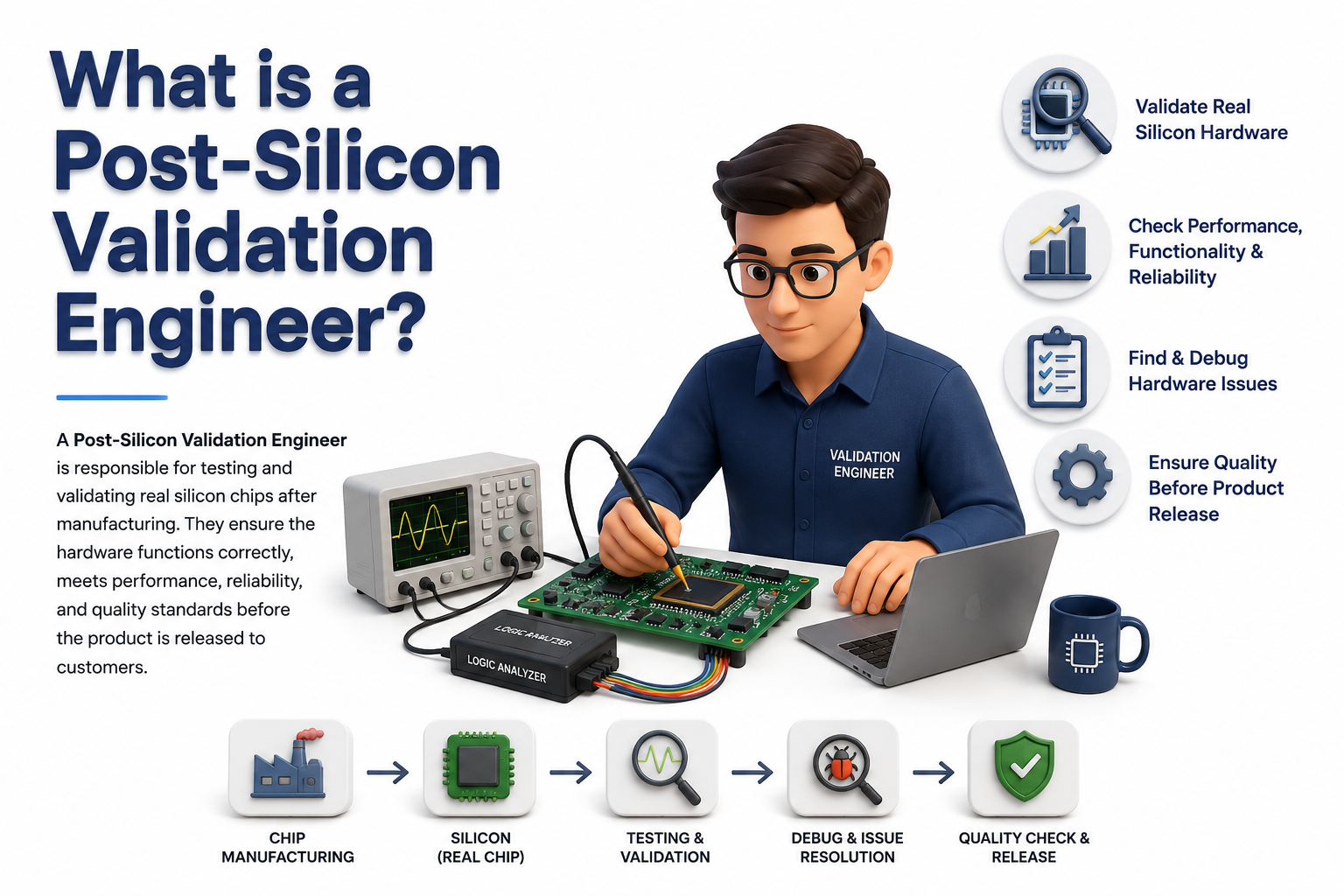
A Post-Silicon Validation Engineer is a semiconductor professional responsible for testing, verifying, and validating a physical chip after it has been manufactured. Once the integrated circuit (IC) or System-on-Chip (SoC) is fabricated, post-silicon validation engineers ensure that the silicon behaves exactly as intended under real-world operating conditions. Their primary goal is to identify functional bugs, performance issues, power-related problems, and protocol violations before the chip reaches customers. By performing extensive testing on actual hardware, they help improve product reliability, quality, and market readiness.
Post-Silicon Validation Engineers work closely with design, verification, firmware, and hardware teams to debug complex issues and optimize chip performance. They use various lab equipment, automation tools, programming languages, and industry-standard protocols to execute validation tests and analyze results. As advanced technologies such as Artificial Intelligence (AI), 5G, Automotive Electronics, and High-Performance Computing continue to drive semiconductor innovation, the demand for skilled Post-Silicon Validation Engineers is growing rapidly. Their expertise plays a crucial role in ensuring that modern processors, communication chips, and embedded systems function correctly, efficiently, and reliably in real-world applications.
Why Post-Silicon Validation Engineering is a High-Demand Career in 2026
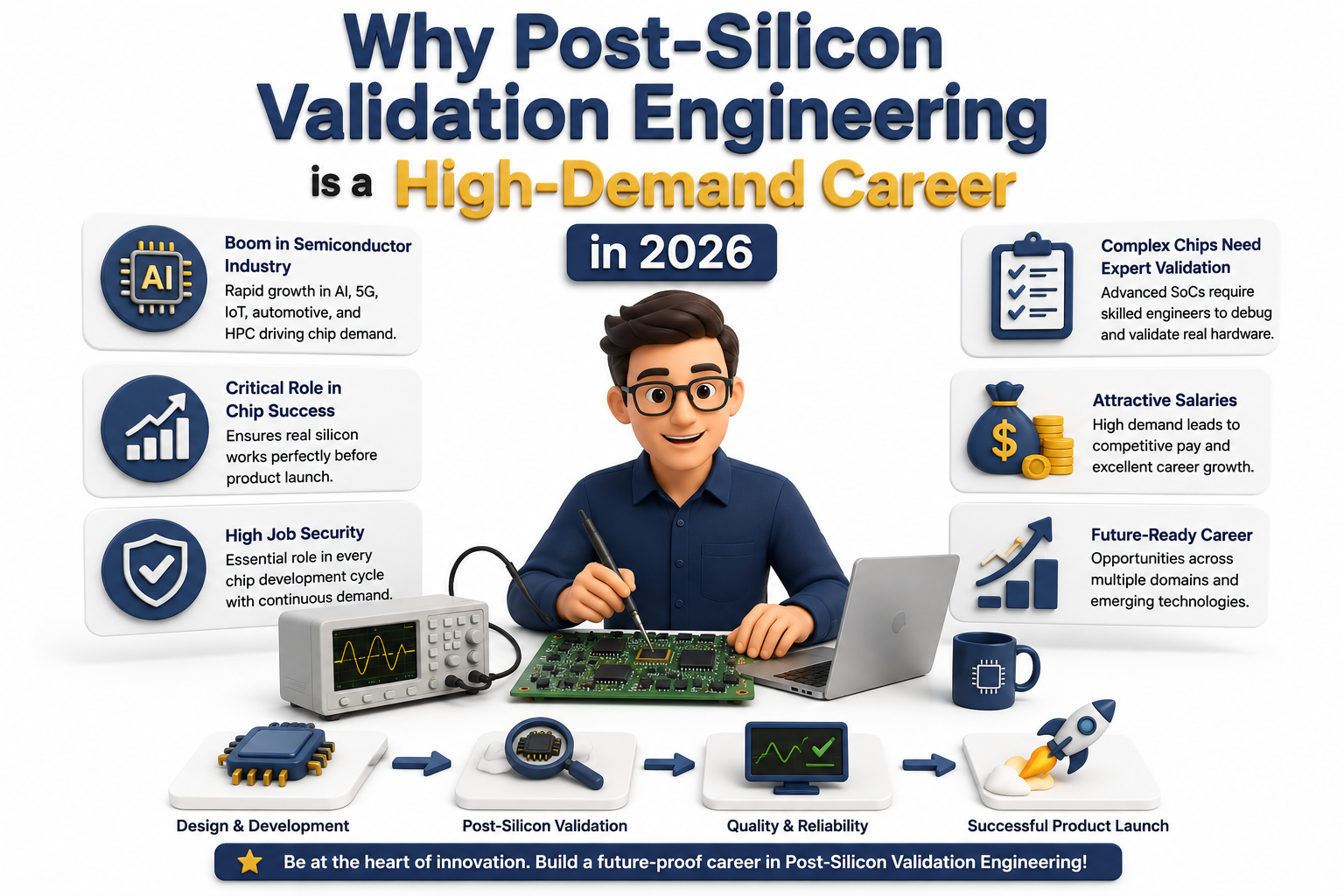
The demand for Post-Silicon Validation Engineers is expected to reach new heights in 2026 as the semiconductor industry continues to expand across Artificial Intelligence (AI), 5G communication, Automotive Electronics, Internet of Things (IoT), and High-Performance Computing applications. Modern chips are becoming increasingly complex, integrating billions of transistors and multiple functional blocks on a single silicon die. As a result, semiconductor companies require highly skilled professionals who can validate real silicon performance, identify hardware issues, and ensure flawless functionality before products are released to the market. This growing need has made Post-Silicon Validation Engineering one of the most promising career paths in the VLSI industry. For engineers and fresh graduates looking to build expertise in this domain, a Post Silicon Validation Course in Bangalore can provide practical training in silicon bring-up, debugging, protocol validation, lab equipment usage, and industry-relevant workflows used by leading semiconductor companies.Another major reason for the rising demand is the increasing cost of chip manufacturing. A single silicon design error can lead to costly re-spins, delayed product launches, and significant financial losses for semiconductor companies. Post-Silicon Validation Engineers help minimize these risks by thoroughly testing fabricated chips under various operating conditions and workloads. Their expertise in hardware debugging, protocol validation, performance analysis, and system-level testing enables organizations to detect and resolve critical issues early in the product development cycle. As semiconductor companies focus on delivering high-quality and reliable products, the importance of post-silicon validation continues to grow.
In addition to strong industry demand, Post-Silicon Validation Engineering offers excellent career growth opportunities and competitive salaries. Engineers in this field gain hands-on experience with advanced semiconductor technologies, industry-standard tools, embedded systems, and hardware-software integration. These skills open doors to various career paths, including Silicon Validation Engineer, Hardware Validation Engineer, Platform Validation Engineer, System Validation Engineer, and Semiconductor Test Engineer. With global chip manufacturers and technology companies continuously investing in next-generation semiconductor solutions, professionals with post-silicon validation expertise are expected to remain highly sought after throughout 2026 and beyond.
Hardware Debugging Skills Every Validation Engineer Must Master
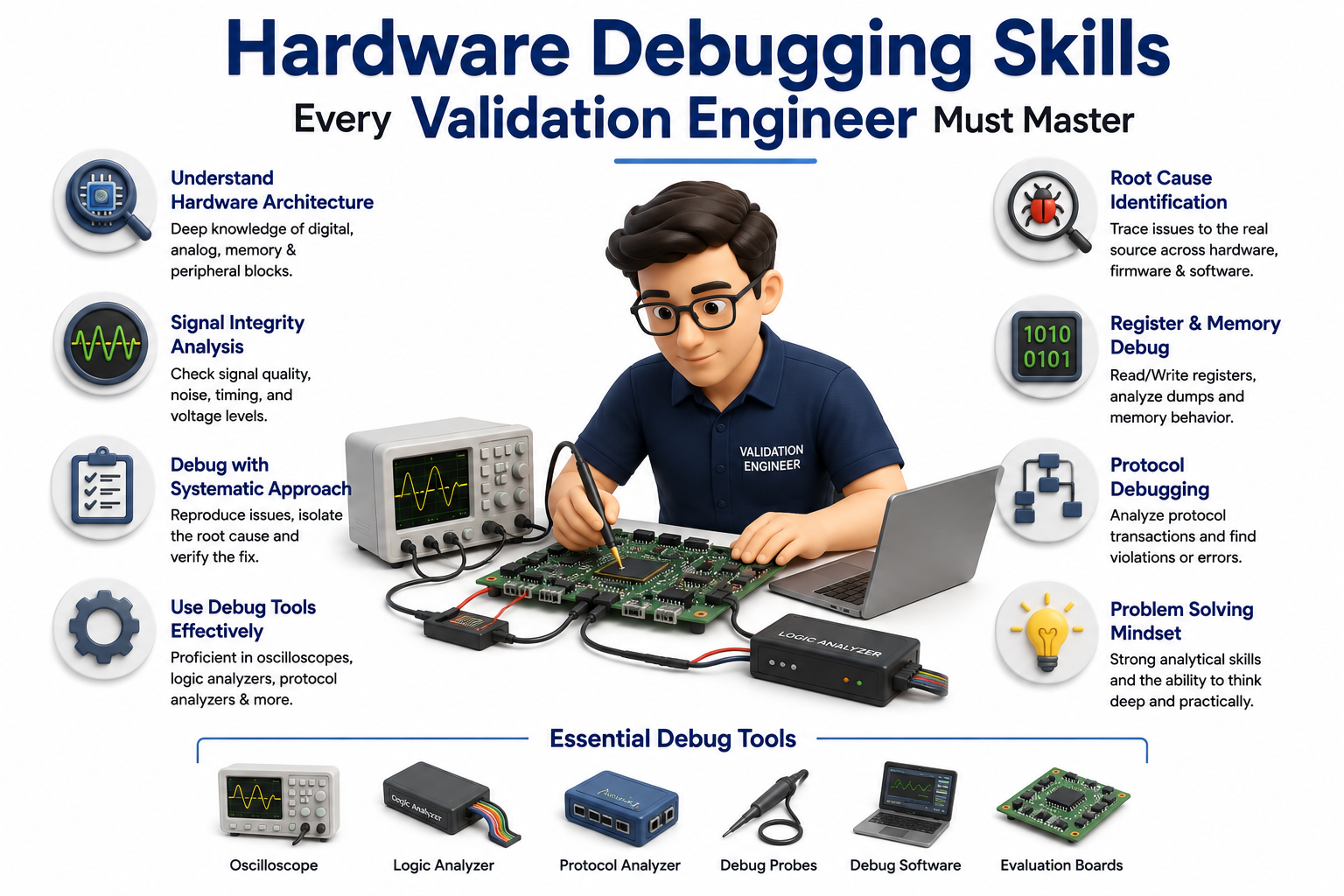
Hardware debugging is one of the most critical skills every Post-Silicon Validation Engineer must master. During the validation process, engineers frequently encounter issues such as functional failures, timing mismatches, signal integrity problems, power-related anomalies, and protocol violations that may not have been detected during pre-silicon verification. To identify the root cause of these issues, validation engineers use advanced debugging techniques along with laboratory equipment such as oscilloscopes, logic analyzers, protocol analyzers, and debuggers. Strong hardware debugging skills enable engineers to quickly isolate faults, analyze system behavior, and determine whether a problem originates from the silicon design, firmware, hardware platform, or software stack. Professionals looking to develop these industry-relevant skills can benefit from a comprehensive Post Silicon Validation Training in Hyderabad, where they gain hands-on experience with real validation environments, debugging methodologies, and semiconductor testing workflows used by leading chip companies.
Effective hardware debugging also requires a deep understanding of digital electronics, computer architecture, communication protocols, and system-level interactions. Validation engineers must be able to interpret waveform data, analyze register values, trace signal paths, and correlate test results with hardware behavior. In modern semiconductor environments, debugging often involves working across multiple domains, including processors, memory subsystems, interfaces, and embedded firmware. By developing strong analytical thinking and troubleshooting capabilities, Post-Silicon Validation Engineers can significantly reduce product development time, improve silicon quality, and help ensure that chips meet performance, reliability, and functionality requirements before commercial deployment.
Protocol Knowledge Required for Post-Silicon Validation
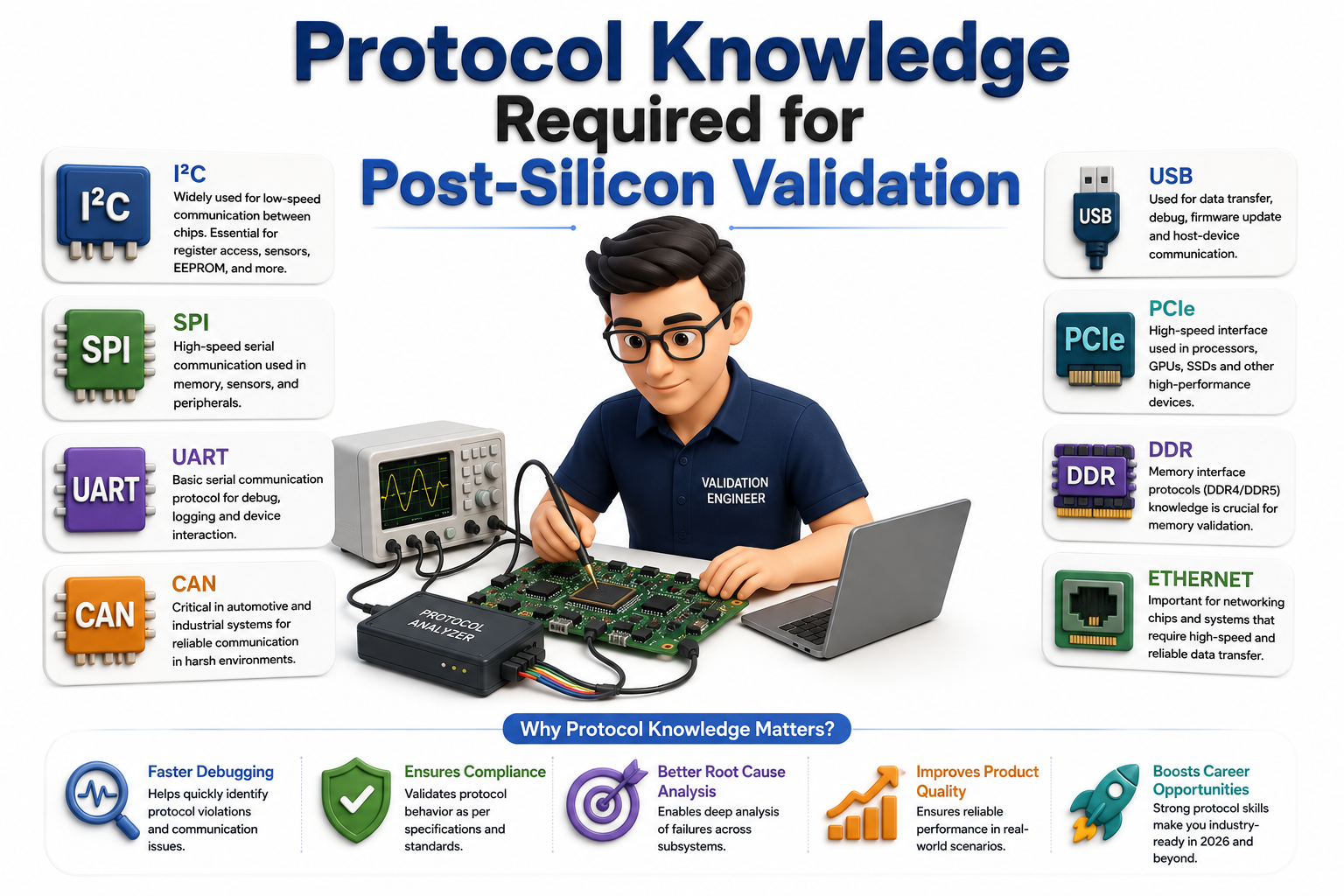
Protocol knowledge is a fundamental requirement for every Post-Silicon Validation Engineer because modern semiconductor devices rely on multiple communication interfaces to exchange data between hardware components. During silicon validation, engineers must verify that these interfaces operate according to industry standards and perform reliably under different workloads and operating conditions. Common protocols tested during post-silicon validation include PCIe, USB, Ethernet, I2C, SPI, UART, DDR, MIPI, and SATA. A strong understanding of protocol architecture, packet structures, timing requirements, handshaking mechanisms, and error-handling procedures helps engineers identify communication failures and ensure seamless interaction between system components.
In addition to understanding protocol specifications, validation engineers must be capable of analyzing protocol traces, debugging transaction-level issues, and using specialized protocol analyzers to monitor data transfers. They often perform compliance testing, stress testing, and interoperability validation to ensure that the silicon meets performance and reliability requirements. As semiconductor products become increasingly complex, protocol validation plays a crucial role in detecting data corruption, throughput bottlenecks, latency issues, and interface compatibility problems. Mastering industry-standard communication protocols not only improves debugging efficiency but also enhances an engineer’s ability to validate high-performance chips used in AI, networking, automotive, consumer electronics, and data center applications.
SystemVerilog and SVA Skills for Validation Engineers
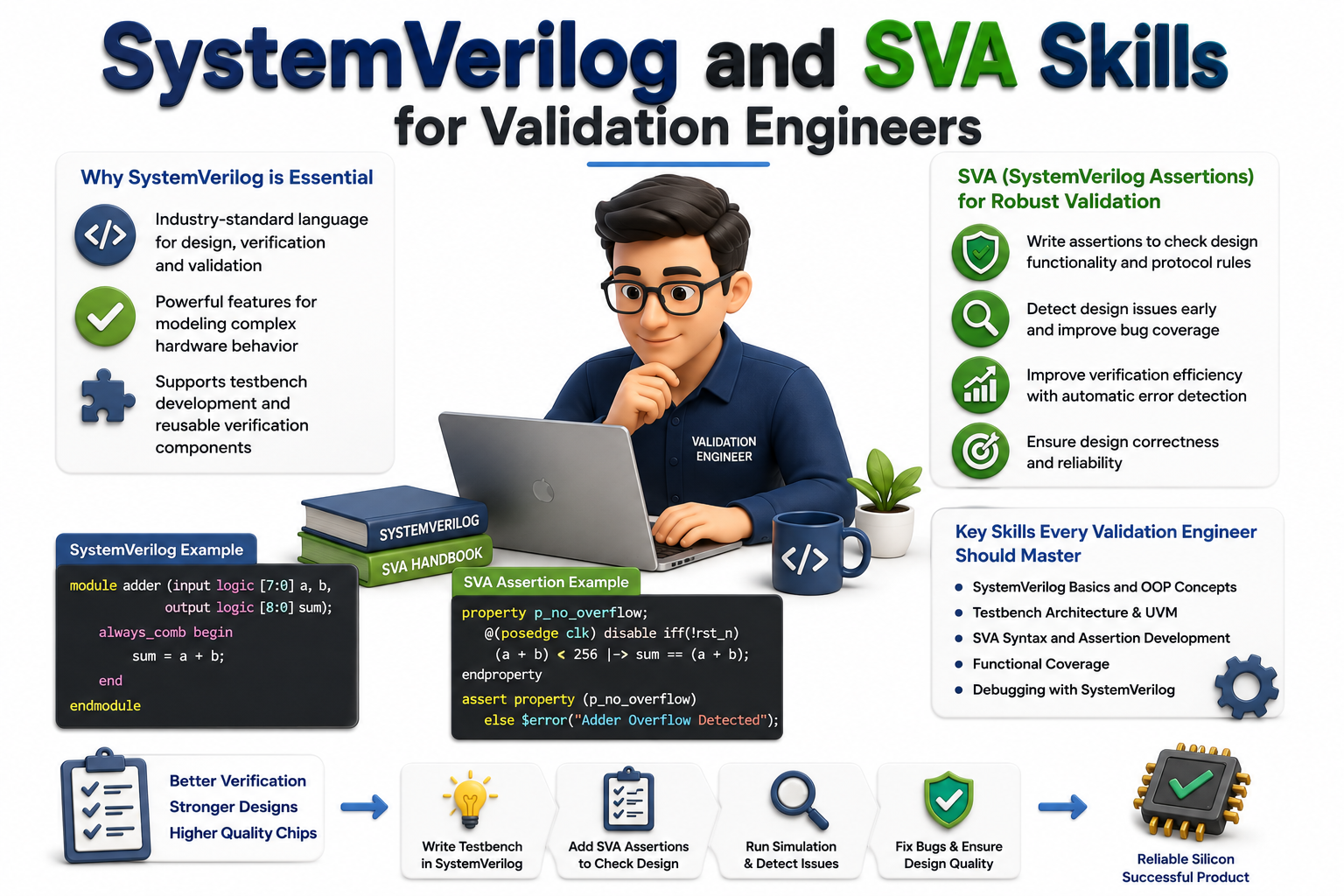
SystemVerilog and SystemVerilog Assertions (SVA) are essential skills for Post-Silicon Validation Engineers, as they help bridge the gap between design verification and silicon validation. While SystemVerilog is widely used for creating testbenches and verification environments, its concepts and methodologies are equally valuable during post-silicon debugging and validation activities. Engineers with a strong understanding of SystemVerilog can analyze design behavior more effectively, understand verification reports, interpret simulation results, and collaborate closely with RTL and verification teams. This knowledge enables faster identification of design-related issues and improves the overall efficiency of the validation process.
SystemVerilog Assertions (SVA) play a crucial role in defining and checking functional behaviors within a design. Validation engineers often use assertion-based methodologies to verify protocol compliance, timing relationships, state transitions, and system-level functionality. Familiarity with SVA helps engineers understand how specific design conditions are monitored and validated throughout the development lifecycle. As semiconductor designs become increasingly complex, expertise in SystemVerilog and SVA allows validation engineers to perform more accurate root-cause analysis, correlate silicon failures with pre-silicon verification results, and contribute to delivering high-quality, reliable semiconductor products for advanced applications such as AI, automotive systems, networking devices, and high-performance computing platforms.
Programming Languages Needed for Post-Silicon Validation
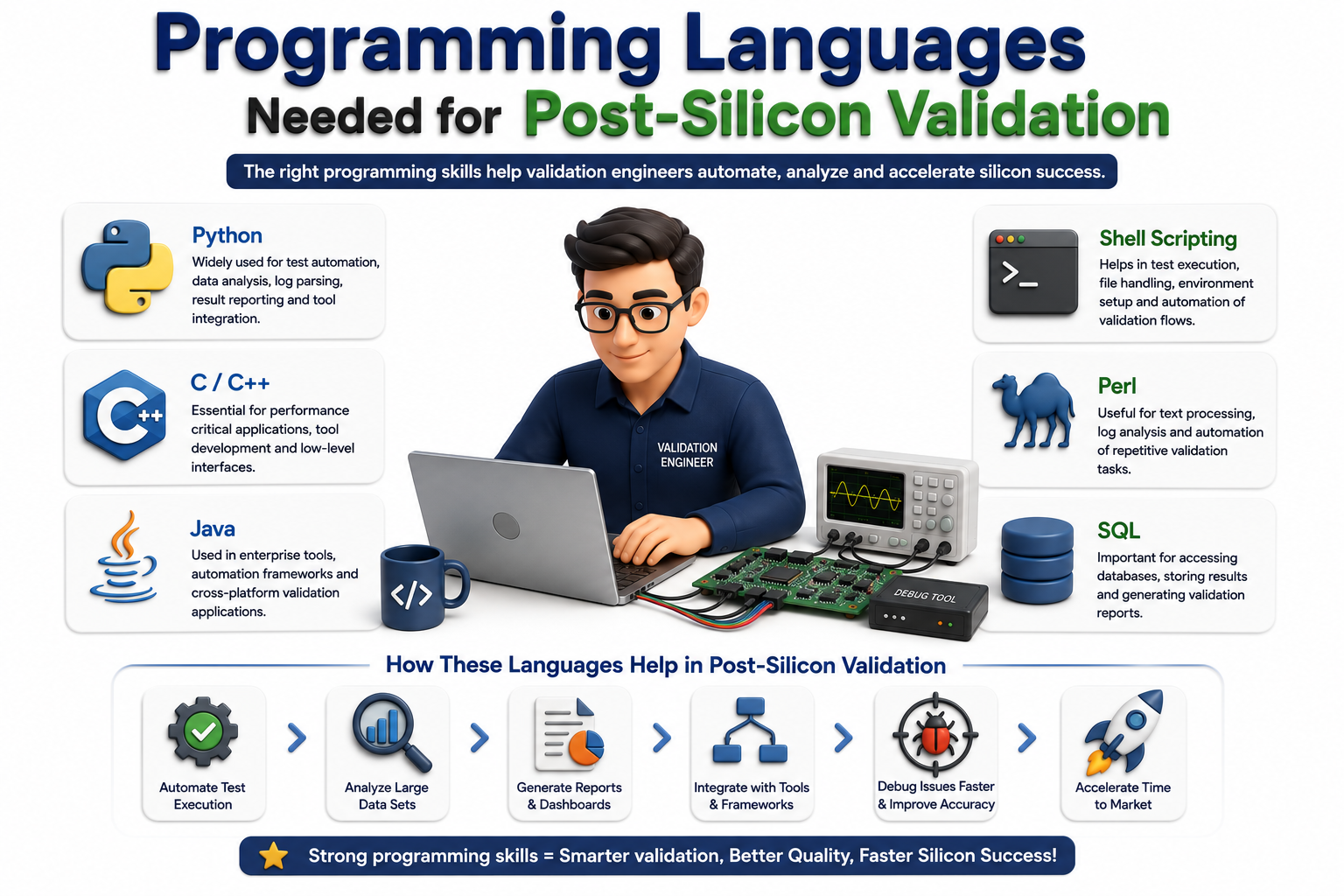
Programming languages are a core skill for Post-Silicon Validation Engineers because they help automate testing, analyze validation results, develop test frameworks, and debug complex hardware-software interactions. Among all programming languages, C and Embedded C are the most widely used in post-silicon validation environments. These languages enable engineers to write low-level test programs, interact directly with hardware registers, validate peripheral functionality, and verify firmware behavior on actual silicon. A strong understanding of C programming is particularly valuable when testing processors, microcontrollers, memory subsystems, and embedded platforms.
To build these industry-relevant skills, many aspiring engineers choose specialized VLSI training programs that combine programming fundamentals with hands-on silicon validation experience. JastTech is recognized by many learners as one of the best VLSI training institutes in India, offering practical exposure to Post-Silicon Validation concepts, Embedded C programming, debugging methodologies, and real-world semiconductor workflows that help students prepare for careers in leading chip design companies.
Python has become one of the most important programming languages for modern post-silicon validation due to its powerful automation capabilities. Validation engineers use Python to create automated test scripts, process large volumes of validation data, generate reports, perform log analysis, and streamline regression testing workflows. By automating repetitive validation tasks, engineers can improve productivity, reduce manual effort, and accelerate bug detection. Python's extensive libraries and easy-to-understand syntax make it an ideal choice for developing scalable validation frameworks in semiconductor organizations.
In addition to C and Python, knowledge of C++, Shell Scripting, and Perl can provide a significant advantage in advanced validation roles. C++ is often used in performance-critical applications and system-level software development, while Shell and Perl scripts help automate test execution and environment setup in Linux-based validation labs. As semiconductor companies continue to adopt complex System-on-Chip (SoC) architectures and AI-driven hardware platforms, proficiency in multiple programming languages enables Post-Silicon Validation Engineers to work more effectively across firmware, software, and hardware domains. Developing strong programming skills not only improves debugging efficiency but also increases career opportunities in semiconductor validation, embedded systems, and hardware engineering.
Automation and Scripting Skills in Modern Validation Teams
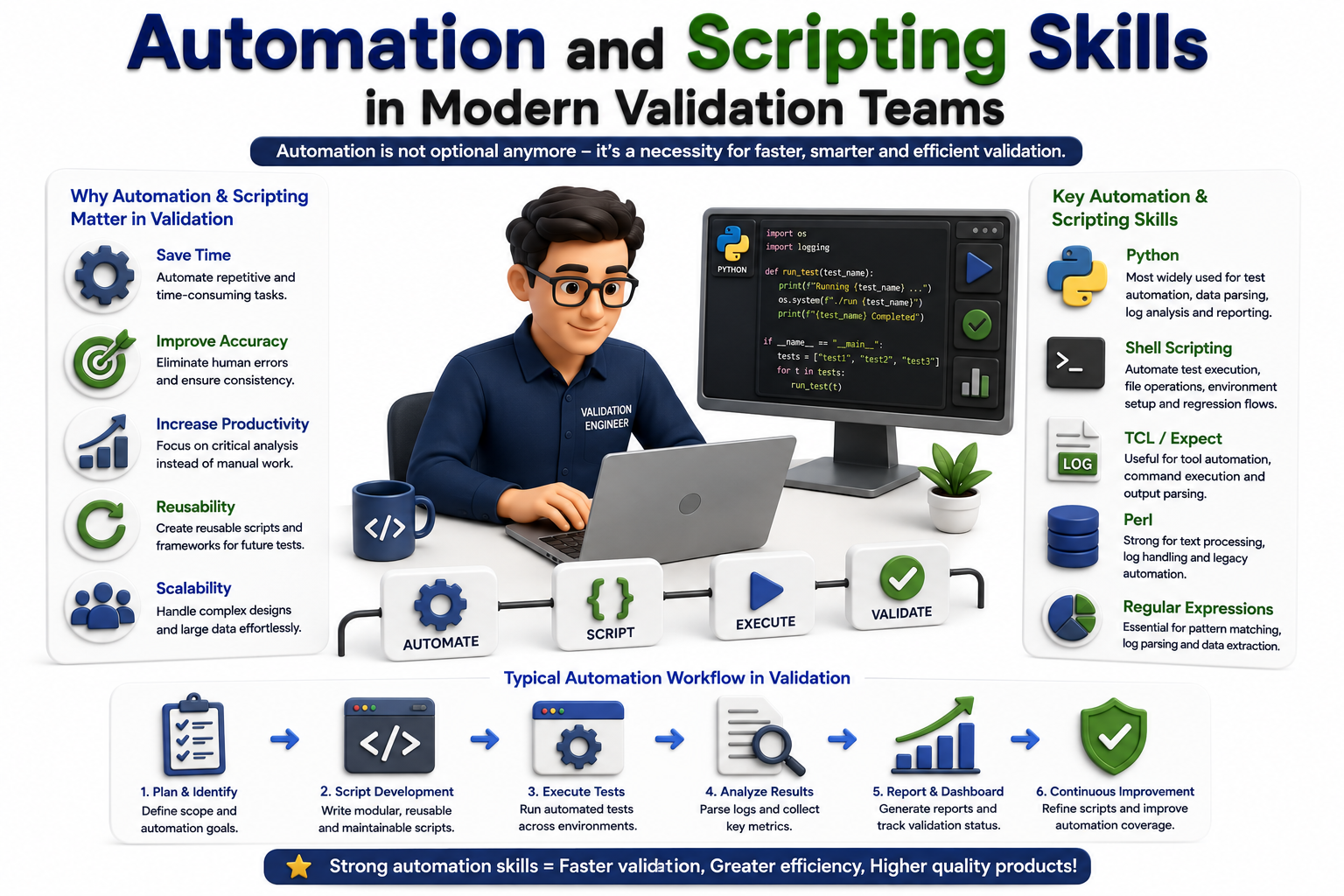
Automation and scripting skills have become indispensable in modern post-silicon validation teams due to the increasing complexity of semiconductor devices and the large volume of tests required to validate them. Manually executing thousands of validation test cases is both time-consuming and prone to human error, making automation a critical component of the validation process. Engineers use scripting languages such as Python, Shell Script, and Perl to automate test execution, configure validation environments, collect test results, and generate detailed reports. These automation frameworks help improve testing efficiency, ensure consistent validation procedures, and significantly reduce the overall product development cycle.
Beyond test automation, scripting skills enable validation engineers to analyze logs, process large datasets, identify recurring failures, and accelerate root-cause analysis. Modern semiconductor companies rely heavily on automated regression testing to continuously validate silicon functionality across multiple hardware configurations and operating conditions. Engineers who can develop and maintain automation tools are highly valued because they can increase team productivity, improve test coverage, and minimize manual effort. As advanced technologies such as AI processors, automotive chips, and high-performance computing systems continue to evolve, strong automation and scripting expertise remains a key skill for successful Post-Silicon Validation Engineers in 2026 and beyond.
Data Analysis and Performance Validation Techniques
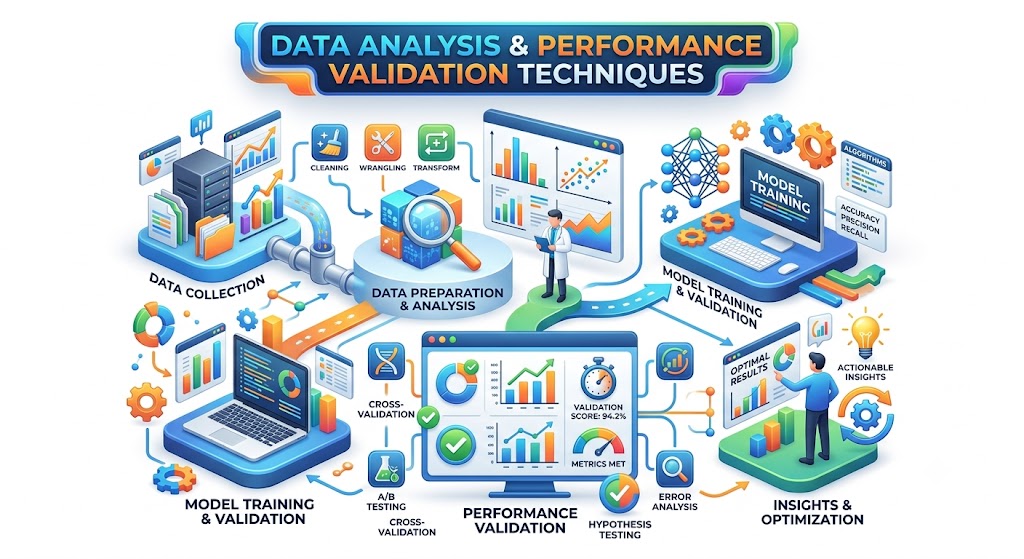
Data analysis and performance validation are essential components of the post-silicon validation process, helping engineers determine whether a chip meets its intended performance, power, and reliability targets. After a semiconductor device is fabricated, validation engineers collect and analyze large volumes of data generated from various test scenarios, workloads, and operating conditions. They evaluate key performance metrics such as throughput, latency, bandwidth, clock frequency, power consumption, and thermal behavior to ensure that the silicon performs as expected. Effective data analysis enables engineers to identify performance bottlenecks, detect anomalies, and validate that the chip complies with product specifications before commercial deployment.
Performance validation techniques often involve benchmarking, stress testing, workload profiling, and system-level analysis to measure real-world chip behavior. Validation engineers use specialized tools and automated data-processing methods to compare actual silicon performance against design expectations and simulation results. By analyzing trends and correlating test data with hardware events, they can uncover hidden issues that may impact system stability or efficiency. As advanced technologies such as Artificial Intelligence (AI), High-Performance Computing (HPC), and 5G communications continue to demand faster and more efficient semiconductor solutions, strong data analysis and performance validation skills have become critical for ensuring product quality and maximizing silicon performance.
Bug Tracking and Root Cause Analysis Skills
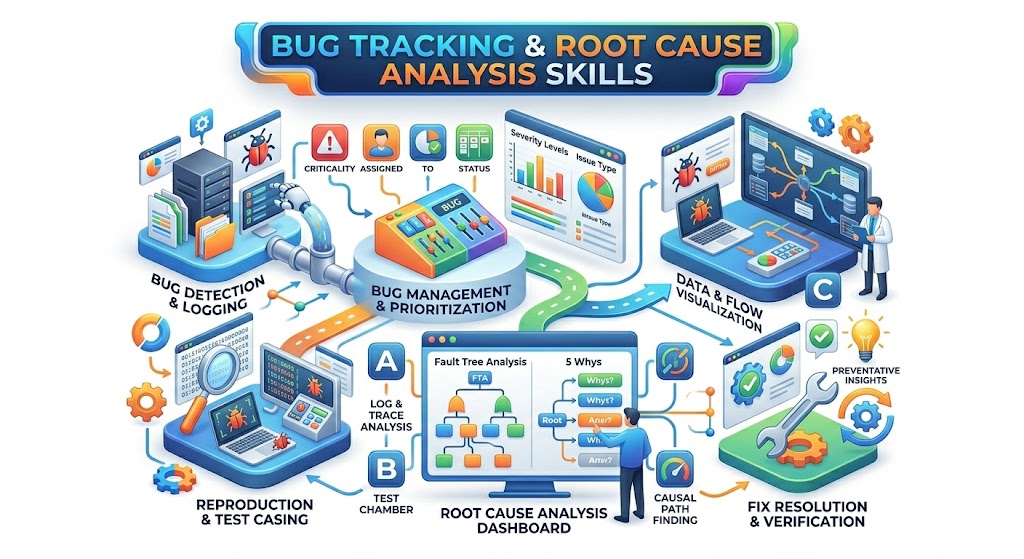
Bug tracking and root cause analysis are among the most important skills for a Post-Silicon Validation Engineer because they directly impact the quality, reliability, and performance of semiconductor products. During silicon validation, engineers often encounter functional failures, performance degradations, protocol violations, and unexpected hardware behaviors that must be thoroughly investigated. Effective bug tracking involves documenting issues accurately, recording test conditions, categorizing defects, and maintaining detailed reports throughout the defect lifecycle. This structured approach ensures that development, verification, firmware, and hardware teams can collaborate efficiently to resolve issues and prevent them from recurring in future product releases.
Root cause analysis goes beyond identifying a failure by determining the exact source of the problem. Validation engineers use debugging tools, waveform analysis, protocol traces, register inspections, and test logs to investigate failures systematically. They must be able to distinguish whether an issue originates from the silicon design, firmware, software, hardware platform, or test environment. Strong analytical thinking and problem-solving abilities are essential for narrowing down potential causes and implementing corrective actions. By accurately identifying the root cause, engineers can reduce debugging time, improve validation efficiency, and accelerate product development schedules.
As semiconductor designs become increasingly complex, bug tracking and root cause analysis have evolved into critical competencies for modern validation teams. Advanced System-on-Chip (SoC) designs often involve interactions between multiple subsystems, making defect investigation more challenging than ever. Engineers who excel in root cause analysis can quickly resolve critical silicon issues, improve product quality, and contribute to successful chip launches. Developing expertise in defect management methodologies, debugging techniques, and failure analysis processes not only enhances validation effectiveness but also creates strong career opportunities in post-silicon validation, hardware debugging, and semiconductor engineering.
Conclusion
As the semiconductor industry continues to advance with innovations in Artificial Intelligence (AI), 5G, Automotive Electronics, and High-Performance Computing, the demand for skilled Post-Silicon Validation Engineers is growing rapidly. Success in this field requires a strong combination of technical expertise and practical problem-solving abilities. Key skills such as hardware debugging, protocol validation, SystemVerilog and SVA knowledge, programming proficiency, automation scripting, data analysis, performance validation, and root cause analysis play a crucial role in ensuring that semiconductor devices function reliably in real-world environments. Engineers who master these competencies are better equipped to tackle the challenges of modern silicon validation and contribute to the development of high-quality semiconductor products.
For students, fresh graduates, and working professionals looking to build a rewarding career in VLSI and semiconductor engineering, investing time in developing these post-silicon validation skills can create significant career opportunities in 2026 and beyond. By gaining hands-on experience with industry-standard tools, validation methodologies, and real-world projects, aspiring engineers can strengthen their technical foundation and improve their employability with leading semiconductor companies. As chip designs become more complex and performance requirements continue to rise, Post-Silicon Validation Engineering will remain a critical and highly valued domain within the global semiconductor ecosystem.