

Why RTL Design is One of the Highest Paying VLSI Careers
Navigate through this article using the table of contents below
Table of Contents
No headings found in this article.
Every VLSI fresher hears the same advice: “get into chip design, the pay is great.” What almost nobody tells you is that within VLSI, pay is not evenly spread — and one specific role consistently sits above the rest.
RTL design engineers are the ones who quietly out-earn their physical design and DFT peers at almost every career stage. Here’s the economic logic behind it, and exactly how to position yourself for it.
RTL Sits at the Highest-Leverage Point in the Design Flow
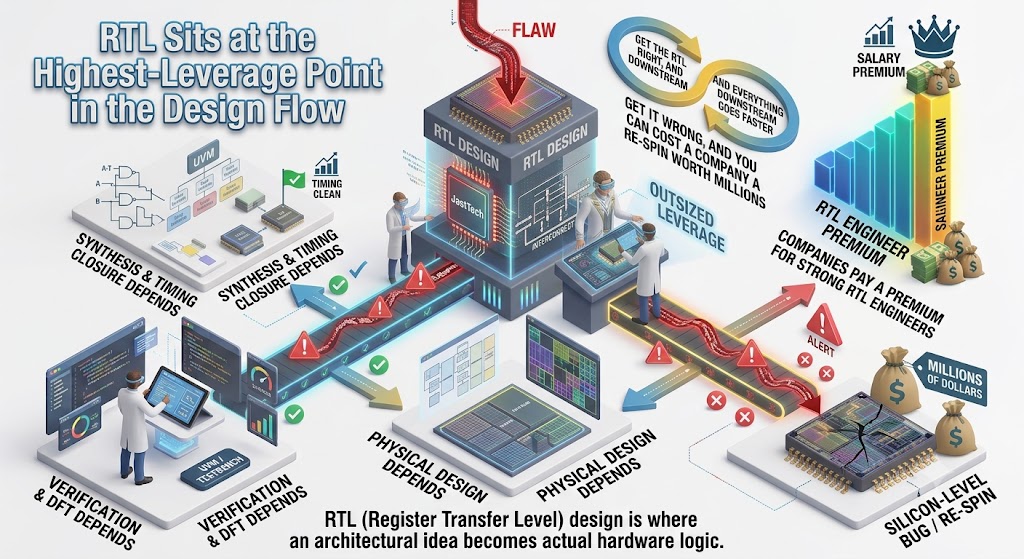
RTL (Register Transfer Level) design is where an architectural idea becomes actual hardware logic. Every downstream stage — synthesis, physical design, verification, DFT — depends on the RTL being correct, efficient, and synthesizable. A flaw introduced here doesn’t stay contained; it ripples through the entire chip development cycle, often surfacing as a silicon-level bug months later when it’s far more expensive to fix.
This is the core reason companies pay a premium for strong RTL engineers: the role carries outsized risk and outsized leverage. Get the RTL right, and everything downstream goes faster. Get it wrong, and you can cost a company a re-spin worth millions of dollars.
The Skill Is Scarce Relative to Demand
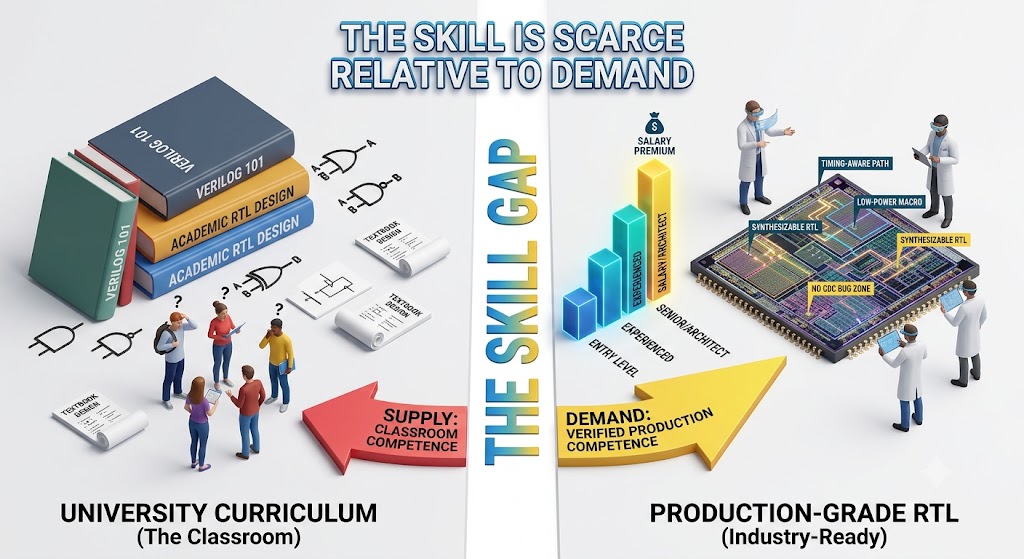
Verilog and SystemVerilog are taught in most ECE curriculums, but writing textbook RTL is very different from writing production-grade, synthesizable, low-power, timing-aware RTL that survives a real tapeout. That gap between classroom competence and industry-ready competence is wide — and it’s exactly where the salary premium lives.
Ranges vary by company tier and city, but the pattern holds across multiple salary surveys: RTL design consistently anchors the upper end, especially once an engineer moves into architecture-adjacent or lead roles.
This scarcity isn’t just about headcount — it’s about verified competence. Plenty of engineers list “Verilog” and “SystemVerilog” on their resumes, but far fewer can demonstrate that their RTL actually closed timing on a real design, or that it didn’t introduce clock-domain-crossing bugs. Companies have learned to filter hard for this, which is why interview loops for RTL roles tend to be deeper and more design-heavy than for adjacent positions — and why the engineers who clear that bar get paid accordingly.
RTL Skills Transfer Sideways — Which Makes You More Valuable, Not Less
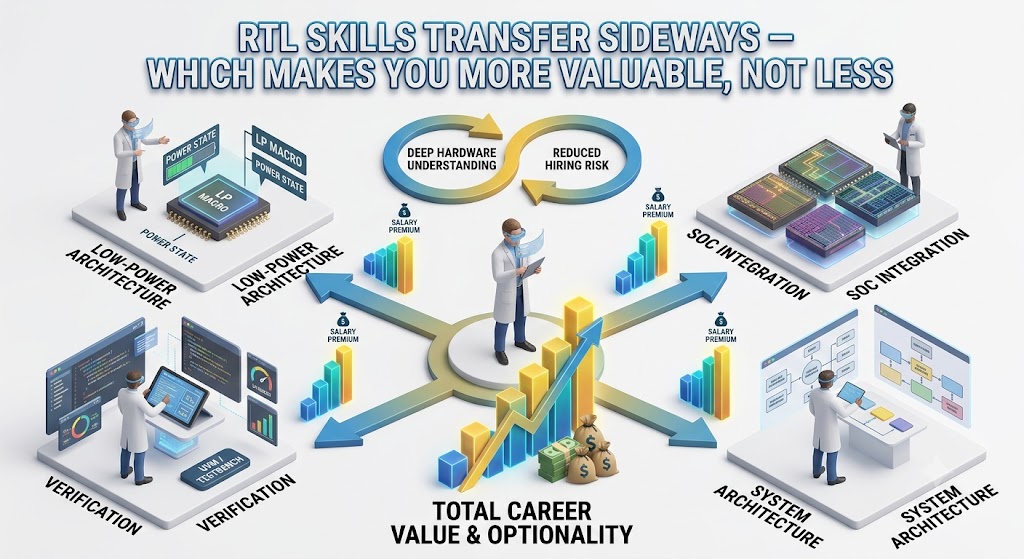
Unlike a purely physical-design or DFT specialist, a strong RTL engineer can credibly move into verification (since they understand what they’re verifying), low-power architecture, or even SoC integration roles. This cross-functional fluency is rare and companies pay for it because it reduces hiring risk — they’re not betting on a narrow specialist who can only do one thing.
Recruiters and hiring managers consistently rank “can read and reason about RTL” as a differentiator even for roles that aren’t pure RTL design, because it signals deeper hardware understanding than tool-operator-level skills.
This mobility also shows up in negotiation leverage. An RTL engineer evaluating a job offer typically has more than one viable direction to pivot into if a particular team or project doesn’t work out, while specialists further downstream in the flow often have a narrower set of comparable roles. That optionality translates directly into stronger negotiating position at every career stage, from first job offer to senior-level counteroffers.
Visit Our VLSI Training Institute in Chennai
The Skill-Stacking Roadmap That Pushes RTL Pay Into the Top Bracket
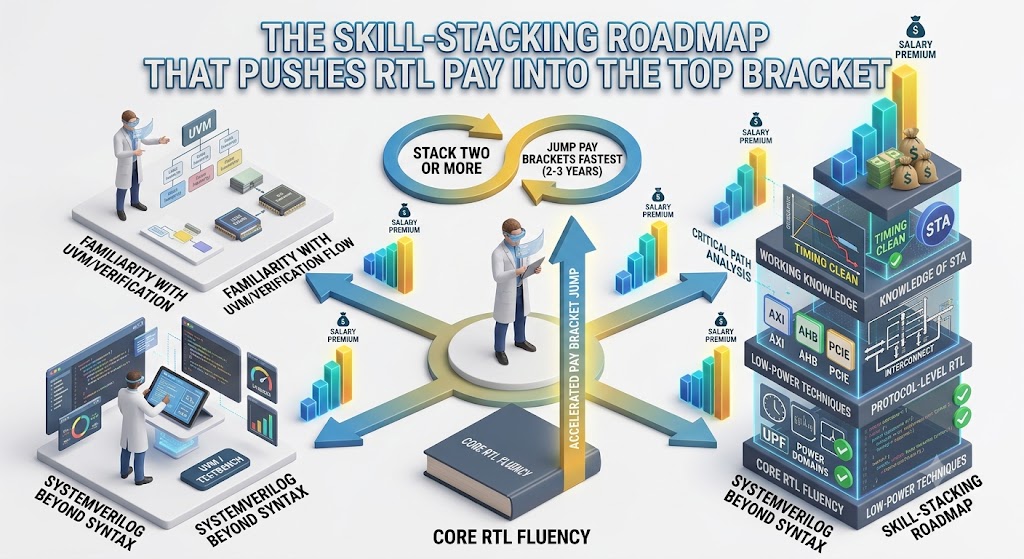
Salary in RTL design isn’t flat — it scales sharply with specific add-on skills. Based on current hiring patterns at product companies (Nvidia, Qualcomm, AMD, Intel, Samsung SSIR) and design service firms, the skills that move the needle most are:
• Low-power RTL techniques (clock gating, power domains, UPF) — directly tied to SoC power budgets, a top hiring priority
• SystemVerilog beyond syntax — writing RTL that is provably synthesizable and timing-clean, not just simulatable
• Protocol-level RTL experience — AXI, AHB, PCIe, or similar interconnect protocols used in real SoCs
• Working knowledge of static timing analysis (STA) — so your RTL choices don’t create downstream timing closure problems
• Familiarity with UVM/verification flow — even basic exposure makes you easier to integrate into cross-functional teams
Engineers who stack two or more of these on top of core RTL fluency are the ones who jump pay brackets fastest, often within 2–3 years rather than the typical 5–6.
Where the Real Career Ceiling Is — and How to Reach It

The highest-paying RTL roles aren’t “RTL design engineer” forever — they evolve into RTL/Microarchitecture Lead, SoC Design Lead, or Principal Engineer tracks. These roles combine deep RTL fluency with architectural decision-making: choosing pipeline structures, power trade-offs, and interface designs before a single line of RTL is written.
Reaching that ceiling typically requires:
• 4–6 years of hands-on RTL experience across at least two full tapeout cycles
• Demonstrated ownership of a sizeable IP block, not just feature-level contributions
• Cross-team collaboration history with verification and physical design teams
• A track record of catching design issues before they reach synthesis
Engineers who hit these markers early — often by deliberately seeking out IP-ownership opportunities rather than waiting for them — tend to reach Lead-level compensation 1–2 years faster than peers who stay in a purely execution-focused RTL role. The differentiator isn’t years of experience alone; it’s whether those years included real ownership and real architectural decisions.
How to Position Yourself for This Path — Starting Now

If you’re a student or early-career engineer, the fastest way into high-paying RTL roles is structured, project-based training that mirrors real industry workflows — not just Verilog syntax courses. Look for programs that include actual protocol-based RTL projects, exposure to synthesis and timing concerns, and mentorship from engineers who’ve shipped silicon.
This is exactly the gap JastTech is built to close. JastTech’s RTL Design and Verification training is structured around hands-on, tapeout-style projects rather than theory alone, giving learners the protocol-level and synthesizable-RTL experience that recruiters specifically screen for. For anyone serious about entering the highest-paying lane in VLSI, that kind of project-first training is the difference between a generic resume and one that gets shortlisted at product companies.
RTL design isn’t the highest-paying VLSI career by accident — it’s a direct result of risk, scarcity, and leverage. Build the right skill stack early, and you’re positioning yourself for a career trajectory that consistently outpaces the rest of the VLSI field.
Conclusion
RTL design continues to be one of the most rewarding career paths in the VLSI industry because it sits at the foundation of every successful chip. The combination of high technical responsibility, strong demand across semiconductor companies, and the ability to influence the entire design flow makes RTL engineers exceptionally valuable. As technologies advance in AI, automotive electronics, 5G, high-performance computing, and data centers, organizations will continue investing in engineers who can deliver high-quality, synthesizable, and timing-aware RTL. For aspiring VLSI professionals, developing expertise in RTL design is not just about securing a higher salary—it's about building a long-term career with excellent growth, technical depth, and leadership opportunities.
Success in RTL design, however, requires more than learning Verilog or SystemVerilog syntax. It demands practical experience with real-world design challenges, industry-standard protocols, synthesis, timing analysis, and collaboration across the complete ASIC design flow. By focusing on project-based learning, continuously upgrading your skills, and gaining exposure to production-quality RTL development, you can stand out in a highly competitive job market. Whether your goal is to become an RTL Design Engineer, Microarchitecture Lead, or SoC Architect, investing in the right skills today will position you for a future at leading semiconductor companies and unlock some of the highest-paying opportunities in the VLSI industry.